Pool Equipment
The best salt systems for an above-ground pool start with your pump
Every salt generator is sold on gallons. The number that actually decides whether one will work on your pool is the pump flow rate it needs, and most listings bury it.
Heads up: we earn a commission if you buy through the links on this page, at no extra cost to you. It never decides the ranking — here is how we pick and here is the full disclosure. Prices are checked automatically; last verified October 8, 2026.
Quick picks
Segmented before it is ranked — the right answer depends on which of these you actually are. Tap any row for the full write-up.
A small pool on a cartridge pump
The only unit here that runs on as little as 330 GPH, which is what most 12- and 15-foot pools actually ship with. Rated to 7,000 gallons.
| # | Product | Best for | Score | Price |
|---|---|---|---|---|
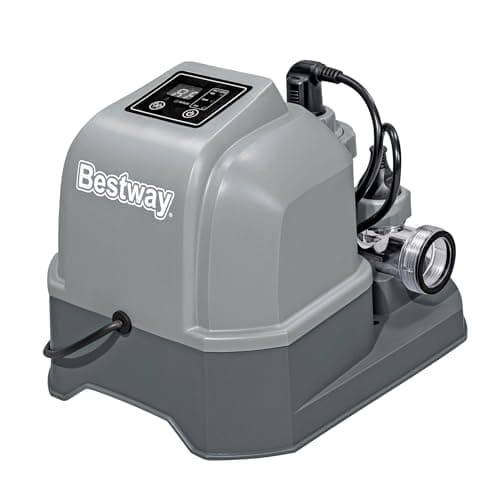
| 1 | Bestway Flowclear Hydrogenic 6 G/H Saltwater Chlorinator Rated for pools up to 7,000 gallons and happy on as little as 330 GPH of pump flow. It is the only unit in this roundup that suits the cartridge pumps most 12- and 15-foot pools actually ship with. | Small pools on a small cartridge pumpSeveral seasons | 8.2out of 10 |
A mid-to-large pool on a sand filter
Salt plus an ozone stage, rated 6,000 to 15,000 gallons. It needs at least 1,600 GPH, so it belongs with a sand filter pump and nothing smaller.
| # | Product | Best for | Score | Price |
|---|---|---|---|---|
| 1 | 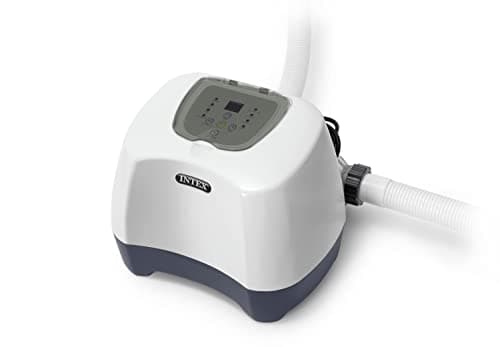 Intex QZ1100 Krystal Clear Ozone & Saltwater System (26665EG) Salt chlorination plus an ozone stage in one unit, rated for 6,000 to 15,000 gallons. The number that decides whether it suits you is not the gallons — it is the 1,600 GPH minimum pump flow. | A mid-to-large pool on a sand filter pumpSeveral seasons | 7.7out of 10 |
Any pool, with no plumbing changes
A cell that sits in the pool rather than in the pipework. It does not care what pump or fittings you have, which makes it the universal option.
| # | Product | Best for | Score | Price |
|---|---|---|---|---|
| 1 | 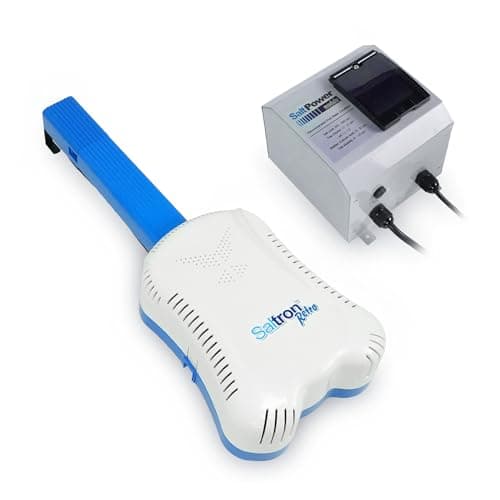 Solaxx Saltron Retro Salt Chlorine Generator A cell that sits in the pool itself rather than being plumbed into the return line. Rated to 20,000 gallons at 8 g/hr, and the only unit here that does not care what pump or fittings you have. | Any pool, with no plumbing changes at allSeveral seasons | 8.0out of 10 |
The largest pools, or app control
Both are rated to 18,000 gallons — far past most above-ground pools. Buy one of these for a specific feature, not for capacity.
| # | Product | Best for | Score | Price |
|---|---|---|---|---|
| 1 | 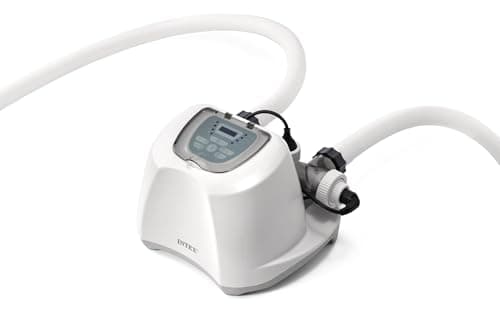 Intex QS1600 Plus Krystal Clear Saltwater System (26689EG) Intex's highest-output salt unit at 16 g/h, rated to 18,000 gallons, with WiFi and app scheduling. More capacity than almost any above-ground pool needs, which is both the appeal and the catch. | The largest pools, and anyone who wants app controlMore than you need yet | 7.2out of 10 | |
| 2 | 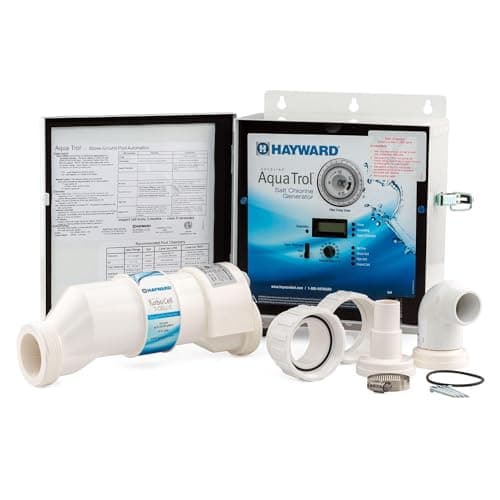 Hayward AquaTrol Salt Chlorine Generator (W3AQ-TROL-RJ-TL) A return-jet mounted generator rated to 18,000 gallons, with a built-in 24-hour timer that runs your filter pump as well. It is the premium end of the category by a wide margin. | A large pool, bought once, from the inground specialistMore than you need yet | 7.1out of 10 |
The short version
- Match the unit to your pump before your gallons. Minimum flow rules out more pools than capacity does.
- The popular Intex QZ1100 needs 1,600 GPH, so it will not run on Intex’s own 1,000 GPH cartridge pump.
- Most above-ground pools are small-pump pools. For those, the Bestway Hydrogenic 6 or the drop-in Solaxx are the realistic choices.
- It is still a chlorine pool. You still test, still balance and still shock after heavy use — the salt makes the chlorine, it does not replace it.
What you are choosing between
A salt chlorine generator passes pool water containing dissolved salt through an electrolytic cell, which turns chloride into chlorine continuously while water flows through it. The sanitizer that results is ordinary chlorine. Our salt systems guide explains the mechanism and our salt versus chlorine comparison covers what genuinely changes in the water and what does not.
This page is the next question: which unit to buy. Almost every listing in this category leads with a gallon rating, and gallons are the least useful number on the box. Four specifications decide whether a salt system will work on your pool, and they are worth checking in this order.
Criterion one: pump flow, which rules units out
A plumbed salt cell only makes chlorine while water moves through it, and each manufacturer publishes the flow range its cell needs. Below the minimum, the unit will not generate properly; above the maximum, water rushes through too fast. This is the specification that quietly eliminates the most popular unit in the category for most above-ground owners.
| Unit | Pump flow needed | Intex C530 (530 GPH) | Intex C1000 (1,000 GPH) | Intex sand filter (2,100 GPH) |
|---|---|---|---|---|
| Bestway Hydrogenic 6 | 330 GPH minimum | Yes | Yes | Yes |
| Intex QZ1100 | 1,600 - 4,000 GPH | No | No | Yes |
| Intex QS1600 Plus | Not confirmed for the US model | Check listing | Check listing | Check listing |
| Solaxx Saltron Retro | Not plumbed in — sits in the pool | Not applicable | Not applicable | Not applicable |
| Hayward AquaTrol | Return-jet mounted | Check listing | Check listing | Check listing |
The QZ1100 row is the one worth reading twice. Intex rates its C1000 cartridge pump at 1,000 GPH — and publishes 750 GPH as the flow it actually delivers through the filter system — while the QZ1100 needs at least 1,600. That is Intex’s own salt unit and Intex’s own pump, and they are not compatible. It is a sand-filter-pump unit, and the sand filter that ships with the 18-foot Ultra XTR, at 2,100 GPH, is what it pairs with.
Criterion two: gallons, read both ends
Every unit publishes a maximum pool size. One of them also publishes a minimum, and that is the detail most people miss: the QZ1100 is rated for pools between 6,000 and 15,000 gallons. Below 6,000 it is the wrong tool.
Which units fit the common above-ground pool sizes
- Intex Prism Frame 12 ft x 30 in
- 1,718 gal
- Bestway Steel Pro MAX 15 ft x 42 in
- 3,955 gal
- Intex Ultra XTR 18 ft x 52 in [Intex]
- 6,981 gal
- Bestway Hydrogenic 6 rating
- up to 7,000 gal
- Intex QZ1100 rating [Intex]
- 6,000 - 15,000 gal
1,718 gal → below the QZ1100 minimum; inside the Bestway rating 3,955 gal → below the QZ1100 minimum; inside the Bestway rating 6,981 gal → inside the QZ1100 range; just under the Bestway 7,000 gal ceiling
Under 6,000 gallons, the QZ1100 is out on size before pump flow is even considered
Criterion three: output, and why headroom matters
Output is published in grams of chlorine per hour. In this roundup it runs from 6 g/hr on the Bestway to 16 g/h on the QS1600 Plus, with the Solaxx at 8 and the QZ1100 at 11.
The useful way to read it is as headroom rather than as a score. A generator sized exactly to your pool copes with an ordinary week. The weeks that test it are the ones our heatwave guide and swimmer load guide describe — hot water, strong sun and a pool full of people, all of which consume chlorine faster than a small cell can make it. A unit running near the top of its rating has no margin for those weeks, and the fix is a dose of shock rather than a bigger generator.
That is also why the largest units are not automatically better. A 16 g/h cell on a 4,000-gallon pool is capacity you pay for and cannot use, and on a pool that size the generator will spend most of its time switched off by its own timer.
Criterion four: how it installs
Plumbed inline — the Intex and Bestway units. The cell goes into the hose run between the pump and the return. Fittings are where these installs go wrong, the problem our fittings guide covers in general; the Bestway ships adapters for most above-ground pools, and the Intex units are designed around Intex’s own plumbing.
Return-jet mounted — the Hayward AquaTrol. It mounts at the return fitting and also carries a 24-hour timer outlet that runs your filter pump, in 15-minute steps with multiple periods a day. That replaces a separate pump timer, which is a genuine saving.
Dropped into the pool — the Solaxx Saltron Retro. The cell sits in the water rather than in the pipework, so it is independent of pump flow ratings and fitting sizes alike. It is the simplest route onto salt for a pool with awkward plumbing, at the cost of having a piece of equipment visibly in the pool.
The five, side by side
| Unit | Pool rating | Output | Install | Warranty |
|---|---|---|---|---|
| Bestway Hydrogenic 6 | Up to 7,000 gal | 6 g/hr | Inline, adapters included | Not published on the listing |
| Intex QZ1100 | 6,000 - 15,000 gal | 11 g/hr + 150 mg/hr ozone | Inline | 2-year limited |
| Solaxx Saltron Retro | Up to 20,000 gal | 8 g/hr | In the pool, not plumbed | 1 year |
| Intex QS1600 Plus | Up to 18,000 gal | 16 g/h | Inline, WiFi | Not confirmed |
| Hayward AquaTrol | Up to 18,000 gal | Not published on the listing | Return jet, pump timer | 1 year parts |
Two gaps in that table are deliberate. We could not confirm the Hayward’s chlorine output or the US QS1600 Plus pump range from a source we could check, and rather than borrow a figure from a different model we have left them marked. Check both on the listing before buying.
Which one, by pool
Put the four criteria together and the choice for most above-ground pools narrows quickly. These are the three reference pools this site uses throughout, with the pump each one actually ships with.
| Pool | Pump it ships with | Unit we would buy | Why |
|---|---|---|---|
| Intex Prism Frame 12 ft, 1,718 gal | C530 cartridge, 530 GPH | Bestway Hydrogenic 6 | The only plumbed unit that runs on this pump |
| Bestway Steel Pro MAX 15 ft, 3,955 gal | Cartridge pump | Bestway Hydrogenic 6, or the Solaxx | Under the QZ1100 minimum; the Solaxx if the fittings are awkward |
| Intex Ultra XTR 18 ft, 6,981 gal | Sand filter, 2,100 GPH | Intex QZ1100 | Inside its range, on its pump, with headroom the Bestway lacks |
| Any size, awkward plumbing | Any | Solaxx Saltron Retro | Nothing to fit into the pipework |
| Any size, want app control | Check flow on the listing | Intex QS1600 Plus | The only unit here with WiFi scheduling |
The Hayward AquaTrol is absent from that table on purpose. It is a well-built unit with a genuinely useful pump timer, and it sits at the premium end of the category by a wide margin. On a seasonal pool the arithmetic in our payback guide does not reach it.
Fitting a plumbed unit
The Solaxx drops into the pool and needs none of this. The Intex, Bestway and Hayward units are plumbed or fitted at the return, and the sequence is broadly the same. Your unit’s manual overrides anything here — it is the only source for your model’s specifics.
Switch the pump off and unplug it
Everything that follows involves opening the circulation and working beside a mains-powered device. Our electrical safety guide covers why the GFCI requirement on these units is not optional.Fit the cell after the filter, before the return
Water should reach the cell already filtered. Debris on the plates reduces output and shortens the cell's life.Use the supplied adapters, not improvised ones
Fittings are where these installs fail, and a slow leak at an adapter is the usual first-week complaint. The hoses and fittings guide covers the general problem.Add salt, and let it dissolve and circulate first
Follow your manual for how long. Switching the cell on while salt is still undissolved on the floor is the usual cause of an immediate low-salt warning.Then test, and set the output
Measure salinity and free chlorine, and adjust the unit from there. The first week is the one to test most often.
What catches people in the first season
Scale on the cell. Calcium deposits build on the plates over time and cut output. That is what the self-clean cycles on the Intex units — 6, 10 and 14 hours — and the automatic self-clean on the Bestway are for. Hard water makes it worse, which our calcium hardness guide covers.
Metal parts. Salt water is harder on some metal frames, fittings and ladders than chlorinated fresh water. Check your pool manufacturer’s guidance before adding salt, not after — it is the question our salt systems guide puts first.
Expecting it to fix a problem. A generator makes a maintenance level of chlorine, not a shock level. A cloudy or green pool still needs the treatment in our shock guide, and the CDC’s targets — at least 1 ppm free chlorine, pH 7.0 to 7.8 — apply exactly as they do on a tablet pool.
Running it on the pump’s schedule without thinking. The cell only works while the pump runs, so your run time is now also your chlorine output. Cut the pump hours to save electricity and you have cut the chlorine too — which is the trade our run-time guide helps you find the balance in.
How long the cell lasts, and why the listings go quiet
The cell is the part that wears out. It is a consumable, the way a filter cartridge is, and replacing one is a significant fraction of the price of the whole unit. None of the five product pages we checked published a cell life for these specific models, which is worth knowing before you compare their prices — the unit price is only half of what you are committing to.
What we can say is how cell life behaves. Cells are generally rated in operating hours, which means every hour the cell spends producing chlorine is an hour spent from its life. That has a practical consequence that runs against intuition: an oversized generator can outlast a correctly sized one, because it reaches your chlorine target in fewer hours and then sits idle. An undersized unit running flat-out to keep up with a heatwave is wearing through its cell the whole time.
So the honest sizing advice has two halves. Buy enough output that the unit is not running at its limit in an ordinary week — which rules out the Bestway on an 18-foot pool — and do not buy so much that you are paying for capacity you will never use, which rules out the 18,000-gallon units on a 12-foot pool. Ask the seller what a replacement cell costs before you buy. Solaxx, notably, sells replacement cells and power supplies as separate parts, so a failure there is a part rather than a whole new unit.
At closing
A plumbed cell is equipment, and it closes like the pump: drained, disconnected and stored somewhere it cannot freeze. Water left in a cell expands the same way it does in a pump housing, and our winterizing guide is clear that this is the most avoidable winter loss there is.
The salt stays in whatever water stays in the pool. If you drain and dismantle each autumn — the routine our storing a pool guide describes — you buy the salt again every spring. That recurring cost is small, and it is one more line in the payback arithmetic that favors pools kept filled year-round.
Salt level, which we will not give you a number for
Every generator has a target salinity range, and it is not the same across manufacturers. The figure that matters is the one printed in your unit’s manual, and adding salt to a number from a different brand’s guidance is a reliable way to trip a low- or high-salt warning. Measure with strips that read salinity — our test kit roundup covers which ones do — and add salt to reach your own unit’s range.
Before you buy any of them
Run the money question. Our salt system payback guide works out how many tablets a salt cell actually displaces on a pool this size — roughly 14 a season on a 15-foot pool at published dosing — and adds back the electricity, the salt and the cell replacement. On most seasonal pools the cost case is weak and the convenience case is strong, and it is worth knowing which one you are buying for.
And if you are still choosing the pool itself, our saltwater pool roundup covers which pools pair well with a generator in the first place.
What we are scoring
We have not tested these and do not claim to. The scores are our reading of published specifications — pool rating, output, required pump flow, installation method and warranty — against the pumps and pool sizes above-ground owners actually have. Where a specification was not published on a source we could check, we have said so rather than filled it in. Our methodology page explains how our scoring works.
The picks, in full
Scores are our own reading of published specifications. They are not test results — we have not tested these products and we do not claim to.
Pick #1 · Small pools on a small cartridge pump
Bestway Flowclear Hydrogenic 6 G/H Saltwater Chlorinator
Bestway
Rated for pools up to 7,000 gallons and happy on as little as 330 GPH of pump flow. It is the only unit in this roundup that suits the cartridge pumps most 12- and 15-foot pools actually ship with.
Key specs
- Pool size
- Up to 7,000 gal
- Chlorine output
- 6 g/hr
- Pump flow required
- At least 330 GPH
- Self-clean
- Automatic self-cleaning mode
- In the box
- Adapters for most above-ground pools, 50 test strips
- Larger sibling
- A 12 G/H Hydrogenic model is also sold
How it scoresour reading of published specs, not a test result
- Sizing fit
- 9.0
- Running cost
- 8.0
- Maintenance
- 8.0
- Build
- 7.0
- Value
- 8.5
Overall 8.2 / 10
What works
- The low 330 GPH minimum means it runs on small cartridge pumps other units cannot use
- Sized for the pools most people actually own, rather than for the largest ones
- Adapters in the box for most above-ground pools, which is where installs usually go wrong
- Ships with test strips, so the first salinity check does not need a separate purchase
What doesn't
- Tops out at 7,000 gallons, so it is undersized for an 18-foot, 52-inch pool
- 6 g/hr is the lowest output here, which leaves little margin in a heatwave or after heavy use
- Warranty terms were not published on the listing we checked
- Cell life is not stated
Skip it if: Large pools and hard use. At the top of its range it has little spare capacity for the week that four children and a heatwave arrive together.
What it costs to run: The cheapest way into salt on a small pool, because it does not force a pump upgrade. That is worth more than any difference in the unit price.
Several seasons: Buy-once. Built and warranted to come back out of the box for a few years, if you store it properly.
Specs from: Bestway Flowclear Hydrogenic 6 G/H — published specifications (retailer listing)
Pick #2 · A mid-to-large pool on a sand filter pump
Intex QZ1100 Krystal Clear Ozone & Saltwater System (26665EG)
Intex
Salt chlorination plus an ozone stage in one unit, rated for 6,000 to 15,000 gallons. The number that decides whether it suits you is not the gallons — it is the 1,600 GPH minimum pump flow.
#ad how this is funded · price as of October 8, 2026
Key specs
- Pool size
- 6,000 to 15,000 gal (manufacturer-stated range)
- Chlorine output
- 11 g/hr
- Ozone output
- 150 mg/hr
- Pump flow required
- 1,600 - 4,000 GPH
- Power
- 110-120V with GFCI
- Timer
- 24-hr auto-clock cycle
- Self-clean
- 3 modes — 6, 10 and 14-hr cycles
- Warranty
- 2-year limited
How it scoresour reading of published specs, not a test result
- Sizing fit
- 6.5
- Running cost
- 7.5
- Maintenance
- 8.0
- Build
- 8.0
- Value
- 8.0
Overall 7.7 / 10
What works
- An ozone stage alongside the chlorine, which no other unit in this roundup has
- Built for Intex's own above-ground plumbing, so the fittings are not a guessing game on an Intex pool
- Built-in 24-hour clock and three self-clean cycles
- Two-year limited warranty, against one year on the Hayward and Solaxx units
What doesn't
- Needs at least 1,600 GPH — it will not run on Intex's own 1,000 GPH cartridge pump
- Has a stated minimum pool size of 6,000 gallons, so it is wrong for small pools
- Ozone is a supplement, not a replacement; you still test and balance as usual
- The cell is a consumable, and its life is not published on the product page
Skip it if: Small pools and cartridge pumps. Both its minimum gallons and its minimum flow rule out most 12- and 15-foot setups.
What it costs to run: Pair it with a sand filter pump or do not buy it. Intex's 2,100 GPH sand filter clears the 1,600 GPH minimum; its 1,000 GPH cartridge pump does not.
Several seasons: Buy-once. Built and warranted to come back out of the box for a few years, if you store it properly.
Specs from: Intex — QZ1100 Krystal Clear Ozone & Saltwater System, published specifications
Pick #3 · Any pool, with no plumbing changes at all
Solaxx Saltron Retro Salt Chlorine Generator
Solaxx
A cell that sits in the pool itself rather than being plumbed into the return line. Rated to 20,000 gallons at 8 g/hr, and the only unit here that does not care what pump or fittings you have.
#ad how this is funded · price as of October 8, 2026
Key specs
- Pool size
- Up to 20,000 gal
- Chlorine output
- 8 g/hr (0.4 lb/day)
- Installation
- Placed in the pool — not plumbed into the pipework
- Suits
- Above-ground or inground
- Warranty
- 1 year
- Spares
- Replacement cell and power supply sold separately
How it scoresour reading of published specs, not a test result
- Sizing fit
- 9.5
- Running cost
- 7.5
- Maintenance
- 7.5
- Build
- 7.5
- Value
- 7.5
Overall 8.0 / 10
What works
- No plumbing — nothing to cut, adapt or seal, which removes the most common install failure
- Independent of your pump's flow rating and your pool's hose fittings
- Moves between pools, and comes out with everything else at closing
- Replacement cells and power supplies are sold as separate parts, so a failure is a part, not a unit
What doesn't
- One-year warranty, the shortest here alongside the Hayward
- A cell in the pool is a thing in the pool — it needs positioning where circulation reaches it
- Toward the upper end of the category on price
- No app, no display to speak of; it is the simplest design here
Skip it if: Anyone who wants the equipment out of sight. The design choice that makes it universal is the same one that puts it in the water.
What it costs to run: The saving is in the installation you do not need. On a pool with awkward fittings or an undersized pump, that can be worth more than the difference in unit price.
Several seasons: Buy-once. Built and warranted to come back out of the box for a few years, if you store it properly.
Specs from: Solaxx — Saltron Retro published specifications
Pick #4 · The largest pools, and anyone who wants app control
Intex QS1600 Plus Krystal Clear Saltwater System (26689EG)
Intex
Intex's highest-output salt unit at 16 g/h, rated to 18,000 gallons, with WiFi and app scheduling. More capacity than almost any above-ground pool needs, which is both the appeal and the catch.
Key specs
- Pool size
- Up to 18,000 gal
- Chlorine output
- 16 g/h
- Electrode
- Large titanium electrode
- Control
- WiFi, via the Intex app
- Scheduling
- Built-in timer plus app schedules and remote on/off
- Variant
- 26689EG; a separate 220V model (26690) also exists
How it scoresour reading of published specs, not a test result
- Sizing fit
- 5.5
- Running cost
- 7.0
- Maintenance
- 8.5
- Build
- 8.5
- Value
- 6.5
Overall 7.2 / 10
What works
- The highest published output in this roundup
- App control and remote scheduling, which none of the others offer
- Enough capacity that it will never be the limiting factor on an above-ground pool
- Titanium electrode, which is the standard material for a cell that lasts
What doesn't
- Rated well past the size of nearly every pool this site covers — capacity you pay for and cannot use
- WiFi is another thing to set up, and app support is the first thing to lapse on connected devices
- We could not confirm the US model's required pump flow range from a manufacturer source — check it on the listing before buying
- The most expensive Intex unit here, at the upper-middle of the category
Skip it if: Small and mid-size pools. An 18,000-gallon rating on a 4,000-gallon pool buys headroom you will never touch.
What it costs to run: The honest question is whether you want the app. If you do, this is the only way to get it in this roundup; if you do not, the QZ1100 does the same job on any above-ground pool for less.
More than you need yet: Real capability a first-pool family cannot use yet. Buy cheaper and put the difference toward chemicals and a cover.
Specs from: Intex QS1600 Plus Krystal Clear Saltwater System — published specifications
Pick #5 · A large pool, bought once, from the inground specialist
Hayward AquaTrol Salt Chlorine Generator (W3AQ-TROL-RJ-TL)
Hayward
A return-jet mounted generator rated to 18,000 gallons, with a built-in 24-hour timer that runs your filter pump as well. It is the premium end of the category by a wide margin.
#ad how this is funded · price as of October 8, 2026
Key specs
- Pool size
- Up to 18,000 gal
- Mounting
- Return jet twist lock fittings, with twist lock line cord and outlet
- Pump control
- 24-hr timer outlet for the filter pump
- Scheduling
- Multiple run periods a day, 15-minute increments
- Chlorine output
- Not published on the listing we checked
- Warranty
- 1 year parts
How it scoresour reading of published specs, not a test result
- Sizing fit
- 6.0
- Running cost
- 7.0
- Maintenance
- 8.5
- Build
- 9.0
- Value
- 5.0
Overall 7.1 / 10
What works
- Runs the filter pump on its own timer, so it replaces a separate pump timer too
- Multiple daily run periods in 15-minute steps, the most flexible scheduling here
- Return-jet mounting keeps it at the pool rather than on the equipment pad
- From the manufacturer behind much of the inground salt market
What doesn't
- Several times the price of the Intex and Bestway units — by far the most expensive option here
- Output was not published on the listing we checked, so it cannot be compared like-for-like
- One-year parts warranty on the most expensive unit in the roundup
- Rated far beyond most above-ground pools
Skip it if: Being value for money on a seasonal pool. Its strengths are real, and on a pool you drain every autumn the payback arithmetic does not reach them.
What it costs to run: The pump timer is a genuine saving — it replaces a separate purchase. It does not close the price gap. Run the numbers in our salt system payback guide before choosing this over an Intex unit.
More than you need yet: Real capability a first-pool family cannot use yet. Buy cheaper and put the difference toward chemicals and a cover.
Specs from: Hayward AquaTrol return-jet 18K gallons — published specifications (retailer listing), Hayward AquaTrol W3AQ-TROL-RJ-TL — current listing (return jet twist lock, line cord and outlet)
Questions people actually ask
What is the best salt water system for an above-ground pool?
Will the Intex QZ1100 work with my Intex cartridge pump?
What size salt system do I need for my pool?
Do I still need chlorine with a salt system?
What salt level should my pool be?
Sources
Read next
- Equipment, sized to your pool and costed by the wattPumps, filters, vacuums, heaters and ladders - matched to your gallons and priced by what they draw.
- Salt systems for an above-ground poolHow a chlorine generator works, what the cell costs over time, and why draining the pool each autumn changes the answer entirely.
- The salt system pays back, eventually, on some poolsThe honest payback arithmetic on a salt chlorine generator for a seasonal above-ground pool, including the cell replacement most buyers do not budget for.
- Salt vs chlorine: a saltwater pool is a chlorine poolWhat a salt chlorine generator actually does, the honest cost comparison over several seasons, and when it does not make sense.
- Running an above-ground pool on salt, and what it actually takesWhich above-ground pools suit a salt conversion, what the generator adds, and why draining each autumn changes the sums.
- Sizing a pump: the number on the box is not the number you useTurnover time computed from published system flow rates for common pool volumes, and why an oversized pump costs you money every day.
- Sand vs cartridge: it is a maintenance choice, not a quality oneThe honest comparison: consumable cost, backwash water, weekly effort, and the season count where sand starts to win.
- Cyanuric acid: the reading that explains your chlorineWhy an outdoor pool needs stabilizer, why tablets add it whether you want them to or not, and the only way to bring it back down.
- Pool test kits, and when you need a number rather than a colorReagent kits and digital testers compared against strips, with the specific situations where each one earns its place.
- Pool salt is a purity specification, not a brandPool salts compared on published purity, additive-free status, production method and how far one bag moves your salinity - with the targets three generator makers publish.
- Salt does not attack the pool. It attacks everything metal in it.What to check before converting an above-ground pool to salt: wall coating, generator sizing against your pump flow, salt purity, and the parts salt reaches first.