Pool Care & Chemistry
Calcium hardness: the reading a vinyl pool can mostly ignore
Most calcium-hardness advice is written for plaster pools, where soft water dissolves the walls. A seasonal vinyl pool has no plaster to dissolve - which changes the answer entirely.
Heads up: we earn a commission if you buy through the links on this page, at no extra cost to you. It never decides the ranking — here is how we pick and here is the full disclosure. Prices are checked automatically; last verified October 8, 2026.
The short version
- Most of the advice you will read is for plaster pools. Soft water dissolves plaster and grout. A vinyl liner has nothing for it to dissolve.
- High hardness is the one that shows up on vinyl — as white scale at the water line and on heater elements, not as damage.
- Cal-hypo shock adds calcium every time you use it. That is the main way a seasonal pool’s hardness climbs.
- Draining fixes it and is cheap here. On a pool you empty each autumn anyway, hardness rarely gets the chance to become a problem.
What the reading actually is
Calcium hardness is how much dissolved calcium your water is carrying. It arrives three ways: in the water you filled the pool with, in calcium hypochlorite shock every time you use it, and in some scale-and-stain products. It does not evaporate, so on a pool that is topped up rather than drained it only ever goes up.
The reason it appears on every pool chemistry chart is that it genuinely matters on a plaster or concrete pool. Water that is short of calcium is chemically hungry for it and will take it out of plaster, grout and tile, which is expensive. That is a real mechanism and it is why the standard advice exists.
| Reading | Why it matters here | How often to act on it |
|---|---|---|
| Total alkalinity | Holds pH still; fix it first, always | Every test |
| pH | Comfort, sanitizer effectiveness, metal corrosion | Every test |
| Free chlorine | The sanitizer actually doing work | Every test |
| Cyanuric acid | Explains why chlorine holds or does not | Monthly, and after tablets |
| Calcium hardness | Scale, and only at the high end | Occasionally, or when you see scale |
The two cases where it does matter
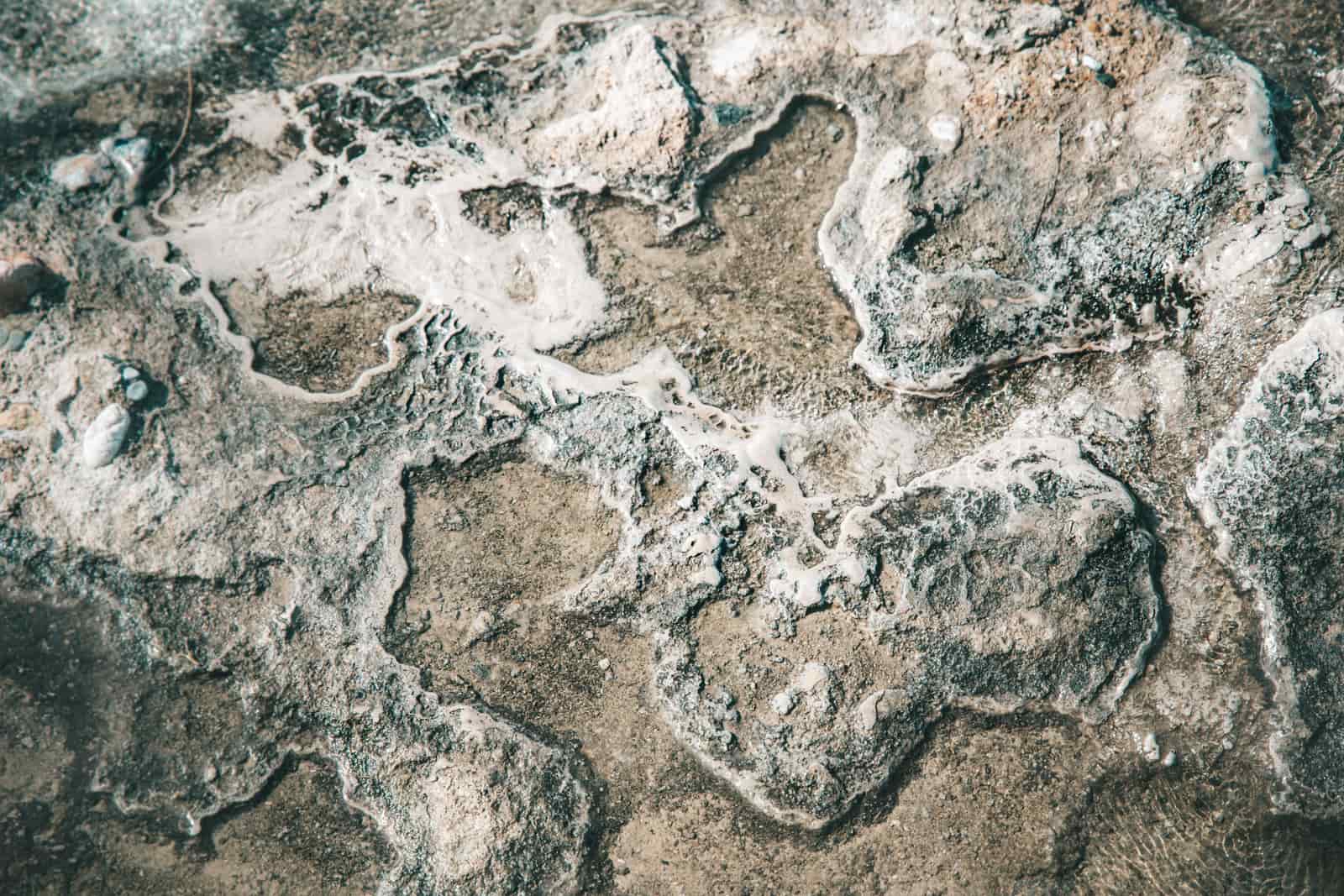
1. You are seeing white scale. A crusty white deposit at the water line, on the ladder, or on a heater element is calcium coming out of solution. It is gritty rather than slimy, it does not brush off the way algae does, and a chlorine tablet held against it does nothing — which distinguishes it from the organic marks in our liner stains guide. Scale and a white haze in the water are the same chemistry at different stages, and total alkalinity is usually the lever — see high alkalinity and cloudy water.
2. You are running a heater or a salt cell. Scale deposits fastest on the hottest surface in the system, which is exactly where you least want it. A scaled element heats less efficiently and a scaled salt cell produces less chlorine. If you have either, hardness stops being academic — see our heater guide and salt system guide.
There is a third case worth naming: scale and high pH travel together. Calcium comes out of solution more readily as pH rises, so what looks like a hardness problem is frequently a pH problem wearing a disguise. Correct alkalinity, then pH, and re-look before you treat the calcium.
What raises it on a seasonal pool
Almost always the shock. Calcium hypochlorite is unstabilized, hits hard, and is the right choice when cyanuric acid is already high — but it adds calcium hardness every single time. On a pool that gets shocked after every busy weekend and every heatwave, that adds up across a season.
The alternative is dichlor, which is stabilized, dissolves fast and adds no calcium. It adds cyanuric acid instead, which is its own constraint. That is the real trade, and which side of it you want depends on which number is climbing:
| Shock | Adds | Reach for it when |
|---|---|---|
| Calcium hypochlorite | Calcium hardness | Cyanuric acid is already high |
| Dichlor | Cyanuric acid | Calcium hardness is high, or you see scale |
Our shock guide covers the dosing for both, and the cyanuric acid guide covers the other half of the trade. Alternating rather than committing to one is a perfectly reasonable approach on a seasonal pool.
How to test it
Seven-way strips report total hardness, which is close enough to tell you whether you are anywhere near a problem. It is a color band rather than a number, and for a seasonal pool that is usually adequate — you are looking for “is this high”, not for a precise figure.
If you want the number, a drop-count kit measures calcium hardness by titration alongside free and combined chlorine, pH, alkalinity and cyanuric acid. That is the right tool if you are running a heater, chasing scale, or trying to work out whether your fill water is the source. Our test kit roundup compares both approaches.
What to do if it is genuinely high
There is no chemical that removes calcium from pool water. The fix is dilution, the same as for cyanuric acid: replace a portion of the water and the reading falls roughly in proportion. Replace a third, drop it by roughly a third.
On a seasonal above-ground pool that is inexpensive — a third of a 3,955-gallon pool is about 1,300 gallons, roughly $8 of water at the EPA WaterSense national average of $6.06 per 1,000 gallons. Re-test alkalinity, pH and chlorine afterwards, because you have diluted those too, and correct in the usual order. Our cost-to-fill guide does the arithmetic for other volumes.
What to buy
Scores are our own reading of published specifications. They are not test results — we have not tested these products and we do not claim to.
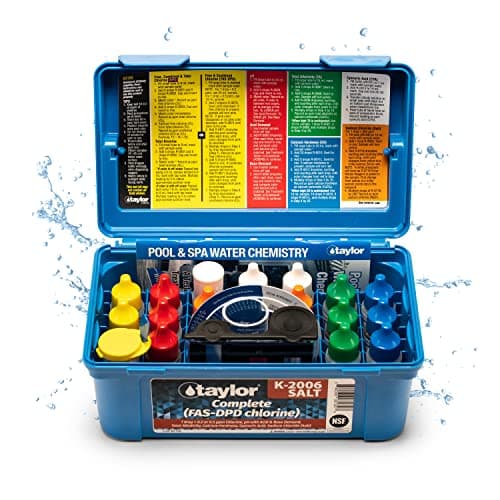
When you need a number, not a color band
Taylor K-2006 Complete Test Kit (FAS-DPD)
Taylor Technologies
The reference kit. It uses a drop-count titration for free chlorine, which gives you an actual figure rather than a shade of pink. Overkill for a 1,500-gallon pool and indispensable when something has gone properly wrong.
#ad how this is funded · price as of October 8, 2026
Key specs
- Method
- FAS-DPD drop-count titration
- Measures
- Free and combined chlorine, pH, alkalinity, calcium hardness, cyanuric acid
- Resolution
- Reads to 0.2 ppm free chlorine with the standard 10 mL sample
- Format
- Reagent bottles and graduated comparators
How it scoresour reading of published specs, not a test result
- Accuracy
- 9.8
- Ease
- 5.5
- Coverage
- 9.5
- Cost per use
- 7.0
- Value
- 8.0
Overall 8.3 / 10
What works
- Distinguishes free from combined chlorine, which is the single most useful thing a test can tell you when water smells of chlorine
- Gives a numeric result you can act on precisely rather than a color to interpret
- Reagents are individually replaceable, so the kit is a multi-season purchase
What doesn't
- Considerably more expensive than strips and more of a ritual to use
- Reagents have a shelf life and do expire
- Genuinely more kit than a small seasonal pool needs
Skip it if: Casual weekly checks. If it is a five-minute job you will skip it, and a test you skip is worse than a rough one you actually do.
What it costs to run: The reagents are the running cost, not the kit. For most seasonal above-ground owners this is a second purchase made in year two after a bad algae summer, not a first one.
Several seasons: Buy-once. Built and warranted to come back out of the box for a few years, if you store it properly.
Specs from: Taylor Technologies
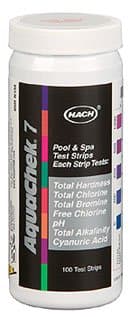
The default first test kit
AquaChek Silver 7-Way Test Strips (100 count)
AquaChek
Seven readings in fifteen seconds, including the two that beginners never measure and then fight all summer: total alkalinity and cyanuric acid.
#ad how this is funded · price as of October 8, 2026
Key specs
- Tests
- Free chlorine, total chlorine, bromine, pH, total alkalinity, total hardness, cyanuric acid
- Free chlorine range
- 0-20 ppm
- pH range
- 6.2-8.4
- Total alkalinity range
- 0-240 ppm
- Cyanuric acid range
- 0-300 ppm
- Read time
- 15 seconds
- Count
- 100 strips
How it scoresour reading of published specs, not a test result
- Accuracy
- 7.0
- Ease
- 9.5
- Coverage
- 9.5
- Cost per use
- 9.0
- Value
- 9.2
Overall 8.9 / 10
What works
- Covers cyanuric acid, which most cheap strips omit and which is the reason chlorine stops working in a stabilized pool
- pH range spans 6.2-8.4, comfortably bracketing the CDC's recommended 7.0-7.8
- 15 seconds and a color chart printed on the bottle — no separate booklet to lose
- 100 strips is a full season of twice-weekly testing with room to spare
What doesn't
- Strips are a comparison against a printed color chart, so they are directional rather than precise
- Reading them in bright sun is harder than it should be
- The bottle must be kept sealed and dry or the strips degrade quietly
Skip it if: Fine adjustment. If you are chasing a stubborn problem and need a number rather than a color band, a liquid reagent kit is the tool.
What it costs to run: 100 strips at twice-weekly testing covers roughly two seasons for one pool. The real saving is upstream: knowing your alkalinity stops you buying pH adjuster you did not need.
One honest season: The cheapest setup that genuinely works for a season of real swimming. Nothing spare, nothing missing.
Specs from: CDC — home pool and hot tub water treatment and testing
Actually clearing a green pool
Calcium Hypochlorite Pool Shock
Various (compare available chlorine %)
Unstabilized, fast-acting and strong. This is the tool for an algae bloom precisely because it does not add more cyanuric acid to a pool that probably already has too much.
Key specs
- Type
- Calcium hypochlorite, unstabilized
- Adds stabilizer
- No
- Adds
- Calcium hardness
- Dosing
- By pool volume, per the bag
How it scoresour reading of published specs, not a test result
- Effectiveness
- 9.5
- Ease
- 6.5
- Water impact
- 7.0
- Cost per season
- 9.0
- Value
- 8.8
Overall 8.6 / 10
What works
- No cyanuric acid added, so it does not worsen the problem it is usually solving
- Fast and strong enough to actually break an algae bloom in one treatment when dosed properly
- Cheap per pound of available chlorine
What doesn't
- Adds calcium hardness, which matters in hard-water areas
- Must be dissolved properly or it will bleach a vinyl liner where it settles
- Needs careful storage — it is a genuine oxidizer, not a household product
Skip it if: Routine daily chlorination. This is the emergency tool; tablets are the routine.
What it costs to run: The single most cost-effective way to fix a green pool, and the most commonly under-dosed. Half a dose twice does not equal a full dose once — it just wastes the bag.
One honest season: The cheapest setup that genuinely works for a season of real swimming. Nothing spare, nothing missing.
A gentler shock on a vinyl liner
Dichlor Granular Shock (stabilized)
Various (compare available chlorine %)
Dissolves fast and completely, which makes it kinder to a vinyl liner than cal-hypo. The catch is that it is stabilized, so every shock treatment also adds cyanuric acid.
Key specs
- Type
- Sodium dichlor, stabilized
- Adds stabilizer
- Yes
- Dissolving
- Fast, generally without pre-dissolving
How it scoresour reading of published specs, not a test result
- Effectiveness
- 8.5
- Ease
- 9.0
- Water impact
- 5.5
- Cost per season
- 7.0
- Value
- 7.5
Overall 7.8 / 10
What works
- Dissolves quickly and evenly, so there is much less liner-bleaching risk
- Close to pH neutral, so it does not swing your water while you are fixing it
- Convenient for routine oxidation rather than emergencies
What doesn't
- Adds cyanuric acid every single time, which is a problem in a pool that is never drained
- Generally more expensive per pound of available chlorine than cal-hypo
- Wrong tool for a heavy algae bloom in an already over-stabilized pool
Skip it if: A pool whose cyanuric acid is already high. Check the strip before you reach for this one.
What it costs to run: Costs more per treatment than cal-hypo and carries a hidden cost: the stabilizer it adds eventually forces a partial drain and refill, which is water you pay for.
One honest season: The cheapest setup that genuinely works for a season of real swimming. Nothing spare, nothing missing.
Questions people actually ask
Does calcium hardness matter in a vinyl above-ground pool?
What raises calcium hardness in a pool?
How do you lower calcium hardness?
Is white crusty deposit at the water line calcium?
Sources
Read next
- Pool care, from someone who assumes you have never done thisThe weekly routine, the four numbers that matter, and the fix for the week the water turns.
- pH and alkalinity, and why yours will not stay putWhy pH drifts, what total alkalinity actually does, and the order of operations that turns a season of chasing into one adjustment.
- Stains on the liner, and the one test that tells you which kindOrganic or metal? The five-minute test that identifies a liner stain, plus what removes each kind and what prevents both.
- Pool shock: use enough, once, and use the right kindCal-hypo versus dichlor, correct dosing, and the counter-intuitive reason a chlorine smell means you need more chlorine.
- The best pool test stripsTest strips compared on parameter coverage - specifically whether they read cyanuric acid, which most cheap strips omit.
- Cyanuric acid: the reading that explains your chlorineWhy an outdoor pool needs stabilizer, why tablets add it whether you want them to or not, and the only way to bring it back down.
- Pool heaters, priced by the wattHeater running costs computed at national average rates, and why a cover has to come first for a heater to make any sense.
- Draining an above-ground pool, and the two ways it goes wrongWhen a partial drain is the only fix, why liner makers say never to empty a vinyl pool, and the discharge rules that decide where the water may legally go.
- Hard water changes which chemicals you buy, not how often you testWhat hard fill water actually does to an above-ground pool, why vinyl tolerates it better than plaster, and the one chemical choice that stops it getting worse.