Pool Equipment
Sand vs cartridge: it is a maintenance choice, not a quality one
Both filter the water perfectly well. What differs is what you have to do each week and what you have to buy each season.
Heads up: we earn a commission if you buy through the links on this page, at no extra cost to you. It never decides the ranking — here is how we pick and here is the full disclosure. Prices are checked automatically; last verified October 19, 2026.
The short version
- Both work. This is not a filtration quality decision and anyone framing it that way is overselling.
- Cartridge: no media cost, simple, but a recurring consumable and a weekly rinse.
- Sand: no cartridges, two-minute backwash, but higher up-front cost and it discards water.
- Sand wins from about three seasons onward. Below that the payback never arrives.
How each one actually works
A cartridge filter passes water through a pleated fabric element. You pull the element out, hose it off, and put it back. Eventually the fiber clogs permanently and you replace it.
A sand filter passes water through a bed of graded sand. You do not clean the sand; you reverse the flow (backwash) so the trapped debris is flushed out to waste. The sand itself lasts years.
| Cartridge | Sand | |
|---|---|---|
| Up-front cost | Lower | Higher |
| Recurring consumable | Cartridges, ~every 2 weeks heavy use | Sand, every few years |
| Weekly chore | Remove and rinse — 10 minutes | Backwash — 2 minutes |
| Wastes water? | No | Yes, every backwash |
| Wastes chemicals? | No | Yes — backwash water is treated water |
| Complexity | Almost none | A multi-port valve to understand |
| Best for | Small or seasonal pools | Pools kept several seasons |
The cost comparison, honestly framed
We are not going to print a dollar total, because cartridge and sand prices move and a number written into this paragraph would be wrong within weeks. What we can give you is the structure of the comparison, which does not change:
The comparison to run with your own prices
- Cartridges per season
- count yours — Intex suggests ~every 2 weeks heavy use
- Seasons you expect to keep the pool
- your number
- Sand replacement interval
- several years
- Backwash water [EPA]
- $6.06 / 1,000 gal
(cartridges/season × seasons × cartridge price) vs (sand system price + sand + backwash water)
Sand generally wins from about three seasons onward
The chore is different, not smaller
People frequently describe sand as “less maintenance”. It is more accurate to say it is different maintenance.
A cartridge means a ten-minute job in the yard with a hose, roughly weekly in a busy pool. It is mildly unpleasant and completely straightforward, and there is nothing to understand.
Sand means turning a multi-port valve to backwash, running it for a minute or two until the sight glass runs clear, then rinsing and returning to filter. Faster, and it requires knowing what the valve positions do. It also means you must never move the valve with the pump running, which damages the gaskets.
Which to buy
Cartridge if your pool is small, if it comes down each autumn, if you are not certain you will keep it, or if your kit already includes one — which for most Intex and Bestway sets under 15 feet it does.
Sand if the pool is large, if it stays up across seasons, if you have a dog in it or trees over it, or if you have simply had enough of rinsing cartridges. Intex’s Ultra XTR line ships with a 2,100 GPH sand filter as standard, which tells you where the manufacturer thinks the crossover sits.
Whichever you choose, the running-cost lever is the same and it is not the filter: it is pump hours. Get the turnover math right and put the pump on a timer before you think about upgrading filtration.
What to buy
Scores are our own reading of published specifications. They are not test results — we have not tested these products and we do not claim to.
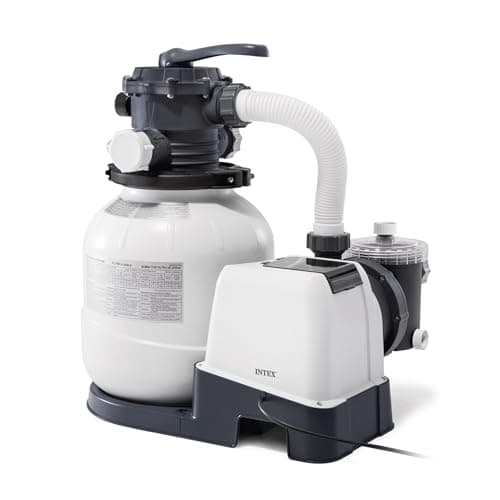
Getting off the cartridge treadmill
Intex Krystal Clear Sand Filter Pump
Intex
Sand filtration replaces a recurring cartridge purchase with a backwash valve and a bag of sand that lasts years. On a pool you intend to keep, the arithmetic favors it.
Key specs
- Media
- Filter sand (or glass media)
- Maintenance
- Backwash rather than rinse-and-replace
- Media life
- Several seasons before replacement
- Wattage
- Not published by Intex
How it scoresour reading of published specs, not a test result
- Sizing fit
- 8.5
- Running cost
- 8.0
- Maintenance
- 8.5
- Build
- 8.0
- Value
- 8.5
Overall 8.4 / 10
What works
- No cartridges to buy, which removes the single largest recurring equipment cost
- Backwashing takes about two minutes versus rinsing a cartridge in the yard
- Sand lasts years rather than weeks
What doesn't
- Backwashing sends water down the drain, and that water has chemicals in it you paid for
- Higher purchase price than a cartridge pump of the same flow
- Heavier and needs a stable, level base of its own
Skip it if: A small seasonal pool that comes down every autumn. The payback period is measured in seasons, so it only works if there will be seasons.
What it costs to run: The comparison to run: cartridge replacements per season versus one bag of sand every few years, plus the water each backwash discards at the EPA WaterSense average of $6.06 per 1,000 gallons. On a pool you will own for three or more years, sand usually wins.
Several seasons: Buy-once. Built and warranted to come back out of the box for a few years, if you store it properly.
Specs from: EPA WaterSense — cost per 1,000 gallons
The consumable you will actually buy repeatedly
Type A Replacement Filter Cartridges (multipack)
Various
Buy them in a multipack before you need them. A pool running on an exhausted cartridge is a cloudy pool, and the fix is a two-dollar part you did not have.
Key specs
- Type
- Type A — the most common Intex format
- Replacement interval
- Every 2 weeks in heavy use, per Intex guidance
- Between changes
- Rinse, do not scrub
How it scoresour reading of published specs, not a test result
- Sizing fit
- 9.0
- Running cost
- 7.0
- Maintenance
- 8.5
- Build
- 7.0
- Value
- 8.5
Overall 8.2 / 10
What works
- Type A is the most widely stocked cartridge format in the US
- Multipacks cost a fraction of buying singles
- Having a spare turns a cloudy week into a five-minute fix
What doesn't
- It is a genuine recurring cost that nobody includes in the purchase price
- Aftermarket quality varies noticeably
- Rinsing extends life but does not restore a cartridge that is done
Skip it if: Being restored. Once the pleats are permanently gray and stiff, rinsing is not saving it.
What it costs to run: The line item most people leave out of their pool budget. Count how many you use in your first season and you have your real annual filtration cost — this is exactly the number the cost-to-run guide asks you to record.
One honest season: The cheapest setup that genuinely works for a season of real swimming. Nothing spare, nothing missing.
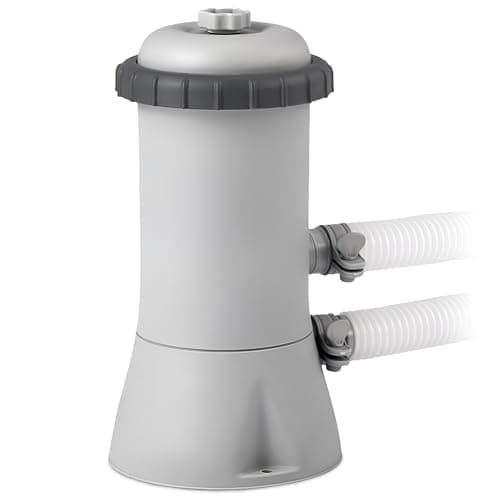
Pools up to about 6,000 gallons
Intex Krystal Clear C1000 Cartridge Filter Pump
Intex
The workhorse replacement pump for mid-size frame pools. 1,000 GPH pump flow, 750 GPH through the system once the cartridge is in the way — and that second number is the one your turnover math needs.
#ad how this is funded · price as of October 19, 2026
Key specs
- Pump flow rate
- 1,000 GPH
- System flow rate
- 750 GPH
- Rated pool size
- Up to 6,000 gallons
- Cartridge
- Type A
- Wattage
- Not published by Intex
How it scoresour reading of published specs, not a test result
- Sizing fit
- 9.0
- Running cost
- 7.0
- Maintenance
- 7.5
- Build
- 7.5
- Value
- 8.5
Overall 8.3 / 10
What works
- Intex publishes both pump flow and system flow, which is more honesty than most of this category offers
- Type A cartridges are the most widely stocked filter consumable in the US
- Sized correctly for the 12ft-15ft frame pools most families own
What doesn't
- Wattage is not published anywhere on the Intex site, so you cannot cost it before purchase
- Cartridge-only, so there is a consumable every few weeks in a busy pool
- GFCI cord length dictates where the pool can go more than people expect
Skip it if: Pools over about 6,000 gallons. Above that you are asking it to run all day to achieve one turnover, which is the expensive way to filter.
What it costs to run: Do the turnover math before you buy: 750 GPH system flow moves 4,000 gallons in 5.3 hours. Two turnovers a day is therefore about 11 hours of running. At the EIA's June 2026 US residential average of 18.34 cents per kWh, every 100 watts of pump draw running 11 hours a day for a 120-day season costs about $24. Find your wattage on the pump label and multiply.
Several seasons: Buy-once. Built and warranted to come back out of the box for a few years, if you store it properly.
Specs from: Intex — Krystal Clear cartridge filter pumps, EIA Electric Power Monthly, Table 5.6.A — US residential average price
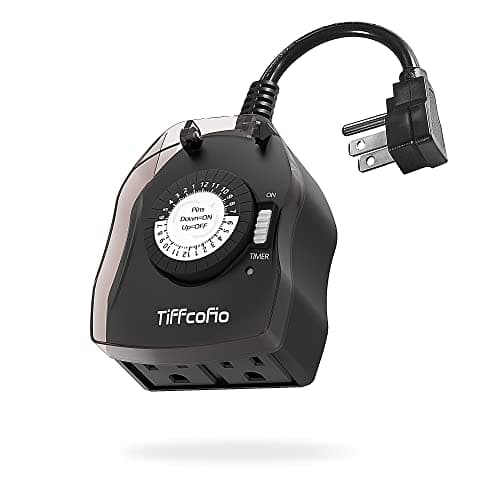
Cutting the electricity bill without cutting filtration
Outdoor Pool Pump Timer
Various
A weatherproof outdoor timer is the highest-return equipment purchase on this site. Most people run the pump too long because remembering to switch it off is a chore.
Key specs
- Type
- Outdoor-rated mechanical or digital timer
- Required rating
- Must be rated for the pump's amperage and for outdoor use
- Must not defeat
- The pump's GFCI protection
How it scoresour reading of published specs, not a test result
- Sizing fit
- 8.5
- Running cost
- 9.8
- Maintenance
- 9.0
- Build
- 7.5
- Value
- 9.5
Overall 9.0 / 10
What works
- Turns your filtration from a guess into a schedule
- Pays for itself within a single season on most pools
- Lets you shift running hours to off-peak if your utility has time-of-use rates
What doesn't
- Must be genuinely outdoor-rated and correctly amperage-matched, which cheap indoor timers are not
- Never bypass or defeat the pump's GFCI to fit one
- Mechanical timers drift and need resetting after a power cut
Skip it if: Fixing an undersized pump. Running the wrong pump on a schedule just makes the schedule longer.
What it costs to run: The arithmetic that justifies it: at the EIA's June 2026 US residential average of 18.34 cents per kWh, trimming a 400 W pump from 12 hours to 8 hours a day across a 120-day season saves 192 kWh, or about $35. That is more than the timer costs.
Several seasons: Buy-once. Built and warranted to come back out of the box for a few years, if you store it properly.
Specs from: EIA Electric Power Monthly, Table 5.6.A
Questions people actually ask
Is a sand filter better than a cartridge filter for an above-ground pool?
How often do you backwash a sand filter?
How long does pool filter sand last?
Sources
Read next
- Equipment, sized to your pool and costed by the wattPumps, filters, vacuums, heaters and ladders - matched to your gallons and priced by what they draw.
- Pool filters: the consumable nobody budgets forCartridge replacement intervals, what rinsing does and does not achieve, and when sand becomes the cheaper answer.
- Above-ground pool pumps: how many gallons per hour you actually needPumps matched to pool volume by system flow rate, with the season running-cost table manufacturers do not publish.
- What an above-ground pool actually costs to run for a yearElectricity, chemicals, water and consumables for a full season - every input sourced, every calculation shown, and every assumption named.
- What upkeep costs, separated from everything elseChemicals by published dosing, cartridge replacement intervals, and the honest weekly time commitment.
- Sand filters, and the flow rate that is not on the boxSand filter systems from 800 gph to 35 GPM, compared on the flow that actually reaches the pool, how much sand each takes, and which makers void the warranty over media.
- Filter balls: the claims do not agree with each otherFilter balls weighed against sand on the claims sellers publish, the contradictions between them, and what your filter maker says about non-specified media.
- Your filter manual already chose the sandThe grade every above-ground filter manual names, what each bag on the shelf actually publishes, how many bags your tank takes, and where zeolite and glass genuinely fit.