Pool Equipment
Salt does not attack the pool. It attacks everything metal in it.
Converting to salt is cheap and popular. The equipment decision is what makes it a good idea or an expensive one, and it starts with what your pool wall is coated in.

Heads up: we earn a commission if you buy through the links on this page, at no extra cost to you. It never decides the ranking — here is how we pick and here is the full disclosure. Prices are checked automatically; last verified October 8, 2026.
The short version
- Check the wall coating before anything else. Resin-coated walls resist salt; bare galvanized steel is what salt goes after.
- Size the generator on pump flow, not gallons. Several units publish a minimum flow their cell needs.
- Salt purity is an equipment spec. Generator makers ask for 99.8% pure, additive-free salt for a reason.
- Target salinity is not universal. Manufacturers publish materially different numbers — dose to your own manual.
What to look for
1. The wall, and what it is coated with. This is the decision that cannot be fixed later. Galvanized steel is zinc-coated against rust and is the baseline on most above-ground pools; resin-coated walls add a polymer layer on one or both faces. Salt water is mildly corrosive and it finds bare metal first. Our permanent pools roundup identifies which walls are resin-coated on both faces, which is the specification to want if salt is in the plan.
2. The pump flow your generator needs. Salt cells are rated on the water moving through them, not only on pool volume. The Intex unit here publishes a required pump flow range as well as a gallon rating, and getting that wrong is the most common reason a salt conversion disappoints. Our salt system roundup compares named units on exactly that specification, and our pump sizing guide is where your own number comes from.
3. Salt purity, which is an equipment decision. Pentair asks for salt that is at least 99.8% pure sodium chloride, evaporated, food quality and non-iodized with no additives, and warns specifically against anti-caking agents and rock salt. Hayward bans the same list. Those impurities do not get consumed — they stay in the water working on the cell. Our pool salt roundup covers which bags publish a purity figure at all.
4. Everything else metal in the water. Ladder frames, step hardware, the skimmer faceplate screws, a heater’s heat exchanger. Stainless and resin survive; plain steel does not. This is where a salt conversion quietly costs money on a pool that was not bought for it.
The numbers the makers do not agree on
Target salinity varies by manufacturer, and the differences are large enough to matter. Hayward publishes an ideal band of 2,700 to 3,400 ppm with 3,200 optimal. Intex publishes 3,000 ppm ideal within an operating range of 2,500 to 3,500. Pentair recommends 3,600 ppm and warns that above 4,500 ppm corrosion becomes a problem, with the unit shutting off below 2,600.
Pentair’s recommended level sits above Hayward’s entire ideal band. There is no universal correct salinity — only the figure in the manual for the cell you own. Anyone quoting one number for all salt pools is repeating folklore.
The picks
The Intex QZ1100 is the realistic starting point for a frame pool: it is sized for 6,000 to 15,000 gallons and publishes the pump flow range it needs, so you can check compatibility before buying rather than after.
The Hayward AquaTrol is the other end: a return-jet mounted unit rated to 18,000 gallons with a built-in timer outlet that runs your filter pump too. It is several times the price, and it suits a permanent pool rather than a seasonal one.
Pool salt is the consumable, and it is the one where the specification is simple: high purity, no additives, sold for pools. One 40 lb bag adds about 480 ppm to 10,000 gallons on the bags that publish a figure, which is how you calculate the first charge.
What a salt conversion does not change
It is still a chlorine pool — the cell makes chlorine from the salt, as our salt versus chlorine comparison explains. You still test free chlorine, pH, alkalinity and stabilizer, and salt cells drive pH upward as a matter of normal operation, so pH becomes a more frequent job rather than a less frequent one.
It also does not pay for itself quickly on a small seasonal pool. Our payback guide runs that arithmetic honestly, and the answer depends on how many seasons the pool will actually last.
Before you add the first bag
Confirm the wall and fittings can take it
Resin-coated wall, stainless or resin hardware. If the pool is bare galvanized steel and you intend to keep it for years, think twice.Check the generator against your pump, not your pool
Match the published flow range the cell needs to what your pump actually delivers through the filter.Work out the charge from your real volume
Use the ppm-per-bag figure and your own gallons. Aim low and retest - the only way down is replacing water.Buy salt that publishes its purity
99.8% pure, evaporated, additive-free is what the generator manuals ask for. A bag that publishes nothing cannot be checked against that.Plan for winter
The cell comes off and comes indoors with the rest of the equipment. The salt stays in the water and does not degrade.
The conversion, in order
Balance the water first
Get pH, alkalinity and stabilizer where they should be before adding salt. A cell will not fix chemistry, and it pushes pH up once running.Add salt with the pump running
Broadcast it rather than dumping it in one place, and brush it around. Give it time to dissolve fully before trusting any reading.Test with something other than the cell
Pentair notes its own salt sensor is accurate to within 500 ppm, which is a sixth of the working range. A strip or meter is the check.Bring the cell on slowly
Start at a modest output and adjust over a week against actual free chlorine readings rather than the display.Watch pH weekly for the first month
This is the change most converts are unprepared for: salt cells drive pH upward as normal operation.
What to keep testing
A salt pool is a chlorine pool, so free chlorine remains the reading that matters — CDC guidance is at least 1 ppm, or 2 ppm with stabilizer. Salinity is the new one, and it moves only when water leaves the pool. pH is the one that moves fastest.
Our testing comparison covers which method gives a usable number for each, and it is worth noting there that most digital testers infer chlorine from ORP rather than measuring it — useful for salinity, not a substitute for a chlorine test.
The parts salt reaches first
Ladder frames and step hardware, the skimmer faceplate screws, any heater’s exchanger, and the wall itself where the coating is scratched. Stainless and resin cope; plain steel is the vulnerable material, and the damage is slow enough that people attribute it to age rather than to the conversion.
If you are buying a pool with salt already in mind, our saltwater pools roundup covers which walls are specified for it, and our brand guide covers which makers publish the wall construction at all.
What it costs across three seasons
The generator is the large up-front number and the salt is close to a rounding error after the first charge, since the cell does not consume it. What people miss is the cell itself: it is a wear item with a finite life, and replacing one is a significant fraction of the price of the whole system.
That is what makes the payback arithmetic genuinely dependent on how long your pool lasts. On a permanent steel-wall pool the sums work over years. On a seasonal frame pool with a published 180-day to two-year warranty, the pool may not outlive the cell — our payback guide runs that properly rather than assuming the pool is permanent.
The other running-cost note is honest and often omitted: a salt pool still buys acid. Cells drive pH up continuously, so pH-down becomes a regular purchase where a tablet pool might need it occasionally. Set that against the tablets you no longer buy.
What to buy
Scores are our own reading of published specifications. They are not test results — we have not tested these products and we do not claim to.
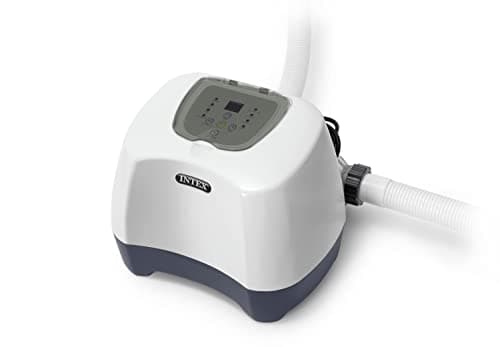
A mid-to-large pool on a sand filter pump
Intex QZ1100 Krystal Clear Ozone & Saltwater System (26665EG)
Intex
Salt chlorination plus an ozone stage in one unit, rated for 6,000 to 15,000 gallons. The number that decides whether it suits you is not the gallons — it is the 1,600 GPH minimum pump flow.
#ad how this is funded · price as of October 8, 2026
Key specs
- Pool size
- 6,000 to 15,000 gal (manufacturer-stated range)
- Chlorine output
- 11 g/hr
- Ozone output
- 150 mg/hr
- Pump flow required
- 1,600 - 4,000 GPH
- Power
- 110-120V with GFCI
- Timer
- 24-hr auto-clock cycle
- Self-clean
- 3 modes — 6, 10 and 14-hr cycles
- Warranty
- 2-year limited
How it scoresour reading of published specs, not a test result
- Sizing fit
- 6.5
- Running cost
- 7.5
- Maintenance
- 8.0
- Build
- 8.0
- Value
- 8.0
Overall 7.7 / 10
What works
- An ozone stage alongside the chlorine, which no other unit in this roundup has
- Built for Intex's own above-ground plumbing, so the fittings are not a guessing game on an Intex pool
- Built-in 24-hour clock and three self-clean cycles
- Two-year limited warranty, against one year on the Hayward and Solaxx units
What doesn't
- Needs at least 1,600 GPH — it will not run on Intex's own 1,000 GPH cartridge pump
- Has a stated minimum pool size of 6,000 gallons, so it is wrong for small pools
- Ozone is a supplement, not a replacement; you still test and balance as usual
- The cell is a consumable, and its life is not published on the product page
Skip it if: Small pools and cartridge pumps. Both its minimum gallons and its minimum flow rule out most 12- and 15-foot setups.
What it costs to run: Pair it with a sand filter pump or do not buy it. Intex's 2,100 GPH sand filter clears the 1,600 GPH minimum; its 1,000 GPH cartridge pump does not.
Several seasons: Buy-once. Built and warranted to come back out of the box for a few years, if you store it properly.
Specs from: Intex — QZ1100 Krystal Clear Ozone & Saltwater System, published specifications
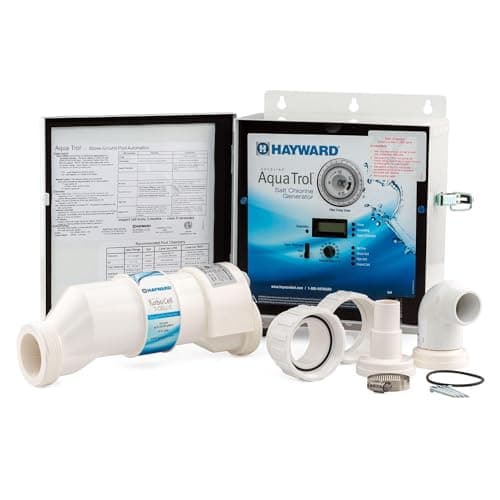
A large pool, bought once, from the inground specialist
Hayward AquaTrol Salt Chlorine Generator (W3AQ-TROL-RJ-TL)
Hayward
A return-jet mounted generator rated to 18,000 gallons, with a built-in 24-hour timer that runs your filter pump as well. It is the premium end of the category by a wide margin.
#ad how this is funded · price as of October 8, 2026
Key specs
- Pool size
- Up to 18,000 gal
- Mounting
- Return jet twist lock fittings, with twist lock line cord and outlet
- Pump control
- 24-hr timer outlet for the filter pump
- Scheduling
- Multiple run periods a day, 15-minute increments
- Chlorine output
- Not published on the listing we checked
- Warranty
- 1 year parts
How it scoresour reading of published specs, not a test result
- Sizing fit
- 6.0
- Running cost
- 7.0
- Maintenance
- 8.5
- Build
- 9.0
- Value
- 5.0
Overall 7.1 / 10
What works
- Runs the filter pump on its own timer, so it replaces a separate pump timer too
- Multiple daily run periods in 15-minute steps, the most flexible scheduling here
- Return-jet mounting keeps it at the pool rather than on the equipment pad
- From the manufacturer behind much of the inground salt market
What doesn't
- Several times the price of the Intex and Bestway units — by far the most expensive option here
- Output was not published on the listing we checked, so it cannot be compared like-for-like
- One-year parts warranty on the most expensive unit in the roundup
- Rated far beyond most above-ground pools
Skip it if: Being value for money on a seasonal pool. Its strengths are real, and on a pool you drain every autumn the payback arithmetic does not reach them.
What it costs to run: The pump timer is a genuine saving — it replaces a separate purchase. It does not close the price gap. Run the numbers in our salt system payback guide before choosing this over an Intex unit.
More than you need yet: Real capability a first-pool family cannot use yet. Buy cheaper and put the difference toward chemicals and a cover.
Specs from: Hayward AquaTrol return-jet 18K gallons — published specifications (retailer listing), Hayward AquaTrol W3AQ-TROL-RJ-TL — current listing (return jet twist lock, line cord and outlet)
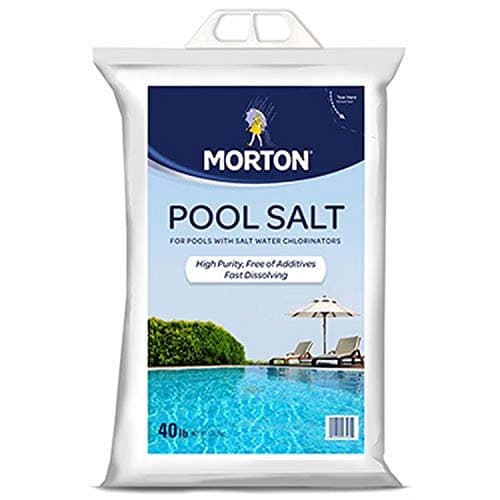
The bag in every hardware store
Morton Pool Salt, 40 lb
Morton
High-purity sodium chloride with no additives, sold for pools and available everywhere. Morton publishes less about it than the specialist brands do, and defers the dose to your generator's maker.
Key specs
- Marketed for
- Saltwater pools — Morton lists it as a pool product
- Purity
- Over 99% sodium chloride per Morton's safety data sheet; one retailer states 99.7%+
- Additives
- Safety data sheet describes it as common salt without additives
- Form
- Fine-grade granules for quick dissolving; mesh size not published
- Production method
- Not published for this product
- Dosing
- Morton defers to the pool or chlorinator maker's instructions
How it scoresour reading of published specs, not a test result
- Effectiveness
- 8.0
- Ease
- 8.5
- Water impact
- 8.5
- Cost per season
- 9.0
- Value
- 8.5
Overall 8.4 / 10
What works
- Stocked in general hardware and grocery stores, not just pool shops
- Safety data sheet confirms no additives, which is the specification that matters
- Fine granules dissolve faster than coarse solar crystals
- Usually the cheapest per bag of the pool-labeled salts
What doesn't
- Morton does not publish a purity figure on the product page itself
- No published production method, so evaporated versus solar is unknown
- No ppm-per-bag figure, unlike two competitors here
- Easy to confuse with Morton water-softener salt on a shelf — check the bag says pool
Skip it if: Telling you how much to add. There is no dosing figure on the product, so you need your generator's manual and a salt reading before you open a bag.
What it costs to run: Salt is a one-time charge plus top-ups after splash-out and rain overflow, not a repeating seasonal cost. Our salt system payback guide works through the arithmetic against tablets.
One honest season: The cheapest setup that genuinely works for a season of real swimming. Nothing spare, nothing missing.
Specs from: Morton Salt — pool salt product page, Morton Salt — pool salt safety data sheet (composition, no additives)
Questions people actually ask
Will salt water damage an above-ground pool?
What salt level should the pool run at?
Can I put a salt system on any frame pool?
Does a salt pool still need chlorine testing?
Sources
Read next
- Equipment, sized to your pool and costed by the wattPumps, filters, vacuums, heaters and ladders - matched to your gallons and priced by what they draw.
- Salt systems for an above-ground poolHow a chlorine generator works, what the cell costs over time, and why draining the pool each autumn changes the answer entirely.
- The best salt systems for an above-ground pool start with your pumpFive named salt chlorine generators for above-ground pools compared on pump flow, pool rating, chlorine output and installation — the four specs that decide fit.
- Pool salt is a purity specification, not a brandPool salts compared on published purity, additive-free status, production method and how far one bag moves your salinity - with the targets three generator makers publish.
- Salt vs chlorine: a saltwater pool is a chlorine poolWhat a salt chlorine generator actually does, the honest cost comparison over several seasons, and when it does not make sense.
- Running an above-ground pool on salt, and what it actually takesWhich above-ground pools suit a salt conversion, what the generator adds, and why draining each autumn changes the sums.
- The salt system pays back, eventually, on some poolsThe honest payback arithmetic on a salt chlorine generator for a seasonal above-ground pool, including the cell replacement most buyers do not budget for.
- The best permanent above-ground pools, and what makes one permanentSteel- and resin-wall above-ground pools built to stay up all year, compared on wall coating, liner gauge, what ships in the box and the warranty behind it.