Pool Care & Chemistry
Pool test kits, and when you need a number rather than a color
Strips are right for the weekly routine. A kit is right for the week something is wrong and you need a figure you can act on rather than a band you are squinting at.
Heads up: we earn a commission if you buy through the links on this page, at no extra cost to you. It never decides the ranking — here is how we pick and here is the full disclosure. Prices are checked automatically; last verified October 8, 2026.
Quick picks
Segmented before it is ranked — the right answer depends on which of these you actually are. Tap any row for the full write-up.
If you want an actual number
Drop-count titration reads free and combined chlorine separately and resolves far finer than any color band. This is the tool for diagnosing something stubborn.
| # | Product | Best for | Score | Price |
|---|---|---|---|---|
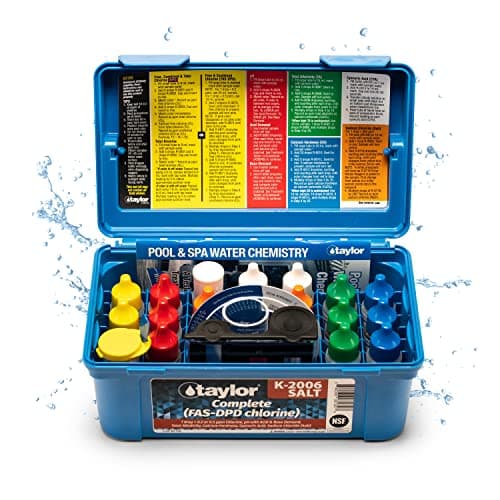
| 1 | Taylor K-2006 Complete Test Kit (FAS-DPD) The reference kit. It uses a drop-count titration for free chlorine, which gives you an actual figure rather than a shade of pink. Overkill for a 1,500-gallon pool and indispensable when something has gone properly wrong. | When you need a number, not a color bandSeveral seasons | 8.3out of 10 |
If you want a screen and a trend
A probe reader gives a figure without reagents and tracks drift day to day. Read the caveats before treating it as your only test.
| # | Product | Best for | Score | Price |
|---|---|---|---|---|
| 1 | 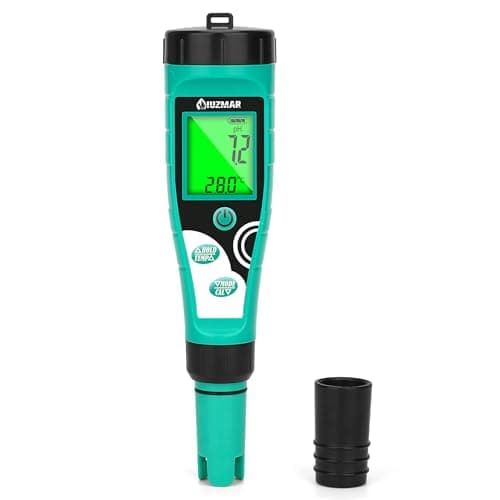 Digital Pool Water Tester A probe-based reader that gives you a figure on a screen. Useful for tracking a trend day to day; not a replacement for a reagent kit when a reading has to be right. | A number instead of a color band, without reagentsSeveral seasons | 7.0out of 10 |
What most people should actually own
Strips do the weekly routine faster and cheaper than anything else, and a seven-way strip covers the reading five-way strips omit.
| # | Product | Best for | Score | Price |
|---|---|---|---|---|
| 1 |  AquaChek Silver 7-Way Test Strips (100 count) Seven readings in fifteen seconds, including the two that beginners never measure and then fight all summer: total alkalinity and cyanuric acid. | The default first test kitOne honest season | 8.9out of 10 | |
| 2 | 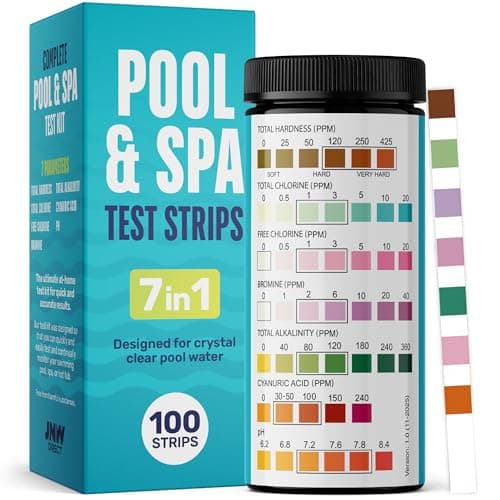 JNW Direct 7-in-1 Pool and Spa Test Strips Covers the same seven parameters as the AquaChek at a lower cost per strip. The color chart is harder to read in sunlight, which is a real usability cost rather than a nitpick. | Seven readings at a lower priceOne honest season | 8.0out of 10 | |
| 3 | 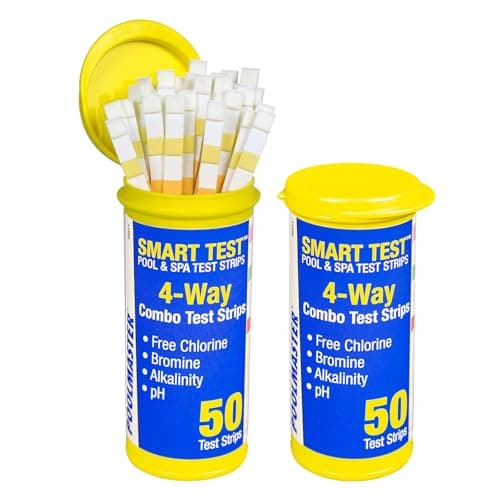 Poolmaster 5-Way Test Strips Five readings instead of seven, and the two it drops are the ones that matter most. Fine as a spare in the shed, wrong as your only kit. | A cheap backup bottleA few weekends | 6.4out of 10 |
The short version
- Strips and kits are not competitors. Strips are the weekly routine; a kit is the diagnostic you reach for when something is wrong.
- A drop-count kit gives you free and combined chlorine separately. That gap is the reading that explains the chlorine smell, and no strip resolves it well.
- Most digital testers infer sanitizer from ORP rather than measuring free chlorine directly. That is a meaningful difference, not a technicality.
- On a four-month seasonal pool, a $10 bottle of strips is hard to beat on value. Buy the kit for the diagnosis, not for the routine.
What each format actually does
Three technologies, and they answer different questions.
Test strips are reagent pads you dip and read against a bottle. Fifteen seconds, several parameters at once, and a result expressed as a color band. Fast, cheap, and adequate for deciding whether today is normal. Our test strip roundup is the companion to this page and covers that side properly.
Drop-count reagent kits use titration: you add reagent drop by drop until the sample changes color, and count the drops. Slower, and it produces a number rather than a judgment. The Taylor K-2006 uses FAS-DPD titration and reads free and combined chlorine separately, resolving to about 0.2 ppm free chlorine on the standard sample.
Digital testers use probes and give a figure on a screen, often with an app. Current units report pH, ORP, salinity, conductivity, total dissolved solids and temperature. Note what is missing from that list.
| Strips | Reagent kit | Digital tester | |
|---|---|---|---|
| Free chlorine | Color band | Number, ~0.2 ppm resolution | Usually inferred from ORP |
| Combined chlorine | Total minus free, roughly | Measured separately | No |
| pH | Color band | Number | Number |
| Total alkalinity | Color band | Number | No on most units |
| Cyanuric acid | Seven-way only | Yes | No |
| Calcium hardness | Total hardness band | Number | No |
| Salinity | No | Separate test | Yes — its best trick |
| Time per test | ~15 seconds | Several minutes | Seconds, once calibrated |
| Consumables | Strips | Reagents, which expire | Calibration solution, probes |
When a reagent kit is genuinely the right tool
Four situations, all of them diagnostic rather than routine.
The pool smells and you need to know why. The gap between free and total chlorine is your combined chlorine, and that gap is what produces the sharp public-pool smell. A kit measures it directly; a strip makes you subtract two color bands, which is exactly the situation where band-reading error swamps the answer. Our chlorine smell guide covers what to do about it.
Chlorine reads fine and the water misbehaves. That is usually cyanuric acid, and getting a real number rather than a band matters when you are deciding whether to drain a third of the pool. Our cyanuric acid guide covers the decision.
The water is hazy and the chemistry looks fine. Diagnosing that means looking at calcium hardness, alkalinity corrected for cyanuric acid, and pH together — the saturation relationship Taylor describes, which combines calcium hardness, pH, corrected alkalinity, total dissolved solids and temperature. Bands are not precise enough to feed into that. Our high alkalinity guide works the arithmetic.
You are about to spend real money. Before a partial drain, a big chemical purchase, or a decision about whether a liner stain is metal or organic, a number is worth the extra five minutes.
Where digital testers fit
Their genuine advantage is salinity, which is awkward to test any other way and matters if you run a salt system — see our salt systems guide. Their second advantage is trend: a floating unit reporting to an app shows drift over days, which is how you catch a problem before it is visible.
The honest caveats are three. They infer chlorine rather than measuring it. They need calibration and eventually new probes, so they are not a buy-once item. And they cost many times a season of strips on a pool that is up for four months. For a permanent pool or a hot tub run year-round the sums are different; for a seasonal above-ground pool they are hard to justify as the primary instrument.
Reagents expire, and that is the trap
A reagent kit bought for diagnosis and used three times a season has bottles sitting in a shed for months. Reagents degrade, and heat accelerates it — the same problem that affects strips, described in our testing mistakes guide, but with a higher replacement cost when it happens.
Store the kit indoors rather than poolside, check the dates before you trust a diagnosis, and budget for replacement reagents rather than assuming the kit is a one-off purchase. A kit that gives you a confident wrong number is worse than a strip that gives you an honest band.
What we are scoring
We have not tested these and do not claim to. The scores are our reading of published specifications — what each format measures, at what resolution, and what it costs per use — read against a seasonal above-ground pool specifically. That context is why strips score well here and a digital unit scores modestly, and it would flip on a year-round pool. Our methodology page explains how our scoring works, and clear versus safe is the reason any of this matters.
The picks, in full
Scores are our own reading of published specifications. They are not test results — we have not tested these products and we do not claim to.
Pick #1 · When you need a number, not a color band
Taylor K-2006 Complete Test Kit (FAS-DPD)
Taylor Technologies
The reference kit. It uses a drop-count titration for free chlorine, which gives you an actual figure rather than a shade of pink. Overkill for a 1,500-gallon pool and indispensable when something has gone properly wrong.
#ad how this is funded · price as of October 8, 2026
Key specs
- Method
- FAS-DPD drop-count titration
- Measures
- Free and combined chlorine, pH, alkalinity, calcium hardness, cyanuric acid
- Resolution
- Reads to 0.2 ppm free chlorine with the standard 10 mL sample
- Format
- Reagent bottles and graduated comparators
How it scoresour reading of published specs, not a test result
- Accuracy
- 9.8
- Ease
- 5.5
- Coverage
- 9.5
- Cost per use
- 7.0
- Value
- 8.0
Overall 8.3 / 10
What works
- Distinguishes free from combined chlorine, which is the single most useful thing a test can tell you when water smells of chlorine
- Gives a numeric result you can act on precisely rather than a color to interpret
- Reagents are individually replaceable, so the kit is a multi-season purchase
What doesn't
- Considerably more expensive than strips and more of a ritual to use
- Reagents have a shelf life and do expire
- Genuinely more kit than a small seasonal pool needs
Skip it if: Casual weekly checks. If it is a five-minute job you will skip it, and a test you skip is worse than a rough one you actually do.
What it costs to run: The reagents are the running cost, not the kit. For most seasonal above-ground owners this is a second purchase made in year two after a bad algae summer, not a first one.
Several seasons: Buy-once. Built and warranted to come back out of the box for a few years, if you store it properly.
Specs from: Taylor Technologies
Pick #2 · A number instead of a color band, without reagents
Digital Pool Water Tester
Various
A probe-based reader that gives you a figure on a screen. Useful for tracking a trend day to day; not a replacement for a reagent kit when a reading has to be right.
#ad how this is funded · price as of October 8, 2026
Key specs
- Typical parameters
- pH, ORP, salinity, EC, TDS and temperature, by model
- Free chlorine
- Inferred from ORP on most units, not measured directly
- Power
- Rechargeable; many float and report to an app
- Calibration
- Required periodically — check what the model needs
How it scoresour reading of published specs, not a test result
- Accuracy
- 7.0
- Ease
- 8.5
- Coverage
- 8.0
- Cost per use
- 5.5
- Value
- 6.5
Overall 7.0 / 10
What works
- Gives a number rather than a color judgment, which removes the reading error
- Trend tracking is genuinely useful — you see drift before it is a problem
- No reagents to expire or store
- Salinity readout is the one genuinely hard thing to test by strip
What doesn't
- Most units infer sanitizer from ORP rather than measuring free chlorine directly
- Probes need calibration and eventually replacement — this is not a buy-once item
- App dependence means a dead phone or a dropped connection is a dead test
- Costs many times a bottle of strips for readings you may not act on
Skip it if: Being the only test you own. Keep strips or a reagent kit for the readings that decide whether people swim.
What it costs to run: The unit is the visible cost; probe calibration solution and eventual probe replacement are the recurring one. On a pool that is up for four months a year, that is a hard payback against a $10 bottle of strips.
Several seasons: Buy-once. Built and warranted to come back out of the box for a few years, if you store it properly.
Specs from: Digital pool water tester — current Amazon listing and published parameters
Pick #3 · The default first test kit
AquaChek Silver 7-Way Test Strips (100 count)
AquaChek
Seven readings in fifteen seconds, including the two that beginners never measure and then fight all summer: total alkalinity and cyanuric acid.
#ad how this is funded · price as of October 8, 2026
Key specs
- Tests
- Free chlorine, total chlorine, bromine, pH, total alkalinity, total hardness, cyanuric acid
- Free chlorine range
- 0-20 ppm
- pH range
- 6.2-8.4
- Total alkalinity range
- 0-240 ppm
- Cyanuric acid range
- 0-300 ppm
- Read time
- 15 seconds
- Count
- 100 strips
How it scoresour reading of published specs, not a test result
- Accuracy
- 7.0
- Ease
- 9.5
- Coverage
- 9.5
- Cost per use
- 9.0
- Value
- 9.2
Overall 8.9 / 10
What works
- Covers cyanuric acid, which most cheap strips omit and which is the reason chlorine stops working in a stabilized pool
- pH range spans 6.2-8.4, comfortably bracketing the CDC's recommended 7.0-7.8
- 15 seconds and a color chart printed on the bottle — no separate booklet to lose
- 100 strips is a full season of twice-weekly testing with room to spare
What doesn't
- Strips are a comparison against a printed color chart, so they are directional rather than precise
- Reading them in bright sun is harder than it should be
- The bottle must be kept sealed and dry or the strips degrade quietly
Skip it if: Fine adjustment. If you are chasing a stubborn problem and need a number rather than a color band, a liquid reagent kit is the tool.
What it costs to run: 100 strips at twice-weekly testing covers roughly two seasons for one pool. The real saving is upstream: knowing your alkalinity stops you buying pH adjuster you did not need.
One honest season: The cheapest setup that genuinely works for a season of real swimming. Nothing spare, nothing missing.
Specs from: CDC — home pool and hot tub water treatment and testing
Pick #4 · Seven readings at a lower price
JNW Direct 7-in-1 Pool and Spa Test Strips
JNW Direct
Covers the same seven parameters as the AquaChek at a lower cost per strip. The color chart is harder to read in sunlight, which is a real usability cost rather than a nitpick.
Key specs
- Tests
- 7 parameters including cyanuric acid
- Count
- 100 strips (typical pack)
- Extras
- Companion app offered by the manufacturer
How it scoresour reading of published specs, not a test result
- Accuracy
- 6.5
- Ease
- 8.0
- Coverage
- 9.0
- Cost per use
- 9.5
- Value
- 8.5
Overall 8.0 / 10
What works
- Includes cyanuric acid, which is the thing a cheap 5-way leaves out
- Lower cost per strip than the category benchmark
- Large pack sizes mean you test more often, which matters more than precision
What doesn't
- Color differentiation between adjacent bands is tighter than on the AquaChek chart
- App-based reading is a nice idea and an extra step you will stop taking by July
- Less established than AquaChek if you want a long track record
Skip it if: Reading in direct sun on a bright deck, which is exactly where you will be using it.
What it costs to run: Cheapest route to a full seven-parameter reading. Given that testing frequency beats testing precision for a seasonal pool, buying more strips for the same money is a defensible trade.
One honest season: The cheapest setup that genuinely works for a season of real swimming. Nothing spare, nothing missing.
Pick #5 · A cheap backup bottle
Poolmaster 5-Way Test Strips
Poolmaster
Five readings instead of seven, and the two it drops are the ones that matter most. Fine as a spare in the shed, wrong as your only kit.
#ad how this is funded · price as of October 8, 2026
Key specs
- Tests
- Typically free chlorine, bromine, pH, total alkalinity, total hardness
- Omits
- Cyanuric acid on most 5-way formats
- Read time
- About 15 seconds
How it scoresour reading of published specs, not a test result
- Accuracy
- 6.0
- Ease
- 9.0
- Coverage
- 5.0
- Cost per use
- 9.0
- Value
- 6.0
Overall 6.4 / 10
What works
- Cheap enough to keep a second bottle where you actually test
- Covers the three daily readings — chlorine, pH, alkalinity
- Same 15-second workflow as any strip
What doesn't
- No cyanuric acid reading, which is the number that explains why your chlorine stopped working
- Color bands are coarser than the AquaChek equivalent
- Format varies between production runs, so check what the bottle actually tests
Skip it if: Diagnosing a stabilized pool. Without a cyanuric acid reading you are guessing at exactly the point where guessing is expensive.
What it costs to run: Saves a couple of dollars against a 7-way and can cost you a season of unnecessary chlorine. This is the wrong place to economize.
A few weekends: Fine for a heatwave and a toddler. Treat it as consumable, not as a pool — it will not survive a winter in the yard.
Questions people actually ask
Are pool test kits more accurate than test strips?
Do digital pool testers measure chlorine?
What test kit do I need for an above-ground pool?
Do pool test reagents expire?
Sources
Read next
- Pool care, from someone who assumes you have never done thisThe weekly routine, the four numbers that matter, and the fix for the week the water turns.
- The best pool test stripsTest strips compared on parameter coverage - specifically whether they read cyanuric acid, which most cheap strips omit.
- Your test result is only as good as how you took itThe six common testing errors that produce misleading readings, and how to take a sample that means something.
- Cyanuric acid: the reading that explains your chlorineWhy an outdoor pool needs stabilizer, why tablets add it whether you want them to or not, and the only way to bring it back down.
- High alkalinity, cloudy water, and the pH you cannot hold downWhy high total alkalinity clouds water and drives pH up, the published dosing to bring it down, and the cyanuric acid correction that shows whether yours is genuinely high.
- Clear water and safe water are two different thingsWhy a pool can look perfect and be unsanitized, why haze is often harmless, and the four readings that answer the question clarity cannot.
- The chlorine smell means you need more chlorine, not lessWhat the chlorine smell actually is, why it means the opposite of what people assume, and the test that distinguishes free from combined chlorine.
- Strips, drops or digital: how precise does the answer need to be?Test strips, FAS-DPD drop kits and digital testers compared on what each actually measures, the resolution you get, and which readings a strip cannot really give you.