Above-Ground Pools
Running an above-ground pool on salt, and what it actually takes
There is no such thing as a saltwater pool you buy off the shelf. There is a pool, a generator, and a decision about whether the water stays in long enough to pay for it.
Heads up: we earn a commission if you buy through the links on this page, at no extra cost to you. It never decides the ranking — here is how we pick and here is the full disclosure. Prices are checked automatically; last verified October 8, 2026.
Quick picks
Segmented before it is ranked — the right answer depends on which of these you actually are. Tap any row for the full write-up.
The pool this makes sense on
Salt pays back on volume and on a season long enough to notice. That means the larger end of this category, not the 12-foot class.
| # | Product | Best for | Score | Price |
|---|---|---|---|---|
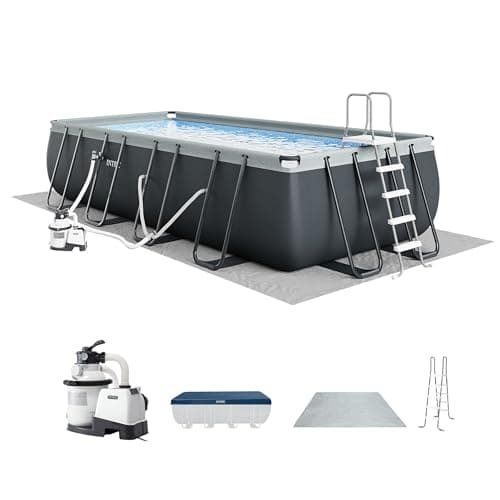
| 1 | Intex Ultra XTR Frame Pool Set, 18ft x 52in The biggest, sturdiest thing in this class that a homeowner can still put up in a weekend. It is also, by a wide margin, the most expensive one to run. | A family that will still be using it in year threeSeveral seasons | 8.4out of 10 | |
| 2 | 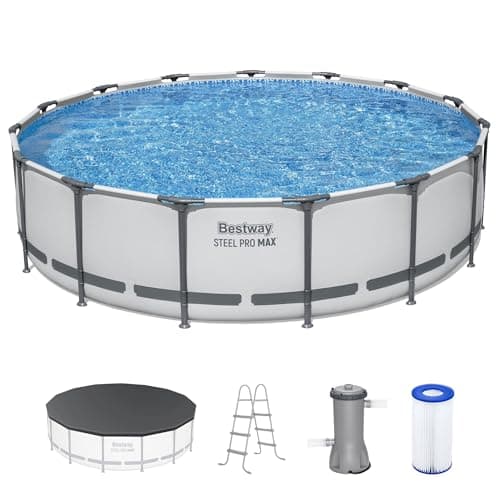 Bestway Steel Pro MAX Pool Set, 15ft x 42in Fewer gallons and a shallower wall than the Intex flagship, which makes it easier to level, cheaper to fill and cheaper to keep clean. For most first-pool families this is the right size, not the compromise size. | The honest middle of the marketSeveral seasons | 8.2out of 10 |
What actually makes it a salt pool
The generator is the product. Everything else on this page is the pool it is bolted to.
| # | Product | Best for | Score | Price |
|---|---|---|---|---|
| 1 | No image Above-Ground Saltwater Chlorine Generator It makes chlorine from salt rather than replacing chlorine. Whether the hardware pays for itself over a seasonal pool's life is genuinely arguable, and it usually depends on how many seasons you will own it. | Owners who dislike handling chemicalsMore than you need yet | 6.9out of 10 |
What you still have to test
A salt pool is a chlorine pool. Every reading you took before, you take now, plus salinity.
| # | Product | Best for | Score | Price |
|---|---|---|---|---|
| 1 | 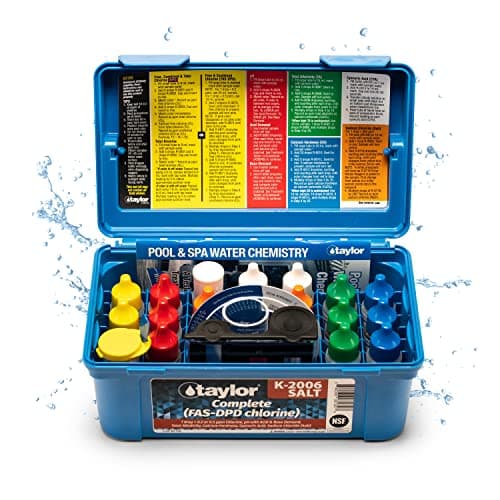 Taylor K-2006 Complete Test Kit (FAS-DPD) The reference kit. It uses a drop-count titration for free chlorine, which gives you an actual figure rather than a shade of pink. Overkill for a 1,500-gallon pool and indispensable when something has gone properly wrong. | When you need a number, not a color bandSeveral seasons | 8.3out of 10 | |
| 2 | 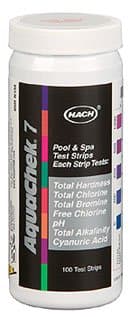 AquaChek Silver 7-Way Test Strips (100 count) Seven readings in fifteen seconds, including the two that beginners never measure and then fight all summer: total alkalinity and cyanuric acid. | The default first test kitOne honest season | 8.9out of 10 |
The short version
- You do not buy a saltwater pool. You buy a pool and add a chlorine generator, and almost any above-ground pool can take one.
- It is still a chlorine pool. The generator makes chlorine from salt; the sanitizer in the water is identical and so is the testing.
- Volume decides whether it is worth it. Generators are rated by gallons, and the convenience payback scales with the size of the chemical chore it replaces.
- Draining each autumn is the catch. The salt leaves with the water, so a seasonal pool buys the salt again every year.
First, what the phrase actually means
There is no product called a saltwater above-ground pool. There is a pool — the same frames and liners covered in our main roundup — and a saltwater chlorine generator plumbed into the return line, which electrolyses dissolved salt into chlorine continuously while the pump runs.
So the shopping decision splits in two. Which pool, which is the ordinary decision this site spends most of its time on. And whether a generator earns its place on that pool, which is a genuinely different question with a genuinely different answer depending on size.
Which pools suit it
Generators are rated by pool volume, so the first filter is simply whether a unit exists for your gallons. Beyond that, three things push the decision toward the larger pools in this category.
| Pool | Gallons | Salt verdict |
|---|---|---|
| Intex Easy Set 12ft x 30in | 1,485 | No — the chore it replaces is tiny |
| Intex Prism Frame 12ft x 30in | 1,718 | No — about six tablets a season |
| Bestway Steel Pro MAX 15ft x 42in | 3,955 | Marginal — depends on how you feel about tablets |
| Intex Ultra XTR 18ft x 52in | 6,981 | Reasonable — roughly 24 tablets a season replaced |
The reason small pools fall out is arithmetic rather than snobbery. At the published dosing of two three-inch tablets a week per 10,000 gallons, a 1,718-gallon pool consumes about six tablets across a 17-week season. That is the entire chore a generator would be removing, and it does not justify a generator, a cell that wears out, and a salinity reading to manage. On a 6,981-gallon pool the same arithmetic gives roughly 24 tablets, which is a real chore — our chemical cost guide has the counts by volume.
What the generator adds, and what it adds back
It removes handling. No buckets, no measuring, no storing chlorine over winter. For people who dislike that part — and it is a common and reasonable dislike — this is the whole benefit and it is real.
It adds a cell. The electrolytic cell is a consumable with a published life in hours, and it needs periodic cleaning, especially in hard water where scale builds on the plates. That is a new maintenance job replacing an old one, not the absence of a job.
It adds a reading. Salinity has to be maintained in the range the unit specifies, and it drifts as you top up and as splash-out removes water. Seven-way strips do not measure it; a drop-count kit or a dedicated meter does.
It produces at a fixed rate. A generator makes chlorine steadily while the pump runs, rather than on demand. That copes poorly with a sudden spike in swimmers, which on a small pool is common — our swimmer load guide covers why. You still keep a bag of shock for the day after a party.
The seasonal catch, which is specific to this site
Salt is dissolved in the water. When the water goes, the salt goes with it.
On a permanent pool that is a one-off purchase amortized over years. On a seasonal above-ground pool that is drained and stored each autumn — the routine in our take-down guide — you buy the salt again every spring, and the payback period on the generator stretches accordingly.
That does not make it wrong. It makes it a convenience purchase rather than an economy one, and it should be bought with that framing. Our salt systems guide works through the equipment side and salt versus chlorine is the direct comparison.
The honest recommendation
If you are buying at the 18-foot, 7,000-gallon end of this category, intend to leave the pool up, and dislike handling chemicals, a generator is a reasonable purchase and the water genuinely does feel different to swim in.
If you are buying a 12-foot pool, or you take it down every autumn, or the appeal was “chlorine-free”, the honest answer is a floating dispenser and a bucket of tablets. It is a fraction of the cost, the chore it replaces is small, and nothing about the water is meaningfully worse — our tablets versus liquid guide covers doing that part well.
For the generator itself, our best salt systems roundup covers which named units suit which pumps. It matters here: the popular Intex QZ1100 needs at least 1,600 GPH, which rules it out on the cartridge pumps most smaller pools ship with.
The picks, in full
Scores are our own reading of published specifications. They are not test results — we have not tested these products and we do not claim to.
Pick #1 · A family that will still be using it in year three
Intex Ultra XTR Frame Pool Set, 18ft x 52in
Intex
The biggest, sturdiest thing in this class that a homeowner can still put up in a weekend. It is also, by a wide margin, the most expensive one to run.
#ad how this is funded · price as of October 8, 2026
Key specs
- Water capacity
- 6,981 gallons
- Pump supplied
- 2,100 GPH sand filter
- Frame
- Galvanized steel, powder-coated inside and out
- Liner
- 3-ply, puncture and tear resistant
- Manufacturer setup claim
- Ready for water in 60 minutes
- Pump wattage
- Not published by Intex
How it scoresour reading of published specs, not a test result
- Build
- 9.0
- Setup
- 6.0
- Upkeep
- 7.5
- Running cost
- 5.0
- Value
- 8.5
Overall 8.4 / 10
What works
- 6,981 gallons is genuinely swimmable for adults, not just a cooling-off pool
- Sand filter rather than a cartridge, so there is no cartridge to buy every few weeks
- Galvanized frame with inner and outer powder coating is the most corrosion-resistant construction in this price class
- Ships with the ladder, cover and ground cloth that cheaper kits make you buy separately
What doesn't
- 52 inches of wall on an 18-foot circle is a lot of water pressure — the ground under it has to be genuinely level
- Intex publishes flow rate but not wattage, so you cannot compute your running cost until the pump is in your hands
- Too heavy and too large to take down and put up casually
Skip it if: Your yard is not close to level, or you want a pool you can pack away mid-season. Nearly 7,000 gallons is not a thing you move.
What it costs to run: It is the most water in this roundup, so it is the most chemicals, the most evaporation and the largest pump. Using ENERGY STAR's own published figures for above-ground pool pumps (an ENERGY STAR model saves about $20 a year, being 11% more efficient), a standard above-ground pump implies roughly $182 a year in electricity — and that is before you scale for a 2,100 GPH sand filter running on a pool this size. Price the season before you price the pool.
Several seasons: Buy-once. Built and warranted to come back out of the box for a few years, if you store it properly.
Specs from: Intex — Ultra XTR Frame 18' x 52' specifications, ENERGY STAR — Pool Pumps
Pick #2 · The honest middle of the market
Bestway Steel Pro MAX Pool Set, 15ft x 42in
Bestway
Fewer gallons and a shallower wall than the Intex flagship, which makes it easier to level, cheaper to fill and cheaper to keep clean. For most first-pool families this is the right size, not the compromise size.
#ad how this is funded · price as of October 8, 2026
Key specs
- Water capacity
- 3,955 gallons (90% full)
- Pump supplied
- 1,000 gal filter pump, Type III cartridge
- Liner
- Tritech 3-layer
- Included
- Ladder and cover
- Wall height
- 42 inches
- Pump wattage
- Not published by Bestway (US listing)
How it scoresour reading of published specs, not a test result
- Build
- 7.5
- Setup
- 8.0
- Upkeep
- 8.0
- Running cost
- 7.5
- Value
- 8.8
Overall 8.2 / 10
What works
- 3,955 gallons is roughly 43% less water than the 18ft Intex — that is 43% less chemical spend, every season, forever
- 42-inch wall is far more forgiving of a yard that is nearly-but-not-quite level
- Ladder and cover included
- Cartridge filtration means no sand to buy or change
What doesn't
- Cartridges are a recurring consumable, and in a busy pool you will rinse one weekly
- 42 inches is shallow for adults who want to actually swim rather than sit
- Wattage is not published, so the running-cost math needs the label on the box
Skip it if: Adults who want to swim lengths. At 42 inches you are sitting in it, not swimming in it.
What it costs to run: The gallons are the story. Chemical dosing scales with volume, so 3,955 gallons costs meaningfully less to sanitize all season than 6,981 does. Filling it once at the EPA WaterSense national average of $6.06 per 1,000 gallons is about $24 of water; the same fill on the 18ft Intex is about $42.
Several seasons: Buy-once. Built and warranted to come back out of the box for a few years, if you store it properly.
Specs from: Bestway USA — Steel Pro MAX 15' x 42' pool set, EPA WaterSense — how the calculator works ($6.06 per 1,000 gallons)
Pick #3 · Owners who dislike handling chemicals
Above-Ground Saltwater Chlorine Generator
Various
It makes chlorine from salt rather than replacing chlorine. Whether the hardware pays for itself over a seasonal pool's life is genuinely arguable, and it usually depends on how many seasons you will own it.
Key specs
- What it does
- Electrolyzes dissolved salt into chlorine
- Still a chlorine pool
- Yes — the sanitizer is identical
- Cell life
- Published in hours; the cell is a replaceable consumable
- Salt required
- Published per model, added once per season
How it scoresour reading of published specs, not a test result
- Sizing fit
- 7.0
- Running cost
- 6.0
- Maintenance
- 8.0
- Build
- 7.0
- Value
- 6.5
Overall 6.9 / 10
What works
- No weekly handling or storage of chlorine tablets
- Water feels noticeably softer to most people, which is the real reason people like them
- Salt is added once and stays until the water is changed
What doesn't
- The cell is a consumable and replacing it is a significant cost
- Adds another powered device to a pool whose running cost is already dominated by power
- Salt is corrosive to some metal frames and fittings if not managed
Skip it if: A pool that gets drained every autumn. You lose the salt with the water each year, and the payback period never arrives.
What it costs to run: The honest comparison is cell replacement cost plus salt plus power, against a season of tablets. On a pool kept up for several years it can work out; on a pool drained every October it generally does not.
More than you need yet: Real capability a first-pool family cannot use yet. Buy cheaper and put the difference toward chemicals and a cover.
Pick #4 · When you need a number, not a color band
Taylor K-2006 Complete Test Kit (FAS-DPD)
Taylor Technologies
The reference kit. It uses a drop-count titration for free chlorine, which gives you an actual figure rather than a shade of pink. Overkill for a 1,500-gallon pool and indispensable when something has gone properly wrong.
#ad how this is funded · price as of October 8, 2026
Key specs
- Method
- FAS-DPD drop-count titration
- Measures
- Free and combined chlorine, pH, alkalinity, calcium hardness, cyanuric acid
- Resolution
- Reads to 0.2 ppm free chlorine with the standard 10 mL sample
- Format
- Reagent bottles and graduated comparators
How it scoresour reading of published specs, not a test result
- Accuracy
- 9.8
- Ease
- 5.5
- Coverage
- 9.5
- Cost per use
- 7.0
- Value
- 8.0
Overall 8.3 / 10
What works
- Distinguishes free from combined chlorine, which is the single most useful thing a test can tell you when water smells of chlorine
- Gives a numeric result you can act on precisely rather than a color to interpret
- Reagents are individually replaceable, so the kit is a multi-season purchase
What doesn't
- Considerably more expensive than strips and more of a ritual to use
- Reagents have a shelf life and do expire
- Genuinely more kit than a small seasonal pool needs
Skip it if: Casual weekly checks. If it is a five-minute job you will skip it, and a test you skip is worse than a rough one you actually do.
What it costs to run: The reagents are the running cost, not the kit. For most seasonal above-ground owners this is a second purchase made in year two after a bad algae summer, not a first one.
Several seasons: Buy-once. Built and warranted to come back out of the box for a few years, if you store it properly.
Specs from: Taylor Technologies
Pick #5 · The default first test kit
AquaChek Silver 7-Way Test Strips (100 count)
AquaChek
Seven readings in fifteen seconds, including the two that beginners never measure and then fight all summer: total alkalinity and cyanuric acid.
#ad how this is funded · price as of October 8, 2026
Key specs
- Tests
- Free chlorine, total chlorine, bromine, pH, total alkalinity, total hardness, cyanuric acid
- Free chlorine range
- 0-20 ppm
- pH range
- 6.2-8.4
- Total alkalinity range
- 0-240 ppm
- Cyanuric acid range
- 0-300 ppm
- Read time
- 15 seconds
- Count
- 100 strips
How it scoresour reading of published specs, not a test result
- Accuracy
- 7.0
- Ease
- 9.5
- Coverage
- 9.5
- Cost per use
- 9.0
- Value
- 9.2
Overall 8.9 / 10
What works
- Covers cyanuric acid, which most cheap strips omit and which is the reason chlorine stops working in a stabilized pool
- pH range spans 6.2-8.4, comfortably bracketing the CDC's recommended 7.0-7.8
- 15 seconds and a color chart printed on the bottle — no separate booklet to lose
- 100 strips is a full season of twice-weekly testing with room to spare
What doesn't
- Strips are a comparison against a printed color chart, so they are directional rather than precise
- Reading them in bright sun is harder than it should be
- The bottle must be kept sealed and dry or the strips degrade quietly
Skip it if: Fine adjustment. If you are chasing a stubborn problem and need a number rather than a color band, a liquid reagent kit is the tool.
What it costs to run: 100 strips at twice-weekly testing covers roughly two seasons for one pool. The real saving is upstream: knowing your alkalinity stops you buying pH adjuster you did not need.
One honest season: The cheapest setup that genuinely works for a season of real swimming. Nothing spare, nothing missing.
Specs from: CDC — home pool and hot tub water treatment and testing
Questions people actually ask
Can you make an above-ground pool saltwater?
Is a saltwater pool chlorine-free?
Is a salt system worth it on a small above-ground pool?
Do you lose the salt when you drain the pool?
Sources
Read next
- Above-ground pools for ordinary backyardsSoft-side, metal-frame and steel-wall pools compared by what they cost across a whole season, not at the till.
- The best above-ground pools for an ordinary backyardFrame pools ranked on published specs and season running cost, from a 1,700-gallon first pool to a 7,000-gallon family one.
- Salt systems for an above-ground poolHow a chlorine generator works, what the cell costs over time, and why draining the pool each autumn changes the answer entirely.
- Salt vs chlorine: a saltwater pool is a chlorine poolWhat a salt chlorine generator actually does, the honest cost comparison over several seasons, and when it does not make sense.
- Chlorine alternatives, and the ones that are chlorine wearing a hatSalt, mineral systems, UV, ozone and biguanide assessed for a seasonal above-ground pool, with what each actually replaces.
- One size up is not a premium, it is a subscriptionThe recurring multiplier attached to each size step, priced out - and the two cases where paying it is clearly right.
- Taking the pool down without ruining itThe take-down sequence for a seasonal pool: draining responsibly, drying completely, folding warm, and storing where rodents are not.
- Salt does not attack the pool. It attacks everything metal in it.What to check before converting an above-ground pool to salt: wall coating, generator sizing against your pump flow, salt purity, and the parts salt reaches first.