Seasonal Care
Taking the pool down without ruining it
More seasonal pools are destroyed in October than in July. Almost all of it comes down to two things: packing away damp, and folding vinyl while it is cold.
Heads up: we earn a commission if you buy through the links on this page, at no extra cost to you. It never decides the ranking — here is how we pick and here is the full disclosure. Prices are checked automatically; last verified October 8, 2026.
The short version
- Decide first whether it comes down at all. Soft-side and small frame pools come down; heavy steel-wall pools stay up and get winterized instead.
- Dry is the whole game. A pool folded damp grows mildew that no cleaning removes, and that is the most common take-down failure by a distance.
- Never fold cold vinyl. A crease put into cold material becomes a crack along exactly that line next summer.
- Drain responsibly. Let chlorine fall first, spread the outflow, and do not send several thousand gallons at one patch of ground or one drain.
First: should it come down?
Not every above-ground pool is a take-down pool, and getting this wrong in either direction is expensive. Inflatable and soft-side pools come down, always — there is nothing about them built to survive a freeze standing. Small and mid-size metal-frame pools are designed to be dismantled and re-erected, which is a large part of their appeal.
Heavier steel-wall pools generally stay up. Nearly 7,000 gallons and a galvanized frame is not something you casually take apart each autumn, and those pools are built to overwinter with a proper close: lowered water, a winter cover, an air pillow to absorb ice expansion. That is a different procedure and it is covered in our winterizing guide. If you are unsure which category your pool is in, our types of backyard pool page sorts them out.
The take-down sequence
Let the chlorine fall before you drain
Stop adding tablets and let the level drop over several days. Heavily chlorinated water is not something to send onto planting, into a watercourse or down a storm drain in one go. Check what your local rules are — they vary, and we cannot look yours up for you.Drain slowly, and think about where it goes
Use the drain plug and a hose rather than tipping the wall. Several thousand gallons arriving at one spot will saturate ground, undermine a path or find its way into a basement. Spread it out, move the hose, and direct it away from the ground you intend to reuse next season.Clean while the wall is still supported
Wipe the liner down while there is still enough water to hold the shape. Cleaning a standing wall is a fraction of the work of cleaning a heap of vinyl on wet grass, and anything you leave on the surface has all winter to work on it.Dry it completely, then turn it and dry it again
Open the liner out in shade — not direct sun, which is hard on vinyl — and leave it until genuinely dry. Then lift it and dry the underside, which is the side that has been sitting on damp ground all summer. This step is not optional and it is the one people rush.Repair before you fold
Any puncture, however small, gets patched now. Vinyl repair kits work on liners, floats and air beds, and they need a clean, completely dry surface plus hours of cure. October has both. The first hot Saturday in May has neither.Fold warm, fold loosely
Pick a mild day. Fold along broad curves rather than pressing sharp creases, and do not force the package smaller than it wants to be. If the weather has already turned, bring the liner indoors and let it come up to room temperature first.Store sealed, dark and dry
A sealed plastic tub, indoors or in a dry garage. Dark, because UV degrades vinyl even through a window. Sealed, because mice nest in folded liners and a chewed liner cannot be repaired. Keep frame poles and fittings dry and together in a labeled box — a missing pin in May is its own kind of misery.
| Mistake | What it causes | The fix |
|---|---|---|
| Packed away damp | Mildew through the folds, permanent | Dry both sides fully, in shade |
| Folded in cold weather | Cracks along the fold lines | Fold on a mild day, or indoors |
| Stored in a shed corner | Rodent damage, unrepairable | Sealed tub, indoors |
| Punctures left for spring | Discovered flat on the first hot day | Patch in autumn with cure time |
| Dumped water in one place | Saturated ground, damaged path | Drain slowly, move the outflow |
Looking after the ground, not just the pool
The patch under the pool has spent a summer under several thousand pounds of water with no light. It will be compacted, and it will be dead. Lift the ground cloth, let the ground dry and recover, and keep the cloth itself — rinse it, dry it and store it with the liner, because it is the item that protects against punctures from underneath next year.
If you intend to put the pool back in the same place next season, this is also the moment to notice whether the ground moved. A hollow or a lean that developed over the summer will be worse next year, and it is far easier to correct on bare, dry ground in autumn than on setup day in June. Our setup guide covers leveling.
When it is not worth storing
Be honest about this one. If the liner is brittle at the water line, if there are multiple repairs from the same season, or if the frame has corroded through at the joints, storing it carefully is postponing a decision rather than making one. A replacement liner on a cheap pool can approach the price of a new pool, and the liner types are not interchangeable — our liner replacement guide works through that comparison and how to measure so you order the right one.
If the pool is sound, though, the hour you spend in October is what makes the difference between reopening in May and re-buying in May. Our how long they last guide covers what decides lifespan across the whole category, and the opening guide is what to read when it comes back out.
What to buy
Scores are our own reading of published specifications. They are not test results — we have not tested these products and we do not claim to.
Protecting the liner from below
Pool Ground Cloth / Under-Pool Pad
Various
Most liner punctures come from underneath, from a stone or a root you did not see. A ground cloth is the cheapest way to avoid the most expensive repair in above-ground pool ownership.
Key specs
- Function
- Barrier between ground and liner
- Sizing
- Should extend past the pool footprint
- Included with
- Some kits — check before buying separately
How it scoresour reading of published specs, not a test result
- Retention
- 8.0
- Durability
- 7.5
- Handling
- 8.5
- Running cost
- 10.0
- Value
- 9.0
Overall 8.5 / 10
What works
- Prevents the failure mode that ends pools: a puncture in the floor you cannot reach to patch
- Also slows grass and weeds growing up under the pool
- Included free in better kits, so check before you buy one
What doesn't
- Not a substitute for actually clearing stones and roots first
- Thin ones tear during installation before the pool is even up
- Traps moisture, which kills the grass underneath regardless
Skip it if: Fixing uneven ground. It protects against punctures; it does nothing about level, and level is the bigger problem.
What it costs to run: Compare its cost to a liner replacement, which is the single largest unplanned expense in above-ground pool ownership. It is not a close call.
Several seasons: Buy-once. Built and warranted to come back out of the box for a few years, if you store it properly.
Five months of weather, not one night
Winter Cover for Above-Ground Pools
Various
A structural product, not a summer one. Its job is carrying snow and blocking light for a whole winter, and a solar cover pressed into that role will be in shreds by February.
Key specs
- Construction
- Woven polyethylene, weight published in mil or scrim count
- Securing
- Cable and winch, or wraparound straps
- Overlap
- Needs genuine overlap past the wall — check the stated size against your pool
- Not the same as
- A solar cover or a safety cover
How it scoresour reading of published specs, not a test result
- Retention
- 8.5
- Durability
- 8.0
- Handling
- 6.5
- Running cost
- 9.0
- Value
- 8.5
Overall 8.3 / 10
What works
- Blocks light for the whole winter, which is what stops algae in a closed pool
- Cable-and-winch securing survives wind that lifts a strapped cover
- Buying the heavier scrim genuinely doubles the number of winters you get
What doesn't
- Needs a way to shed or pump off standing water, or the weight tears it
- Bulky to store in summer
- Not a safety cover — it will not support a person and must not be treated as if it will
Skip it if: A pool you take down each autumn. If the pool comes apart, the cover is money spent on nothing.
What it costs to run: This is insurance rather than a saving. A torn cover in January means an opening in April that costs a full shock treatment and a week of filtration to fix, which is more than the better cover cost.
Several seasons: Buy-once. Built and warranted to come back out of the box for a few years, if you store it properly.
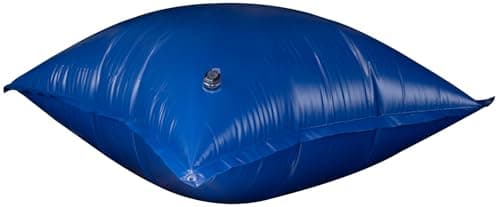
Stopping ice from pushing on the wall
Winter Air Pillow for Above-Ground Pools
Various
A few dollars of inflatable that gives expanding ice something compressible to push against instead of your pool wall. In a freezing climate this is not optional.
#ad how this is funded · price as of October 8, 2026
Key specs
- Function
- Absorbs ice expansion; centers the load away from the wall
- Inflation
- Inflate to roughly 60% — a fully inflated pillow bursts
- Placement
- Centered under the winter cover
How it scoresour reading of published specs, not a test result
- Retention
- 8.0
- Durability
- 6.5
- Handling
- 9.0
- Running cost
- 10.0
- Value
- 9.0
Overall 8.4 / 10
What works
- Extremely cheap relative to the wall or liner it protects
- Also stops rainwater and snowmelt pooling in the center of the cover
- Reusable for several winters if it survives one
What doesn't
- Cheap ones deflate mid-winter, which is when it matters
- Must be tethered or it drifts to the edge and does nothing
- Over-inflating is the most common mistake and it destroys the pillow
Skip it if: Climates that do not freeze. If your water never ices over, this is solving a problem you do not have.
What it costs to run: The cheapest insurance in this entire site against the most expensive winter failure. Inflate to about 60% and tether it.
One honest season: The cheapest setup that genuinely works for a season of real swimming. Nothing spare, nothing missing.
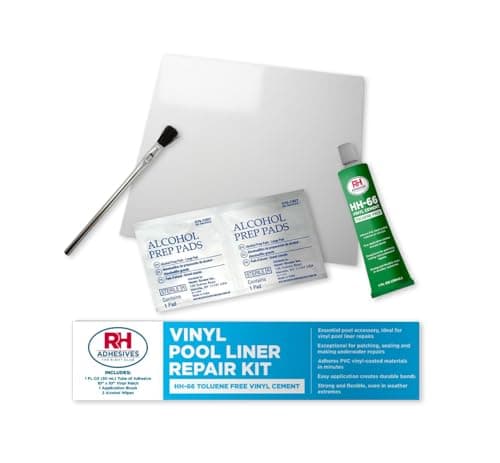
Not throwing away a float over one hole
Vinyl Repair Patch Kit
Various
A few dollars of adhesive patches that turn most float failures into a ten-minute fix. The reason people replace floats annually is usually that they did not own one of these.
#ad how this is funded · price as of October 8, 2026
Key specs
- Use
- Vinyl floats, liners, air beds
- Requirement
- Surface must be clean and fully dry
- Cure
- Follow the kit — most need hours before re-inflating
How it scoresour reading of published specs, not a test result
- Material
- 8.0
- Valve
- 8.0
- Capacity
- 7.0
- Storage
- 9.5
- Value
- 9.5
Overall 8.5 / 10
What works
- Fixes the dominant failure mode of the entire floats category
- Also patches a pinhole in a pool liner, which is a far more expensive save
- Lasts indefinitely in the shed
What doesn't
- Will not fix a split seam, only a puncture
- Needs a genuinely dry surface, which is inconvenient poolside
- Cheap kits use adhesive that fails after a season in the water
Skip it if: Seam failures and valve leaks. Those are the end of the float and no patch changes that.
What it costs to run: The highest-leverage few dollars in this hub: one saved float pays for it several times over, and one saved liner pays for it a hundred times over.
Several seasons: Buy-once. Built and warranted to come back out of the box for a few years, if you store it properly.
When the liner has failed, not before
Replacement Above-Ground Pool Liner
Various
The one repair that is genuinely worth doing rather than replacing the whole pool, provided the frame is sound. Measure twice: liner fit is unforgiving.
Key specs
- Types
- Overlap, beaded and unibead — they are not interchangeable
- Measure
- Diameter and wall height, exactly
- Gauge
- Published in mil — thicker lasts longer and is harder to fit
How it scoresour reading of published specs, not a test result
- Retention
- 8.0
- Durability
- 8.0
- Handling
- 5.5
- Running cost
- 9.0
- Value
- 8.0
Overall 7.9 / 10
What works
- Far cheaper than replacing a pool whose frame is still good
- A thicker gauge liner outlasts the original on most budget kits
- Beaded liners can be replaced without dismantling the top rail
What doesn't
- Overlap, beaded and unibead are different fitting systems and buying the wrong one is a total loss
- Fitting is a warm-day job — cold vinyl will not stretch into place
- A liner failure often reveals a frame or base problem that caused it
Skip it if: A pool whose frame is corroded. Replacing the liner in a failing frame just moves the failure a few months out.
What it costs to run: The largest single unplanned expense of above-ground pool ownership, and it is mostly preventable: a ground cloth, a level base and a winter close done properly are what decide whether you ever buy one.
Several seasons: Buy-once. Built and warranted to come back out of the box for a few years, if you store it properly.
Questions people actually ask
Should I take my above-ground pool down for winter?
How do you store an above-ground pool liner?
Where should I drain my pool water?
Can you leave an above-ground pool up all winter?
Sources
Read next
- Closing, covering and opening againWinterizing, covers and spring opening - the four weeks of the year that decide whether you own a pool next summer.
- How to winterize an above-ground poolThe correct closing sequence, the freeze damage that ends pools, and why a cracked pump housing is entirely preventable.
- Opening an above-ground pool in springThe spring sequence in order, why cloudy water at opening is normal, and the two timing errors that cause green openings.
- Pool closing kits: buy one the first year, then stopWhat is in a closing kit, whether the bundle premium is justified, and how to buy separately once you know your water.
- How long an above-ground pool actually lastsRealistic lifespans by pool type, the four failure modes that account for nearly all of them, and the cheap items that add seasons.
- How to store pool floats so you are not rebuying them in MayThe end-of-season routine for inflatables and foam: drying properly, folding without creasing, and where to keep them so they survive winter.
- Liner replacement: the big occasional cost, and how to avoid itOverlap, beaded and unibead are not interchangeable - plus the three habits that decide whether you ever need a replacement.
- Where the pump spends the winterManufacturer instructions for draining and storing pumps and filters over winter, the plug conflict between makers, and how pool chemicals should be stored.
- Draining an above-ground pool, and the two ways it goes wrongWhen a partial drain is the only fix, why liner makers say never to empty a vinyl pool, and the discharge rules that decide where the water may legally go.