Seasonal Care
A heatwave attacks a small pool from three directions at once
Chlorine burns off faster, water evaporates faster, and algae grows faster - all in the week when the pool is getting the heaviest use it will see all year.

Heads up: we earn a commission if you buy through the links on this page, at no extra cost to you. It never decides the ranking — here is how we pick and here is the full disclosure. Prices are checked automatically; last verified October 8, 2026.
The short version
- Three effects arrive together — faster chlorine loss, faster evaporation, faster algae growth — in the week of heaviest use.
- Cyanuric acid is what decides whether you cope. Unstabilized chlorine in full sun can be largely gone by evening.
- Evaporation drops the level, and the skimmer stops working before anyone notices the pool got shallower.
- Cover it at night, not in the day. In a heatwave the cover is doing evaporation control rather than heating.
Effect one: chlorine goes faster
Two mechanisms stack. Ultraviolet light destroys free chlorine, and hot water speeds up every reaction it takes part in — so the same dose that held all week in June is gone by Thursday in a heatwave.
Whether you cope with that comes down to one reading. Cyanuric acid is chlorine’s sunscreen, and a pool with none — a fresh fill, or one dosed only with liquid chlorine — can lose most of its free chlorine between morning and evening on a sunny day. A pool with stabilizer present holds it. Our cyanuric acid guide covers both ends of that, because too much is its own problem.
Practically: test daily rather than twice a week during the hot spell, keep the dispenser loaded so the level does not trough, and shock at dusk rather than midday, because sunlight destroys unstabilized chlorine quickly. The CDC publishes a minimum of at least 1 ppm free chlorine, or at least 2 ppm where a stabilizer is in use.
Effect two: the water level drops
Evaporation accelerates with temperature, sun and wind, and on a shallow pool with a large surface area relative to its volume it is noticeable within days.
The consequence people miss is not the water, it is the skimmer. It only works at about the middle of its opening; below that it starts drawing air, and the pump can lose prime entirely. So a hot week quietly degrades your filtration at exactly the moment demand is highest. Check the level daily during a heatwave — it takes ten seconds and it is the most valuable of these checks. Our skimmer guide covers the operating window.
Every gallon you add also dilutes chlorine, stabilizer and alkalinity, so a week of heavy top-ups is a week of drifting chemistry. Test after topping up rather than assuming, and at the national average of $6.06 per 1,000 gallons the water itself is a trivial cost — it is the re-balancing that takes the attention.
Effect three: algae gets its best week of the year
Warm water, strong light and a sanitizer under pressure is the combination algae is waiting for. And because the water can stay clear while a biofilm establishes, the first visible sign is often several days after the conditions changed.
Brushing is the cheap defense here, and specifically brushing the shaded, low-circulation areas where it establishes first. Our algae guide covers a bloom in progress, and the mustard algae guide covers the yellow variant that tolerates normal chlorine levels and hides in exactly those spots.
| Job | Normal | Heatwave |
|---|---|---|
| Test the water | Twice a week | Daily |
| Check the water level | Weekly | Daily |
| Brush the walls | Weekly | Every two or three days |
| Cover the pool | Overnight for heat | Overnight for evaporation |
| Shock | As needed | After every busy day, at dusk |
| Pump run time | One to two turnovers | Toward the upper end |
The cover, used the other way round
In spring and autumn a solar cover is a heater: it holds warmth the pool would otherwise lose overnight. In a heatwave that is not what you want it for — the pool is warm enough and the job is stopping evaporation.
So the pattern flips. Cover it overnight and whenever the pool is unused during the hottest part of the day, which reduces both water loss and the debris load. Take it off when people are swimming, obviously. And if the pool is becoming uncomfortably warm, leaving it uncovered overnight is a legitimate way to shed heat — the opposite of the advice in our season extension guide, for the opposite reason.
The pump: more hours, in daylight
Circulation is doing more work in a heatwave, both in distributing what you add and in keeping the surface moving into the skimmer. Push toward the upper end of your turnover range — one to two turnovers a day, computed as gallons divided by your pump’s published system flow rate.
Run those hours during the day rather than overnight, because demand is highest when the sun is on the water and people are in it. At the EIA US residential average of 18.34 cents per kWh, an extra hour a day on a 300 W pump is about $6.60 across a whole season, so a week of extra hours is pennies — this is not the place to economize. Our run-time guide has the arithmetic.
Afterwards
A heatwave leaves a pool depleted in a specific pattern: chlorine low, stabilizer possibly climbed if you dosed heavily with tablets, cartridge loaded, and a fine biofilm on surfaces that never quite became visible.
That is exactly the state our midsummer reset is designed to clear: test everything, brush thoroughly, replace the cartridge, drain a third if stabilizer has climbed, re-balance in order and shock at dusk. Doing it in the week after a hot spell rather than waiting for something to go wrong is what keeps the rest of the season easy.
What to buy
Scores are our own reading of published specifications. They are not test results — we have not tested these products and we do not claim to.
The default first test kit
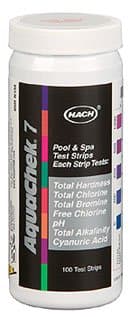
AquaChek Silver 7-Way Test Strips (100 count)
AquaChek
Seven readings in fifteen seconds, including the two that beginners never measure and then fight all summer: total alkalinity and cyanuric acid.
#ad how this is funded · price as of October 8, 2026
Key specs
- Tests
- Free chlorine, total chlorine, bromine, pH, total alkalinity, total hardness, cyanuric acid
- Free chlorine range
- 0-20 ppm
- pH range
- 6.2-8.4
- Total alkalinity range
- 0-240 ppm
- Cyanuric acid range
- 0-300 ppm
- Read time
- 15 seconds
- Count
- 100 strips
How it scoresour reading of published specs, not a test result
- Accuracy
- 7.0
- Ease
- 9.5
- Coverage
- 9.5
- Cost per use
- 9.0
- Value
- 9.2
Overall 8.9 / 10
What works
- Covers cyanuric acid, which most cheap strips omit and which is the reason chlorine stops working in a stabilized pool
- pH range spans 6.2-8.4, comfortably bracketing the CDC's recommended 7.0-7.8
- 15 seconds and a color chart printed on the bottle — no separate booklet to lose
- 100 strips is a full season of twice-weekly testing with room to spare
What doesn't
- Strips are a comparison against a printed color chart, so they are directional rather than precise
- Reading them in bright sun is harder than it should be
- The bottle must be kept sealed and dry or the strips degrade quietly
Skip it if: Fine adjustment. If you are chasing a stubborn problem and need a number rather than a color band, a liquid reagent kit is the tool.
What it costs to run: 100 strips at twice-weekly testing covers roughly two seasons for one pool. The real saving is upstream: knowing your alkalinity stops you buying pH adjuster you did not need.
One honest season: The cheapest setup that genuinely works for a season of real swimming. Nothing spare, nothing missing.
Specs from: CDC — home pool and hot tub water treatment and testing
Actually clearing a green pool
Calcium Hypochlorite Pool Shock
Various (compare available chlorine %)
Unstabilized, fast-acting and strong. This is the tool for an algae bloom precisely because it does not add more cyanuric acid to a pool that probably already has too much.
Key specs
- Type
- Calcium hypochlorite, unstabilized
- Adds stabilizer
- No
- Adds
- Calcium hardness
- Dosing
- By pool volume, per the bag
How it scoresour reading of published specs, not a test result
- Effectiveness
- 9.5
- Ease
- 6.5
- Water impact
- 7.0
- Cost per season
- 9.0
- Value
- 8.8
Overall 8.6 / 10
What works
- No cyanuric acid added, so it does not worsen the problem it is usually solving
- Fast and strong enough to actually break an algae bloom in one treatment when dosed properly
- Cheap per pound of available chlorine
What doesn't
- Adds calcium hardness, which matters in hard-water areas
- Must be dissolved properly or it will bleach a vinyl liner where it settles
- Needs careful storage — it is a genuine oxidizer, not a household product
Skip it if: Routine daily chlorination. This is the emergency tool; tablets are the routine.
What it costs to run: The single most cost-effective way to fix a green pool, and the most commonly under-dosed. Half a dose twice does not equal a full dose once — it just wastes the bag.
One honest season: The cheapest setup that genuinely works for a season of real swimming. Nothing spare, nothing missing.
Making tablets work properly
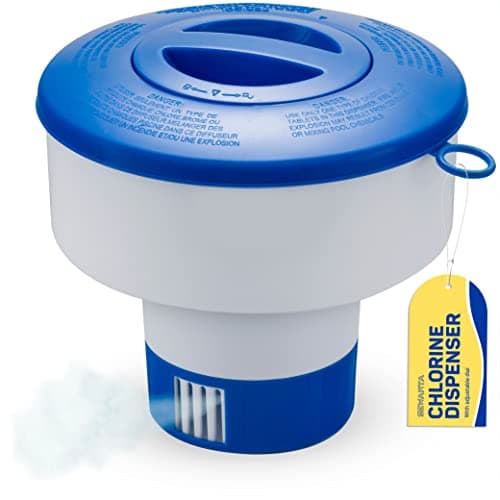
Floating Chlorine Tablet Dispenser
Various
Two dollars of plastic that decides whether your chlorine dissolves evenly over days or sits in a corner bleaching your liner. Buy it with the tablets, not after.
#ad how this is funded · price as of October 8, 2026
Key specs
- Function
- Holds 3-inch tablets, meters dissolution rate
- Adjustment
- Vented base, adjustable on most models
- Compatibility
- Standard 3-inch tablets
How it scoresour reading of published specs, not a test result
- Effectiveness
- 8.0
- Ease
- 9.5
- Water impact
- 9.0
- Cost per season
- 9.8
- Value
- 9.5
Overall 9.0 / 10
What works
- Adjustable venting lets you slow or speed dissolution to match the weather
- Keeps tablets off the liner, which is what causes bleach spots
- Trivially cheap and lasts years
What doesn't
- Drifts to one end of the pool in wind, so distribution is uneven without circulation
- Must be removed before swimming with small children
- Cheap ones crack after a season in UV
Skip it if: Being left in an empty or unfiltered pool. Without circulation it creates a concentrated pocket rather than an even dose.
What it costs to run: The cheapest item on this site and one of the highest-return: even dissolution means you use fewer tablets to hold the same free chlorine level.
One honest season: The cheapest setup that genuinely works for a season of real swimming. Nothing spare, nothing missing.
The single highest-return accessory here
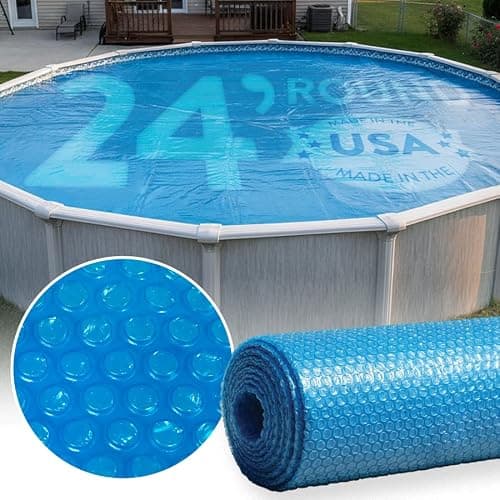
Bubble Solar Cover for Above-Ground Pools
Various
It cuts evaporation, and evaporation is simultaneously your water bill, your chemical bill and your heat loss. Nothing else on this site reduces three costs at once.
#ad how this is funded · price as of October 8, 2026
Key specs
- Construction
- Bubble sheet, thickness published in mil
- Thickness
- Higher mil lasts longer — 12 mil and 16 mil are common
- Fit
- Cut to size; buy oversize and trim
- Orientation
- Bubbles face down, toward the water
How it scoresour reading of published specs, not a test result
- Retention
- 9.0
- Durability
- 7.0
- Handling
- 6.0
- Running cost
- 9.8
- Value
- 9.5
Overall 9.0 / 10
What works
- Reduces evaporation, which is the mechanism behind the water, chemical and heat savings all at once
- Cheap relative to everything it saves
- Can be cut to fit any pool shape, so sizing is forgiving
What doesn't
- Awkward to get on and off without a reel, and awkward is how covers end up unused
- Degrades in UV like every vinyl product
- Not a safety cover and will not support weight — this is important
Skip it if: Being a safety barrier. A solar cover looks solid and is not; a child or pet on it goes through and under.
What it costs to run: The one accessory with a clear payback. Every gallon that does not evaporate is a gallon you do not replace at the EPA WaterSense national average of $6.06 per 1,000 gallons, and it is chlorine you do not re-dose. If you buy one thing from this hub, buy this.
Several seasons: Buy-once. Built and warranted to come back out of the box for a few years, if you store it properly.
Specs from: EPA WaterSense — cost per 1,000 gallons
Cutting the electricity bill without cutting filtration
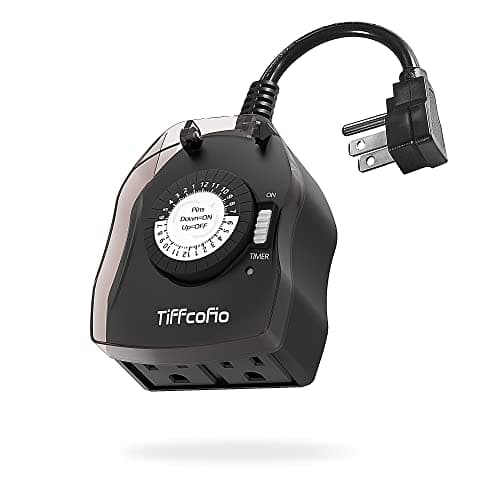
Outdoor Pool Pump Timer
Various
A weatherproof outdoor timer is the highest-return equipment purchase on this site. Most people run the pump too long because remembering to switch it off is a chore.
#ad how this is funded · price as of October 8, 2026
Key specs
- Type
- Outdoor-rated mechanical or digital timer
- Required rating
- Must be rated for the pump's amperage and for outdoor use
- Must not defeat
- The pump's GFCI protection
How it scoresour reading of published specs, not a test result
- Sizing fit
- 8.5
- Running cost
- 9.8
- Maintenance
- 9.0
- Build
- 7.5
- Value
- 9.5
Overall 9.0 / 10
What works
- Turns your filtration from a guess into a schedule
- Pays for itself within a single season on most pools
- Lets you shift running hours to off-peak if your utility has time-of-use rates
What doesn't
- Must be genuinely outdoor-rated and correctly amperage-matched, which cheap indoor timers are not
- Never bypass or defeat the pump's GFCI to fit one
- Mechanical timers drift and need resetting after a power cut
Skip it if: Fixing an undersized pump. Running the wrong pump on a schedule just makes the schedule longer.
What it costs to run: The arithmetic that justifies it: at the EIA's June 2026 US residential average of 18.34 cents per kWh, trimming a 400 W pump from 12 hours to 8 hours a day across a 120-day season saves 192 kWh, or about $35. That is more than the timer costs.
Several seasons: Buy-once. Built and warranted to come back out of the box for a few years, if you store it properly.
Specs from: EIA Electric Power Monthly, Table 5.6.A
Questions people actually ask
Why does my pool lose chlorine so fast in hot weather?
Should I cover my pool during a heatwave?
How often should I test pool water in hot weather?
Can you cool down an above-ground pool?
Sources
Read next
- Closing, covering and opening againWinterizing, covers and spring opening - the four weeks of the year that decide whether you own a pool next summer.
- The midsummer reset, and the drift it fixesThe four things that drift by midsummer, and the one-afternoon reset that gets the second half of the season back to week-one effort.
- Adding weeks to the season, starting with the cheapest thing firstCover, placement and timing before hardware, plus the kilowatt arithmetic that shows what running an electric heater actually costs.
- Cyanuric acid: the reading that explains your chlorineWhy an outdoor pool needs stabilizer, why tablets add it whether you want them to or not, and the only way to bring it back down.
- Bather load: the variable that explains your worst weeksWhy gallons per swimmer is the number that matters, what a busy afternoon costs you in chlorine, and the routine that absorbs it.
- Pool algae: brush, shock, filter, then rebalanceThe correct order for clearing green water, how to tell algae from pollen, and why algaecide prevents rather than cures.
- What it costs to fill a pool, and to keep it fullOne fill priced for four common pool volumes at the national average water rate, plus why every gallon you add has to be re-balanced.
- How long to run the pump, worked out rather than repeatedRun time derived from your own turnover time, when in the day to run it, and what each hour a day costs across a season.