Seasonal Care
How to winterize an above-ground pool
Closing badly is the most expensive mistake a first-year owner makes, and the consequences arrive six months later when it is far too late to fix.
Heads up: we earn a commission if you buy through the links on this page, at no extra cost to you. It never decides the ranking — here is how we pick and here is the full disclosure. Prices are checked automatically; last verified October 18, 2026.
The short version
- Cold water first. Closing a warm pool is how a clean pool becomes a swamp by April.
- Balance before you close, not after. Unbalanced water sitting still for five months stains and corrodes.
- Drain the pump completely. A cracked housing from trapped freezing water is the most common winter loss and takes ten minutes to prevent.
- A winter cover is not a solar cover. Using the wrong one is a common and expensive substitution.
Why this afternoon matters more than any other
A seasonal pool spends more of the year closed than open, and almost every expensive failure happens during the closed part. The pattern is consistent: nothing appears to go wrong in October, and in April the liner is cracked, the pump housing has split, or the water is unrecoverable.
None of those is difficult to prevent. All of them are impossible to fix afterwards. That asymmetry is why closing deserves a careful afternoon rather than a rushed hour.
The sequence, and why the order matters
Most closing failures are sequence errors rather than knowledge failures. The full step list is below; three points deserve emphasis.
Wait for genuinely cold water
Chlorine is consumed faster in warm water and algae grows in it. A pool closed while the water is still warm has months of biological activity under a cover with no filtration and no fresh sanitizer. Wait for consistently cold water rather than the first cold week — a warm spell after you close is worse than closing two weeks later.
Balance before, not after
Water sitting still for five months at the wrong pH is water working slowly against your liner and fittings the entire time. Set alkalinity, then pH into the CDC’s published 7.0–7.8 range, then chlorine, before the cover goes on. Detail in pH and alkalinity.
Drain the equipment completely
This is the ten-minute step that prevents the single most common winter loss. Water trapped in a pump housing, a filter body or a hose expands when it freezes, and the housing cracks. Disconnect everything, drain it, and store it somewhere that does not freeze. There is no chemical or cover that compensates for skipping this.
The steps in full
Wait for cold water
Consistently cold, not one cold week. A warm spell after closing is worse than closing later.Deep clean
Skim, brush every surface including the waterline, vacuum the floor. Organic material left in the pool feeds algae all winter.Balance the chemistry
Alkalinity, then pH into the CDC's 7.0–7.8 range, then chlorine. Test rather than assume — this is the last reading you will take for months.Add winterizing chemicals
A polyquat algaecide and an oxidizer, dosed for your actual volume, with the pump running. A closing kit bundles these and is worth the small premium the first year.Run the filter for a few final hours
So the winterizing chemicals distribute fully before circulation stops for the season.Lower the water to the stated level
Your manufacturer publishes a winter water level. Follow theirs rather than a general rule — it differs by pool type and wall height.Disconnect and drain all equipment
Pump, filter, every hose. Tip them, shake them, and store somewhere that does not freeze. This is the step that prevents the most common winter loss.Fit and secure the winter cover
A winter cover, not a solar cover. Secure with its cable and winch or straps so wind cannot lift it, with enough slack to sit on the water rather than stretch across it.Float an air pillow, if you freeze
Inflated to about 60 percent and tethered in the center. Expanding ice pushes against the pillow rather than the wall. Over-inflating bursts it, which is the most common mistake here.Check on it through the winter
Clear standing water and heavy snow off the cover. Accumulated weight is what tears covers, and a torn cover in January means a green pool in April.
Soft-side pools: a different answer
If you have an inflatable or a small soft-side pool, none of the above applies in the same way. Empty it, dry it thoroughly, fold it and store it indoors. A soft-side pool left up through a freezing winter is a pool you are gambling with, and the odds are poor.
Dry is the operative word. A pool folded away damp develops mildew along the folds, which weakens the material exactly where it is already stressed. Give it a genuinely dry day.
What closing costs
The chemicals are modest — a closing kit plus the cover, which is a multi-season purchase. The water you lower is real but small at the national average of $6.06 per 1,000 gallons. The full picture is in the annual cost guide, which includes closing and opening as line items most budgets leave out entirely.
Set against that: the cost of a new pump, or a new liner, or a spring recovery that takes a full shock treatment and a week of continuous filtration. Closing properly is the cheapest insurance available in pool ownership.
If you would rather buy the chemistry as one box, our winterizing kit roundup covers what is actually inside one, how to size it to your real gallons, and the three things every kit leaves out.
Two items in that sequence have their own pages. Our skimmer gizzmo and plug roundup covers the sacrificial part that crushes so your skimmer does not, and our pool antifreeze guide covers what to do about plumbing you could not fully drain — including the case, common here, where you do not need any.
What to buy
Scores are our own reading of published specifications. They are not test results — we have not tested these products and we do not claim to.
A first close, when you do not know what you need
Pool Winterizing / Closing Chemical Kit
Various
A box with the closing chemicals pre-matched to a pool size. Worth the small premium the first year purely because the failure mode of buying separately is missing one thing on the day.
Key specs
- Typically contains
- Winter algaecide, shock or oxidizer, and a stain/scale preventer
- Sized by
- Pool volume in gallons — buy to your actual number
- Timing
- Applied at closing, with the pump running, before covering
How it scoresour reading of published specs, not a test result
- Retention
- 8.0
- Durability
- 8.0
- Handling
- 9.0
- Running cost
- 7.5
- Value
- 8.0
Overall 8.0 / 10
What works
- Pre-matched to a volume, so the dosing decision is made for you
- Nothing missing on closing day, which is the actual value
- Polyquat-based kits avoid the liner-staining risk of copper algaecides
What doesn't
- Costs more than the same chemicals bought individually
- Kits are sized in broad volume bands, so you may be over-treating
- Some kits include products a small seasonal pool genuinely does not need
Skip it if: Year two onward. Once you know what your water actually does over a winter, buying the two things you need is cheaper.
What it costs to run: Pay the premium in year one and buy separately afterward. The kit's real value is that it prevents the expensive mistake of closing a pool with something missing.
One honest season: The cheapest setup that genuinely works for a season of real swimming. Nothing spare, nothing missing.
Five months of weather, not one night
Winter Cover for Above-Ground Pools
Various
A structural product, not a summer one. Its job is carrying snow and blocking light for a whole winter, and a solar cover pressed into that role will be in shreds by February.
Key specs
- Construction
- Woven polyethylene, weight published in mil or scrim count
- Securing
- Cable and winch, or wraparound straps
- Overlap
- Needs genuine overlap past the wall — check the stated size against your pool
- Not the same as
- A solar cover or a safety cover
How it scoresour reading of published specs, not a test result
- Retention
- 8.5
- Durability
- 8.0
- Handling
- 6.5
- Running cost
- 9.0
- Value
- 8.5
Overall 8.3 / 10
What works
- Blocks light for the whole winter, which is what stops algae in a closed pool
- Cable-and-winch securing survives wind that lifts a strapped cover
- Buying the heavier scrim genuinely doubles the number of winters you get
What doesn't
- Needs a way to shed or pump off standing water, or the weight tears it
- Bulky to store in summer
- Not a safety cover — it will not support a person and must not be treated as if it will
Skip it if: A pool you take down each autumn. If the pool comes apart, the cover is money spent on nothing.
What it costs to run: This is insurance rather than a saving. A torn cover in January means an opening in April that costs a full shock treatment and a week of filtration to fix, which is more than the better cover cost.
Several seasons: Buy-once. Built and warranted to come back out of the box for a few years, if you store it properly.
Stopping ice from pushing on the wall
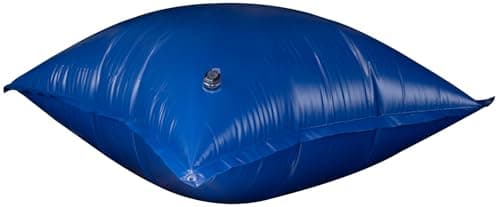
Winter Air Pillow for Above-Ground Pools
Various
A few dollars of inflatable that gives expanding ice something compressible to push against instead of your pool wall. In a freezing climate this is not optional.
#ad how this is funded · price as of October 18, 2026
Key specs
- Function
- Absorbs ice expansion; centers the load away from the wall
- Inflation
- Inflate to roughly 60% — a fully inflated pillow bursts
- Placement
- Centered under the winter cover
How it scoresour reading of published specs, not a test result
- Retention
- 8.0
- Durability
- 6.5
- Handling
- 9.0
- Running cost
- 10.0
- Value
- 9.0
Overall 8.4 / 10
What works
- Extremely cheap relative to the wall or liner it protects
- Also stops rainwater and snowmelt pooling in the center of the cover
- Reusable for several winters if it survives one
What doesn't
- Cheap ones deflate mid-winter, which is when it matters
- Must be tethered or it drifts to the edge and does nothing
- Over-inflating is the most common mistake and it destroys the pillow
Skip it if: Climates that do not freeze. If your water never ices over, this is solving a problem you do not have.
What it costs to run: The cheapest insurance in this entire site against the most expensive winter failure. Inflate to about 60% and tether it.
One honest season: The cheapest setup that genuinely works for a season of real swimming. Nothing spare, nothing missing.
Preventing algae, not curing it
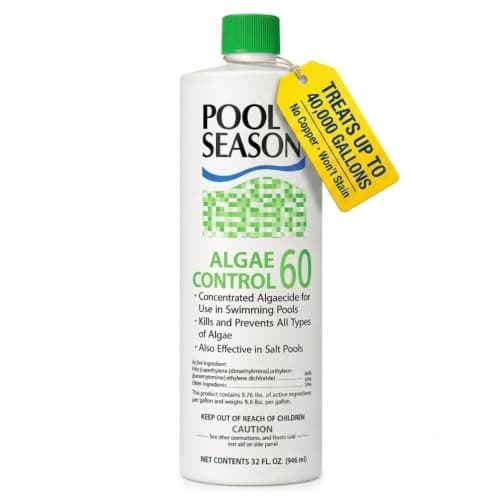
Pool Algaecide (polyquat 60)
Various
Polyquat is the non-foaming, non-staining choice and it is far better at stopping algae than at killing an established bloom. Use it as insurance and as part of closing.
#ad how this is funded · price as of October 18, 2026
Key specs
- Type
- Polyquaternium (polyquat 60)
- Foaming
- Non-foaming, unlike quat algaecides
- Metal content
- None, unlike copper-based algaecides
How it scoresour reading of published specs, not a test result
- Value
- 8.0
Overall 8.0 / 10
What works
- Does not foam, which the cheaper quat products do
- No copper, so no risk of the metal staining a vinyl liner
- The standard product in a winterizing routine, for good reason
What doesn't
- Poor at killing an established bloom — shock does that job
- More expensive than copper-based alternatives
- Easy to over-rely on instead of maintaining chlorine
Skip it if: Rescuing a green pool. Brush and shock first; algaecide is what stops it coming back.
What it costs to run: One of the few chemicals where buying the better version is clearly right — a copper algaecide that stains a liner costs vastly more than the few dollars it saved.
One honest season: The cheapest setup that genuinely works for a season of real swimming. Nothing spare, nothing missing.
The default first test kit
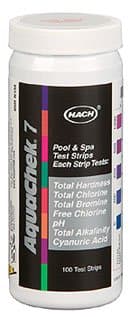
AquaChek Silver 7-Way Test Strips (100 count)
AquaChek
Seven readings in fifteen seconds, including the two that beginners never measure and then fight all summer: total alkalinity and cyanuric acid.
#ad how this is funded · price as of October 18, 2026
Key specs
- Tests
- Free chlorine, total chlorine, bromine, pH, total alkalinity, total hardness, cyanuric acid
- Free chlorine range
- 0-20 ppm
- pH range
- 6.2-8.4
- Total alkalinity range
- 0-240 ppm
- Cyanuric acid range
- 0-300 ppm
- Read time
- 15 seconds
- Count
- 100 strips
How it scoresour reading of published specs, not a test result
- Value
- 9.2
Overall 8.9 / 10
What works
- Covers cyanuric acid, which most cheap strips omit and which is the reason chlorine stops working in a stabilized pool
- pH range spans 6.2-8.4, comfortably bracketing the CDC's recommended 7.0-7.8
- 15 seconds and a color chart printed on the bottle — no separate booklet to lose
- 100 strips is a full season of twice-weekly testing with room to spare
What doesn't
- Strips are a comparison against a printed color chart, so they are directional rather than precise
- Reading them in bright sun is harder than it should be
- The bottle must be kept sealed and dry or the strips degrade quietly
Skip it if: Fine adjustment. If you are chasing a stubborn problem and need a number rather than a color band, a liquid reagent kit is the tool.
What it costs to run: 100 strips at twice-weekly testing covers roughly two seasons for one pool. The real saving is upstream: knowing your alkalinity stops you buying pH adjuster you did not need.
One honest season: The cheapest setup that genuinely works for a season of real swimming. Nothing spare, nothing missing.
Specs from: CDC — home pool and hot tub water treatment and testing
Questions people actually ask
When should I close my above-ground pool for winter?
Do I need to drain my above-ground pool for winter?
Can I use a solar cover as a winter cover?
Why do I need an air pillow under my pool cover?
Sources
Read next
- Closing, covering and opening againWinterizing, covers and spring opening - the four weeks of the year that decide whether you own a pool next summer.
- The best winter covers for an above-ground poolScrim weight, cable-and-winch versus straps, and the overlap you need - the three specs that decide whether a cover survives a winter.
- Pool closing kits: buy one the first year, then stopWhat is in a closing kit, whether the bundle premium is justified, and how to buy separately once you know your water.
- Opening an above-ground pool in springThe spring sequence in order, why cloudy water at opening is normal, and the two timing errors that cause green openings.
- Liner replacement: the big occasional cost, and how to avoid itOverlap, beaded and unibead are not interchangeable - plus the three habits that decide whether you ever need a replacement.
- The air pillow is structural, not paddingWinter air pillows compared on size, published vinyl gauge and pool ratings, with the inflation guidance that makes them work and the conflicts between listings.
- Where the pump spends the winterManufacturer instructions for draining and storing pumps and filters over winter, the plug conflict between makers, and how pool chemicals should be stored.
- A cold climate does not stop you owning a pool. It picks which one.How a freezing winter changes the buying decision: which pools manufacturers allow to stay up, which must be drained and stored, and the closing kit that protects either.
- What closing an above-ground pool costsPublished closing-service prices compared against the DIY list, with the part of the bill that recurs separated from the part that amortizes.