Above-Ground Pools
What size pool your backyard can actually take
Measure the flattest rectangle you have, subtract the walking space, and buy what is left. Almost every first-pool regret starts with skipping that.
Heads up: we earn a commission if you buy through the links on this page, at no extra cost to you. It never decides the ranking — here is how we pick and here is the full disclosure. Prices are checked automatically; last verified October 19, 2026.
The short version
- Add three feet of clear space on every side. A 15-foot pool needs a 21-foot square, not a 15-foot one.
- Ground must be level to within roughly one to two inches across the whole footprint.
- Size is a permanent decision about your annual bill, not a one-off premium. Gallons drive everything recurring.
- Wall height is not water depth. Intex publishes 23 inches of water in a 30-inch pool.
The three-foot rule
A pool needs more space than its diameter. You need room to walk around it, a place for the ladder, a spot for the pump within its cord length, and enough clearance to get a cover on and off without dragging it across a fence.
Three feet on every side is the working minimum. That means a 12-foot pool needs an 18-foot square, a 15-foot pool needs 21 feet, and an 18-foot pool needs 24 feet. Measure that before you shop, not after.
Find your flattest rectangle
Walk the yard and identify the area with the least slope. Not the biggest area — the flattest. Slope is the constraint that actually matters.Check how level it really is
Lay a long straight board across it with a spirit level on top, and check in several directions. You are looking for variation within one to two inches across the whole footprint.Subtract three feet on every side
Mark the walking space out with string or a hose. What is left inside is your maximum pool diameter.Check the pump can reach power
The pump's cord length, and the position of your outdoor outlet, frequently dictate where the pool goes more than the lawn does. Never use an unrated extension cord or defeat a GFCI to solve this.Now choose a size — and price the season
Take the diameter you arrived at and look up its capacity, then run it through the annual cost guide before buying. Gallons are a permanent commitment.
Yard size to pool size
| Pool | Clear space needed | Capacity | One fill |
|---|---|---|---|
| 10 ft round | 16 × 16 ft | Not published | ≈ $7 |
| 12 ft round (Prism Frame) | 18 × 18 ft | 1,718 gal | $10.41 |
| 15 ft round (Steel Pro MAX) | 21 × 21 ft | 3,955 gal | $23.96 |
| 18 ft round (Ultra XTR) | 24 × 24 ft | 6,981 gal | $42.30 |
Wall height is not water depth
A persistent source of disappointment. Pools are sold by wall height and filled below it — Intex publishes 23 inches of water in the 30-inch Easy Set, and Bestway publishes capacity at 90% full for the Steel Pro MAX. Expect roughly six to eight inches less water than the number on the box.
Practically: a 30-inch pool is thigh-deep on an adult, a 42-inch pool is waist-deep, and a 52-inch pool is chest-deep. If someone in the household wants to actually swim, that difference matters more than diameter does.
It also decides your gallons, which is the number every chemical dose you ever buy is calculated against. That turns out to be messier than it sounds — Intex publishes capacity at 80% full on one 12-foot pool and 90% on another the same size. Our guide to working out how many gallons your pool holds has the formula and the published figures side by side.
If the answer is “not much space”
It is a more workable answer than it sounds. A 10 or 12-foot pool in the right place beats a 15-foot pool wedged into a slope, and it is cheaper on every line forever. Read pools for small yards for the options, and setup for making a marginal patch of ground work.
What to buy
Scores are our own reading of published specifications. They are not test results — we have not tested these products and we do not claim to.
Small yards and first-time owners
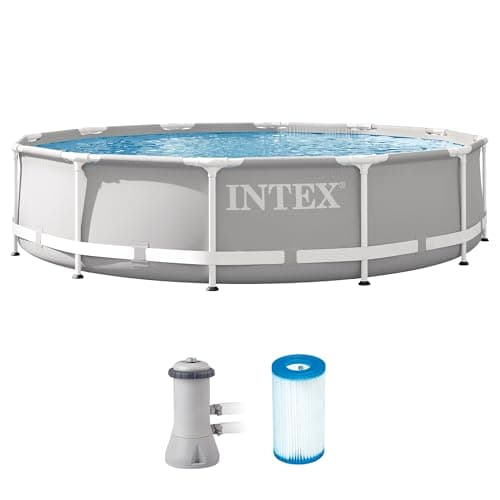
Intex Prism Frame Pool Set, 12ft x 30in
Intex
The size most people should buy first and the one most people talk themselves out of. 1,718 gallons is cheap to fill, cheap to treat, and forgiving of every mistake you are about to make.
Key specs
- Water capacity
- 1,718 gallons (90%), published by Intex
- Pump supplied
- Krystal Clear C530 — 530 GPH pump / 475 GPH system
- Frame
- Powder-coated metal, tool-free Easy Lock
- Liner
- 3-ply, puncture resistant
- Manufacturer setup claim
- Ready in 30 minutes
- Pump wattage
- Not published by Intex
How it scoresour reading of published specs, not a test result
- Build
- 7.0
- Setup
- 9.0
- Upkeep
- 9.0
- Running cost
- 9.0
- Value
- 9.0
Overall 8.6 / 10
What works
- A 12-foot circle fits in a yard where a 15 or 18 will not, once you allow three feet of walking space
- 1,718 gallons turns over in about 3.6 hours on the supplied 475 GPH system flow — so a short daily run genuinely filters it
- Cheapest of the frame pools to make a mistake in: a bad chemical week costs a few dollars, not a few tens
- Tool-free assembly is real, not marketing — this is a genuinely one-afternoon job
What doesn't
- 30-inch wall means shallow water and it warms and cools fast
- Small enough that three adults fill it
- The C530 is sized for exactly this pool and nothing bigger, so it does not carry over if you upgrade
Skip it if: Anyone planning to swim rather than sit. This is a cooling-off and playing pool and it is very good at that.
What it costs to run: The cheapest frame pool here to run, and the gap is not small. At the EPA WaterSense average of $6.06 per 1,000 gallons a fill is about $10. Its turnover math — 1,718 gallons at 475 GPH system flow — means roughly 3.6 hours per full turnover, so a 7-8 hour daily run is two full turnovers rather than a partial one.
One honest season: The cheapest setup that genuinely works for a season of real swimming. Nothing spare, nothing missing.
Specs from: Intex — Prism Frame 12' x 30' pool set, Intex — Krystal Clear cartridge filter pumps
The honest middle of the market
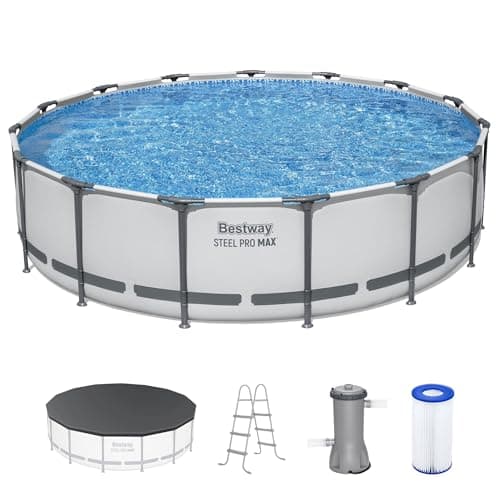
Bestway Steel Pro MAX Pool Set, 15ft x 42in
Bestway
Fewer gallons and a shallower wall than the Intex flagship, which makes it easier to level, cheaper to fill and cheaper to keep clean. For most first-pool families this is the right size, not the compromise size.
#ad how this is funded · price as of October 19, 2026
Key specs
- Water capacity
- 3,955 gallons (90% full)
- Pump supplied
- 1,000 gal filter pump, Type III cartridge
- Liner
- Tritech 3-layer
- Included
- Ladder and cover
- Wall height
- 42 inches
- Pump wattage
- Not published by Bestway (US listing)
How it scoresour reading of published specs, not a test result
- Build
- 7.5
- Setup
- 8.0
- Upkeep
- 8.0
- Running cost
- 7.5
- Value
- 8.8
Overall 8.2 / 10
What works
- 3,955 gallons is roughly 43% less water than the 18ft Intex — that is 43% less chemical spend, every season, forever
- 42-inch wall is far more forgiving of a yard that is nearly-but-not-quite level
- Ladder and cover included
- Cartridge filtration means no sand to buy or change
What doesn't
- Cartridges are a recurring consumable, and in a busy pool you will rinse one weekly
- 42 inches is shallow for adults who want to actually swim rather than sit
- Wattage is not published, so the running-cost math needs the label on the box
Skip it if: Adults who want to swim lengths. At 42 inches you are sitting in it, not swimming in it.
What it costs to run: The gallons are the story. Chemical dosing scales with volume, so 3,955 gallons costs meaningfully less to sanitize all season than 6,981 does. Filling it once at the EPA WaterSense national average of $6.06 per 1,000 gallons is about $24 of water; the same fill on the 18ft Intex is about $42.
Several seasons: Buy-once. Built and warranted to come back out of the box for a few years, if you store it properly.
Specs from: Bestway USA — Steel Pro MAX 15' x 42' pool set, EPA WaterSense — how the calculator works ($6.06 per 1,000 gallons)
A family that will still be using it in year three
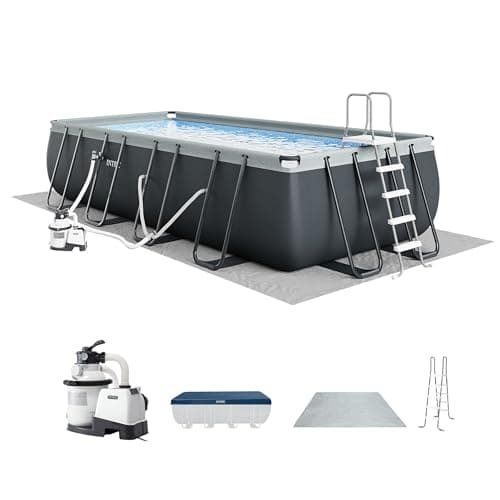
Intex Ultra XTR Frame Pool Set, 18ft x 52in
Intex
The biggest, sturdiest thing in this class that a homeowner can still put up in a weekend. It is also, by a wide margin, the most expensive one to run.
#ad how this is funded · price as of October 19, 2026
Key specs
- Water capacity
- 6,981 gallons; Intex publishes no fill percentage for this model
- Pump supplied
- 2,100 GPH sand filter
- Frame
- Galvanized steel, powder-coated inside and out
- Liner
- 3-ply, puncture and tear resistant
- Manufacturer setup claim
- Ready for water in 60 minutes
- Pump wattage
- Not published by Intex
How it scoresour reading of published specs, not a test result
- Build
- 9.0
- Setup
- 6.0
- Upkeep
- 7.5
- Running cost
- 5.0
- Value
- 8.5
Overall 8.4 / 10
What works
- 6,981 gallons is genuinely swimmable for adults, not just a cooling-off pool
- Sand filter rather than a cartridge, so there is no cartridge to buy every few weeks
- Galvanized frame with inner and outer powder coating is the most corrosion-resistant construction in this price class
- Ships with the ladder, cover and ground cloth that cheaper kits make you buy separately
What doesn't
- 52 inches of wall on an 18-foot circle is a lot of water pressure — the ground under it has to be genuinely level
- Intex publishes flow rate but not wattage, so you cannot compute your running cost until the pump is in your hands
- Too heavy and too large to take down and put up casually
Skip it if: Your yard is not close to level, or you want a pool you can pack away mid-season. Nearly 7,000 gallons is not a thing you move.
What it costs to run: It is the most water in this roundup, so it is the most chemicals, the most evaporation and the largest pump. Using ENERGY STAR's own published figures for above-ground pool pumps (an ENERGY STAR model saves about $20 a year, being 11% more efficient), a standard above-ground pump implies roughly $182 a year in electricity — and that is before you scale for a 2,100 GPH sand filter running on a pool this size. Price the season before you price the pool.
Several seasons: Buy-once. Built and warranted to come back out of the box for a few years, if you store it properly.
Specs from: Intex — Ultra XTR Frame 18' x 52' specifications, ENERGY STAR — Pool Pumps
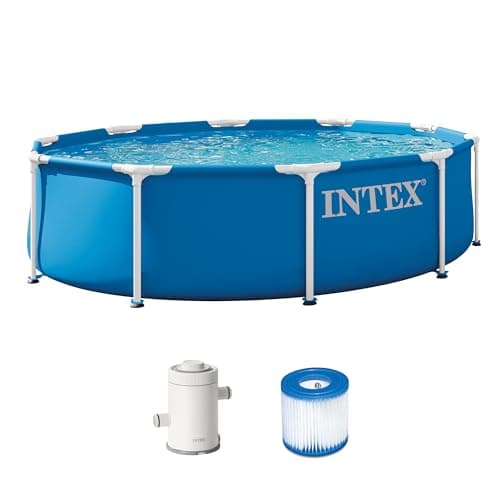
The smallest pool worth filtering
Intex Metal Frame Pool, 10ft x 30in
Intex
Below this size you are buying a paddling pool with a pump attached. At 10 feet you still get a real frame and real filtration, in a footprint that fits almost any yard.
#ad how this is funded · price as of October 19, 2026
Key specs
- Nominal size
- 10ft diameter x 30in wall
- Water capacity
- Not published on the current Intex spec page
- Frame
- Powder-coated steel
- Pump supplied
- Varies by SKU — check the box, not the listing photo
- Pump wattage
- Not published by Intex
How it scoresour reading of published specs, not a test result
- Build
- 6.5
- Setup
- 9.0
- Upkeep
- 9.0
- Running cost
- 9.5
- Value
- 8.0
Overall 7.8 / 10
What works
- Fits a genuinely small yard with walking space left over
- Small enough to drain, dry and store indoors in one afternoon at season's end
- Lowest chemical bill of anything with a real frame
What doesn't
- Intex does not publish a capacity figure for every variant of this size, which makes dosing guesswork until you measure it yourself
- Some SKUs ship without a pump and the listings do not always make that obvious
- Two adults is a crowd
Skip it if: Anything involving more than about three people at once, or an adult who wants to lie on a lounger in it.
What it costs to run: Cheapest thing here to own. If your SKU does not state gallons, measure it: a round pool is roughly diameter squared x average depth x 5.9 gallons, so a 10ft pool filled to 24 inches is about 1,180 gallons. Do that once and every chemical dose for the rest of the pool's life is correct.
One honest season: The cheapest setup that genuinely works for a season of real swimming. Nothing spare, nothing missing.
Specs from: Intex — above-ground pools
Questions people actually ask
What is a good size pool for a small backyard?
How much space do you need around an above-ground pool?
How deep is the water in a 52-inch above-ground pool?
Sources
Read next
- Above-ground pools for ordinary backyardsSoft-side, metal-frame and steel-wall pools compared by what they cost across a whole season, not at the till.
- Pools for a small yardRound versus rectangular in a narrow yard, the smallest sizes worth filtering, and why smaller is cheaper twice over.
- The best above-ground pools for an ordinary backyardFrame pools ranked on published specs and season running cost, from a 1,700-gallon first pool to a 7,000-gallon family one.
- How to set up an above-ground pool properlyLeveling, ground protection, filling and priming - the afternoon that decides how the rest of the season goes.
- What an above-ground pool actually costs to run for a yearElectricity, chemicals, water and consumables for a full season - every input sourced, every calculation shown, and every assumption named.
- The 24-foot pool, and the yard that has to hold it24 ft round pools from frame sets to steel-wall kits, compared on published gallons, what ships in the box, and the ground preparation the size actually demands.
- 12 feet or 15 feet: the step that doubles the waterThe 12-foot and 15-foot classes compared on published capacity, wall height, ground needed and what the extra water costs to fill and treat.
- How many gallons your pool holds, and why two of the same size disagreeThe number every chemical dose on this site depends on, and the published evidence that two pools of the same size can be 233 gallons apart on paper and 53 apart in reality.