Pool Care & Chemistry
Pool salt is a purity specification, not a brand
A salt cell is the expensive part of a salt system, and what you feed it decides how long it lasts. Two of the four bags here publish the purity figure the generator makers ask for.
Heads up: we earn a commission if you buy through the links on this page, at no extra cost to you. It never decides the ranking — here is how we pick and here is the full disclosure. Prices are checked automatically; last verified October 8, 2026.
Quick picks
Segmented before it is ranked — the right answer depends on which of these you actually are. Tap any row for the full write-up.
Highest published purity
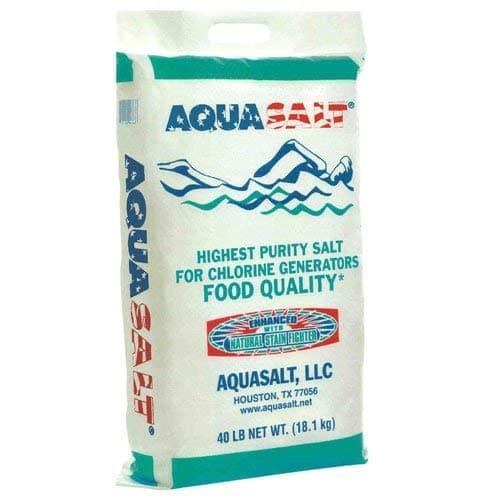
Evaporated, food-grade process, published at 99.9% sodium chloride, and packaged solely for chlorine generators.
| # | Product | Best for | Score | Price |
|---|---|---|---|---|
| 1 | AQUASALT Pool and Spa Chlorine Generator Salt, 40 lb Packaged solely for chlorine generators, evaporated rather than mined, and published at 99.9% sodium chloride. If your generator's manual demands 99.8% purity, this is the bag that documents it. | The highest published purityOne honest season | 8.6out of 10 |
The bag with the arithmetic on it
A full manufacturer data sheet, NSF certification, no additives, and the only published figure for how far one bag moves a 10,000 gallon pool.
| # | Product | Best for | Score | Price |
|---|---|---|---|---|
| 1 | 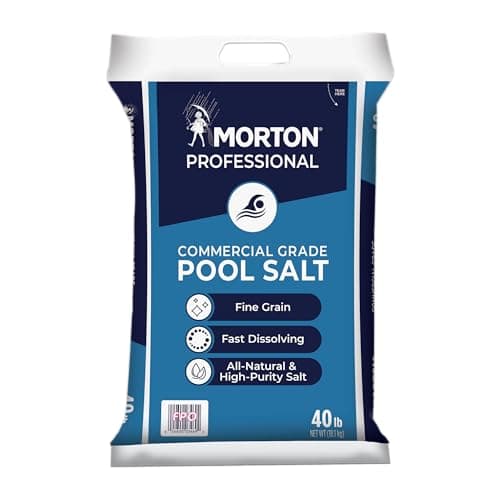 Morton Professionals' Choice Pool Salt, 40 lb A screened, fast-dissolving pool salt with a real product data sheet: 99% typical purity, NSF certified, no additives, and the only published figure for how far one bag moves your salinity. | The one that publishes ppm per bagOne honest season | 8.1out of 10 |
Available everywhere
Over 99% sodium chloride with no additives per Morton's safety data sheet, and usually the cheapest bag in the store.
| # | Product | Best for | Score | Price |
|---|---|---|---|---|
| 1 | 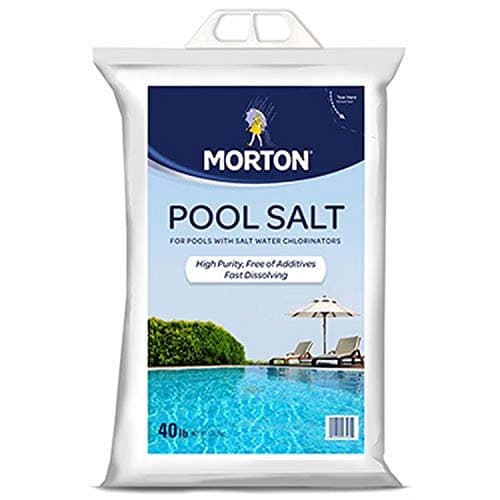 Morton Pool Salt, 40 lb High-purity sodium chloride with no additives, sold for pools and available everywhere. Morton publishes less about it than the specialist brands do, and defers the dose to your generator's maker. | The bag in every hardware storeOne honest season | 8.4out of 10 |
A published dose, mainstream distribution
Raises salinity by a stated 480 ppm per 10,000 gallons. Publishes nothing at all about purity, which is the specification that protects the cell.
| # | Product | Best for | Score | Price |
|---|---|---|---|---|
| 1 | 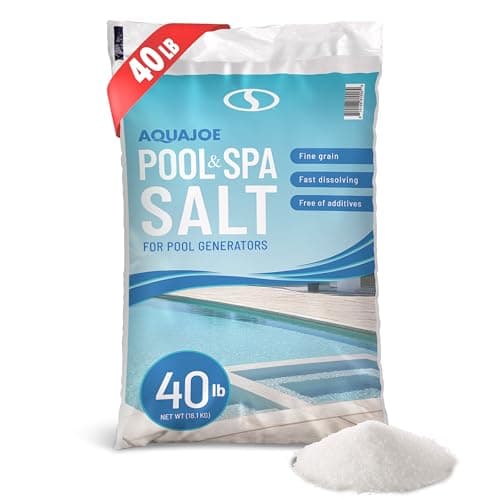 Aqua Joe Pool and Spa Salt for Chlorine Generators, 40 lb Fine-grain salt for chlorinated generator systems that publishes what a bag does to your salinity. It publishes nothing at all about purity, which is the specification generator makers care about. | A published dose, from a mainstream brandOne honest season | 7.8out of 10 |
The short version
- Generator makers specify purity, and they are strict. Pentair and Intex both ask for at least 99.8% pure sodium chloride.
- Anti-caking agents are the thing to avoid. Pentair names sodium ferrocyanide specifically and warns it can discolor fittings and finishes.
- Target salinity is not universal. Hayward publishes 2,700-3,400 ppm, Intex 2,500-3,500, and Pentair recommends 3,600. Dose to your own manual.
- One 40 lb bag adds about 480 ppm per 10,000 gallons — published by two of the four bags here, and the figure that makes dosing arithmetic.
Why the bag matters at all
A salt chlorine generator does not consume salt. It borrows it: the cell splits sodium chloride into chlorine, the chlorine sanitizes and then reverts to chloride, and the cycle repeats. You top up only for what leaves by splash-out, backwashing and rain overflow.
So the salt you add stays in the water for the whole season, and anything else in the bag stays with it. That is the entire argument for buying salt on its purity specification: the impurities do not get used up, and the cell is the expensive component they act on. Our salt systems guide covers how the cell works and what shortens its life.
What the generator makers actually require
This is not a question anyone needs to guess about, because three major manufacturers publish it. Pentair’s IntelliChlor guide asks for salt that is at least 99.8% pure NaCl, preferably evaporated, granulated, food quality and non-iodized with no additives, and warns specifically against anti-caking agents containing sodium ferrocyanide, against calcium or potassium chloride, and against rock salt.
Hayward’s Aqua Rite manual asks for greater than 99% pure sodium chloride and says plainly: do not use rock salt, salt with yellow prussiate of soda, salt with anti-caking additives, or iodized salt. Intex asks for at least 99.8% pure and warns against iodized and yellow-tinted salt.
Read against those requirements, the four bags here sort themselves. AQUASALT publishes 99.9% typical purity and an evaporated production process. Morton’s Professionals’ Choice data sheet publishes 99.00% typical — below what Pentair and Intex ask for, although it does state no additives and NSF certification. Morton Pool Salt’s safety data sheet says over 99% with no additives. Aqua Joe publishes no purity figure at all.
| Salt | Published purity | Additives | Production | ppm per bag |
|---|---|---|---|---|
| AQUASALT | 99.9% typical | Additive-free per distributor | Evaporated, food-grade process | Not published |
| Morton Professionals' Choice | 99.00% typical | States no additives; NSF certified | Rock, solar or vacuum pan | 480 ppm per 10,000 gal |
| Morton Pool Salt | Over 99% per safety data sheet | Common salt without additives | Not published | Not published |
| Aqua Joe | Not published | Not published | Not published | 480 ppm per 10,000 gal |
How much salt, and how to work it out
Two of the bags here publish the number that makes this arithmetic possible: one 40 lb bag raises salinity by about 480 ppm in 10,000 gallons. From that, and your target, the initial charge falls out.
Initial salt charge for a 10,000 gallon pool
- Target salinity, Hayward Aqua Rite optimum
- 3,200 ppm
- Starting salinity, fresh fill
- 0 ppm
- Published rise per 40 lb bag per 10,000 gal
- 480 ppm
3,200 ppm ÷ 480 ppm per bag = 6.7 bags ≈ 7 x 40 lb bags
About 270 lb of salt for the first fill
Three practical rules follow from that. Add salt with the pump running and brush it around rather than dumping it in one place. Give it time to dissolve fully before trusting a cell reading — Pentair notes its own salt sensor is accurate to within 500 ppm. And always aim slightly low: too little salt is a top-up, too much is a partial drain.
The targets are not the same, and that matters
The three manufacturers we checked publish genuinely different targets. Hayward’s ideal band is 2,700 to 3,400 ppm with 3,200 optimal. Intex publishes 3,000 ppm ideal within an operating range of 2,500 to 3,500. Pentair recommends 3,600 ppm for optimum water condition, turning off below 2,600 and warning about corrosion above 4,500.
Pentair’s recommended level sits above Hayward’s entire ideal band and above Intex’s operating ceiling. There is no universal correct salinity; there is only the figure in your own manual. Anyone quoting a single number for all salt pools is repeating folklore.
It is also worth knowing that salt becomes noticeable to taste at around 3,500 to 4,000 ppm per Hayward, which is well below seawater and part of why a salt pool feels softer rather than briny. Our salt versus chlorine comparison deals with what a salt pool actually is, which is a chlorine pool that makes its own chlorine.
Which bag to buy
If your manual specifies 99.8%: AQUASALT is the only bag here that documents it, at 99.9% typical with an evaporated process. That is the defensible choice for a Pentair or Intex system.
If you want the arithmetic printed on the bag: Morton’s Professionals’ Choice, which publishes both the ppm-per-bag figure and a full data sheet, and carries NSF certification. Note its published 99.00% typical purity against the 99.8% some manuals ask for.
If you need salt today: Morton Pool Salt, from the hardware store, with a safety data sheet confirming no additives. Check the bag says pool.
What we would avoid: any bag that publishes no purity figure at all. Not because it is necessarily bad salt, but because purity is the one specification that protects the cell, and a product that does not state it cannot be checked against your manual.
How we picked
We have not tested these salts. Scores are our reading of published specifications, weighted toward the makers who publish purity, additives and production method — the three things generator manuals actually specify. Where a retailer’s purity claim contradicts the manufacturer’s own data sheet, as it does for one product here, we have used the manufacturer’s figure and said so.
Why purity protects the part that costs money
A salt cell works by passing current through the water across titanium plates. Anything in the bag that is not sodium chloride ends up on or around those plates, and the plates are the expensive component — on most systems, replacing a cell costs a meaningful fraction of replacing the whole generator.
Pentair names the specific culprit rather than talking in generalities: anti-caking agents containing sodium ferrocyanide, also known as yellow prussiate of soda, which it warns can discolor fittings and surface finishes. It also rules out calcium chloride and potassium chloride as salt sources, and rock salt, on the grounds that insoluble impurities shorten cell life. Hayward’s manual bans the same list.
That is the whole case for reading the bag. Salt is cheap; cells are not; and the difference between a compliant bag and a non-compliant one is usually a couple of dollars. Our salt systems guide covers how the cell works and what else shortens its life.
Topping up, and where the salt actually goes
Salt is not consumed by chlorination, so an established pool needs far less than people expect. What it loses is water: splash-out, backwash water, a to-waste vacuum, rain overflowing the skimmer, and a partial drain. Every gallon that leaves takes its dissolved salt with it; evaporation does not, because the salt stays behind.
That gives a simple rule. Top up after anything that removes water, not on a calendar. A season with two backwashes and a wet August may need nothing at all; a season with a flocculant treatment and a partial drain to fix cyanuric acid will need a bag or two, as our draining guide explains.
Test before adding, every time. Cell readings drift, and Pentair notes its own salt sensor is accurate to within 500 ppm — which is a sixth of the whole working range. A strip or a meter costs less than a bag of salt, and our test strip roundup covers what to buy.
Too little, too much, and what each does
Both ends of the range have published consequences, and they are not symmetrical.
Too low and the cell stops. Pentair states that a concentration below 2,600 ppm will cause the unit to turn off, which on a hot week means a pool with no sanitizer while you work out why. Low salt also makes cells work harder, which is the quiet version of the same problem.
Too high and you are into corrosion territory: Pentair warns that concentrations above 4,500 ppm may cause excessive corrosion. Hayward notes that salt starts to be tasted at about 3,500 to 4,000 ppm, which is a useful early warning that costs nothing.
The asymmetry matters because there is no way to remove salt except replacing water. Adding is easy; overshooting means diluting a pool you have just filled and rebalancing everything else with it. Aim low, test, and add again.
Salt pools over winter
The cell comes off and comes indoors with the rest of the equipment — it is a temperature-sensitive electronic component with water inside it, which is the worst combination for a freeze. Our equipment storage guide covers the wider close, and the same rule applies here: drain it, dry it, store it somewhere that does not freeze.
The salt itself stays in the pool. It does not degrade, it does not need removing, and a closed pool reopens in spring with essentially the salinity it had in autumn, minus whatever water left. That is the quiet advantage of a salt pool over tablets: the sanitizer supply does not have a shelf life, which our payback guide counts alongside the hardware cost.
What a salt pool does not change
Buying the right salt is worth doing, and it is worth being clear about what it does not buy. A salt pool is a chlorine pool that manufactures its own chlorine, as our comparison of the two explains, and every reading you tested before still needs testing now: free chlorine, pH, alkalinity and stabilizer.
Two of those get harder rather than easier. Salt cells drive pH upward as a matter of normal operation, which is the argument for the buffering covered in our borates guide. And stabilizer still matters, because the chlorine a cell makes is consumed by sunlight exactly like the chlorine from a tablet.
The salt itself is the one consumable that behaves well: no shelf life, no degradation, and a top-up only when water physically leaves the pool.
The picks, in full
Scores are our own reading of published specifications. They are not test results — we have not tested these products and we do not claim to.
Pick #1 · The highest published purity
AQUASALT Pool and Spa Chlorine Generator Salt, 40 lb
AQUASALT
Packaged solely for chlorine generators, evaporated rather than mined, and published at 99.9% sodium chloride. If your generator's manual demands 99.8% purity, this is the bag that documents it.
#ad how this is funded · price as of October 8, 2026
Key specs
- Marketed for
- Packaged solely for swimming pools and spas with chlorine generators
- Purity
- Greater than 99% NaCl; typical analysis 99.9%
- Production
- Evaporated food-grade salt process, mechanical vapor recompression from saturated brine
- Additives
- Described as additive-free by its distributor
- Form
- Crystal size chosen for fast dissolving; mesh not published
- Dosing
- Defers to the chlorine generator maker's guidance
How it scoresour reading of published specs, not a test result
- Effectiveness
- 9.0
- Ease
- 8.0
- Water impact
- 9.0
- Cost per season
- 8.0
- Value
- 8.5
Overall 8.6 / 10
What works
- The highest published typical purity here at 99.9%, with a published data sheet behind it
- Evaporated rather than rock salt, which is what generator makers specify
- Made for one job only, so there is no risk of grabbing a softener product
- Fast-dissolving crystal size, which shortens the wait before the cell reads correctly
What doesn't
- Specialist distribution — harder to find locally than Morton
- No explicit no-iodine or no-anti-caking wording on the maker's own pages
- No ppm-per-bag dosing figure published
- Usually costs more per bag than general-purpose pool salt
Skip it if: Emergency top-ups. It is a pool-trade product rather than a hardware-store one, so it is rarely the bag you can fetch on a Sunday.
What it costs to run: Purity is not a running cost, it is an equipment-protection cost. Anti-caking agents and insolubles are what shorten cell life, and a cell is the expensive part of a salt system.
One honest season: The cheapest setup that genuinely works for a season of real swimming. Nothing spare, nothing missing.
Specs from: AQUASALT — product data sheet, purity and production process, AQUASALT — product overview
Pick #2 · The one that publishes ppm per bag
Morton Professionals' Choice Pool Salt, 40 lb
Morton
A screened, fast-dissolving pool salt with a real product data sheet: 99% typical purity, NSF certified, no additives, and the only published figure for how far one bag moves your salinity.
Key specs
- Marketed for
- Swimming pools with salt water chlorinators, applied directly to the pool
- Purity
- 99.00% typical sodium chloride per Morton's data sheet; one retailer claims 99.8%
- Additives
- Contains no additives; certified to NSF/ANSI/CAN 60
- Production
- Rock, solar or vacuum pan evaporation, depending on plant
- Particle size
- 12 mesh (1.7 mm), up to 51% retained
- Salinity
- One 40 lb bag adds about 480 ppm to 10,000 gallons
How it scoresour reading of published specs, not a test result
- Effectiveness
- 8.0
- Ease
- 8.0
- Water impact
- 8.0
- Cost per season
- 8.5
- Value
- 8.0
Overall 8.1 / 10
What works
- Publishes the ppm-per-bag figure, which turns dosing into arithmetic instead of guesswork
- NSF/ANSI/CAN 60 certification, which none of the other bags here claims
- A full manufacturer data sheet with a published particle size
- Explicitly states it contains no additives
What doesn't
- Morton's own data sheet says 99.00% typical, below the 99.8% that Pentair and Intex specify
- A retailer claims 99.8%, which contradicts the manufacturer's data sheet
- May be rock-mined depending on the plant, and generator makers warn against rock salt
- Coarser than fine pool salt, so it takes longer to dissolve
Skip it if: Meeting the strictest generator specifications on paper. If your manual demands 99.8% pure evaporated salt, Morton's published 99.00% typical does not clear that bar and AQUASALT does.
What it costs to run: With 480 ppm per bag per 10,000 gallons published, you can work out the whole initial charge before buying. That arithmetic is in our salt systems guide.
One honest season: The cheapest setup that genuinely works for a season of real swimming. Nothing spare, nothing missing.
Specs from: Morton Salt — Professionals' Choice pool salt product data sheet PDS 2685, Morton Salt — Professionals' Choice product page
Pick #3 · The bag in every hardware store
Morton Pool Salt, 40 lb
Morton
High-purity sodium chloride with no additives, sold for pools and available everywhere. Morton publishes less about it than the specialist brands do, and defers the dose to your generator's maker.
Key specs
- Marketed for
- Saltwater pools — Morton lists it as a pool product
- Purity
- Over 99% sodium chloride per Morton's safety data sheet; one retailer states 99.7%+
- Additives
- Safety data sheet describes it as common salt without additives
- Form
- Fine-grade granules for quick dissolving; mesh size not published
- Production method
- Not published for this product
- Dosing
- Morton defers to the pool or chlorinator maker's instructions
How it scoresour reading of published specs, not a test result
- Effectiveness
- 8.0
- Ease
- 8.5
- Water impact
- 8.5
- Cost per season
- 9.0
- Value
- 8.5
Overall 8.4 / 10
What works
- Stocked in general hardware and grocery stores, not just pool shops
- Safety data sheet confirms no additives, which is the specification that matters
- Fine granules dissolve faster than coarse solar crystals
- Usually the cheapest per bag of the pool-labeled salts
What doesn't
- Morton does not publish a purity figure on the product page itself
- No published production method, so evaporated versus solar is unknown
- No ppm-per-bag figure, unlike two competitors here
- Easy to confuse with Morton water-softener salt on a shelf — check the bag says pool
Skip it if: Telling you how much to add. There is no dosing figure on the product, so you need your generator's manual and a salt reading before you open a bag.
What it costs to run: Salt is a one-time charge plus top-ups after splash-out and rain overflow, not a repeating seasonal cost. Our salt system payback guide works through the arithmetic against tablets.
One honest season: The cheapest setup that genuinely works for a season of real swimming. Nothing spare, nothing missing.
Specs from: Morton Salt — pool salt product page, Morton Salt — pool salt safety data sheet (composition, no additives)
Pick #4 · A published dose, from a mainstream brand
Aqua Joe Pool and Spa Salt for Chlorine Generators, 40 lb
Aqua Joe
Fine-grain salt for chlorinated generator systems that publishes what a bag does to your salinity. It publishes nothing at all about purity, which is the specification generator makers care about.
#ad how this is funded · price as of October 8, 2026
Key specs
- Marketed for
- Pools and hot tubs using automatic chlorination systems
- Salinity
- Raises salt by 480 ppm per 10,000 gallons
- Form
- Fast-dissolving fine grain
- Purity
- Not published
- Additives
- Not published
- Production method
- Not published
How it scoresour reading of published specs, not a test result
- Effectiveness
- 7.5
- Ease
- 8.5
- Water impact
- 7.0
- Cost per season
- 8.5
- Value
- 7.5
Overall 7.8 / 10
What works
- Publishes the ppm-per-bag figure, so the initial charge can be calculated
- Fine grain, which dissolves faster than coarse solar salt
- Widely distributed through mainstream outdoor-equipment retailers
- Explicitly sold for automatic chlorination systems rather than general use
What doesn't
- No published purity figure at all, which is the one number generator manuals specify
- No statement about anti-caking agents or iodine
- No published production method, so rock versus evaporated is unknown
- Nothing to check against if your cell later reports impurity problems
Skip it if: Satisfying a manual that specifies purity. Pentair asks for 99.8% pure evaporated salt with no anti-caking agents; this product publishes neither figure, so it cannot be shown to comply.
What it costs to run: 480 ppm per bag per 10,000 gallons lets you price the initial fill exactly: work out your gallons first, and our sizing guide is where that number comes from.
One honest season: The cheapest setup that genuinely works for a season of real swimming. Nothing spare, nothing missing.
Specs from: VM Innovations — Aqua Joe AJ-PS40 40 lb pool and spa salt, published dosing figure
Questions people actually ask
Can I use water softener salt in a pool?
What salt level should an above-ground salt pool run at?
How many bags of salt does a 10,000 gallon pool need?
Why must pool salt be additive-free?
Do you have to add salt every year?
Sources
- AQUASALT — product data sheet, purity and production process
- Morton Salt — Professionals' Choice pool salt product data sheet
- Pentair — IntelliChlor installation and user's guide (salt type and target)
- Hayward — Aqua Rite electronic chlorine generator manual (salt type and range)
- Intex — CS2220 Krystal Clear saltwater system manual (purity and target)
Read next
- Pool care, from someone who assumes you have never done thisThe weekly routine, the four numbers that matter, and the fix for the week the water turns.
- Salt vs chlorine: a saltwater pool is a chlorine poolWhat a salt chlorine generator actually does, the honest cost comparison over several seasons, and when it does not make sense.
- Salt systems for an above-ground poolHow a chlorine generator works, what the cell costs over time, and why draining the pool each autumn changes the answer entirely.
- The best salt systems for an above-ground pool start with your pumpFive named salt chlorine generators for above-ground pools compared on pump flow, pool rating, chlorine output and installation — the four specs that decide fit.
- The salt system pays back, eventually, on some poolsThe honest payback arithmetic on a salt chlorine generator for a seasonal above-ground pool, including the cell replacement most buyers do not budget for.
- Running an above-ground pool on salt, and what it actually takesWhich above-ground pools suit a salt conversion, what the generator adds, and why draining each autumn changes the sums.
- The best pool test stripsTest strips compared on parameter coverage - specifically whether they read cyanuric acid, which most cheap strips omit.