Pool Equipment
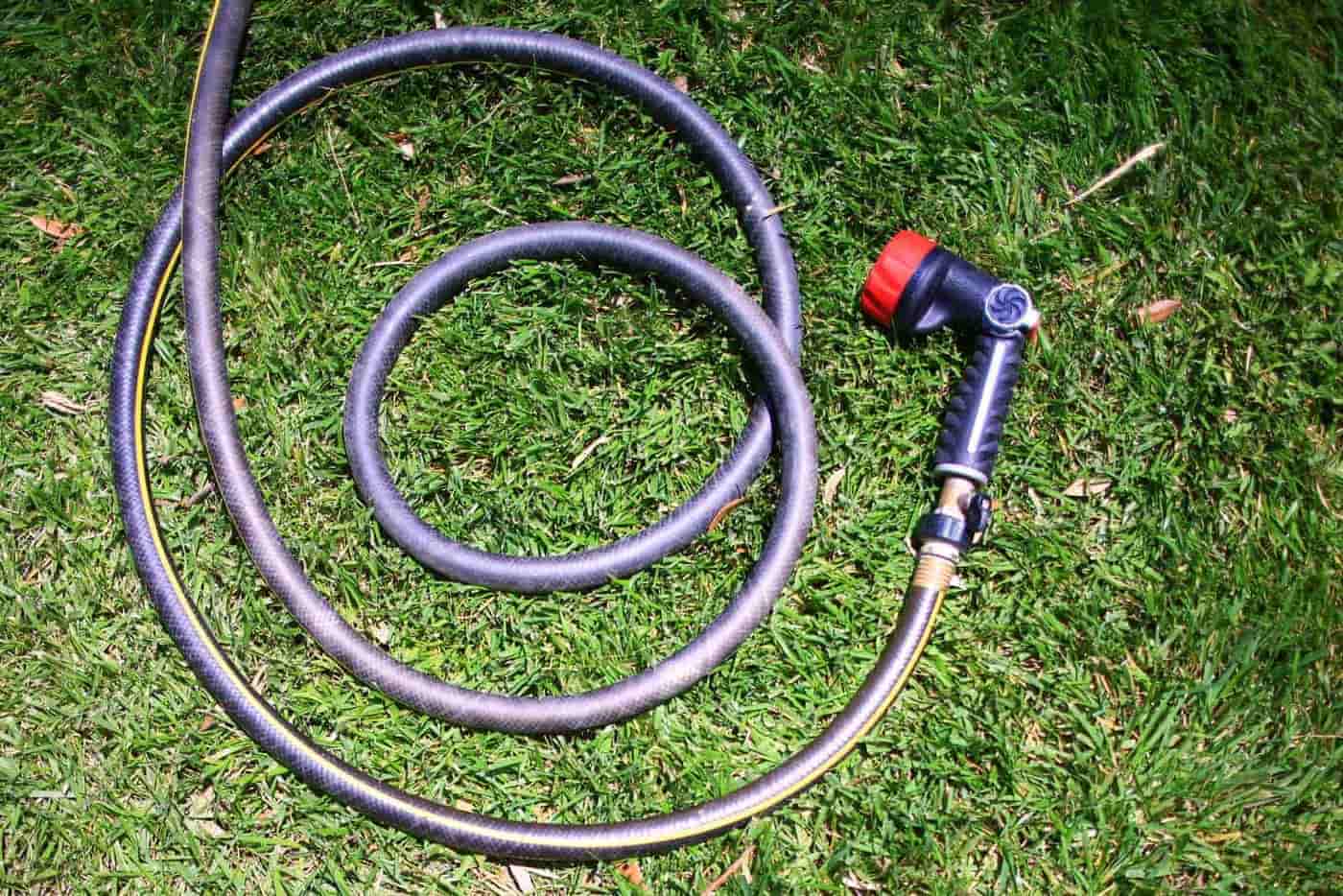
Nothing in this category is standardized, and the hoses are where you find out
A correctly sized pump with the wrong fitting is a return. Measure before you order, because listings rarely tell you and brands rarely agree.
Heads up: we earn a commission if you buy through the links on this page, at no extra cost to you. It never decides the ranking — here is how we pick and here is the full disclosure. Prices are checked automatically; last verified October 8, 2026.
The short version
- Measure the hose, do not assume it. Above-ground fittings differ between manufacturers and sometimes between models from the same one.
- The suction side is where leaks matter. A leak before the pump draws air in; a leak after it drips water out. The first is far more disruptive.
- Hose length is not free. Every extra foot and every extra bend costs you flow, which means turnover time you have to make up in hours.
- Check fittings before buying a replacement pump, not after. It is the single most common reason a correctly sized pump gets returned.
Why nothing matches
Inground pool plumbing is largely standardized around rigid pipe in a small number of sizes. Above-ground pools are not: they use flexible hose with molded or clamped ends, and each manufacturer designed its own arrangement around its own pumps.
The practical result is that a hose from one brand may physically fit another brand’s fitting and still not seal, or may need an adapter that is not supplied. This is not something the listing will tell you, and it is why our kit versus separate guide treats a bundled pump as one of the real arguments for buying the kit — it is guaranteed to fit the pool it came with.
Measuring what you actually have
Four measurements, five minutes, and they make every future purchase decision simple. Write them on a label inside the pump lid so they are there when you need them.
| Measure | How | Why it matters |
|---|---|---|
| Hose internal diameter | Across the inside of the cut end, in inches | The number every replacement is sold by |
| Fitting type at each end | Threaded, clamped or push-fit — photograph it | Threads differ; a photo saves an argument |
| Hose length needed | Pool fitting to pump inlet, following the real route | Too short is useless; too long costs flow |
| Pool wall fitting size | The inlet and outlet through the liner | This is the one that is brand-specific |
The suction side, and why it is different
Everything between the pool and the pump inlet is under suction; everything after the pump is under pressure. That distinction decides what a leak does.
A leak on the pressure side drips water on the ground. Annoying, visible, easy to find, and it does not stop the pool working.
A leak on the suction side draws air into the system instead of leaking water out. That produces bubbles at the return jet, a pump that struggles to hold prime, and eventually a pump that moves nothing at all — and there is often no visible water anywhere to tell you where it is.
The usual culprits are a loose hose clamp, a hose that has hardened with age at the fitting, a dry or missing O-ring on the strainer lid, and a lid that was hand-tightened and has worked loose. All four are minutes to fix and all four produce alarming symptoms — which is why they sit at check two in our troubleshooting sequence.
| Symptom | Side | Usual cause |
|---|---|---|
| Bubbles streaming from the return jet | Suction | Air drawn in before the pump |
| Pump will not hold prime | Suction | Loose fitting, hardened hose, dry O-ring |
| Puddle under the pump, pool works fine | Pressure | Hose clamp or fitting after the pump |
| Water level dropping, no visible leak | Neither | Check the skimmer gasket and the liner |
| Gurgling from the skimmer | Suction | Water level too low — check that first |
Length, bends and the flow you lose
Flexible hose is not free-flowing. Every foot of it, and especially every tight bend, adds resistance the pump has to work against, and that resistance shows up as reduced system flow rate — which is the number your turnover time is calculated from.
Intex publishes both figures for its pumps: the C530 is a 530 GPH pump with a 475 GPH system flow, and the C1000 is 1,000 GPH with 750 GPH system flow. Those system figures already account for the filter; a long, kinked hose run takes more on top. Our pump sizing guide explains why the system figure is the one to size from.
Practically: use the shortest hose that reaches comfortably, keep the runs as straight as the layout allows, and support the hose so it does not sag into a low loop that traps air. None of that costs anything and together it is worth more than most upgrades.
Hose condition, which degrades quietly
Pool hose lives outdoors in sunlight for a season at a time, and ultraviolet exposure hardens it. A hardened hose does two things: it stops sealing properly at the fittings, because it no longer conforms, and it develops cracks at the points where it flexes.
Check for stiffness at the fitting ends and for hairline cracking on the outside of bends when you open the pool each spring. Replacing a hose is cheap; chasing an intermittent air leak through a season is not. Our spring shopping list is where this check belongs, and buying used covers checking somebody else’s.
Storage, because hoses die in winter too
Drain hoses completely before storing them. Water left inside freezes and expands, and hose left coiled tightly in the cold takes a set it never quite loses. Store them loosely coiled, dry, and out of the light, with the fittings kept together and labeled — our take-down guide covers this alongside the pool itself, and the same principle applies to the pump housing in an unexpected freeze.
What to buy
Scores are our own reading of published specifications. They are not test results — we have not tested these products and we do not claim to.
Small frame and inflatable pools
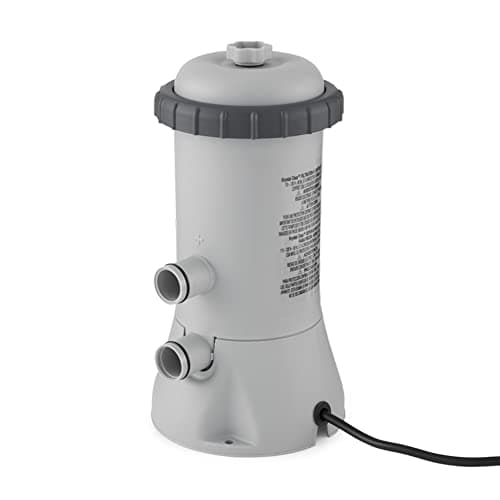
Intex Krystal Clear C530 Cartridge Filter Pump
Intex
530 GPH pump flow, 475 GPH through the system. The right pump for a 12-foot pool and badly undersized for anything much bigger.
#ad how this is funded · price as of October 8, 2026
Key specs
- Pump flow rate
- 530 GPH
- System flow rate
- 475 GPH
- Cartridge
- Type A
- Wattage
- Not published by Intex
How it scoresour reading of published specs, not a test result
- Sizing fit
- 8.0
- Running cost
- 9.0
- Maintenance
- 7.0
- Build
- 7.0
- Value
- 8.5
Overall 8.0 / 10
What works
- Correctly matched to the 12ft Prism Frame and Easy Set pools it ships with
- Smallest pump here that will still genuinely turn over a real pool
- Type A cartridges, which are everywhere
What doesn't
- Undersized the moment you upgrade the pool, and it will not carry over
- No wattage published
- Cartridge needs rinsing frequently in a busy small pool
Skip it if: Anything over about 2,000 gallons. Below that it is right; above it you are running it all day for one turnover.
What it costs to run: 475 GPH system flow turns over 1,718 gallons in about 3.6 hours, so a 7-hour daily run is two full turnovers. That is a genuinely short run time and it is where a small pool's low running cost actually comes from.
One honest season: The cheapest setup that genuinely works for a season of real swimming. Nothing spare, nothing missing.
Specs from: Intex — Krystal Clear cartridge filter pumps
Pools up to about 6,000 gallons
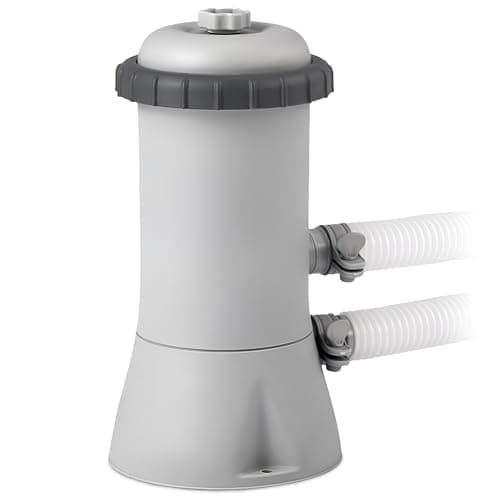
Intex Krystal Clear C1000 Cartridge Filter Pump
Intex
The workhorse replacement pump for mid-size frame pools. 1,000 GPH pump flow, 750 GPH through the system once the cartridge is in the way — and that second number is the one your turnover math needs.
#ad how this is funded · price as of October 8, 2026
Key specs
- Pump flow rate
- 1,000 GPH
- System flow rate
- 750 GPH
- Rated pool size
- Up to 6,000 gallons
- Cartridge
- Type A
- Wattage
- Not published by Intex
How it scoresour reading of published specs, not a test result
- Sizing fit
- 9.0
- Running cost
- 7.0
- Maintenance
- 7.5
- Build
- 7.5
- Value
- 8.5
Overall 8.3 / 10
What works
- Intex publishes both pump flow and system flow, which is more honesty than most of this category offers
- Type A cartridges are the most widely stocked filter consumable in the US
- Sized correctly for the 12ft-15ft frame pools most families own
What doesn't
- Wattage is not published anywhere on the Intex site, so you cannot cost it before purchase
- Cartridge-only, so there is a consumable every few weeks in a busy pool
- GFCI cord length dictates where the pool can go more than people expect
Skip it if: Pools over about 6,000 gallons. Above that you are asking it to run all day to achieve one turnover, which is the expensive way to filter.
What it costs to run: Do the turnover math before you buy: 750 GPH system flow moves 4,000 gallons in 5.3 hours. Two turnovers a day is therefore about 11 hours of running. At the EIA's June 2026 US residential average of 18.34 cents per kWh, every 100 watts of pump draw running 11 hours a day for a 120-day season costs about $24. Find your wattage on the pump label and multiply.
Several seasons: Buy-once. Built and warranted to come back out of the box for a few years, if you store it properly.
Specs from: Intex — Krystal Clear cartridge filter pumps, EIA Electric Power Monthly, Table 5.6.A — US residential average price
Getting off the cartridge treadmill
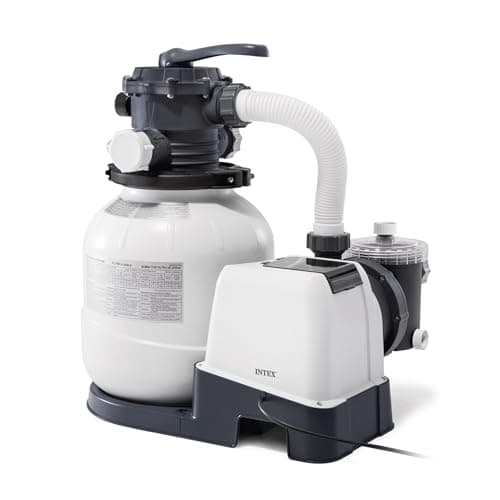
Intex Krystal Clear Sand Filter Pump
Intex
Sand filtration replaces a recurring cartridge purchase with a backwash valve and a bag of sand that lasts years. On a pool you intend to keep, the arithmetic favors it.
Key specs
- Media
- Filter sand (or glass media)
- Maintenance
- Backwash rather than rinse-and-replace
- Media life
- Several seasons before replacement
- Wattage
- Not published by Intex
How it scoresour reading of published specs, not a test result
- Sizing fit
- 8.5
- Running cost
- 8.0
- Maintenance
- 8.5
- Build
- 8.0
- Value
- 8.5
Overall 8.4 / 10
What works
- No cartridges to buy, which removes the single largest recurring equipment cost
- Backwashing takes about two minutes versus rinsing a cartridge in the yard
- Sand lasts years rather than weeks
What doesn't
- Backwashing sends water down the drain, and that water has chemicals in it you paid for
- Higher purchase price than a cartridge pump of the same flow
- Heavier and needs a stable, level base of its own
Skip it if: A small seasonal pool that comes down every autumn. The payback period is measured in seasons, so it only works if there will be seasons.
What it costs to run: The comparison to run: cartridge replacements per season versus one bag of sand every few years, plus the water each backwash discards at the EPA WaterSense average of $6.06 per 1,000 gallons. On a pool you will own for three or more years, sand usually wins.
Several seasons: Buy-once. Built and warranted to come back out of the box for a few years, if you store it properly.
Specs from: EPA WaterSense — cost per 1,000 gallons
The consumable you will actually buy repeatedly
Type A Replacement Filter Cartridges (multipack)
Various
Buy them in a multipack before you need them. A pool running on an exhausted cartridge is a cloudy pool, and the fix is a two-dollar part you did not have.
Key specs
- Type
- Type A — the most common Intex format
- Replacement interval
- Every 2 weeks in heavy use, per Intex guidance
- Between changes
- Rinse, do not scrub
How it scoresour reading of published specs, not a test result
- Sizing fit
- 9.0
- Running cost
- 7.0
- Maintenance
- 8.5
- Build
- 7.0
- Value
- 8.5
Overall 8.2 / 10
What works
- Type A is the most widely stocked cartridge format in the US
- Multipacks cost a fraction of buying singles
- Having a spare turns a cloudy week into a five-minute fix
What doesn't
- It is a genuine recurring cost that nobody includes in the purchase price
- Aftermarket quality varies noticeably
- Rinsing extends life but does not restore a cartridge that is done
Skip it if: Being restored. Once the pleats are permanently gray and stiff, rinsing is not saving it.
What it costs to run: The line item most people leave out of their pool budget. Count how many you use in your first season and you have your real annual filtration cost — this is exactly the number the cost-to-run guide asks you to record.
One honest season: The cheapest setup that genuinely works for a season of real swimming. Nothing spare, nothing missing.
Questions people actually ask
Are above-ground pool hoses a standard size?
What causes bubbles coming out of the pool return jet?
Does a longer pool hose reduce flow?
What should I check before buying a replacement pool pump?
Sources
Read next
- Equipment, sized to your pool and costed by the wattPumps, filters, vacuums, heaters and ladders - matched to your gallons and priced by what they draw.
- Sizing a pump: the number on the box is not the number you useTurnover time computed from published system flow rates for common pool volumes, and why an oversized pump costs you money every day.
- Pool pump problems, diagnosed in the cheapest orderThe five-check diagnostic sequence for an above-ground pool pump, from free fixes to the point at which it is genuinely the motor.
- The skimmer is the cheapest part of the system and the one that stops itHow a skimmer actually works, the water level it needs, and the three silent faults that get blamed on the pump.
- Above-ground pool pumps: how many gallons per hour you actually needPumps matched to pool volume by system flow rate, with the season running-cost table manufacturers do not publish.
- Buying a used pool without buying somebody else's problemThe inspection checklist for a secondhand pool, which faults are cheap and which end the deal, and the parts you will have to buy anyway.
- Pool kit or piece by piece: which is genuinely cheaperHow to compare a bundled pool set against a pool-only listing plus separate pump, ladder, cover and ground cloth - and when buying separately actually wins.