Pool Care & Chemistry
First-time pool owner: the complete first month
The shopping list nobody gives you at the store, the four numbers that matter, and what to do the week the water goes cloudy - because it will.
Heads up: we earn a commission if you buy through the links on this page, at no extra cost to you. It never decides the ranking — here is how we pick and here is the full disclosure. Prices are checked automatically; last verified October 18, 2026.
The short version
- Buy the seven day-one items below with the pool, not in week three. That single change prevents most first-year misery.
- Four readings matter: free chlorine, pH, total alkalinity, cyanuric acid. The CDC publishes at least 1 ppm free chlorine (2 ppm with a stabilizer) and pH 7.0–7.8.
- Fix alkalinity first, then pH, then chlorine. Any other order and you will be adding chemicals all summer to no effect.
- Cloudy water in week three is normal, not a failure. It has four causes and they are distinguishable.
The day-one shopping list
Almost every first-pool story goes the same way. The pool arrives, it goes up in an afternoon, everybody swims, and about a fortnight later the water is cloudy, there is no test kit in the house, and the household concludes that pools are hard.
Pools are not hard. They are a routine, and the routine needs equipment nobody mentioned at the store. Buy all of this with the pool:
| Item | Why | Skip it and… |
|---|---|---|
| Test strips | You cannot manage water you cannot measure | You are guessing at everything |
| Chlorine tablets | The standing sanitizer | The water goes off in days |
| Floating dispenser | Meters tablets out evenly | Tablets bleach the liner |
| Skimmer net + pole | Debris is easy floating, hard sunken | You are vacuuming instead |
| Alkalinity increaser | Stops pH drifting | You chase pH all season |
| pH increaser | Trichlor pushes pH down | Chlorine stops working properly |
| Solar cover | Cuts evaporation, chemistry loss and heat loss | You pay for all three |
The four numbers
Pool chemistry sounds like a subject and is closer to a checklist. A test strip gives you all four readings in about fifteen seconds.
Free chlorine is the sanitizer actually available to kill things. The CDC publishes a minimum of 1 ppm in pools, or at least 2 ppm when you are using cyanuric acid — and every trichlor tablet contains cyanuric acid, so for most above-ground pools the 2 ppm figure is the relevant one.
pH is how acidic or basic the water is. The CDC’s published range is 7.0–7.8, and it notes that chlorine’s ability to kill germs falls as pH rises above 8.0, while below 7.0 the water starts to corrode equipment.
Total alkalinity is how strongly the water resists pH swings. This is the reading beginners ignore and then fight all summer: when alkalinity is low, pH will not stay where you put it no matter how much adjuster you add. The conventional industry target is 80–120 ppm — that is a trade convention rather than a published federal standard, and we flag it as such.
Cyanuric acid is chlorine’s sunscreen. Some is essential outdoors or UV destroys your chlorine within hours. Too much and chlorine stops responding, which in a small pool that is topped up rather than drained happens faster than people expect.
The first month, week by week
Week 1 — get the baseline right
Fresh tap water is not swim-ready. Test it. Set total alkalinity, then pH, then add chlorine and get free chlorine into range. Run the filter continuously for the first 24 hours, then move to your normal schedule.Week 2 — establish the routine
Skim twice, test twice, top up chlorine to hold the level rather than to rescue it. Brush the water line. Note how long the pump runs — you are calibrating, not just maintaining.Week 3 — the cloudy week
If the water goes milky this is the week it happens, and it is normal. Work the cloudy water decision tree rather than throwing chemicals at it — the fix depends entirely on which of four causes you have.Week 4 — check the cartridge and the cyanuric acid
Intex's guidance is cartridge replacement roughly every two weeks in heavy use, so by now yours needs attention. Also read your cyanuric acid level: if it has climbed sharply in a small pool, that explains any chlorine that stopped working.
How long to run the pump
Filtration is time, not power. You want the whole pool volume to pass through the filter at least once a day, ideally twice in hot weather. The arithmetic is simple and it uses the pump’s system flow rate, not its headline pump flow rate — the system figure is what actually gets through once the cartridge is in the way.
Your turnover time
- Pool volume
- your gallons
- System flow rate [Intex]
- e.g. 475 GPH on an Intex C530
hours per turnover = gallons ÷ system flow rate
1,718 gal ÷ 475 GPH ≈ 3.6 hours per turnover
How much chlorine you will actually use
Clorox Pool&Spa publishes dosing of two 3-inch tablets weekly per 10,000 gallons. For a 1,718-gallon pool that is about a third of a tablet a week, or roughly six tablets across a 17-week season. For a 6,981-gallon pool it is about 24. Plan around the quantity; our tablet picks carry live prices so nothing here goes stale.
The five mistakes that cost the most
1. Chasing pH without fixing alkalinity. Covered above and worth repeating, because it is the expensive one.
2. Reaching for clarifier before testing. Most cloudy water is chemistry or filtration, and clarifier addresses neither.
3. Putting tablets loose in the pool. They settle on the liner and bleach a permanent pale patch. Use a floating dispenser.
4. Under-dosing shock. Half a dose twice is not a full dose once. It wastes the bag and leaves the problem alive. See shock.
5. Swimming in unbalanced water and assuming it is fine. The CDC’s guidance is explicit that chlorine works poorly outside the published pH range. Badly balanced water is not just an aesthetic problem.
Once the routine is established, the beginner’s routine page is the short version to keep on your phone, and winterizing is the job at the other end of the season that decides whether you own a pool next year.
What to buy
Scores are our own reading of published specifications. They are not test results — we have not tested these products and we do not claim to.
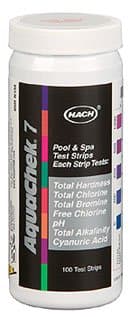
The default first test kit
AquaChek Silver 7-Way Test Strips (100 count)
AquaChek
Seven readings in fifteen seconds, including the two that beginners never measure and then fight all summer: total alkalinity and cyanuric acid.
#ad how this is funded · price as of October 18, 2026
Key specs
- Tests
- Free chlorine, total chlorine, bromine, pH, total alkalinity, total hardness, cyanuric acid
- Free chlorine range
- 0-20 ppm
- pH range
- 6.2-8.4
- Total alkalinity range
- 0-240 ppm
- Cyanuric acid range
- 0-300 ppm
- Read time
- 15 seconds
- Count
- 100 strips
How it scoresour reading of published specs, not a test result
- Ease
- 9.5
- Value
- 9.2
Overall 8.9 / 10
What works
- Covers cyanuric acid, which most cheap strips omit and which is the reason chlorine stops working in a stabilized pool
- pH range spans 6.2-8.4, comfortably bracketing the CDC's recommended 7.0-7.8
- 15 seconds and a color chart printed on the bottle — no separate booklet to lose
- 100 strips is a full season of twice-weekly testing with room to spare
What doesn't
- Strips are a comparison against a printed color chart, so they are directional rather than precise
- Reading them in bright sun is harder than it should be
- The bottle must be kept sealed and dry or the strips degrade quietly
Skip it if: Fine adjustment. If you are chasing a stubborn problem and need a number rather than a color band, a liquid reagent kit is the tool.
What it costs to run: 100 strips at twice-weekly testing covers roughly two seasons for one pool. The real saving is upstream: knowing your alkalinity stops you buying pH adjuster you did not need.
One honest season: The cheapest setup that genuinely works for a season of real swimming. Nothing spare, nothing missing.
Specs from: CDC — home pool and hot tub water treatment and testing
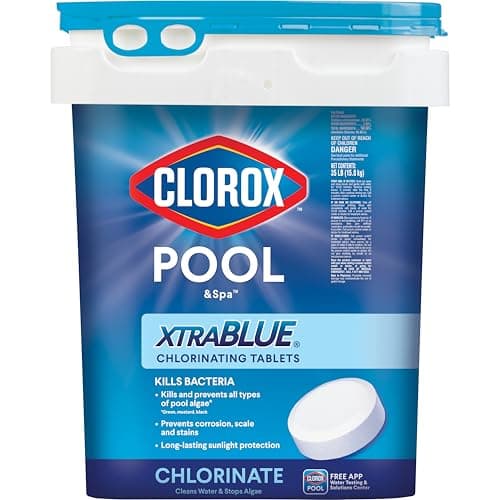
The default chlorine source
Clorox Pool&Spa 3-Inch Chlorinating Tablets
Clorox Pool&Spa
Stabilized trichlor tablets in a floating dispenser is the standard answer for a seasonal above-ground pool, and this is the standard version of it.
#ad how this is funded · price as of October 18, 2026
Key specs
- Type
- Stabilized trichlor, 3-inch tablets
- Contains stabilizer
- Yes — cyanuric acid is part of trichlor
- Dosing
- Per manufacturer instructions, by pool volume
- CDC target
- At least 2 ppm free chlorine when using a stabilizer
How it scoresour reading of published specs, not a test result
- Effectiveness
- 9.0
- Ease
- 9.0
- Water impact
- 6.0
- Cost per season
- 8.5
- Value
- 8.5
Overall 8.5 / 10
What works
- Dissolves slowly, so a floating dispenser meters chlorine out over days rather than hours
- Stabilized, so sunlight does not destroy your chlorine within an afternoon
- Widely stocked, so you are never hunting for it in July
What doesn't
- Every tablet adds cyanuric acid, and in a pool you never fully drain that accumulates until chlorine stops responding
- Trichlor is acidic and will pull your pH down over a season
- Tablets must be kept dry and sealed or they degrade and gas off
Skip it if: A small pool that is topped up rather than drained. Cyanuric acid only leaves with the water, so in a 1,500-gallon pool it climbs fast.
What it costs to run: The standing chemical cost of the season, and it scales directly with gallons. Watch the cyanuric acid reading on your test strip: once it is high, you are buying chlorine that cannot work, which is the most common invisible waste in a first pool year.
One honest season: The cheapest setup that genuinely works for a season of real swimming. Nothing spare, nothing missing.
Specs from: CDC — free chlorine target with cyanuric acid
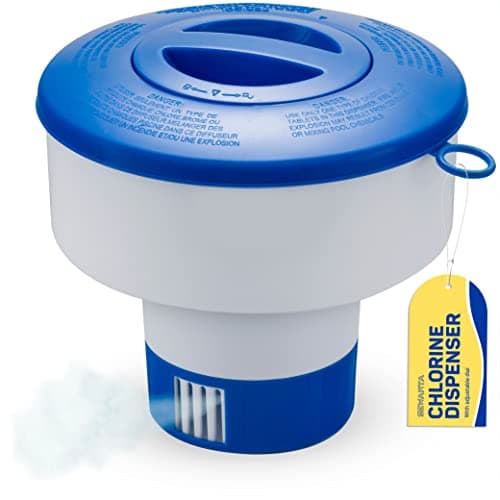
Making tablets work properly
Floating Chlorine Tablet Dispenser
Various
Two dollars of plastic that decides whether your chlorine dissolves evenly over days or sits in a corner bleaching your liner. Buy it with the tablets, not after.
#ad how this is funded · price as of October 18, 2026
Key specs
- Function
- Holds 3-inch tablets, meters dissolution rate
- Adjustment
- Vented base, adjustable on most models
- Compatibility
- Standard 3-inch tablets
How it scoresour reading of published specs, not a test result
- Effectiveness
- 8.0
- Ease
- 9.5
- Water impact
- 9.0
- Cost per season
- 9.8
- Value
- 9.5
Overall 9.0 / 10
What works
- Adjustable venting lets you slow or speed dissolution to match the weather
- Keeps tablets off the liner, which is what causes bleach spots
- Trivially cheap and lasts years
What doesn't
- Drifts to one end of the pool in wind, so distribution is uneven without circulation
- Must be removed before swimming with small children
- Cheap ones crack after a season in UV
Skip it if: Being left in an empty or unfiltered pool. Without circulation it creates a concentrated pocket rather than an even dose.
What it costs to run: The cheapest item on this site and one of the highest-return: even dissolution means you use fewer tablets to hold the same free chlorine level.
One honest season: The cheapest setup that genuinely works for a season of real swimming. Nothing spare, nothing missing.
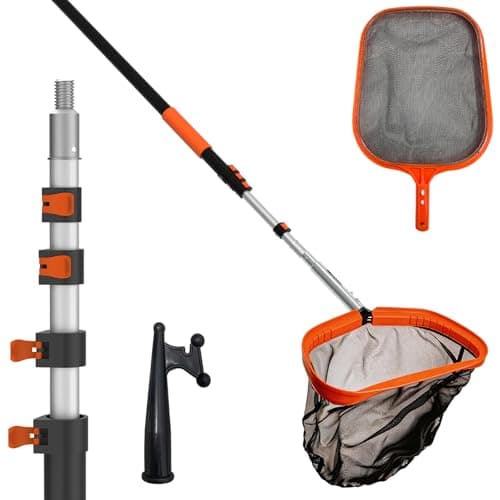
The five-dollar tool you use most
Skimmer Net with Telescopic Pole
Various
Catching leaves while they float is a two-minute job. Catching them after they sink is a vacuum session and a filter clean. Buy this first.
Key specs
- Type
- Flat skimmer or deep leaf rake
- Pole
- Telescopic, sized to reach the middle of your pool
- Frame
- Plastic or aluminum
How it scoresour reading of published specs, not a test result
- Value
- 9.5
Overall 8.8 / 10
What works
- The single most-used tool in pool ownership and among the cheapest
- Removing debris before it sinks prevents most of the work that follows
- A deep leaf rake handles far more per pass than a flat skimmer
What doesn't
- Cheap plastic frames snap where the pole attaches, which is the standard failure
- Telescopic poles seize with hard water unless rinsed
- A too-short pole means you cannot reach the middle, which makes it useless
Skip it if: Anything on the floor. This is a surface tool and pretending otherwise is how debris ends up in the filter.
What it costs to run: Free to use and it directly reduces your chemical bill: organic debris consumes chlorine as it breaks down, so removing leaves is the cheapest sanitizer saving there is.
Several seasons: Buy-once. Built and warranted to come back out of the box for a few years, if you store it properly.
Fixing the number beginners skip
Alkalinity Increaser (sodium bicarbonate)
Various
The most under-bought chemical in the category. If your pH will not stay put, this is almost always the actual fix, and it is chemically just baking soda.
Key specs
- Active
- Sodium bicarbonate
- Raises
- Total alkalinity, with minimal pH movement
- Common target range
- 80-120 ppm (industry convention, not a CDC figure)
How it scoresour reading of published specs, not a test result
- Effectiveness
- 9.0
- Ease
- 8.0
- Water impact
- 9.0
- Cost per season
- 9.8
- Value
- 9.5
Overall 9.0 / 10
What works
- Raises alkalinity with only a small effect on pH, which is exactly what you want
- Extremely cheap — it is sodium bicarbonate
- Fixing alkalinity first stops the endless pH chase that eats a first season
What doesn't
- Works slowly and needs circulation, so it is not a same-afternoon fix
- Easy to overshoot, and bringing alkalinity back down is more work than raising it
- The 80-120 ppm target is an industry convention rather than a published federal standard, so treat it as guidance
Skip it if: Emergencies. Nothing about alkalinity is urgent; it is the thing you fix first and then stop thinking about.
What it costs to run: Pennies per dose, and it is the cheapest lever on your whole chemical bill: stable alkalinity means stable pH, and stable pH means the chlorine you already bought actually works.
One honest season: The cheapest setup that genuinely works for a season of real swimming. Nothing spare, nothing missing.
Bringing pH back up after a season of trichlor
pH Increaser (sodium carbonate)
Various
One of two bottles every pool owner ends up with. Trichlor tablets push pH down all season, and this is what pushes it back.
Key specs
- Active
- Sodium carbonate (soda ash)
- Raises
- pH, and total alkalinity somewhat
- CDC pH target
- 7.0-7.8
How it scoresour reading of published specs, not a test result
- Effectiveness
- 8.5
- Ease
- 8.5
- Water impact
- 8.0
- Cost per season
- 9.5
- Value
- 8.8
Overall 8.5 / 10
What works
- Cheap, stable and does exactly one thing
- Also nudges total alkalinity up, which is often what actually needed fixing
- A single container lasts most seasonal pools a full year
What doesn't
- Overdosing clouds the water for a day or two
- Raises alkalinity as well as pH, which is not always what you want
- Needs to be added with the pump running or it settles
Skip it if: Raising alkalinity on its own without moving pH. Use sodium bicarbonate for that.
What it costs to run: A few dollars a season. The expensive mistake is not this bottle, it is failing to fix alkalinity first and then using this one repeatedly all summer.
One honest season: The cheapest setup that genuinely works for a season of real swimming. Nothing spare, nothing missing.
Specs from: CDC — recommended pH range for pools
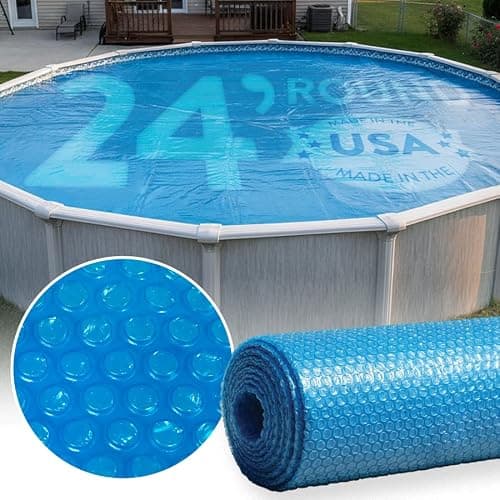
The single highest-return accessory here
Bubble Solar Cover for Above-Ground Pools
Various
It cuts evaporation, and evaporation is simultaneously your water bill, your chemical bill and your heat loss. Nothing else on this site reduces three costs at once.
#ad how this is funded · price as of October 18, 2026
Key specs
- Construction
- Bubble sheet, thickness published in mil
- Thickness
- Higher mil lasts longer — 12 mil and 16 mil are common
- Fit
- Cut to size; buy oversize and trim
- Orientation
- Bubbles face down, toward the water
How it scoresour reading of published specs, not a test result
- Value
- 9.5
Overall 9.0 / 10
What works
- Reduces evaporation, which is the mechanism behind the water, chemical and heat savings all at once
- Cheap relative to everything it saves
- Can be cut to fit any pool shape, so sizing is forgiving
What doesn't
- Awkward to get on and off without a reel, and awkward is how covers end up unused
- Degrades in UV like every vinyl product
- Not a safety cover and will not support weight — this is important
Skip it if: Being a safety barrier. A solar cover looks solid and is not; a child or pet on it goes through and under.
What it costs to run: The one accessory with a clear payback. Every gallon that does not evaporate is a gallon you do not replace at the EPA WaterSense national average of $6.06 per 1,000 gallons, and it is chlorine you do not re-dose. If you buy one thing from this hub, buy this.
Several seasons: Buy-once. Built and warranted to come back out of the box for a few years, if you store it properly.
Specs from: EPA WaterSense — cost per 1,000 gallons
Questions people actually ask
What do I need to buy for a new above-ground pool?
What chemicals do I need for a first-time pool?
How long should I run my pool pump each day?
Why did my new pool go cloudy after two weeks?
Is it safe to swim in a pool that has not been tested?
Sources
Read next
- Pool care, from someone who assumes you have never done thisThe weekly routine, the four numbers that matter, and the fix for the week the water turns.
- Pool maintenance for beginners, in twenty minutes a weekThe complete weekly routine in order, what each step is actually for, and the things you can safely ignore.
- Cloudy pool water: work out which of four problems you haveA diagnostic decision tree for cloudy water - four causes, how to tell them apart, and the correct fix for each.
- pH and alkalinity, and why yours will not stay putWhy pH drifts, what total alkalinity actually does, and the order of operations that turns a season of chasing into one adjustment.
- What an above-ground pool actually costs to run for a yearElectricity, chemicals, water and consumables for a full season - every input sourced, every calculation shown, and every assumption named.
- How to set up an above-ground pool properlyLeveling, ground protection, filling and priming - the afternoon that decides how the rest of the season goes.
- What to buy with the pool, and what can waitThe day-one list for a first above-ground pool - testing, sanitizer, a dispenser and the two manual tools - plus what to deliberately postpone until the pool is running.