Pool Care & Chemistry
Salt vs chlorine: a saltwater pool is a chlorine pool
The single most misunderstood product in this category. A salt system does not replace chlorine - it manufactures it on site.

Heads up: we earn a commission if you buy through the links on this page, at no extra cost to you. It never decides the ranking — here is how we pick and here is the full disclosure. Prices are checked automatically; last verified October 19, 2026.
The short version
- A saltwater pool is still sanitized with chlorine. The system electrolyzes salt to make it on site.
- The real benefits are no tablet handling and no cyanuric acid accumulation from the sanitizer.
- The real costs are the cell, which is a consumable, and more electricity on a bill already dominated by the pump.
- On a pool drained every autumn, the payback never arrives. You lose the salt with the water.
The misunderstanding, cleared up
People describe salt pools as an alternative to chlorine. They are not. A salt chlorine generator passes current through salted water and produces chlorine from it. The sanitizer in the pool is chemically identical to the sanitizer from a tablet. The CDC’s published targets — at least 1 ppm free chlorine, pH 7.0–7.8 — apply exactly the same way.
What changes is how the chlorine arrives, and that difference is genuine enough to be worth understanding.
What actually changes
| Chlorine tablets | Salt system | |
|---|---|---|
| Sanitizer | Chlorine | Chlorine (generated on site) |
| Weekly handling | Load the dispenser | None |
| Adds cyanuric acid? | Yes, every tablet | No (though you add some separately) |
| Ongoing consumable | Tablets | The cell, plus salt each season |
| Electricity | None | Additional draw while running |
| Up-front cost | Low | Significant hardware |
| Water feel | Standard | Noticeably softer — the real appeal |
The case for
No weekly handling of chlorine. This is the honest headline benefit and it is not trivial — no bucket in the shed, no tablets to store dry, no dispenser to refill.
No cyanuric acid accumulation from the sanitizer. For anyone whose small pool keeps hitting high cyanuric acid from trichlor tablets, this genuinely solves the problem at the root rather than managing it with partial drains.
The water feels different. Softer, less harsh on skin and eyes. This is subjective and it is also the reason most people who like salt pools like them.
The case against, on an above-ground pool
The cell is a consumable with a real replacement cost. Manufacturers publish cell life in operating hours, and replacement is a significant fraction of the original hardware cost. That is the number that decides whether the system ever pays back.
It adds to the electricity line. Your annual bill is already dominated by the pump — see the cost-to-run guide — and a generator runs alongside it.
Salt is mildly corrosive. Above-ground pools have metal frames, fittings and ladders. Check what your specific pool’s manufacturer says before adding salt to it, because not every frame is intended for it.
You still need shock
A frequent surprise: salt systems generate a maintenance level of chlorine, not a shock level. When you get an algae bloom or a heavy bather load, you still reach for cal-hypo exactly as you would on a tablet pool. Some systems have a “boost” mode; it is not the same as shocking.
You also still test the same four numbers, still balance pH and alkalinity the same way, and still need a test kit. A salt system removes one chore from the routine. It does not remove the routine.
Who should get one
Someone with a larger above-ground pool that stays up across seasons, who dislikes handling chemicals, and who has read the cell replacement cost and accepted it. For most first-pool families with a seasonal pool, tablets and a floating dispenser are the right answer and the money is better spent on a cover.
If the chemistry argument has not decided it for you, the money one might. Our salt system payback guide works out how many tablets a salt cell actually displaces on a pool this size, and adds back the electricity, the salt and the cell replacement that payback calculations usually leave out.
What to buy
Scores are our own reading of published specifications. They are not test results — we have not tested these products and we do not claim to.
Owners who dislike handling chemicals
Above-Ground Saltwater Chlorine Generator
Various
It makes chlorine from salt rather than replacing chlorine. Whether the hardware pays for itself over a seasonal pool's life is genuinely arguable, and it usually depends on how many seasons you will own it.
Key specs
- What it does
- Electrolyzes dissolved salt into chlorine
- Still a chlorine pool
- Yes — the sanitizer is identical
- Cell life
- Published in hours; the cell is a replaceable consumable
- Salt required
- Published per model, added once per season
How it scoresour reading of published specs, not a test result
- Value
- 6.5
Overall 6.9 / 10
What works
- No weekly handling or storage of chlorine tablets
- Water feels noticeably softer to most people, which is the real reason people like them
- Salt is added once and stays until the water is changed
What doesn't
- The cell is a consumable and replacing it is a significant cost
- Adds another powered device to a pool whose running cost is already dominated by power
- Salt is corrosive to some metal frames and fittings if not managed
Skip it if: A pool that gets drained every autumn. You lose the salt with the water each year, and the payback period never arrives.
What it costs to run: The honest comparison is cell replacement cost plus salt plus power, against a season of tablets. On a pool kept up for several years it can work out; on a pool drained every October it generally does not.
More than you need yet: Real capability a first-pool family cannot use yet. Buy cheaper and put the difference toward chemicals and a cover.
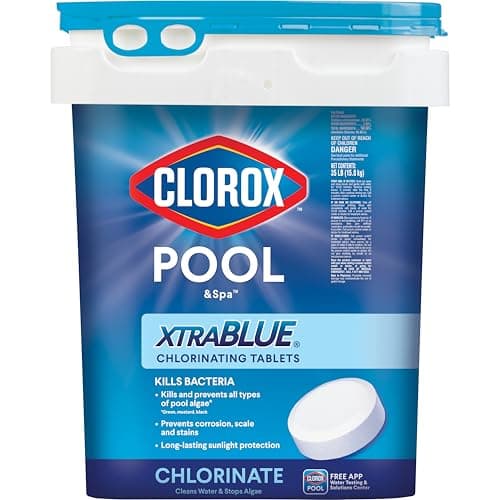
The default chlorine source
Clorox Pool&Spa 3-Inch Chlorinating Tablets
Clorox Pool&Spa
Stabilized trichlor tablets in a floating dispenser is the standard answer for a seasonal above-ground pool, and this is the standard version of it.
#ad how this is funded · price as of October 19, 2026
Key specs
- Type
- Stabilized trichlor, 3-inch tablets
- Contains stabilizer
- Yes — cyanuric acid is part of trichlor
- Dosing
- Per manufacturer instructions, by pool volume
- CDC target
- At least 2 ppm free chlorine when using a stabilizer
How it scoresour reading of published specs, not a test result
- Effectiveness
- 9.0
- Ease
- 9.0
- Water impact
- 6.0
- Cost per season
- 8.5
- Value
- 8.5
Overall 8.5 / 10
What works
- Dissolves slowly, so a floating dispenser meters chlorine out over days rather than hours
- Stabilized, so sunlight does not destroy your chlorine within an afternoon
- Widely stocked, so you are never hunting for it in July
What doesn't
- Every tablet adds cyanuric acid, and in a pool you never fully drain that accumulates until chlorine stops responding
- Trichlor is acidic and will pull your pH down over a season
- Tablets must be kept dry and sealed or they degrade and gas off
Skip it if: A small pool that is topped up rather than drained. Cyanuric acid only leaves with the water, so in a 1,500-gallon pool it climbs fast.
What it costs to run: The standing chemical cost of the season, and it scales directly with gallons. Watch the cyanuric acid reading on your test strip: once it is high, you are buying chlorine that cannot work, which is the most common invisible waste in a first pool year.
One honest season: The cheapest setup that genuinely works for a season of real swimming. Nothing spare, nothing missing.
Specs from: CDC — free chlorine target with cyanuric acid
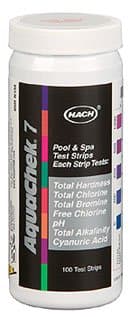
The default first test kit
AquaChek Silver 7-Way Test Strips (100 count)
AquaChek
Seven readings in fifteen seconds, including the two that beginners never measure and then fight all summer: total alkalinity and cyanuric acid.
#ad how this is funded · price as of October 19, 2026
Key specs
- Tests
- Free chlorine, total chlorine, bromine, pH, total alkalinity, total hardness, cyanuric acid
- Free chlorine range
- 0-20 ppm
- pH range
- 6.2-8.4
- Total alkalinity range
- 0-240 ppm
- Cyanuric acid range
- 0-300 ppm
- Read time
- 15 seconds
- Count
- 100 strips
How it scoresour reading of published specs, not a test result
- Ease
- 9.5
- Value
- 9.2
Overall 8.9 / 10
What works
- Covers cyanuric acid, which most cheap strips omit and which is the reason chlorine stops working in a stabilized pool
- pH range spans 6.2-8.4, comfortably bracketing the CDC's recommended 7.0-7.8
- 15 seconds and a color chart printed on the bottle — no separate booklet to lose
- 100 strips is a full season of twice-weekly testing with room to spare
What doesn't
- Strips are a comparison against a printed color chart, so they are directional rather than precise
- Reading them in bright sun is harder than it should be
- The bottle must be kept sealed and dry or the strips degrade quietly
Skip it if: Fine adjustment. If you are chasing a stubborn problem and need a number rather than a color band, a liquid reagent kit is the tool.
What it costs to run: 100 strips at twice-weekly testing covers roughly two seasons for one pool. The real saving is upstream: knowing your alkalinity stops you buying pH adjuster you did not need.
One honest season: The cheapest setup that genuinely works for a season of real swimming. Nothing spare, nothing missing.
Specs from: CDC — home pool and hot tub water treatment and testing
Actually clearing a green pool
Calcium Hypochlorite Pool Shock
Various (compare available chlorine %)
Unstabilized, fast-acting and strong. This is the tool for an algae bloom precisely because it does not add more cyanuric acid to a pool that probably already has too much.
Key specs
- Type
- Calcium hypochlorite, unstabilized
- Adds stabilizer
- No
- Adds
- Calcium hardness
- Dosing
- By pool volume, per the bag
How it scoresour reading of published specs, not a test result
- Effectiveness
- 9.5
- Ease
- 6.5
- Water impact
- 7.0
- Cost per season
- 9.0
- Value
- 8.8
Overall 8.6 / 10
What works
- No cyanuric acid added, so it does not worsen the problem it is usually solving
- Fast and strong enough to actually break an algae bloom in one treatment when dosed properly
- Cheap per pound of available chlorine
What doesn't
- Adds calcium hardness, which matters in hard-water areas
- Must be dissolved properly or it will bleach a vinyl liner where it settles
- Needs careful storage — it is a genuine oxidizer, not a household product
Skip it if: Routine daily chlorination. This is the emergency tool; tablets are the routine.
What it costs to run: The single most cost-effective way to fix a green pool, and the most commonly under-dosed. Half a dose twice does not equal a full dose once — it just wastes the bag.
One honest season: The cheapest setup that genuinely works for a season of real swimming. Nothing spare, nothing missing.
Questions people actually ask
Is a saltwater pool better than a chlorine pool?
Do you still need chlorine in a saltwater pool?
Is a salt system worth it for an above-ground pool?
Sources
Read next
- Pool care, from someone who assumes you have never done thisThe weekly routine, the four numbers that matter, and the fix for the week the water turns.
- The best chlorine tablets for an above-ground poolTrichlor tablets compared on available chlorine and stabilizer load, with the season-quantity arithmetic for your pool size.
- Salt systems for an above-ground poolHow a chlorine generator works, what the cell costs over time, and why draining the pool each autumn changes the answer entirely.
- What an above-ground pool actually costs to run for a yearElectricity, chemicals, water and consumables for a full season - every input sourced, every calculation shown, and every assumption named.
- First-time pool owner: the complete first monthThe pillar guide: day-one shopping list, the four water readings, the weekly routine and the week-three problem everybody gets.
- Pool salt is a purity specification, not a brandPool salts compared on published purity, additive-free status, production method and how far one bag moves your salinity - with the targets three generator makers publish.