Pool Equipment
Equipment for a small pool, where most advice is written for a big one
A 1,700-gallon pool does not need a scaled-down version of a 15,000-gallon setup. It needs a shorter list, and the money saved belongs on a cover.
Heads up: we earn a commission if you buy through the links on this page, at no extra cost to you. It never decides the ranking — here is how we pick and here is the full disclosure. Prices are checked automatically; last verified October 8, 2026.
The short version
- The pump in the box is usually enough. Do the turnover arithmetic before upgrading anything.
- Cartridges are the running cost, not electricity, on a pool this size.
- A brush does more than a vacuum when the floor area is small.
- Skip the automation. Robots, feeders and heaters rarely earn their keep under a few thousand gallons.
What to look for
1. Turnover, not horsepower. The only number that matters is how long the pump takes to move the whole pool once. Our pump sizing guide sets out the method, and on a small pool the supplied pump usually passes easily.
Turnover on a 12-foot frame pool
- Pool volume, Intex published
- 1,718 gal
- Supplied pump, system flow rating
- 475 gph
1,718 gal ÷ 475 gph = 3.6 hours per turnover
Two turnovers a day is about seven hours of running
2. Cartridge cost per season. Small pools run cartridge filters, and the cartridges are the recurring spend. Buying a multipack of the right type is the single cheapest optimization available — our cartridge roundup covers which type your pump takes.
3. Manual tools over automated ones. A small floor can be brushed in two minutes. A brush moves debris to the filter and keeps algae from establishing, which is why our brush roundup treats it as a chemistry tool.
4. A cordless handheld vacuum, not a robot. For a pool this size a rechargeable handheld picks up the settled grit without plumbing, a hose or a second motor.
The list, in buying order
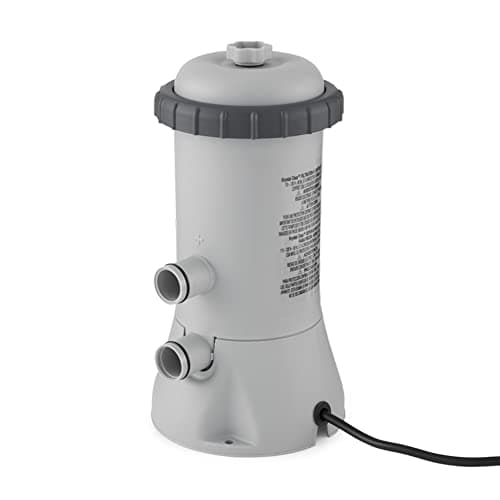
Filtration — keep the supplied pump until the arithmetic says otherwise. A C530-class cartridge unit publishes a 530 GPH pump rating and a 475 GPH system rating, which is the figure to size against.
Cartridges — a multipack of the matching type, bought at the start of the season rather than one at a time.
A wall brush — nylon bristles for a vinyl liner, on a telescopic pole you already own if the pool came with a skim net.
A handheld vacuum — optional, and the first thing to buy once brushing alone stops keeping up.
What to skip
A sand filter. Our sand filter roundup puts the published minimum for the common Intex unit at 5,500 gallons. Below that you are buying 120 lb of sand to solve a problem the pool does not have.
A robotic cleaner. On a small floor it costs a meaningful fraction of the pool itself, as our robot versus manual comparison works through.
A heater. Heating cost scales with volume and surface area, and a cover returns more warmth per dollar at this size than any heater — our solar cover guide shows the arithmetic.
A salt system, usually. Most publish a minimum pump flow and a minimum volume that a small frame pool does not meet.
Where the money should go instead
A cover, a decent test kit and the right cartridges. That combination does more for water quality on a small pool than any equipment upgrade, and it costs less than one robot. Our cheapest setup guide prices the whole first-season list, and our large-pool guide is the mirror of this page for when the pool grows.
The cartridge routine
On a small pool the cartridge is the whole maintenance story, and doing it properly is worth more than any upgrade. Rinse rather than replace, replace on performance rather than on a schedule, and keep a spare so the pool never runs unfiltered while one dries.
Two cartridges rotated — one in, one clean and dry — is the single best habit for a small pool. A dry cartridge cleans better than a damp one, and the pool never loses a day. Our cartridge guide covers what actually ends a cartridge’s life.
Chemistry at small volume
A small pool is not a forgiving pool. Doses that are rounding errors on 15,000 gallons are significant on 1,700, so measuring matters more, not less. Our bather load guide covers the other half of it: four people in a small pool is a heavy load in a way the same four are not in a large one.
That argues for buying chemicals in the smallest sensible pack and for testing before every dose rather than dosing to a schedule. It also argues for a cover, because evaporation concentrates everything left behind.
When it is time to upgrade
Three honest signals. The pump cannot clear the pool in a working day, which is arithmetic rather than opinion. You are replacing cartridges faster than you are willing to buy them, which points at a sand filter — our sand against cartridge comparison covers the trade. Or the pool itself has grown, in which case our large-pool equipment guide is the next page.
Short of those, the equipment that came in the box plus a brush, a cover and the right cartridges is a complete setup for a small pool, and everything else is discretionary.
The cover is the first upgrade, not the last
On a small pool a cover does more than anything you could bolt onto the filtration. It cuts evaporation, which on a 1,700 gallon pool is a meaningful proportion of the water each week. It keeps debris out, which is the load your cartridge is fighting. And it holds heat overnight, which on a small volume is the difference between usable at 4pm and usable at 11am.
It also slows the chemistry problem. Evaporation concentrates everything dissolved in the water while sunlight destroys the chlorine, so a covered small pool holds its readings noticeably longer between doses — the effect our solar cover guide quantifies.
Buy it sized to the pool, and buy something to keep it on: a cover that ends up on the lawn every windy afternoon gets left off by July. For small pools a reel is usually unnecessary — the cover is light enough to fold by hand, which is one of the genuine advantages of being small.
The honest recommendation
Keep the pump that came in the box, buy a multipack of the right cartridges, add a brush and a cover, and stop there for the first season. That is a complete small-pool setup and it costs very little.
Then let the pool tell you what it needs. If you are cleaning cartridges more often than you are willing to, look at a sand filter. If the floor collects grit faster than you brush it, look at a handheld vacuum. Buying either before the pool has demonstrated the problem is how small pools end up with equipment worth more than the pool.
One habit worth more than any purchase
Test before you dose, every time. On a small pool the doses are small enough that guessing feels harmless and is not: the same scoop that is a rounding error on 15,000 gallons moves 1,700 gallons a long way. A fifteen-second strip test before adding anything prevents more cloudy weekends than any equipment on this page, and our test strip roundup covers what to buy.
What to buy
Scores are our own reading of published specifications. They are not test results — we have not tested these products and we do not claim to.
Small frame and inflatable pools
Intex Krystal Clear C530 Cartridge Filter Pump
Intex
530 GPH pump flow, 475 GPH through the system. The right pump for a 12-foot pool and badly undersized for anything much bigger.
#ad how this is funded · price as of October 8, 2026
Key specs
- Pump flow rate
- 530 GPH
- System flow rate
- 475 GPH
- Cartridge
- Type A
- Wattage
- Not published by Intex
How it scoresour reading of published specs, not a test result
- Sizing fit
- 8.0
- Running cost
- 9.0
- Maintenance
- 7.0
- Build
- 7.0
- Value
- 8.5
Overall 8.0 / 10
What works
- Correctly matched to the 12ft Prism Frame and Easy Set pools it ships with
- Smallest pump here that will still genuinely turn over a real pool
- Type A cartridges, which are everywhere
What doesn't
- Undersized the moment you upgrade the pool, and it will not carry over
- No wattage published
- Cartridge needs rinsing frequently in a busy small pool
Skip it if: Anything over about 2,000 gallons. Below that it is right; above it you are running it all day for one turnover.
What it costs to run: 475 GPH system flow turns over 1,718 gallons in about 3.6 hours, so a 7-hour daily run is two full turnovers. That is a genuinely short run time and it is where a small pool's low running cost actually comes from.
One honest season: The cheapest setup that genuinely works for a season of real swimming. Nothing spare, nothing missing.
Specs from: Intex — Krystal Clear cartridge filter pumps
The consumable you will actually buy repeatedly
Type A Replacement Filter Cartridges (multipack)
Various
Buy them in a multipack before you need them. A pool running on an exhausted cartridge is a cloudy pool, and the fix is a two-dollar part you did not have.
Key specs
- Type
- Type A — the most common Intex format
- Replacement interval
- Every 2 weeks in heavy use, per Intex guidance
- Between changes
- Rinse, do not scrub
How it scoresour reading of published specs, not a test result
- Sizing fit
- 9.0
- Running cost
- 7.0
- Maintenance
- 8.5
- Build
- 7.0
- Value
- 8.5
Overall 8.2 / 10
What works
- Type A is the most widely stocked cartridge format in the US
- Multipacks cost a fraction of buying singles
- Having a spare turns a cloudy week into a five-minute fix
What doesn't
- It is a genuine recurring cost that nobody includes in the purchase price
- Aftermarket quality varies noticeably
- Rinsing extends life but does not restore a cartridge that is done
Skip it if: Being restored. Once the pleats are permanently gray and stiff, rinsing is not saving it.
What it costs to run: The line item most people leave out of their pool budget. Count how many you use in your first season and you have your real annual filtration cost — this is exactly the number the cost-to-run guide asks you to record.
One honest season: The cheapest setup that genuinely works for a season of real swimming. Nothing spare, nothing missing.
The job that prevents algae rather than treating it
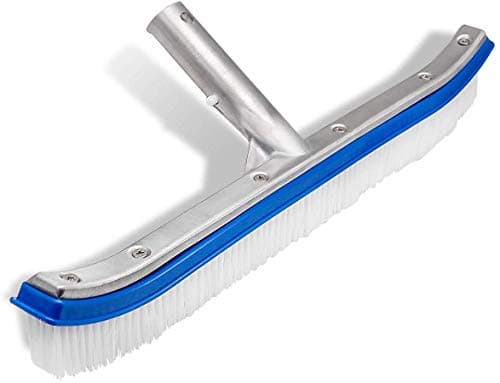
Pool Wall Brush with Nylon Bristles
Various
Shares the telescopic pole you already own and prevents more chemical spend than anything else you can buy for the money. Nylon bristles, always, on a vinyl liner.
#ad how this is funded · price as of October 8, 2026
Key specs
- Typical width
- 18 inches is the common size
- Bristles
- Nylon for vinyl liners — never stainless on vinyl
- Head
- Plastic or aluminum backed; curved ends reach corners
- Fitting
- Standard telescopic pole connection
How it scoresour reading of published specs, not a test result
- Sizing fit
- 8.5
- Running cost
- 10.0
- Maintenance
- 9.0
- Build
- 7.5
- Value
- 9.5
Overall 8.9 / 10
What works
- Lifts the biofilm that becomes visible algae, before you can see it
- Shares the pole with the skimmer net and the vacuum head, so it adds no storage
- Curved ends actually reach the wall-to-floor corner where algae starts
- No running cost and nothing to replace
What doesn't
- Wide heads are harder to control on a curved above-ground wall
- Cheap heads shed bristles into the pool, which then load the filter
- Needs a pole long enough to reach the middle, which is bought separately
- Stainless-bristle versions exist and will damage a vinyl liner — read the label
Skip it if: Anything on the floor that needs removing rather than disturbing. Brushing lifts it; a vacuum takes it out.
What it costs to run: A few dollars, once, and it lasts seasons. Measured against a bottle of algaecide and a heavy shock, it is the cheapest chemistry on this site.
Several seasons: Buy-once. Built and warranted to come back out of the box for a few years, if you store it properly.
Specs from: 18-inch nylon pool wall brush — current Amazon listing and published specifications
The realistic vacuum for a seasonal pool
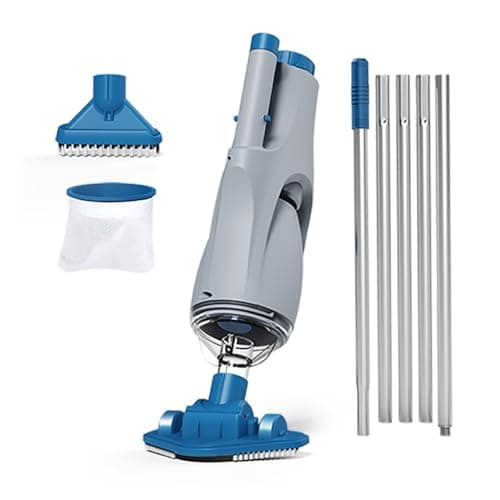
Rechargeable Handheld Pool Vacuum
Various
Battery, no hoses, no pump connection. It picks up what settles on the floor and that is genuinely all a seasonal above-ground pool needs.
Key specs
- Power
- Rechargeable battery
- Runtime
- Published per model — typically enough for one small pool
- Collection
- Onboard filter bag or chamber
- Connection
- None to the pool's filtration
How it scoresour reading of published specs, not a test result
- Sizing fit
- 8.0
- Running cost
- 9.5
- Maintenance
- 7.5
- Build
- 7.0
- Value
- 8.5
Overall 8.2 / 10
What works
- No hoses to connect and no risk of losing pump prime
- Works in a pool too small for a hose-driven vacuum head
- Cheap enough that it is not a difficult decision
What doesn't
- Battery runtime is short, and on a bigger pool you will be recharging mid-job
- Suction is modest, so it lifts silt and not much heavier
- The onboard filter needs emptying constantly
Skip it if: A large pool with real debris. If leaves are the problem rather than silt, you want a hose-driven head.
What it costs to run: The cost here is your time rather than power. On a pool over about 5,000 gallons the recharge cycles make this genuinely tedious, and that is the argument for stepping up.
One honest season: The cheapest setup that genuinely works for a season of real swimming. Nothing spare, nothing missing.
Questions people actually ask
Is the pump that comes with a frame pool good enough?
Do I need a sand filter on a small pool?
What is the most useful thing to buy for a small pool?
Is a robotic cleaner worth it on a small pool?
Sources
Read next
- Equipment, sized to your pool and costed by the wattPumps, filters, vacuums, heaters and ladders - matched to your gallons and priced by what they draw.
- Equipment for a big above-ground pool, where the small-pool answers stop workingThe filtration, timing and cleaning kit for a 6,000-gallon-plus above-ground pool, and why the small-pool defaults stop applying.
- Sizing a pump: the number on the box is not the number you useTurnover time computed from published system flow rates for common pool volumes, and why an oversized pump costs you money every day.
- Above-ground pool pumps: how many gallons per hour you actually needPumps matched to pool volume by system flow rate, with the season running-cost table manufacturers do not publish.
- Filter cartridges: the consumable that decides whether your water is clearGetting the right cartridge for your pump, how many a season takes, and why buying singly is where this line gets expensive.
- The best 12-foot pools, and why 12 feet is the sensible sizeFrame and inflatable 12-foot pools side by side, with the fill cost and season chlorine bill computed from published gallons.
- The cheapest pool setup that actually works for a yearA complete, deliberately minimal first-year setup: the pool, the pump, the testing, the chlorine and the one tool you will use most.
- The manual pool tools that do most of the real workNets, poles and vacuum heads compared against powered cleaners for a seasonal above-ground pool, on running cost as well as capability.