Pool Costs · Cheapest Honest Setup
The cheapest pool setup that actually works for a year
Not the cheapest pool. The cheapest complete setup - because a pool with no test kit and no way to skim leaves is not cheaper, it is just unfinished.
Heads up: we earn a commission if you buy through the links on this page, at no extra cost to you. It never decides the ranking — here is how we pick and here is the full disclosure. Prices are checked automatically; last verified October 8, 2026.
Quick picks
Segmented before it is ranked — the right answer depends on which of these you actually are. Tap any row for the full write-up.
The pool and the pump
The smallest thing that is genuinely a pool rather than a paddling tub, with the pump sized to it rather than to the aisle.
| # | Product | Best for | Score | Price |
|---|---|---|---|---|
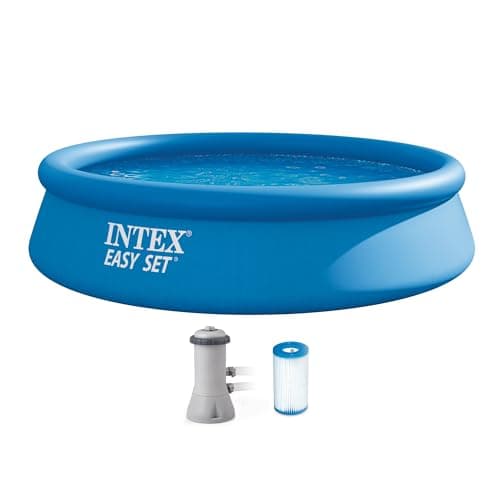
| 1 | Intex Easy Set Pool Set, 12ft x 30in Inflate the ring, add water, done. It is the fastest route from box to swimming that exists, and it is honest about being a seasonal item rather than a fixture. | Water in the yard this weekendOne honest season | 8.3out of 10 | |
| 2 | 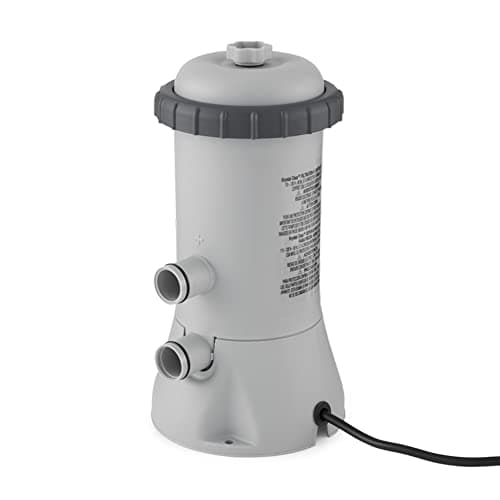 Intex Krystal Clear C530 Cartridge Filter Pump 530 GPH pump flow, 475 GPH through the system. The right pump for a 12-foot pool and badly undersized for anything much bigger. | Small frame and inflatable poolsOne honest season | 8.0out of 10 |
The chemistry, done cheaply but properly
Seven readings rather than five, tablets metered rather than dumped. Both of these are cheap; neither is optional.
| # | Product | Best for | Score | Price |
|---|---|---|---|---|
| 1 | 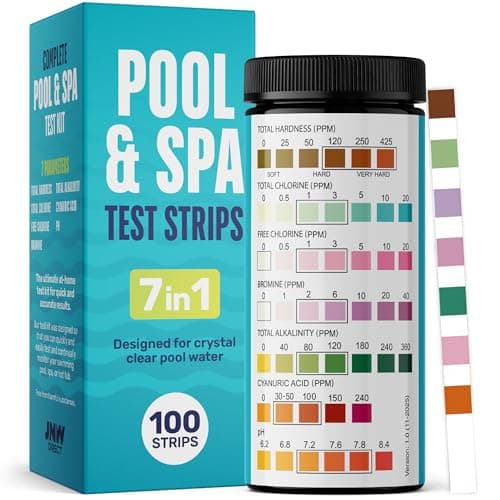 JNW Direct 7-in-1 Pool and Spa Test Strips Covers the same seven parameters as the AquaChek at a lower cost per strip. The color chart is harder to read in sunlight, which is a real usability cost rather than a nitpick. | Seven readings at a lower priceOne honest season | 8.0out of 10 | |
| 2 | 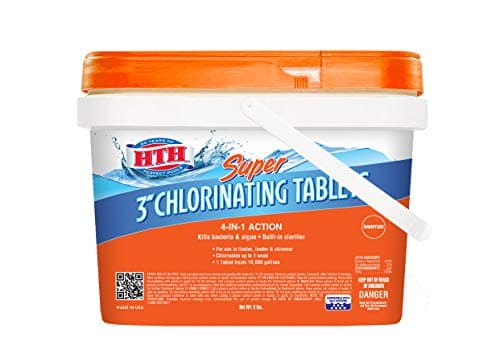 HTH 3-Inch Chlorinating Tablets Functionally the same product as any other stabilized trichlor tablet. Buy on price per pound of available chlorine, not on the label. | The direct alternativeOne honest season | 8.4out of 10 | |
| 3 | 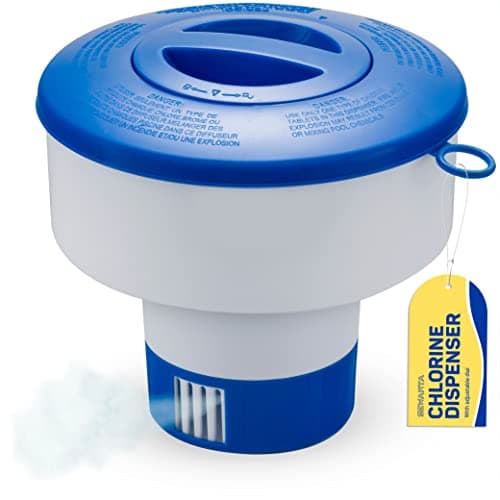 Floating Chlorine Tablet Dispenser Two dollars of plastic that decides whether your chlorine dissolves evenly over days or sits in a corner bleaching your liner. Buy it with the tablets, not after. | Making tablets work properlyOne honest season | 9.0out of 10 |
The one tool you will use most
Five dollars of skimmer net removes more future chlorine demand than anything else you can buy for the money.
| # | Product | Best for | Score | Price |
|---|---|---|---|---|
| 1 | 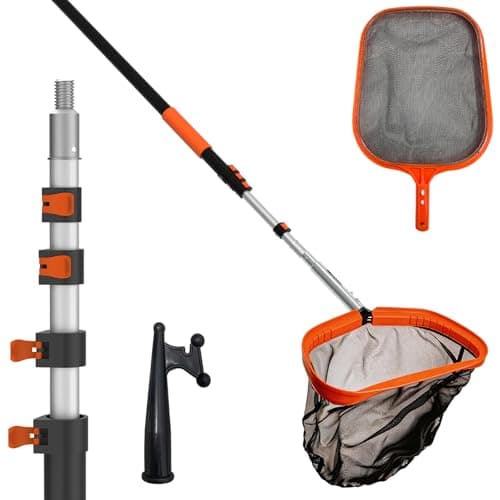 Skimmer Net with Telescopic Pole Catching leaves while they float is a two-minute job. Catching them after they sink is a vacuum session and a filter clean. Buy this first. | The five-dollar tool you use mostSeveral seasons | 8.8out of 10 |
The short version
- The cheapest pool is not the cheapest setup. A pool with no test kit, no dispenser and no net is the version that gets abandoned in week four.
- Go small deliberately. At 1,485 gallons the water costs about $9 to fill and the season needs roughly five chlorine tablets. Every recurring cost is tied to that number.
- Buy seven-way strips, not five-way. The extra reading is cyanuric acid, which is the one that explains why your chlorine behaves the way it does.
- The complete list is six items. Everything else in the pool aisle can wait until you have a specific problem.
What “cheapest” has to mean
It is easy to find the cheapest pool. It is not useful, because the cheapest pool arrives with no way to test the water, no way to meter chlorine and nothing to get leaves out with, and those three omissions are what produce the cloudy-water disappointment that ends most first seasons. A cheap setup that works is a different shopping list from a cheap pool.
So this page prices the whole thing. Six items, each of them the least expensive option that genuinely does the job, and an honest account of what the first year costs to run once they are all in the yard.
Start with gallons, because everything else follows
The single most effective cost decision in this category is buying a smaller pool, and it is effective permanently rather than once. Intex publishes 1,485 gallons at 80 percent full for the 12-foot Easy Set, with 23 inches of water depth and a ready-for-water claim of about ten minutes. That volume is what makes everything downstream cheap.
What 1,485 gallons costs to run
- Published capacity, Intex Easy Set 12ft
- 1,485 gallons
- US average water price [EPA WaterSense]
- $6.06 / 1,000 gal
- Published tablet dosing [Clorox Pool&Spa]
- 2 tablets / week / 10,000 gal
- Season length
- 120 days ≈ 17 weeks
Fill: 1.485 × $6.06 = $9.00 Tablets: 2 × (1,485 ÷ 10,000) × 17 ≈ 5.0
About $9 of water and roughly 5 chlorine tablets for the season
The six items, and why each one is on the list
The pool. A 12-foot inflatable is the honest bottom of the market that is still a pool rather than a toy. It is consumable rather than permanent — a season or two of hard use is a normal life — and paying more does not buy a better version of the same thing. If you want the frame version instead, our 12-foot roundup compares them at the same diameter.
The pump. Sized to the gallons, not to the shelf. A 530 GPH cartridge pump is what this volume needs, and it is also the cheapest thing in the range to run, which matters more than the purchase price across a season. Our pump sizing guide shows the turnover arithmetic if you want to check it against your own pool.
Seven-way test strips. This is where the cheapest option is genuinely the wrong one. Five-way strips omit cyanuric acid, which is the reading that explains why chlorine vanishes on a sunny day. A seven-way strip costs the same order of money and tells you seven things. Our test kit roundup covers the options.
Chlorine tablets. Three-inch trichlor tablets are the default for good reason: stable, cheap per week, and they carry their own stabilizer. Compare on the available chlorine percentage printed on the label rather than on brand. Our tablet guide does that comparison.
A floating dispenser. The cheapest item that prevents the most problems. It meters tablets steadily instead of letting the level sawtooth between weekly doses, and it stops tablets sitting on the liner. It lasts years.
A skimmer net on a telescopic pole. Two minutes a day with this removes organic material before it sinks and becomes chlorine demand. It is the tool you will use most and the one most often left off the list.
| Item | Why it is on the list | Buy again? |
|---|---|---|
| 12ft inflatable pool | 1,485 gallons — the cheapest thing that is genuinely a pool | Every season or two |
| 530 GPH cartridge pump | Sized to the volume; cheapest in the range to run | No — lasts |
| Seven-way test strips | Includes cyanuric acid, which five-way strips omit | One bottle a season |
| 3-inch trichlor tablets | ≈ 5 tablets for a 17-week season at this volume | Yes, per season |
| Floating dispenser | Meters the tablets instead of dosing in bursts | No — lasts years |
| Skimmer net and pole | Removes debris before it becomes chlorine demand | No — lasts |
What this setup will not do
It will not let adults swim. At 23 inches of water this is a sitting pool, and if you want to push off and move you need a 42-inch or 52-inch wall with the recurring costs that follow — our pools for adults page does that arithmetic. It will not survive winters outside; it comes down and gets dried and stored, which our storage guide covers. And it will not heat itself: a solar cover helps and a heater is a serious electricity decision rather than an accessory.
What it will do is give a family a summer of water in the yard for a genuinely small amount of money, with a routine that takes about half an hour a week. If you are still deciding whether any of this is worth it, our are they worth it page argues both sides, and the first-time owner guide is what to read the week it arrives.
The picks, in full
Scores are our own reading of published specifications. They are not test results — we have not tested these products and we do not claim to.
Pick #1 · Water in the yard this weekend
Intex Easy Set Pool Set, 12ft x 30in
Intex
Inflate the ring, add water, done. It is the fastest route from box to swimming that exists, and it is honest about being a seasonal item rather than a fixture.
#ad how this is funded · price as of October 8, 2026
Key specs
- Water capacity
- 1,485 gallons (80% full)
- Water depth
- 23 inches
- Pump supplied
- 530 GPH Krystal Clear cartridge pump
- Material
- 3-ply, puncture resistant
- Manufacturer setup claim
- Ready for water in about 10 minutes
- Pump wattage
- Not published by Intex
How it scoresour reading of published specs, not a test result
- Build
- 5.5
- Setup
- 9.8
- Upkeep
- 8.5
- Running cost
- 9.2
- Value
- 8.8
Overall 8.3 / 10
What works
- Genuinely 10 minutes to set up — the top ring rises with the water and there is no frame to assemble
- 1,485 gallons at 80% is a real, filterable pool rather than a paddling pool
- Comes down as fast as it goes up, which makes mid-season relocation possible
- Cheapest way to find out whether your family actually wants a pool before committing to a frame one
What doesn't
- The inflated ring is the single point of failure and it is exposed to sun all season
- 23 inches of water is shallow — this is for cooling off, not swimming
- Soft walls flex, so it needs level ground as much as a frame pool does
Skip it if: Lasting. Treat this as a two-or-three-season item at best and you will not be disappointed; expect five years and you will be.
What it costs to run: A fill at the EPA WaterSense average of $6.06 per 1,000 gallons is about $9. The 530 GPH pump moves 1,485 gallons in under three hours, so this is a pool where a genuinely short daily run does the job — which is where the running-cost saving actually comes from.
One honest season: The cheapest setup that genuinely works for a season of real swimming. Nothing spare, nothing missing.
Specs from: Intex — Easy Set 12' x 30' pool set, EPA WaterSense — cost per 1,000 gallons
Pick #2 · Small frame and inflatable pools
Intex Krystal Clear C530 Cartridge Filter Pump
Intex
530 GPH pump flow, 475 GPH through the system. The right pump for a 12-foot pool and badly undersized for anything much bigger.
#ad how this is funded · price as of October 8, 2026
Key specs
- Pump flow rate
- 530 GPH
- System flow rate
- 475 GPH
- Cartridge
- Type A
- Wattage
- Not published by Intex
How it scoresour reading of published specs, not a test result
- Sizing fit
- 8.0
- Running cost
- 9.0
- Maintenance
- 7.0
- Build
- 7.0
- Value
- 8.5
Overall 8.0 / 10
What works
- Correctly matched to the 12ft Prism Frame and Easy Set pools it ships with
- Smallest pump here that will still genuinely turn over a real pool
- Type A cartridges, which are everywhere
What doesn't
- Undersized the moment you upgrade the pool, and it will not carry over
- No wattage published
- Cartridge needs rinsing frequently in a busy small pool
Skip it if: Anything over about 2,000 gallons. Below that it is right; above it you are running it all day for one turnover.
What it costs to run: 475 GPH system flow turns over 1,718 gallons in about 3.6 hours, so a 7-hour daily run is two full turnovers. That is a genuinely short run time and it is where a small pool's low running cost actually comes from.
One honest season: The cheapest setup that genuinely works for a season of real swimming. Nothing spare, nothing missing.
Specs from: Intex — Krystal Clear cartridge filter pumps
Pick #3 · Seven readings at a lower price
JNW Direct 7-in-1 Pool and Spa Test Strips
JNW Direct
Covers the same seven parameters as the AquaChek at a lower cost per strip. The color chart is harder to read in sunlight, which is a real usability cost rather than a nitpick.
Key specs
- Tests
- 7 parameters including cyanuric acid
- Count
- 100 strips (typical pack)
- Extras
- Companion app offered by the manufacturer
How it scoresour reading of published specs, not a test result
- Accuracy
- 6.5
- Ease
- 8.0
- Coverage
- 9.0
- Cost per use
- 9.5
- Value
- 8.5
Overall 8.0 / 10
What works
- Includes cyanuric acid, which is the thing a cheap 5-way leaves out
- Lower cost per strip than the category benchmark
- Large pack sizes mean you test more often, which matters more than precision
What doesn't
- Color differentiation between adjacent bands is tighter than on the AquaChek chart
- App-based reading is a nice idea and an extra step you will stop taking by July
- Less established than AquaChek if you want a long track record
Skip it if: Reading in direct sun on a bright deck, which is exactly where you will be using it.
What it costs to run: Cheapest route to a full seven-parameter reading. Given that testing frequency beats testing precision for a seasonal pool, buying more strips for the same money is a defensible trade.
One honest season: The cheapest setup that genuinely works for a season of real swimming. Nothing spare, nothing missing.
Pick #4 · The direct alternative
HTH 3-Inch Chlorinating Tablets
HTH
Functionally the same product as any other stabilized trichlor tablet. Buy on price per pound of available chlorine, not on the label.
#ad how this is funded · price as of October 8, 2026
Key specs
- Type
- Stabilized trichlor, 3-inch tablets
- Contains stabilizer
- Yes
- Compare on
- Available chlorine percentage stated on the label
How it scoresour reading of published specs, not a test result
- Effectiveness
- 9.0
- Ease
- 9.0
- Water impact
- 6.0
- Cost per season
- 8.8
- Value
- 8.5
Overall 8.4 / 10
What works
- Chemically equivalent to competing trichlor tablets — this is a commodity
- Widely available in large buckets, which is the cheaper format
- Long shelf life if the bucket stays sealed and dry
What doesn't
- Same cyanuric acid accumulation as every other trichlor product
- Same downward pH pressure over a season
- Bucket sizes are often larger than a small seasonal pool will use in a year
Skip it if: Being different. If you are comparing trichlor brands you are comparing price, and you should be.
What it costs to run: Cost per season is decided by the available-chlorine percentage on the label and the bucket size, not the brand. Compare those two numbers and buy the cheaper one.
One honest season: The cheapest setup that genuinely works for a season of real swimming. Nothing spare, nothing missing.
Pick #5 · Making tablets work properly
Floating Chlorine Tablet Dispenser
Various
Two dollars of plastic that decides whether your chlorine dissolves evenly over days or sits in a corner bleaching your liner. Buy it with the tablets, not after.
#ad how this is funded · price as of October 8, 2026
Key specs
- Function
- Holds 3-inch tablets, meters dissolution rate
- Adjustment
- Vented base, adjustable on most models
- Compatibility
- Standard 3-inch tablets
How it scoresour reading of published specs, not a test result
- Effectiveness
- 8.0
- Ease
- 9.5
- Water impact
- 9.0
- Cost per season
- 9.8
- Value
- 9.5
Overall 9.0 / 10
What works
- Adjustable venting lets you slow or speed dissolution to match the weather
- Keeps tablets off the liner, which is what causes bleach spots
- Trivially cheap and lasts years
What doesn't
- Drifts to one end of the pool in wind, so distribution is uneven without circulation
- Must be removed before swimming with small children
- Cheap ones crack after a season in UV
Skip it if: Being left in an empty or unfiltered pool. Without circulation it creates a concentrated pocket rather than an even dose.
What it costs to run: The cheapest item on this site and one of the highest-return: even dissolution means you use fewer tablets to hold the same free chlorine level.
One honest season: The cheapest setup that genuinely works for a season of real swimming. Nothing spare, nothing missing.
Pick #6 · The five-dollar tool you use most
Skimmer Net with Telescopic Pole
Various
Catching leaves while they float is a two-minute job. Catching them after they sink is a vacuum session and a filter clean. Buy this first.
Key specs
- Type
- Flat skimmer or deep leaf rake
- Pole
- Telescopic, sized to reach the middle of your pool
- Frame
- Plastic or aluminum
How it scoresour reading of published specs, not a test result
- Retention
- 8.5
- Durability
- 7.0
- Handling
- 9.0
- Running cost
- 10.0
- Value
- 9.5
Overall 8.8 / 10
What works
- The single most-used tool in pool ownership and among the cheapest
- Removing debris before it sinks prevents most of the work that follows
- A deep leaf rake handles far more per pass than a flat skimmer
What doesn't
- Cheap plastic frames snap where the pole attaches, which is the standard failure
- Telescopic poles seize with hard water unless rinsed
- A too-short pole means you cannot reach the middle, which makes it useless
Skip it if: Anything on the floor. This is a surface tool and pretending otherwise is how debris ends up in the filter.
What it costs to run: Free to use and it directly reduces your chemical bill: organic debris consumes chlorine as it breaks down, so removing leaves is the cheapest sanitizer saving there is.
Several seasons: Buy-once. Built and warranted to come back out of the box for a few years, if you store it properly.
Questions people actually ask
What is the cheapest way to have a pool in the backyard?
Can I run a pool without a pump?
What is the cheapest thing I should not skimp on?
How much does a cheap pool cost to run for a season?
Sources
Read next
- What a pool actually costs, with the arithmetic shownPurchase, electricity, chemicals, water and replacement parts - added up, sourced, and shown as arithmetic you can redo.
- What an above-ground pool costs to buyThe purchase side: what is in the kit, what is not, and the day-one spend that turns a cheap pool into a not-cheap one.
- What an above-ground pool actually costs to run for a yearElectricity, chemicals, water and consumables for a full season - every input sourced, every calculation shown, and every assumption named.
- Are backyard pools worth it?The four questions that decide whether a pool is a good buy for your household - argued honestly in both directions.
- The best backyard pools on a budgetThe lowest-cost pools that are genuinely worth owning, plus the three false economies that make a cheap pool expensive.
- First-time pool owner: the complete first monthThe pillar guide: day-one shopping list, the four water readings, the weekly routine and the week-three problem everybody gets.
- What to buy with the pool, and what can waitThe day-one list for a first above-ground pool - testing, sanitizer, a dispenser and the two manual tools - plus what to deliberately postpone until the pool is running.