Pool Equipment
Sand filters, and the flow rate that is not on the box
A sand filter is sold on pump flow and sized on system flow, and those are two different numbers. One maker here publishes both; the rest publish the flattering one.
Heads up: we earn a commission if you buy through the links on this page, at no extra cost to you. It never decides the ranking — here is how we pick and here is the full disclosure. Prices are checked automatically; last verified October 8, 2026.
Quick picks
Segmented before it is ranked — the right answer depends on which of these you actually are. Tap any row for the full write-up.
The one most frame pools should buy
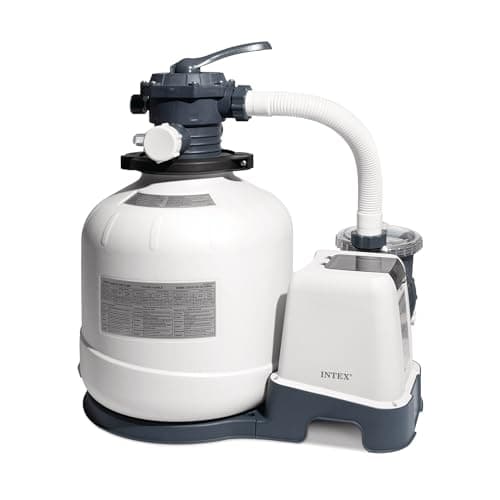
Intex publishes both the pump flow and the lower system flow, approves glass media with a stated capacity, and builds in a 24-hour timer.
| # | Product | Best for | Score | Price |
|---|---|---|---|---|
| 1 | Intex Krystal Clear 3,000 GPH Sand Filter Pump (26651EG) The sand filter most Intex and Bestway pools end up with. Intex publishes the number that matters — 2,450 gph through the system, not the 3,000 gph on the box — and approves glass media as an alternative. | The frame-pool owner moving off cartridgesSeveral seasons | 8.2out of 10 |
Smallest pools
Under 20 lb of sand and a 300 to 4,800 gallon range. The cheapest way off cartridges for a small frame pool.
| # | Product | Best for | Score | Price |
|---|---|---|---|---|
| 1 | 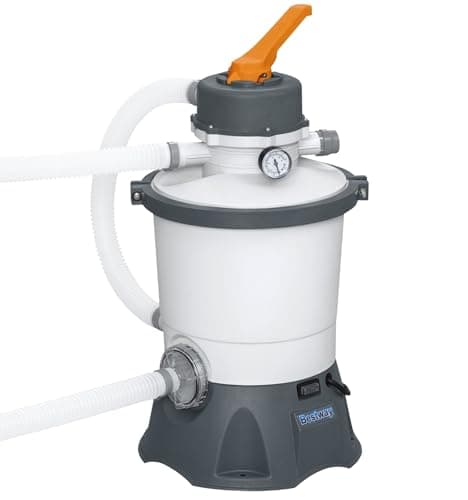 Bestway Flowclear 800 gal Sand Filter Pump (58516E) An entry-level sand system for pools from 300 to 4,800 gallons. It needs about 19 lb of sand rather than a hundred, which is the whole argument for it. | The smallest pool that still wants sandOne honest season | 7.8out of 10 |
Mid-size frame pools
Covers up to 11,200 gallons on the same small sand charge. Read Bestway's restriction to storable pools before buying.
| # | Product | Best for | Score | Price |
|---|---|---|---|---|
| 1 | 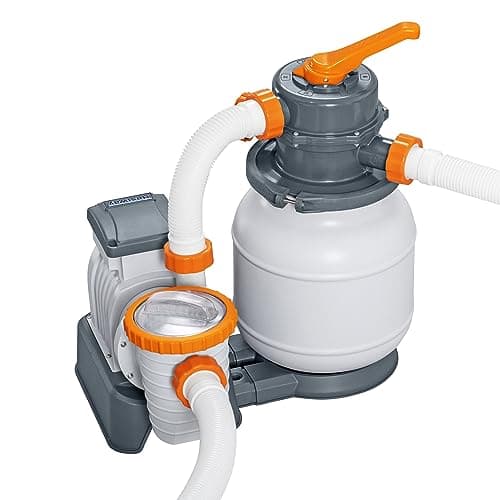 Bestway Flowclear 1,500 gal Sand Filter Pump (58498E) Nearly double the flow of the 800 for pools up to 11,200 gallons. Read one line in the manual before buying: Bestway says it is for storable pools only, not permanently installed ones. | Mid-size frame pools, storable onlySeveral seasons | 7.9out of 10 |
A permanent pool, properly filtered
Real pool plant: a 50 PSI tank, a serviceable VariFlo valve and a published parts warranty. Hayward's own figure is 0.85 HP, not the 1 HP on the listing.
| # | Product | Best for | Score | Price |
|---|---|---|---|---|
| 1 | 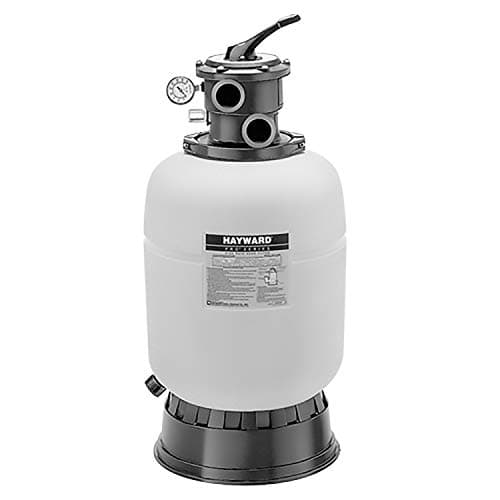 Hayward ProSeries 16 in Sand Filter System (W3S166T1580S) Pool-industry equipment rather than pool-aisle equipment: a 50 PSI tank, a VariFlo valve and a two-year parts warranty. Note that Hayward publishes 0.85 HP where retailers advertise 1 HP. | A permanent pool that will outlive its filterMore than you need yet | 8.0out of 10 |
Big water, fewer backwashes
A quarter more filter area and 5 more GPM than the 16 inch system, which on a 24 foot pool is the difference between keeping up and falling behind.
| # | Product | Best for | Score | Price |
|---|---|---|---|---|
| 1 | 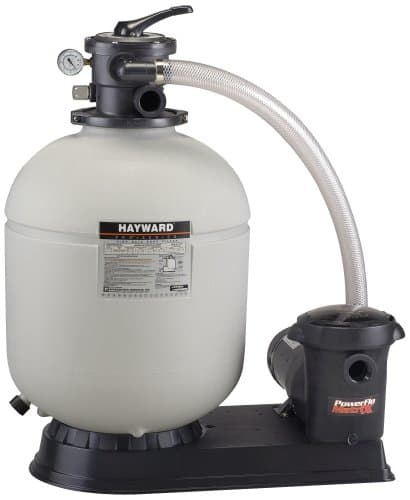 Hayward ProSeries 18 in Sand Filter System (W3S180T92S) The 18 inch tank adds a quarter more filter area and 5 GPM over the 16, which on a 24 foot pool is the difference between chasing the water and staying ahead of it. | Big water, and long runs between backwashesMore than you need yet | 8.1out of 10 |
The short version
- Pump flow is not system flow. Intex publishes 3,000 gph on the pump and 2,450 gph through the system. Size your pool against the second number.
- Sand filters are the coarsest common medium. Industry figures put sand at 20 to 40 microns against 10 to 20 for cartridges. You buy sand for convenience, not clarity.
- The sand charge ranges from 19 lb to 150 lb. That is a genuine difference in what you carry home, and how much a refill costs.
- Backwashing is where sand filters spend money. One municipal source puts a typical backwash at 250 to 1,000 gallons of water.
What a sand filter actually does
Water is pushed down through a bed of sharp silica sand. Dirt lodges between the grains, and filtered water leaves through laterals at the bottom. When the bed clogs, you reverse the flow and send the trapped dirt out of the waste line. That is backwashing, and it is the entire argument for sand over cartridges: no rinsing a pleated element every fortnight, no buying replacements.
The cost of that convenience is fineness. Leslie’s puts sand at 20 to 40 microns, against 10 to 20 for cartridges and 3 to 5 for DE, and In The Swim publishes the same ranges. Sand is the coarsest of the three. In a properly balanced above-ground pool that is invisible; on a pool fighting fine particulate, it is why the water stays faintly hazy, and it is why our clarifier guide exists.
The number that decides everything: system flow
Every sand filter is advertised on the pump’s flow rate. That figure is measured at the pump, not through a tank full of sand. Intex is unusually straight about this, publishing a 3,000 gph pump flow and a 2,450 gph system flow on the same page. The second number is the one that turns your pool over.
Hayward sidesteps the issue by publishing in GPM and by filter area: 30 GPM through 1.4 square feet on the 16 inch system, 35 GPM through 1.75 square feet on the 18. Bestway publishes a single gallons-per-hour figure and no horsepower at all.
To size a filter you need your pool volume and a target turnover. Our pump sizing guide does that arithmetic properly, and our run-time guide converts it into hours a day. The short version: divide your gallons by the system flow, and if the answer is more than eight hours you are under-filtered.
Turnover on a 24 foot pool
- Pool volume (Intex Ultra XTR 24 ft)
- 12,481 gal
- Intex system flow (not pump flow)
- 2,450 gph
- Hayward ProSeries 18 design flow, 35 GPM
- 2,100 gph
12,481 gal ÷ 2,450 gph = 5.1 h | 12,481 gal ÷ 2,100 gph = 5.9 h
Both clear one turnover in under six hours
How much sand, and what grade
This is the difference nobody mentions until delivery day. The Bestway units take about 19 to 20 lb. The Intex takes 120 lb. The Hayward 16 inch takes 100 lb and the 18 inch takes 150 lb. That is the difference between one bag and three, and it repeats every few years.
The grade is specific and it is not optional. Intex specifies No. 20 silica at 0.45 to 0.85 mm with a uniformity coefficient under 1.75; Hayward specifies No. 20 silica at 0.45 to 0.55 mm. Bestway’s manuals go further and state that using the wrong size reduces filtering performance and may damage the filter, voiding the warranty.
Sand does not last forever, because the grains round off and stop catching dirt. Intex publishes four to five years under normal conditions, two to three where the air is dusty, and eight to nine years for glass media. That is a real running cost, and it is covered in our filter media guide.
| System | Published flow | Sand charge | Pool range | Warranty |
|---|---|---|---|---|
| Intex 26651EG | 3,000 gph pump / 2,450 gph system | 120 lb | 5,500-19,600 gal | 2 years limited |
| Bestway 58516E | 800 gph | About 19 lb | 300-4,800 gal | Not published |
| Bestway 58498E | 1,500 gph | About 20 lb | 300-11,200 gal | Not published |
| Hayward ProSeries 16 | 30 GPM (1.4 sq ft) | 100 lb | Sized by turnover | 2 years parts |
| Hayward ProSeries 18 | 35 GPM (1.75 sq ft) | 150 lb | Sized by turnover | 2 years parts |
Alternative media, and who actually approves it
Glass and filter balls are both sold as sand replacements. Whether they are allowed depends entirely on which filter you own, and the three makers here take three different positions.
Intex approves glass explicitly and publishes a capacity for it: 85 lb, against 120 lb of sand, with a stated particle size of 0.4 to 0.8 mm. Bestway’s manuals void the warranty for media other than the specified sand and mention no alternatives. Hayward publishes nothing either way — its manual specifies No. 20 silica and is silent on substitutes.
Filter balls are a separate question again, and one where the marketing has run well ahead of the evidence. Our filter balls roundup goes through the claims in detail; the summary is that no filter manufacturer here publishes an approval for them.
The running cost nobody budgets: backwash water
Every backwash sends filtered pool water down the drain, and it has to be replaced and re-treated. The City of Chandler, Arizona puts a typical backwash at 250 to 1,000 gallons. Intex gives a duration rather than a volume: backwash until the sight glass runs clear, about three minutes.
On a small frame pool, 250 gallons is a meaningful fraction of the whole pool, and it takes your chemistry with it. That is the honest case for a larger tank on a larger pool: more filter area means longer between backwashes, and fewer backwashes means less water and less chemistry replaced. Our backwashing guide covers the rinse step most owners skip, which is what sends dirty water back into the pool.
Which one belongs on your pool
Under about 5,000 gallons: the Bestway 800. It is the only unit here sized for genuinely small pools, and 19 lb of sand suits a pool that comes down each autumn.
5,000 to 11,000 gallons, seasonal frame pool: the Bestway 1,500 if the pool is storable, the Intex if it is bigger or if you want the timer and the glass-media option. Note Bestway’s own restriction: the 1,500 is specified for storable pools, not permanent installations.
A permanent steel-wall pool: a Hayward. The difference is not the flow, it is that the tank is rated to 50 PSI, the valve is serviceable, the parts are stocked, and there is a published two-year parts warranty. On a pool you intend to keep for a decade, that is the relevant specification, and our permanent pools roundup is where those pools live.
Over about 15,000 gallons: the Hayward 18 inch, for the filter area rather than the flow. Our large-pool equipment guide covers what else changes at that size.
How we picked
We have not tested these filters. Scores are our reading of published specifications, with credit for publishing the unflattering numbers: Intex for its system flow, Hayward for its horsepower and pressure rating. Bestway publishes neither horsepower nor wattage for either unit, and no manufacturer here publishes pump wattage at all — so any running-cost figure you see quoted for these filters was not read off a maker’s page.
Backwashing properly, and the step everyone skips
A sand filter only stays effective if the bed is cleaned, and cleaning it is a sequence rather than a switch. Intex’s manual gives the endpoint rather than a duration: backwash until clean, clear water runs through the sight glass or drain outlet, about three minutes.
The step that gets missed is the rinse afterwards. Backwashing lifts and turns the bed; if you go straight back to filter, the first thing the pool receives is the disturbed sand and debris sitting above the laterals. Every six-function valve here has a rinse position for exactly that reason, and our backwashing guide covers the full sequence.
Two habits make the job cheaper. Note the clean pressure when the filter is fresh and write it on the tank, so you are backwashing on a real change rather than a schedule. And backwash after vacuuming rather than before, since vacuuming is what actually loads the bed.
The sand itself: grade, life and the refill job
The grade is specified, not suggested. Intex asks for No. 20 silica at 0.45 to 0.85 mm with a uniformity coefficient under 1.75; Hayward’s ProSeries manual asks for No. 20 silica at 0.45 to 0.55 mm. Bestway’s manuals state that the wrong size reduces performance, may damage the filter and can void the warranty.
Sand does not dissolve, it rounds. Grains that arrive sharp are worn smooth by years of water and backwashing, and smooth grains let dirt through. Intex publishes the interval plainly: four to five years for residential filters under normal conditions, and two to three years in dusty conditions or where frequent backwashing is needed. Hayward and Bestway publish no interval at all.
Replacing it is the job nobody warns you about. Wet sand has to come out of a tank through an opening designed for pouring it in, usually with a scoop and a wet vacuum, and on a Hayward that is 100 to 150 lb of it. That single afternoon is the strongest argument for the lighter media covered in our filter balls roundup, and for Intex’s approved glass option at 85 lb with a published eight to nine year life.
What we would not buy
A filter sized on pump flow. If a listing quotes only the pump’s gallons per hour, assume the figure through the sand is materially lower — Intex publishes 3,000 gph at the pump and 2,450 gph through the system for the same unit.
A model with no live manufacturer page. Two Bestway units here are absent from Bestway’s own US catalog, which makes spares and warranty support a question rather than a given.
A big filter for a small pool. The Intex unit publishes a minimum of 5,500 gallons. Below that, a cartridge pump is the correct answer and our pump roundup covers it — a sand filter on a 2,000 gallon pool is 120 lb of sand solving a problem the pool does not have.
The picks, in full
Scores are our own reading of published specifications. They are not test results — we have not tested these products and we do not claim to.
Pick #1 · The frame-pool owner moving off cartridges
Intex Krystal Clear 3,000 GPH Sand Filter Pump (26651EG)
Intex
The sand filter most Intex and Bestway pools end up with. Intex publishes the number that matters — 2,450 gph through the system, not the 3,000 gph on the box — and approves glass media as an alternative.
Key specs
- Pump flow
- 3,000 gph (11.3 m³/hr)
- System flow
- 2,450 gph (9.2 m³/hr) — the figure to size from
- Motor
- 0.75 HP, 110-120V with GFCI
- Tank
- 16 in (410 mm)
- Sand
- 120 lb of #20 silica, 0.45-0.85 mm, uniformity coefficient under 1.75
- Glass media
- 85 lb capacity — Intex approves and sizes it
- Pool range
- 5,500 to 19,600 gal
- Valve
- Six functions: filter, backwash, rinse, recirculate, drain, closed
- Hoses
- Two 1.5 in (38 mm) connector hoses
- Warranty
- 2 years limited
How it scoresour reading of published specs, not a test result
- Sizing fit
- 8.5
- Running cost
- 7.5
- Maintenance
- 8.0
- Build
- 8.0
- Value
- 8.5
Overall 8.2 / 10
What works
- Intex publishes both the pump flow and the lower system flow, which is the honest number to size a pool against
- Glass media is approved with a published capacity, so the lighter alternative does not void the warranty
- Built-in 24-hour timer with 2 to 12 hour cycles, which a separate timer would otherwise cost
- Six-function valve including drain, so the filter doubles as the way to lower the pool
What doesn't
- 120 lb of sand is eight bags to carry, and it has to be bought separately
- Wattage is not published, so running cost has to be measured rather than read
- The 16 in tank is at the small end for pools near the top of its range
- Using the wrong sand grade voids the warranty, and the grade is specific
Skip it if: Small pools. The published minimum is 5,500 gallons; on a 10 or 12 foot pool this is more filter than the water needs, and a cartridge pump is the sane answer.
What it costs to run: Sand is the cheap part, and Intex says residential sand lasts four to five years, or two to three where air is dusty. Glass runs eight to nine. The running cost is the pump hours, which our pump electricity guide prices from the label.
Several seasons: Buy-once. Built and warranted to come back out of the box for a few years, if you store it properly.
Specs from: Intex — 16 in Krystal Clear sand filter pump, 3,000 gal pump flow rate: published specifications, Intex — Krystal Clear sand filter pump owner's manual (sand grade, media life)
Pick #2 · The smallest pool that still wants sand
Bestway Flowclear 800 gal Sand Filter Pump (58516E)
Bestway
An entry-level sand system for pools from 300 to 4,800 gallons. It needs about 19 lb of sand rather than a hundred, which is the whole argument for it.
#ad how this is funded · price as of October 8, 2026
Key specs
- Flow rate
- 800 gallons per hour
- Pool range
- 300 to 4,800 gal
- Tank
- 270 mm (about 10.6 in)
- Sand
- Approximately 8.5 kg (about 19 lb) per the manual; one retailer says 20 lb
- Sand grade
- #20 silica, 0.45-0.85 mm
- Valve
- Six modes: filter, rinse, circulate, backwash, closed, drain
- Power
- 110-120V
- Motor HP
- Not published
How it scoresour reading of published specs, not a test result
- Sizing fit
- 7.5
- Running cost
- 8.5
- Maintenance
- 8.0
- Build
- 7.0
- Value
- 8.0
Overall 7.8 / 10
What works
- Sized for the small frame pools that dominate this category, where bigger sand filters are wasted
- Under 20 lb of sand to buy and carry, against 120 lb for the Intex unit
- Full six-mode valve despite the small tank, including drain
- The cheapest route out of buying cartridges every few weeks
What doesn't
- 800 gph is genuinely slow; at the top of its stated range turnover takes most of a day
- Neither horsepower nor wattage is published
- Bestway states that using the wrong sand size can void the warranty
- Bestway's own US catalog no longer lists this model, which is a supply risk for parts
Skip it if: Growing with you. If there is any chance of a bigger pool next year, this filter does not move up with it — the 1,500 gal version or the Intex unit will.
What it costs to run: Sand at this size is one bag, replaced every few years. Against cartridges at roughly one per fortnight through a season, the arithmetic in our filter cartridge guide favors sand within a season or two.
One honest season: The cheapest setup that genuinely works for a season of real swimming. Nothing spare, nothing missing.
Specs from: Bestway — 58516E Flowclear 800 gallon sand filter pump owner's manual
Pick #3 · Mid-size frame pools, storable only
Bestway Flowclear 1,500 gal Sand Filter Pump (58498E)
Bestway
Nearly double the flow of the 800 for pools up to 11,200 gallons. Read one line in the manual before buying: Bestway says it is for storable pools only, not permanently installed ones.
Key specs
- Flow rate
- 1,500 gallons per hour
- Pool range
- 300 to 11,200 gal
- Tank
- 254 mm (about 10 in) per the manual
- Sand
- Approximately 9 kg (about 20 lb)
- Sand grade
- #20 silica, 0.45-0.85 mm
- Fits
- Pool valves with a 1.5 in outer diameter
- Restriction
- For storable pools only; Bestway says do not use with permanently installed pools
- Valve
- Six modes including backwash and drain
How it scoresour reading of published specs, not a test result
- Sizing fit
- 8.0
- Running cost
- 8.5
- Maintenance
- 8.0
- Build
- 7.0
- Value
- 8.0
Overall 7.9 / 10
What works
- Covers the whole mid-size frame pool range on one unit
- Still only around 20 lb of sand, which keeps the refill cheap and liftable
- 1.5 in fittings match the hoses most frame pools already use
- Six-mode valve, so backwashing and draining are both built in
What doesn't
- Bestway restricts it to storable pools, which rules out permanent steel-wall installs
- The published tank diameter is smaller than the lower-flow 58516E, which is odd and unexplained
- No published horsepower, wattage or warranty term
- Wrong sand grade voids the warranty, per the manual
Skip it if: Permanent pools. The manual is explicit, and using it on a steel-wall pool you intend to leave up is running outside the maker's stated use.
What it costs to run: One bag of sand every few years plus pump hours. Our pump run-time guide works out how many hours this actually needs, which for most pools is fewer than people run.
Several seasons: Buy-once. Built and warranted to come back out of the box for a few years, if you store it properly.
Specs from: Bestway — 58498E Flowclear sand filter owner's manual
Pick #4 · A permanent pool that will outlive its filter
Hayward ProSeries 16 in Sand Filter System (W3S166T1580S)
Hayward
Pool-industry equipment rather than pool-aisle equipment: a 50 PSI tank, a VariFlo valve and a two-year parts warranty. Note that Hayward publishes 0.85 HP where retailers advertise 1 HP.
#ad how this is funded · price as of October 8, 2026
Key specs
- Pump
- 0.85 HP PowerFlo LX per Hayward; retailers advertise it as 1 HP
- Filter area
- 1.4 sq ft
- Design flow
- 30 GPM, and 30 GPM on backwash
- Sand
- 100 lb of #20 silica, 0.45-0.55 mm
- Valve
- 1.5 in VariFlo control valve, 6 or 7 position
- Max pressure
- 50 PSI
- Size
- 16.5 x 16.5 in footprint, 33 in tall; system weight 55 lb
- Warranty
- 2 years parts; no labor coverage
How it scoresour reading of published specs, not a test result
- Sizing fit
- 8.0
- Running cost
- 6.5
- Maintenance
- 8.5
- Build
- 9.5
- Value
- 7.5
Overall 8.0 / 10
What works
- Built and warranted as pool equipment, with published pressure ratings and a real parts warranty
- The VariFlo valve is serviceable and its parts are stocked, unlike most sealed pool-aisle valves
- Sized for genuine turnover on a permanent above-ground pool rather than a seasonal frame pool
- Hayward publishes full specifications, including the ones that flatter it less
What doesn't
- Hayward's own site says 0.85 HP while the listing says 1 HP — the retailer number is the wrong one
- Several times the price of a frame-pool sand filter, for a difference most small pools cannot use
- Needs 100 lb of sand and a level pad to sit on
- Labor is not covered by the warranty, only parts
Skip it if: Seasonal frame pools. On a pool that comes down each autumn this is money spent on longevity you will never reach, and the plumbing does not match frame-pool hoses without adapters.
What it costs to run: A bigger motor is a bigger electricity bill, and it runs all season. Our pump electricity guide converts the label into dollars, and a timer pays for itself faster on this class of pump than on any other.
More than you need yet: Real capability a first-pool family cannot use yet. Buy cheaper and put the difference toward chemicals and a cover.
Specs from: Hayward — ProSeries 16 in sand filter system with PowerFlo LX pump, published specifications, Hayward — ProSeries above-ground high-rate sand filters manual (sand grade)
Pick #5 · Big water, and long runs between backwashes
Hayward ProSeries 18 in Sand Filter System (W3S180T92S)
Hayward
The 18 inch tank adds a quarter more filter area and 5 GPM over the 16, which on a 24 foot pool is the difference between chasing the water and staying ahead of it.
#ad how this is funded · price as of October 8, 2026
Key specs
- Pump
- 0.85 HP PowerFlo Matrix per Hayward; sold by retailers as 1 HP
- Filter area
- 1.75 sq ft
- Design flow
- 35 GPM, and 35 GPM on backwash
- Sand
- 150 lb of #20 silica
- Valve
- 7-position VariFlo valve with lever handle
- Max pressure
- 50 PSI
- Size
- 18.5 x 18.5 in footprint, 35 in tall
- Warranty
- 2 years parts; no labor coverage
How it scoresour reading of published specs, not a test result
- Sizing fit
- 8.5
- Running cost
- 6.5
- Maintenance
- 8.5
- Build
- 9.5
- Value
- 7.5
Overall 8.1 / 10
What works
- More filter area means longer between backwashes, which saves water as well as time
- The right size for the 24 foot and rectangular pools that defeat pool-aisle filters
- Seven-position valve with a lever action that survives a decade of use
- Same published pressure rating and parts warranty as the 16 in system
What doesn't
- 150 lb of sand, which is three heavy bags and an afternoon
- The horsepower discrepancy between Hayward and retailers applies here too
- Physically large next to a frame pool's own pump, and it needs somewhere solid to stand
- Overkill under about 10,000 gallons
Skip it if: Small yards and small pools. It is a full-size piece of pool plant; if the pool holds less than about 10,000 gallons the 16 in system already had more capacity than the water needed.
What it costs to run: Backwashing is where sand filters spend money — one municipal water utility puts a typical backwash at 250 to 1,000 gallons. Fewer, longer cycles is the saving the larger tank buys.
More than you need yet: Real capability a first-pool family cannot use yet. Buy cheaper and put the difference toward chemicals and a cover.
Specs from: Hayward — ProSeries 18 in sand filter system with PowerFlo Matrix pump, published specifications, City of Chandler, Arizona — pool care and backwash water use
Questions people actually ask
Is a sand filter better than a cartridge filter?
How often does filter sand need replacing?
Can I put filter balls or glass in any sand filter?
What size sand filter do I need?
How much water does backwashing waste?
Sources
- Intex — 16 in Krystal Clear sand filter pump, published specifications
- Intex — Krystal Clear sand filter pump owner's manual (sand grade, media life)
- Hayward — ProSeries 16 in sand filter system, published specifications
- Bestway — 58498E Flowclear sand filter owner's manual
- City of Chandler, Arizona — pool care, published backwash water use
- Leslie's — pool filter media types, published micron comparison
Read next
- Equipment, sized to your pool and costed by the wattPumps, filters, vacuums, heaters and ladders - matched to your gallons and priced by what they draw.
- Sand vs cartridge: it is a maintenance choice, not a quality oneThe honest comparison: consumable cost, backwash water, weekly effort, and the season count where sand starts to win.
- Filter balls: the claims do not agree with each otherFilter balls weighed against sand on the claims sellers publish, the contradictions between them, and what your filter maker says about non-specified media.
- Backwashing, and the rinse step everyone skipsThe full backwash and rinse cycle, how to know when it is due, and why every gallon discharged is water you pay for and re-balance.
- What is inside the filter, and how fine it actually filtersSand, glass and cartridge media compared on what they trap, how long they last, and what each costs to maintain across a season.
- Sizing a pump: the number on the box is not the number you useTurnover time computed from published system flow rates for common pool volumes, and why an oversized pump costs you money every day.
- Above-ground pool pumps: how many gallons per hour you actually needPumps matched to pool volume by system flow rate, with the season running-cost table manufacturers do not publish.
- Equipment for a big above-ground pool, where the small-pool answers stop workingThe filtration, timing and cleaning kit for a 6,000-gallon-plus above-ground pool, and why the small-pool defaults stop applying.
- Your filter manual already chose the sandThe grade every above-ground filter manual names, what each bag on the shelf actually publishes, how many bags your tank takes, and where zeolite and glass genuinely fit.