Pool Costs
The solar cover pays for itself, and it is not close
It is the one purchase on this site where the arithmetic is so lopsided that the only real question is whether you will actually put it on.
Heads up: we earn a commission if you buy through the links on this page, at no extra cost to you. It never decides the ranking — here is how we pick and here is the full disclosure. Prices are checked automatically; last verified October 8, 2026.
The short version
- It saves on two bills at once — the water you are not evaporating and the heat that leaves with it.
- Evaporation is the dominant overnight heat loss on an open pool, which is why a cover does more than its thickness suggests.
- The payback is weeks, not seasons, on any pool big enough to have a meaningful surface area.
- The only real risk is behavioral. A cover that stays folded on the grass saves exactly nothing.
What a cover is actually doing
Two things, and the second is the one people underestimate.
It stops evaporation, which is water you paid for leaving the pool. And because evaporation is a phase change, every gallon that leaves takes a large amount of heat with it — which is why an uncovered pool cools overnight far faster than air temperature alone would explain, and why our season extension guide treats the cover as the primary heating intervention rather than a secondary one.
The water side, priced
What evaporation costs on an 18-foot pool
- Surface area
- 18 ft diameter ≈ 254 sq ft
- Depth lost
- 1/4 inch per day is a common uncovered summer rate
- Gallons per cubic foot
- 7.48
- US average water + sewer [EPA WaterSense]
- $6.06 per 1,000 gal
- Season
- 120 days
254 × (0.25 ÷ 12) = 5.29 cu ft/day 5.29 × 7.48 = 39.6 gal/day 39.6 × 120 = 4,752 gal 4,752 ÷ 1,000 × $6.06 ≈ $28.80
About $29 of water a season, on the water bill alone
The heat side, which is larger
The water figure above is only the water. Every one of those 4,752 gallons left as vapor, and the energy that turned it into vapor came out of the pool. That is the heat you are either replacing with a heater, or simply losing — which shows up as a pool that is never quite warm enough to swim in.
If you are heating, the cover is cutting the bill our heating cost guide prices, and it is cutting it at the largest loss term rather than a marginal one. If you are not heating, the cover is what makes the pool usable in early June and mid September — which is the same thing as extending the season, valued in swims rather than dollars. Our cost per swim guide is where those two meet.
What it costs to own
The cover itself, and nothing else. There is no running cost, no consumable, and no maintenance beyond rinsing it. The one real ongoing cost is replacement: UV is what ends solar covers, and a cover stored badly ends sooner. Our solar cover roundup covers thickness in mil and the bubbles-down orientation that people get wrong.
Set against the water figure above, a cover that lasts two or three seasons is returning several times its price before the heat saving is counted at all. There is no other purchase on this site with that shape.
The catch, and it is the whole catch
A solar cover only works on the nights it is on the pool. It is wet, awkward and slippery, it has to come off before anyone swims, and on a warm evening with people about it does not go back on.
That is not a small footnote. A cover used four nights a week delivers a bit over half the saving; a cover used twice delivers a third. If you are on a 15-foot pool or larger, a reel turns a two-person five-minute job into a one-person one-minute job, and that single change is what converts the arithmetic above into money you actually keep. Our cover reel roundup covers the sizing.
The verdict
Buy the cover. On the water bill alone it returns its price inside a season on any pool over about 12 feet, the heat saving is larger than the water saving, and it is the only item in our energy saving guide that costs nothing to run.
Then buy whatever makes you actually use it, because the difference between a cover on the pool and a cover on the grass is the entire return.
What to buy
Scores are our own reading of published specifications. They are not test results — we have not tested these products and we do not claim to.
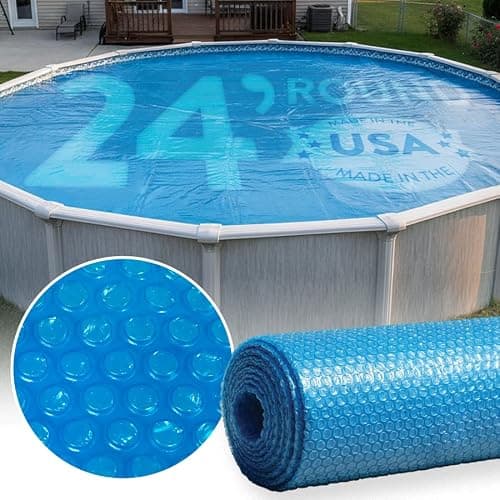
The single highest-return accessory here
Bubble Solar Cover for Above-Ground Pools
Various
It cuts evaporation, and evaporation is simultaneously your water bill, your chemical bill and your heat loss. Nothing else on this site reduces three costs at once.
#ad how this is funded · price as of October 8, 2026
Key specs
- Construction
- Bubble sheet, thickness published in mil
- Thickness
- Higher mil lasts longer — 12 mil and 16 mil are common
- Fit
- Cut to size; buy oversize and trim
- Orientation
- Bubbles face down, toward the water
How it scoresour reading of published specs, not a test result
- Retention
- 9.0
- Durability
- 7.0
- Handling
- 6.0
- Running cost
- 9.8
- Value
- 9.5
Overall 9.0 / 10
What works
- Reduces evaporation, which is the mechanism behind the water, chemical and heat savings all at once
- Cheap relative to everything it saves
- Can be cut to fit any pool shape, so sizing is forgiving
What doesn't
- Awkward to get on and off without a reel, and awkward is how covers end up unused
- Degrades in UV like every vinyl product
- Not a safety cover and will not support weight — this is important
Skip it if: Being a safety barrier. A solar cover looks solid and is not; a child or pet on it goes through and under.
What it costs to run: The one accessory with a clear payback. Every gallon that does not evaporate is a gallon you do not replace at the EPA WaterSense national average of $6.06 per 1,000 gallons, and it is chlorine you do not re-dose. If you buy one thing from this hub, buy this.
Several seasons: Buy-once. Built and warranted to come back out of the box for a few years, if you store it properly.
Specs from: EPA WaterSense — cost per 1,000 gallons
Making sure the cover actually gets used
Solar Cover Reel for Above-Ground Pools
Various
A cover that takes two people and ten minutes to move gets left off. A reel makes it a one-person, one-minute job, which is the difference between owning a cover and using one.
Key specs
- Function
- Rolls the solar cover on and off
- Fit
- Must match pool diameter and wall type
- Mounting
- Freestanding or wall-mounted depending on model
How it scoresour reading of published specs, not a test result
- Retention
- 7.0
- Durability
- 7.5
- Handling
- 9.5
- Running cost
- 8.5
- Value
- 7.0
Overall 7.7 / 10
What works
- Turns cover use from a chore into a habit, which is where all the savings actually are
- Keeps the cover off the ground, which is what shortens its life
- One-person operation
What doesn't
- Frequently costs more than the cover it handles
- Takes up permanent space beside the pool
- Sizing must match the pool exactly, and returns are awkward
Skip it if: A small pool. Under about 12 feet the cover is light enough to handle by hand and the reel is a solution to a problem you do not have.
What it costs to run: Only justified on larger pools. The value is not the reel, it is the cover getting used every night instead of most nights — quantify it by how often you would actually bother otherwise.
Several seasons: Buy-once. Built and warranted to come back out of the box for a few years, if you store it properly.
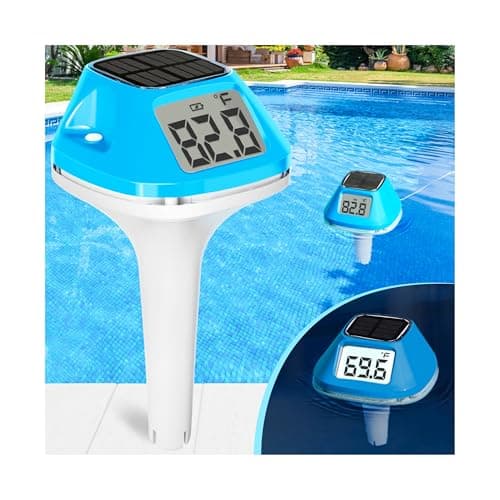
Knowing when to close, and when to stop heating
Floating Pool Thermometer
Various
The cheapest instrument on this site and the one that answers two expensive questions: is it warm enough to swim, and is it cold enough to close.
#ad how this is funded · price as of October 8, 2026
Key specs
- Types
- Floating analog, digital solar, or wireless with an indoor display
- Typical digital range
- About 15.8°F to 176°F on current models
- Typical stated accuracy
- About ±1.8°F on current digital models
- Water resistance
- IPX8 on current digital models
- Materials
- UV-stabilized and chlorine-resistant on better models
How it scoresour reading of published specs, not a test result
- Accuracy
- 7.5
- Ease
- 9.0
- Coverage
- 5.0
- Cost per use
- 9.8
- Value
- 9.2
Overall 8.4 / 10
What works
- Turns the closing decision from a guess into a reading, which is the most expensive judgment call of the pool year
- Tells you whether a solar cover is actually doing anything, rather than assuming
- Digital models are readable from the deck; analog ones need fishing out
- Cheap enough that having one is never the wrong call
What doesn't
- Analog floats get lost, get chewed, and end up under the ladder
- Solar and wireless models add batteries or a panel to a thing that could have had neither
- Tethering it is essential and almost nobody does it
- Accuracy claims are rarely independently verified — treat ±2°F as the working assumption
Skip it if: Telling you anything about water chemistry. It measures one thing, and every other decision needs a test kit.
What it costs to run: A few dollars, once. It pays for itself the first time it stops you closing a pool that was still warm, which is the mistake that produces a green opening in April.
Several seasons: Buy-once. Built and warranted to come back out of the box for a few years, if you store it properly.
Specs from: Digital floating pool thermometer — current Amazon listing and published specifications
Questions people actually ask
Is a solar cover worth it?
How much water does a solar cover save?
Does a solar cover actually heat the pool?
Is a solar cover a safety cover?
Sources
Read next
- What a pool actually costs, with the arithmetic shownPurchase, electricity, chemicals, water and replacement parts - added up, sourced, and shown as arithmetic you can redo.
- Heating a pool, priced properlyThe physics of heating a pool turned into dollars, why a cover changes the answer more than the heater does, and when heating is worth it.
- What it costs to fill a pool, and to keep it fullOne fill priced for four common pool volumes at the national average water rate, plus why every gallon you add has to be re-balanced.
- Seven ways to cut a pool's running cost, ranked by what they actually saveEvery saving measure priced with the same arithmetic and ranked, so you spend effort where the money actually is.
- What an above-ground pool actually costs to run for a yearElectricity, chemicals, water and consumables for a full season - every input sourced, every calculation shown, and every assumption named.
- The best solar covers, and why this is the one thing to buyBubble covers compared on thickness and sizing, plus the arithmetic that makes this the highest-return purchase in the hub.
- The solar cover reel solves a behavior problem, not a water problemSizing a reel to your pool, the above-ground mounting problem, and when a reel is worth more than the cover.
- Adding weeks to the season, starting with the cheapest thing firstCover, placement and timing before hardware, plus the kilowatt arithmetic that shows what running an electric heater actually costs.
- The pool thermometer, and the two expensive questions it answersFloating, digital and wireless pool thermometers compared, and why the closing decision alone justifies owning one.
- Solar pool heating: collector area is the whole storySolar panels, mats and rings compared on published collector area, pump compatibility and what each maker will actually claim in writing.