Pool Equipment
The pool brush, and why it is a chemistry tool
Brushing lifts the biofilm that becomes visible algae later. It costs nothing to run and it prevents more chemical spend than anything else you can buy for the money.
Heads up: we earn a commission if you buy through the links on this page, at no extra cost to you. It never decides the ranking — here is how we pick and here is the full disclosure. Prices are checked automatically; last verified October 8, 2026.
Quick picks
Segmented before it is ranked — the right answer depends on which of these you actually are. Tap any row for the full write-up.
The brush to buy for a vinyl pool
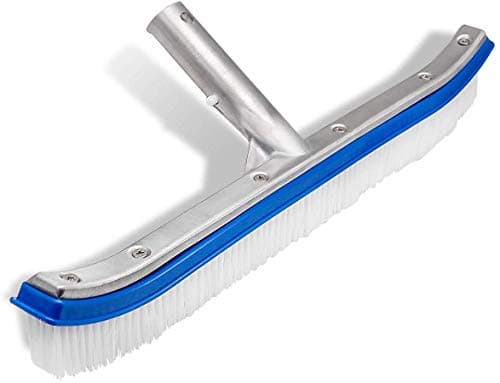
Nylon bristles on an 18-inch head with curved ends. That is the whole specification, and the curved ends are what reaches the wall-to-floor corner.
| # | Product | Best for | Score | Price |
|---|---|---|---|---|
| 1 | Pool Wall Brush with Nylon Bristles Shares the telescopic pole you already own and prevents more chemical spend than anything else you can buy for the money. Nylon bristles, always, on a vinyl liner. | The job that prevents algae rather than treating itSeveral seasons | 8.9out of 10 |
What it shares the pole with
The telescopic pole is the actual purchase. Buy one long enough to reach the middle of your pool and everything else clips onto it.
| # | Product | Best for | Score | Price |
|---|---|---|---|---|
| 1 | 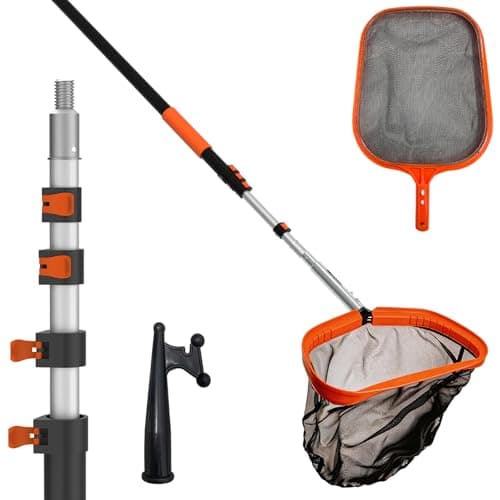 Skimmer Net with Telescopic Pole Catching leaves while they float is a two-minute job. Catching them after they sink is a vacuum session and a filter clean. Buy this first. | The five-dollar tool you use mostSeveral seasons | 8.8out of 10 | |
| 2 | No image Manual Vacuum Head with Telescopic Pole and Hose Connects to the skimmer and uses the pump you already own. It is slower than a robot, cheaper than everything, and it is what most above-ground pools should have. | Actual debris, at the lowest costSeveral seasons | 8.8out of 10 |
The short version
- Nylon bristles on vinyl. Never stainless. Stainless-bristle brushes exist for plaster and concrete and will damage a liner.
- Brushing is prevention, not cleaning. It lifts biofilm before it is visible, which is why it belongs in the routine rather than the response.
- Curved ends matter more than width. The wall-to-floor corner is where algae starts and where a flat head cannot reach.
- Buy the pole, not the brush. The pole is what everything clips onto, and it is the part worth getting right.
The one specification that can damage your pool
Pool brushes are sold with several bristle materials, and they are not interchangeable. Stainless steel bristles exist for plaster and concrete pools, where they are the right tool. On a vinyl liner they are the wrong tool in a way that is not recoverable — they abrade the surface, and a liner with abraded vinyl at the water line is a liner that fails earlier.
Every pool this site covers has a vinyl liner. So the specification is nylon, and it is worth reading the listing rather than assuming, because combination heads with a stainless center strip are common and are also unsuitable.
| Spec | What to buy | Why |
|---|---|---|
| Bristles | Nylon only | Stainless abrades a vinyl liner |
| Width | 18 inches is the common size | Wider covers more; narrower controls better on a curve |
| Ends | Curved | Reaches the wall-to-floor corner where algae starts |
| Backing | Plastic or aluminum | Aluminum holds shape; plastic is lighter and cheaper |
| Fitting | Standard telescopic pole clip | It has to share the pole you already own |
| Bristle retention | Look for reviews mentioning shedding | Shed bristles end up loading your cartridge |
Why brushing is a chemical saving
Algae does not appear as green water. It establishes as a film on surfaces first — walls, the water line, the floor behind the ladder — and it is well established before anything is visible in the water. Brushing disturbs that film and exposes it to the chlorine that is already in the pool.
That is the entire mechanism, and it explains two things. First, why brushing weekly is cheaper than any algaecide: you are using sanitizer you already paid for. Our algaecide roundup is explicit that the bottle is insurance rather than a rescue, and brushing is what makes the insurance rarely necessary.
Second, why brushing comes before shocking rather than after. Shocking an unbrushed pool treats the water and leaves the film; the recovery sequence in our algae guide puts the brush first for that reason, and the mustard algae guide puts it first twice.
Where to brush, which is not everywhere equally
The water line. Oils, sunscreen and film accumulate at the surface and deposit in a band. It is also where liners fail first, so keeping it clean is both a chemistry job and a longevity one — our liner stains guide covers what settles there.
The shaded side and the dead spot. Water circulates from the return jet toward the skimmer, so there is always a low-flow area — usually the section furthest from both. That is where mustard algae establishes, and it is the part people skip because it looks fine.
Behind and under the ladder. Permanently shaded, permanently low-flow, and awkward to reach, which is exactly why it needs doing.
How often, and how long it actually takes
Weekly on a normal week, and every two or three days through a heatwave when warm water and strong light give algae its best conditions — our heatwave guide covers what else changes.
On a 12-foot pool a thorough brush is a few minutes. On an 18-foot pool it is closer to ten. Our weekly schedule budgets brushing and vacuuming together at about ten minutes, and it is the block of the routine most worth protecting because everything else gets easier when it happens.
What we are scoring
We have not tested these and do not claim to. The scores are our reading of published construction — bristle material, head width and backing, end profile and pole fitting — read against a vinyl-lined above-ground pool specifically. Our methodology page explains how our scoring works.
The picks, in full
Scores are our own reading of published specifications. They are not test results — we have not tested these products and we do not claim to.
Pick #1 · The job that prevents algae rather than treating it
Pool Wall Brush with Nylon Bristles
Various
Shares the telescopic pole you already own and prevents more chemical spend than anything else you can buy for the money. Nylon bristles, always, on a vinyl liner.
#ad how this is funded · price as of October 8, 2026
Key specs
- Typical width
- 18 inches is the common size
- Bristles
- Nylon for vinyl liners — never stainless on vinyl
- Head
- Plastic or aluminum backed; curved ends reach corners
- Fitting
- Standard telescopic pole connection
How it scoresour reading of published specs, not a test result
- Sizing fit
- 8.5
- Running cost
- 10.0
- Maintenance
- 9.0
- Build
- 7.5
- Value
- 9.5
Overall 8.9 / 10
What works
- Lifts the biofilm that becomes visible algae, before you can see it
- Shares the pole with the skimmer net and the vacuum head, so it adds no storage
- Curved ends actually reach the wall-to-floor corner where algae starts
- No running cost and nothing to replace
What doesn't
- Wide heads are harder to control on a curved above-ground wall
- Cheap heads shed bristles into the pool, which then load the filter
- Needs a pole long enough to reach the middle, which is bought separately
- Stainless-bristle versions exist and will damage a vinyl liner — read the label
Skip it if: Anything on the floor that needs removing rather than disturbing. Brushing lifts it; a vacuum takes it out.
What it costs to run: A few dollars, once, and it lasts seasons. Measured against a bottle of algaecide and a heavy shock, it is the cheapest chemistry on this site.
Several seasons: Buy-once. Built and warranted to come back out of the box for a few years, if you store it properly.
Specs from: 18-inch nylon pool wall brush — current Amazon listing and published specifications
Pick #2 · The five-dollar tool you use most
Skimmer Net with Telescopic Pole
Various
Catching leaves while they float is a two-minute job. Catching them after they sink is a vacuum session and a filter clean. Buy this first.
Key specs
- Type
- Flat skimmer or deep leaf rake
- Pole
- Telescopic, sized to reach the middle of your pool
- Frame
- Plastic or aluminum
How it scoresour reading of published specs, not a test result
- Retention
- 8.5
- Durability
- 7.0
- Handling
- 9.0
- Running cost
- 10.0
- Value
- 9.5
Overall 8.8 / 10
What works
- The single most-used tool in pool ownership and among the cheapest
- Removing debris before it sinks prevents most of the work that follows
- A deep leaf rake handles far more per pass than a flat skimmer
What doesn't
- Cheap plastic frames snap where the pole attaches, which is the standard failure
- Telescopic poles seize with hard water unless rinsed
- A too-short pole means you cannot reach the middle, which makes it useless
Skip it if: Anything on the floor. This is a surface tool and pretending otherwise is how debris ends up in the filter.
What it costs to run: Free to use and it directly reduces your chemical bill: organic debris consumes chlorine as it breaks down, so removing leaves is the cheapest sanitizer saving there is.
Several seasons: Buy-once. Built and warranted to come back out of the box for a few years, if you store it properly.
Pick #3 · Actual debris, at the lowest cost
Manual Vacuum Head with Telescopic Pole and Hose
Various
Connects to the skimmer and uses the pump you already own. It is slower than a robot, cheaper than everything, and it is what most above-ground pools should have.
Key specs
- Power
- Uses the pool's existing pump suction
- Needs
- A telescopic pole and a vacuum hose of the right length
- Fitting
- Must match the skimmer on your pool
- Consumables
- None beyond the filter it already loads
How it scoresour reading of published specs, not a test result
- Sizing fit
- 8.5
- Running cost
- 9.8
- Maintenance
- 8.0
- Build
- 8.0
- Value
- 9.5
Overall 8.8 / 10
What works
- No batteries, no motor, nothing that can fail electrically
- Lifts real debris, not just silt
- Cheapest capable option, by a wide margin
What doesn't
- You have to prime the hose properly or the pump loses suction
- Loads the filter heavily, so plan to clean it right after
- It is genuinely manual work and takes twenty minutes
Skip it if: A pool without a skimmer connection, which rules out most soft-side inflatables.
What it costs to run: Free to run beyond the pump time you are already paying for. The one hidden cost is filter loading — expect to clean the cartridge immediately after vacuuming.
Several seasons: Buy-once. Built and warranted to come back out of the box for a few years, if you store it properly.
Questions people actually ask
What kind of pool brush is safe for a vinyl liner?
How often should I brush my pool?
Should I brush before or after shocking the pool?
What size pool brush should I buy?
Sources
Read next
- Equipment, sized to your pool and costed by the wattPumps, filters, vacuums, heaters and ladders - matched to your gallons and priced by what they draw.
- The manual pool tools that do most of the real workNets, poles and vacuum heads compared against powered cleaners for a seasonal above-ground pool, on running cost as well as capability.
- Pool algae: brush, shock, filter, then rebalanceThe correct order for clearing green water, how to tell algae from pollen, and why algaecide prevents rather than cures.
- Mustard algae, and why brushing it away is not the same as killing itHow to recognize mustard algae, why normal chlorine levels do not clear it, and the full treatment including the things that reinfect the pool.
- Algaecide is insurance, not a rescueThe three algaecide chemistries compared for a vinyl above-ground pool, and the sequence that actually clears a bloom.
- The weekly pool routine, and how little time it really takesThe daily, weekly and monthly jobs written as a schedule, with the kit each one needs and roughly how long it takes.
- Stains on the liner, and the one test that tells you which kindOrganic or metal? The five-minute test that identifies a liner stain, plus what removes each kind and what prevents both.