Pool Costs
The robot buys back ten minutes a week
That is the whole proposition, stated plainly. Whether it is worth it is a question about your time, not about your pool, and the category never puts it that way.
Heads up: we earn a commission if you buy through the links on this page, at no extra cost to you. It never decides the ranking — here is how we pick and here is the full disclosure. Prices are checked automatically; last verified October 8, 2026.
The short version
- The job being automated is about ten minutes a week on a pool this size. That is the honest size of the prize.
- Running cost is not the issue. A robot draws little and runs briefly; the purchase price is the entire argument.
- Robots are sized for inground pools. Wall climbing and cord length both assume depth an above-ground pool does not have.
- Skimming daily beats vacuuming weekly and costs nothing — it is the option neither product page mentions.
State the prize honestly first
Our weekly schedule budgets brushing and vacuuming together at about ten minutes on a normal week. A robotic cleaner does not remove all of that — you still brush, and brushing is the part that does the chemical work our brush roundup describes. It removes the vacuuming.
So the purchase buys back something on the order of five to ten minutes a week for seventeen weeks. Call it two to three hours a season. Everything below is about whether that is worth what it costs, and there is no universally right answer — only an arithmetic one you can do for yourself.
The three options, priced by what they actually are
| Option | What it is | Running cost | Time per week |
|---|---|---|---|
| Manual vacuum head on a pole | Cheapest possible; runs off the pump you own | None beyond pump hours | 5-10 min |
| Battery handheld vacuum | Self-contained; no hoses, no pump dependency | Charging — negligible | 5-10 min |
| Robotic cleaner | Independent motor and filter; runs unattended | Small draw, short cycle | Under 2 min to deploy |
What a robot costs to run
- Typical draw
- Read the unit's label — draw is rarely published
- Cycle
- Roughly 1.5-2 hours
- Frequency
- Twice a week across a 17-week season
- US residential average rate, June 2026 [EIA]
- 18.34 ¢/kWh
150 W × 2 h × 2/wk × 17 wk ÷ 1,000 = 10.2 kWh 10.2 × $0.1834 ≈ $1.87
Under two dollars for a whole season
The part the listings do not tell you
Robotic cleaners are designed for inground pools, and two assumptions come with that.
Wall climbing needs a wall. Much of a robot’s value proposition is cleaning the walls and the waterline, and above-ground pools have curved, flexible vinyl walls at 42 to 52 inches. Climbing performance on that is a different problem from climbing a rigid plaster wall, and not every unit that claims it manages it.
Cord length assumes a deck. Cords are specified for a pool surrounded by decking with a power point near it. An above-ground pool on a lawn frequently is not.
Our robotic cleaner roundup is already honest that this category clears our value bar for fewer buyers than any other piece of equipment on the site. This page is the cost half of the same argument.
Replacement parts, which is where robots differ
A manual vacuum head has nothing to replace. A robot has brushes, filter cartridges or bags, tracks and a power supply, and it has a motor sealed inside a unit that lives in chlorinated water. Our replacement parts guide covers the general principle: on a seasonal pool, the things that fail are the things with moving parts in the water.
That matters for the payback calculation in a specific way. A manual setup is a one-off purchase that lasts as long as the pole. A robot is a purchase plus a parts stream plus a repair risk, and a payback horizon long enough to matter is long enough for all three to show up.
When a robot is genuinely the right call
Three situations, and they are all about circumstance rather than value.
A large pool. At the 18-foot, 7,000-gallon end the manual job stops being ten minutes. Our large pool equipment guide covers that end of the category.
A yard that generates debris continuously. Under trees, the vacuuming job is not weekly, it is constant — the situation our autumn leaves guide describes for a month of the year and some yards have all summer.
A job that otherwise will not get done. This is the real one. An unvacuumed pool becomes a chemistry problem, and a chemistry problem costs more than a robot in shock, clarifier and lost swimming. If the honest answer is that manual vacuuming will not happen, the robot is cheaper than the alternative — which is not a pool.
What to buy
Scores are our own reading of published specifications. They are not test results — we have not tested these products and we do not claim to.
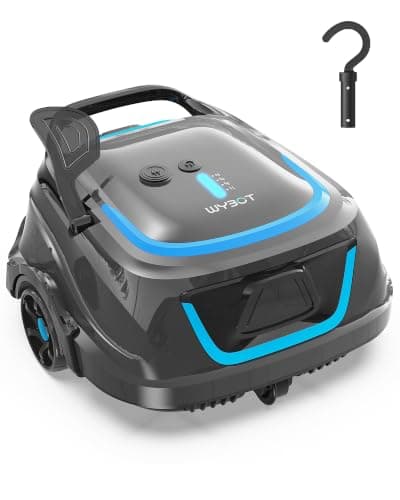
Large above-ground pools and people who will not vacuum
Cordless Robotic Pool Cleaner
Various
Genuinely good at the job and genuinely expensive relative to the pool. For a 1,700-gallon frame pool it costs a meaningful fraction of the pool itself, which is difficult to justify.
#ad how this is funded · price as of October 8, 2026
Key specs
- Power
- Onboard rechargeable battery
- Coverage
- Floor only on most above-ground models
- Runtime
- Published per model
- Filtration
- Onboard basket, independent of the pool's filter
How it scoresour reading of published specs, not a test result
- Sizing fit
- 6.5
- Running cost
- 8.0
- Maintenance
- 7.0
- Build
- 7.5
- Value
- 6.0
Overall 7.1 / 10
What works
- Filters independently of the pool pump, so it adds turnover rather than replacing it
- Genuinely hands-off once it is in the water
- Onboard basket means it does not load your cartridge
What doesn't
- Expensive relative to the price of most above-ground pools
- Batteries degrade and are frequently not user-replaceable
- Most models handle the floor but not the walls of a soft-side pool
Skip it if: Small pools. If your pool cost less than three of these, the money is better spent on a cover and a timer.
What it costs to run: The honest comparison: a manual vacuum head plus a pump timer costs a fraction of this and delivers most of the benefit. A robot earns its place on a large pool owned by someone who genuinely will not vacuum otherwise.
More than you need yet: Real capability a first-pool family cannot use yet. Buy cheaper and put the difference toward chemicals and a cover.
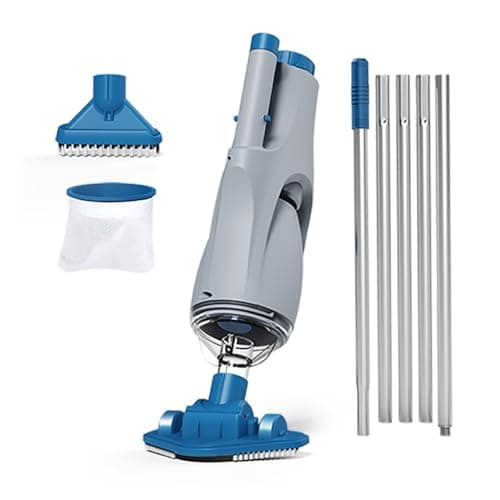
The realistic vacuum for a seasonal pool
Rechargeable Handheld Pool Vacuum
Various
Battery, no hoses, no pump connection. It picks up what settles on the floor and that is genuinely all a seasonal above-ground pool needs.
Key specs
- Power
- Rechargeable battery
- Runtime
- Published per model — typically enough for one small pool
- Collection
- Onboard filter bag or chamber
- Connection
- None to the pool's filtration
How it scoresour reading of published specs, not a test result
- Sizing fit
- 8.0
- Running cost
- 9.5
- Maintenance
- 7.5
- Build
- 7.0
- Value
- 8.5
Overall 8.2 / 10
What works
- No hoses to connect and no risk of losing pump prime
- Works in a pool too small for a hose-driven vacuum head
- Cheap enough that it is not a difficult decision
What doesn't
- Battery runtime is short, and on a bigger pool you will be recharging mid-job
- Suction is modest, so it lifts silt and not much heavier
- The onboard filter needs emptying constantly
Skip it if: A large pool with real debris. If leaves are the problem rather than silt, you want a hose-driven head.
What it costs to run: The cost here is your time rather than power. On a pool over about 5,000 gallons the recharge cycles make this genuinely tedious, and that is the argument for stepping up.
One honest season: The cheapest setup that genuinely works for a season of real swimming. Nothing spare, nothing missing.
Actual debris, at the lowest cost
Manual Vacuum Head with Telescopic Pole and Hose
Various
Connects to the skimmer and uses the pump you already own. It is slower than a robot, cheaper than everything, and it is what most above-ground pools should have.
Key specs
- Power
- Uses the pool's existing pump suction
- Needs
- A telescopic pole and a vacuum hose of the right length
- Fitting
- Must match the skimmer on your pool
- Consumables
- None beyond the filter it already loads
How it scoresour reading of published specs, not a test result
- Sizing fit
- 8.5
- Running cost
- 9.8
- Maintenance
- 8.0
- Build
- 8.0
- Value
- 9.5
Overall 8.8 / 10
What works
- No batteries, no motor, nothing that can fail electrically
- Lifts real debris, not just silt
- Cheapest capable option, by a wide margin
What doesn't
- You have to prime the hose properly or the pump loses suction
- Loads the filter heavily, so plan to clean it right after
- It is genuinely manual work and takes twenty minutes
Skip it if: A pool without a skimmer connection, which rules out most soft-side inflatables.
What it costs to run: Free to run beyond the pump time you are already paying for. The one hidden cost is filter loading — expect to clean the cartridge immediately after vacuuming.
Several seasons: Buy-once. Built and warranted to come back out of the box for a few years, if you store it properly.
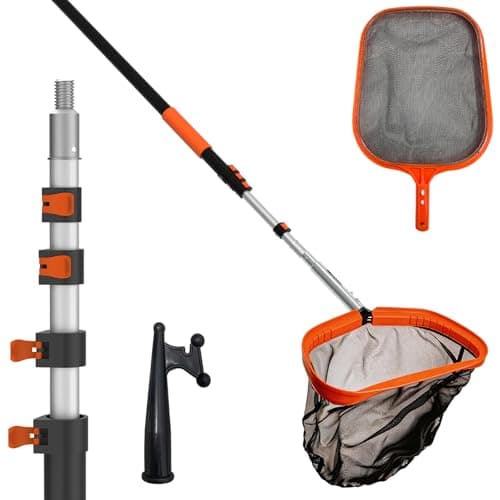
The five-dollar tool you use most
Skimmer Net with Telescopic Pole
Various
Catching leaves while they float is a two-minute job. Catching them after they sink is a vacuum session and a filter clean. Buy this first.
Key specs
- Type
- Flat skimmer or deep leaf rake
- Pole
- Telescopic, sized to reach the middle of your pool
- Frame
- Plastic or aluminum
How it scoresour reading of published specs, not a test result
- Retention
- 8.5
- Durability
- 7.0
- Handling
- 9.0
- Running cost
- 10.0
- Value
- 9.5
Overall 8.8 / 10
What works
- The single most-used tool in pool ownership and among the cheapest
- Removing debris before it sinks prevents most of the work that follows
- A deep leaf rake handles far more per pass than a flat skimmer
What doesn't
- Cheap plastic frames snap where the pole attaches, which is the standard failure
- Telescopic poles seize with hard water unless rinsed
- A too-short pole means you cannot reach the middle, which makes it useless
Skip it if: Anything on the floor. This is a surface tool and pretending otherwise is how debris ends up in the filter.
What it costs to run: Free to use and it directly reduces your chemical bill: organic debris consumes chlorine as it breaks down, so removing leaves is the cheapest sanitizer saving there is.
Several seasons: Buy-once. Built and warranted to come back out of the box for a few years, if you store it properly.
Questions people actually ask
Is a robotic pool cleaner worth it for an above-ground pool?
How much does a robotic pool cleaner cost to run?
Do robotic cleaners work in above-ground pools?
What is the cheapest way to keep an above-ground pool clean?
Sources
Read next
- What a pool actually costs, with the arithmetic shownPurchase, electricity, chemicals, water and replacement parts - added up, sourced, and shown as arithmetic you can redo.
- What an above-ground pool actually costs to run for a yearElectricity, chemicals, water and consumables for a full season - every input sourced, every calculation shown, and every assumption named.
- What actually wears out, and when you will be buying itThe replacement schedule for an above-ground pool - cartridges, covers, liners and hardware - and which spares are worth keeping on the shelf.
- Robotic pool cleaners: good, and hard to justifyThe honest case for and against a robot on an above-ground pool, and the manual setup that does most of the job for a fraction of the price.
- The best above-ground pool vacuumsBattery handhelds, manual suction heads and robotic cleaners - what each actually handles and which pool justifies which.
- The manual pool tools that do most of the real workNets, poles and vacuum heads compared against powered cleaners for a seasonal above-ground pool, on running cost as well as capability.
- The weekly pool routine, and how little time it really takesThe daily, weekly and monthly jobs written as a schedule, with the kit each one needs and roughly how long it takes.
- The pool brush, and why it is a chemistry toolWhich brush head suits a vinyl liner, why bristle material is the one specification that matters, and how brushing saves chemicals.
- Robotic or suction: one adds filtration, the other borrows itCordless robots against suction-side cleaners for above-ground pools: power source, what each needs from your pump, coverage, and which one suits a seasonal pool.