Pool Care & Chemistry · Best Test Strips
The best pool test strips
Cheapest item on this site and the one that saves the most money. The only spec that matters is which parameters it covers.
Heads up: we earn a commission if you buy through the links on this page, at no extra cost to you. It never decides the ranking — here is how we pick and here is the full disclosure. Prices are checked automatically; last verified October 18, 2026.
Quick picks
Segmented before it is ranked — the right answer depends on which of these you actually are. Tap any row for the full write-up.
Strips — for the twice-weekly routine
Frequency beats precision for a seasonal pool. The best strip is the one you will actually use twice a week.
| # | Product | Best for | Score | Price |
|---|---|---|---|---|
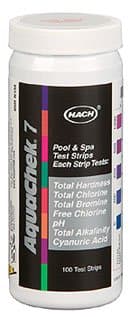
| 1 | AquaChek Silver 7-Way Test Strips (100 count) Seven readings in fifteen seconds, including the two that beginners never measure and then fight all summer: total alkalinity and cyanuric acid. | The default first test kitOne honest season | 8.9out of 10 | |
| 2 | 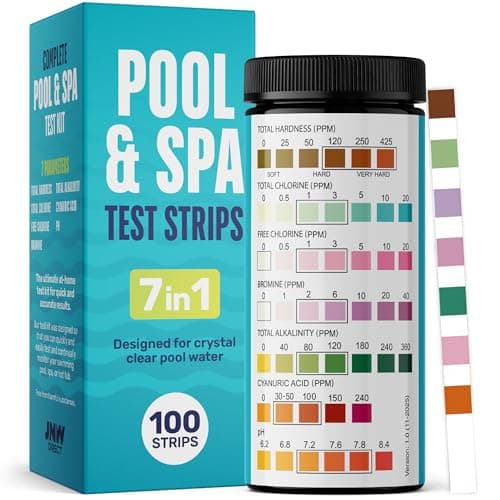 JNW Direct 7-in-1 Pool and Spa Test Strips Covers the same seven parameters as the AquaChek at a lower cost per strip. The color chart is harder to read in sunlight, which is a real usability cost rather than a nitpick. | Seven readings at a lower priceOne honest season | 8.0out of 10 | |
| 3 | 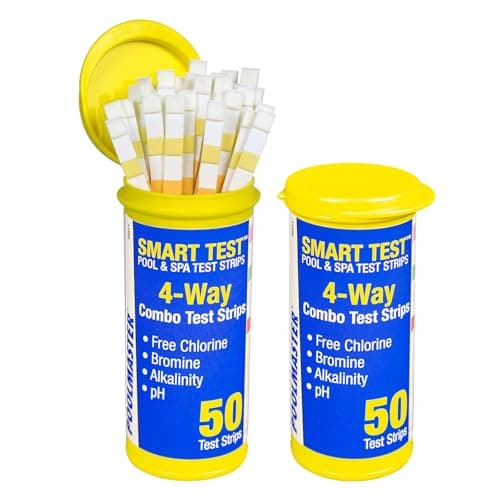 Poolmaster 5-Way Test Strips Five readings instead of seven, and the two it drops are the ones that matter most. Fine as a spare in the shed, wrong as your only kit. | A cheap backup bottleA few weekends | 6.4out of 10 |
Liquid kit — for when you need a number
Overkill for routine checks, genuinely useful when something has gone wrong and you need a figure rather than a color band.
| # | Product | Best for | Score | Price |
|---|---|---|---|---|
| 1 | 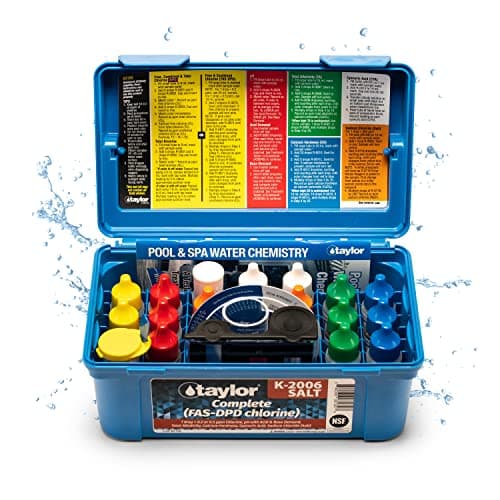 Taylor K-2006 Complete Test Kit (FAS-DPD) The reference kit. It uses a drop-count titration for free chlorine, which gives you an actual figure rather than a shade of pink. Overkill for a 1,500-gallon pool and indispensable when something has gone properly wrong. | When you need a number, not a color bandSeveral seasons | 8.3out of 10 |
The short version
- Buy a 7-way, not a 5-way. The two parameters the cheap ones drop are cyanuric acid and free-versus-total chlorine, and both matter.
- Testing frequency beats testing precision for a seasonal pool. A rough reading twice a week beats a precise one you never take.
- The CDC publishes at least 1 ppm free chlorine (2 ppm with a stabilizer) and pH 7.0–7.8.
- A liquid reagent kit is a year-two purchase after a bad summer, not a first one.
How we picked
There is very little to a test strip beyond what it measures and how readable the chart is, so that is what we compared: published parameter coverage, published ranges, and read time. We have not lab-verified any of these against a reference standard — we have no lab — and you should treat every strip as directional rather than precise. That is fine, because for a seasonal pool the decision you are making is “is this in range or not”, and a color band answers that.
Why 7-way, specifically
The cheap strips read chlorine, pH, alkalinity and hardness. That sounds like enough and it is not, because it omits cyanuric acid.
Cyanuric acid is chlorine’s sunscreen. Some is essential outdoors or UV destroys your chlorine within hours. But every trichlor tablet adds more, and in a pool that is topped up rather than drained it accumulates. Past a certain point your free chlorine reading looks perfectly healthy and the chlorine cannot actually do anything — which is the single most confusing failure mode in pool ownership, and it is invisible without this reading.
| Product | Cyanuric acid? | Free vs total chlorine? | Parameters |
|---|---|---|---|
| AquaChek Silver 7-Way | Yes — 0–300 ppm | Yes, both | 7 |
| JNW Direct 7-in-1 | Yes | Yes | 7 |
| Poolmaster 5-Way | No | Typically not | 5 |
| Taylor K-2006 | Yes | Yes, by titration | 6, numeric |
What the numbers should be
| Reading | Target | Source |
|---|---|---|
| Free chlorine (no stabilizer) | At least 1 ppm | CDC |
| Free chlorine (with cyanuric acid) | At least 2 ppm | CDC |
| pH | 7.0–7.8 | CDC |
| Total alkalinity | 80–120 ppm | Industry convention |
| Cyanuric acid | Watch it rise; high = chlorine stops working | — |
Strips versus a liquid kit
A drop-count titration kit like the Taylor K-2006 gives you an actual number rather than a color band, and it distinguishes free from combined chlorine — which is the single most useful thing a test can tell you when water smells strongly of chlorine. That smell is combined chlorine, and it means you need more chlorine, not less.
But it takes five minutes and a bench, the reagents expire, and a test you skip is worse than a rough one you take. For a seasonal above-ground pool, strips twice a week is the right default, and a liquid kit is what you buy in year two after a summer that went badly.
Using them properly
Three things that materially change your readings. Take the sample elbow-deep and away from the return jet — surface water and water straight out of the jet are both unrepresentative. Read the strip in shade, because bright sun makes adjacent color bands nearly identical. And keep the bottle sealed and dry; humidity degrades strips quietly and a bottle left open on a wet deck is giving you fiction within weeks.
If you want the wider comparison rather than the strip recommendation, our pool test kit roundup puts strips, drop kits and digital testers side by side and is honest about which readings each one can actually be trusted for.
The picks, in full
Scores are our own reading of published specifications. They are not test results — we have not tested these products and we do not claim to.
Pick #1 · The default first test kit
AquaChek Silver 7-Way Test Strips (100 count)
AquaChek
Seven readings in fifteen seconds, including the two that beginners never measure and then fight all summer: total alkalinity and cyanuric acid.
#ad how this is funded · price as of October 18, 2026
Key specs
- Tests
- Free chlorine, total chlorine, bromine, pH, total alkalinity, total hardness, cyanuric acid
- Free chlorine range
- 0-20 ppm
- pH range
- 6.2-8.4
- Total alkalinity range
- 0-240 ppm
- Cyanuric acid range
- 0-300 ppm
- Read time
- 15 seconds
- Count
- 100 strips
How it scoresour reading of published specs, not a test result
- Accuracy
- 7.0
- Ease
- 9.5
- Coverage
- 9.5
- Cost per use
- 9.0
- Value
- 9.2
Overall 8.9 / 10
What works
- Covers cyanuric acid, which most cheap strips omit and which is the reason chlorine stops working in a stabilized pool
- pH range spans 6.2-8.4, comfortably bracketing the CDC's recommended 7.0-7.8
- 15 seconds and a color chart printed on the bottle — no separate booklet to lose
- 100 strips is a full season of twice-weekly testing with room to spare
What doesn't
- Strips are a comparison against a printed color chart, so they are directional rather than precise
- Reading them in bright sun is harder than it should be
- The bottle must be kept sealed and dry or the strips degrade quietly
Skip it if: Fine adjustment. If you are chasing a stubborn problem and need a number rather than a color band, a liquid reagent kit is the tool.
What it costs to run: 100 strips at twice-weekly testing covers roughly two seasons for one pool. The real saving is upstream: knowing your alkalinity stops you buying pH adjuster you did not need.
One honest season: The cheapest setup that genuinely works for a season of real swimming. Nothing spare, nothing missing.
Specs from: CDC — home pool and hot tub water treatment and testing
Pick #2 · Seven readings at a lower price
JNW Direct 7-in-1 Pool and Spa Test Strips
JNW Direct
Covers the same seven parameters as the AquaChek at a lower cost per strip. The color chart is harder to read in sunlight, which is a real usability cost rather than a nitpick.
Key specs
- Tests
- 7 parameters including cyanuric acid
- Count
- 100 strips (typical pack)
- Extras
- Companion app offered by the manufacturer
How it scoresour reading of published specs, not a test result
- Accuracy
- 6.5
- Ease
- 8.0
- Coverage
- 9.0
- Cost per use
- 9.5
- Value
- 8.5
Overall 8.0 / 10
What works
- Includes cyanuric acid, which is the thing a cheap 5-way leaves out
- Lower cost per strip than the category benchmark
- Large pack sizes mean you test more often, which matters more than precision
What doesn't
- Color differentiation between adjacent bands is tighter than on the AquaChek chart
- App-based reading is a nice idea and an extra step you will stop taking by July
- Less established than AquaChek if you want a long track record
Skip it if: Reading in direct sun on a bright deck, which is exactly where you will be using it.
What it costs to run: Cheapest route to a full seven-parameter reading. Given that testing frequency beats testing precision for a seasonal pool, buying more strips for the same money is a defensible trade.
One honest season: The cheapest setup that genuinely works for a season of real swimming. Nothing spare, nothing missing.
Pick #3 · A cheap backup bottle
Poolmaster 5-Way Test Strips
Poolmaster
Five readings instead of seven, and the two it drops are the ones that matter most. Fine as a spare in the shed, wrong as your only kit.
#ad how this is funded · price as of October 18, 2026
Key specs
- Tests
- Typically free chlorine, bromine, pH, total alkalinity, total hardness
- Omits
- Cyanuric acid on most 5-way formats
- Read time
- About 15 seconds
How it scoresour reading of published specs, not a test result
- Accuracy
- 6.0
- Ease
- 9.0
- Coverage
- 5.0
- Cost per use
- 9.0
- Value
- 6.0
Overall 6.4 / 10
What works
- Cheap enough to keep a second bottle where you actually test
- Covers the three daily readings — chlorine, pH, alkalinity
- Same 15-second workflow as any strip
What doesn't
- No cyanuric acid reading, which is the number that explains why your chlorine stopped working
- Color bands are coarser than the AquaChek equivalent
- Format varies between production runs, so check what the bottle actually tests
Skip it if: Diagnosing a stabilized pool. Without a cyanuric acid reading you are guessing at exactly the point where guessing is expensive.
What it costs to run: Saves a couple of dollars against a 7-way and can cost you a season of unnecessary chlorine. This is the wrong place to economize.
A few weekends: Fine for a heatwave and a toddler. Treat it as consumable, not as a pool — it will not survive a winter in the yard.
Pick #4 · When you need a number, not a color band
Taylor K-2006 Complete Test Kit (FAS-DPD)
Taylor Technologies
The reference kit. It uses a drop-count titration for free chlorine, which gives you an actual figure rather than a shade of pink. Overkill for a 1,500-gallon pool and indispensable when something has gone properly wrong.
Key specs
- Method
- FAS-DPD drop-count titration
- Measures
- Free and combined chlorine, pH, alkalinity, calcium hardness, cyanuric acid
- Resolution
- Reads to 0.2 ppm free chlorine with the standard 10 mL sample
- Format
- Reagent bottles and graduated comparators
How it scoresour reading of published specs, not a test result
- Accuracy
- 9.8
- Ease
- 5.5
- Coverage
- 9.5
- Cost per use
- 7.0
- Value
- 8.0
Overall 8.3 / 10
What works
- Distinguishes free from combined chlorine, which is the single most useful thing a test can tell you when water smells of chlorine
- Gives a numeric result you can act on precisely rather than a color to interpret
- Reagents are individually replaceable, so the kit is a multi-season purchase
What doesn't
- Considerably more expensive than strips and more of a ritual to use
- Reagents have a shelf life and do expire
- Genuinely more kit than a small seasonal pool needs
Skip it if: Casual weekly checks. If it is a five-minute job you will skip it, and a test you skip is worse than a rough one you actually do.
What it costs to run: The reagents are the running cost, not the kit. For most seasonal above-ground owners this is a second purchase made in year two after a bad algae summer, not a first one.
Several seasons: Buy-once. Built and warranted to come back out of the box for a few years, if you store it properly.
Specs from: Taylor Technologies
Questions people actually ask
Are pool test strips accurate?
What should pool test strips read?
Do I need test strips that measure cyanuric acid?
How often should I test my pool water?
Sources
Read next
- Pool care, from someone who assumes you have never done thisThe weekly routine, the four numbers that matter, and the fix for the week the water turns.
- First-time pool owner: the complete first monthThe pillar guide: day-one shopping list, the four water readings, the weekly routine and the week-three problem everybody gets.
- pH and alkalinity, and why yours will not stay putWhy pH drifts, what total alkalinity actually does, and the order of operations that turns a season of chasing into one adjustment.
- Cloudy pool water: work out which of four problems you haveA diagnostic decision tree for cloudy water - four causes, how to tell them apart, and the correct fix for each.
- What upkeep costs, separated from everything elseChemicals by published dosing, cartridge replacement intervals, and the honest weekly time commitment.
- Strips, drops or digital: how precise does the answer need to be?Test strips, FAS-DPD drop kits and digital testers compared on what each actually measures, the resolution you get, and which readings a strip cannot really give you.