Pool Equipment
What to buy with the pool, and what can wait
Almost every first-pool regret is the same one: the box arrived, the water went in, and nothing was ready to keep it clear. This is the day-one list.
Heads up: we earn a commission if you buy through the links on this page, at no extra cost to you. It never decides the ranking — here is how we pick and here is the full disclosure. Prices are checked automatically; last verified October 8, 2026.
The short version
- Buy testing before sanitizer. You cannot dose what you have not measured, and the pool is full on day one.
- Tablets need a dispenser, not a skimmer basket. The dispenser costs less than the tablets.
- A brush earns its place immediately. It prevents the problem the chemicals then have to fix.
- Almost everything else can wait a month until you know how your pool behaves.
What to look for
1. A test that covers stabilizer, not just chlorine. The cheapest strips test chlorine and pH and leave you blind to cyanuric acid, which is the reading that explains why chlorine stops working in August. A seven-way strip covers free and total chlorine, pH, alkalinity, hardness and cyanuric acid, and reads in about 15 seconds.
2. A sanitizer you can actually meter. Stabilized 3-inch trichlor tablets are the default because they dissolve slowly and predictably. What matters is putting them somewhere controlled.
3. A dispenser, bought at the same time. A vented floating dispenser holds standard 3-inch tablets and adjusts. Our floater versus feeder comparison covers the upgrade, but on day one the floater is the right call.
4. A brush before a vacuum. Brushing moves settled debris into suspension where the filter can catch it, and disturbs the surfaces where algae starts.
The day-one list
Four things, in this order: test strips, tablets, a floating dispenser, and a wall brush. That combination keeps a new pool clear through its first month, and it costs a fraction of what a “starter kit” bundle usually does.
To that, add whatever the pool did not include. Frame pool sets often ship with a pump and sometimes a ladder and cover; base packages for steel-wall pools frequently ship with none of those, as our kit versus separate guide explains.
What the numbers should read
CDC guidance for home pools is free chlorine of at least 1 ppm, or at least 2 ppm where a stabilizer is in use — which it is, if you are using trichlor tablets — and pH between 7.0 and 7.8. That is the target your day-one purchases exist to hit, and our first month guide turns it into a routine.
What can wait
A vacuum — wait until brushing alone stops keeping up, which on a small pool may be never.
Shock — buy it when you need it rather than storing an oxidizer all season. Our shock roundup covers which type suits your water when the time comes.
A cover — the exception to “wait” if you are buying anything extra, because it saves water, heat and chemicals from the first week. It is the one upgrade our payback guide says pays back reliably.
Automation, heaters and salt — all of it belongs to a second season, once you know how much time the pool actually takes.
The mistake this list prevents
The common first-pool failure is not buying the wrong equipment. It is filling the pool on a Saturday with nothing to test or sanitize with, then spending the following week clearing water that went green. Our cloudy water guide exists largely because of that weekend, and the four items above are what avoid it.
Week one, in practice
Test before you add anything
Fresh fill water is not neutral. You need to know the starting pH, alkalinity and hardness before the first tablet goes in.Correct alkalinity before pH
Alkalinity is what holds pH still. Chasing pH first is how people spend a week adding acid to a pool that will not stay put.Load the dispenser, then leave it alone
Set it nearly closed, run the pump for two days, then test and adjust once.Run the pump on a real schedule
Work out turnover from your gallons and pump flow rather than guessing hours. Our run-time guide covers it.Brush the walls before you decide the water is cloudy
New pools are often just dusty. A brush and a day of filtration solves more first-week complaints than any chemical.
Storing what you have bought
Chemicals are the part of this list that needs somewhere to live. CDC guidance is to keep them in original labeled containers, each in a dedicated place, incompatible products apart, below 95°F, dry and out of direct sun.
A hot shed in August is outside that guidance, and a damp shed floor is genuinely dangerous with an oxidizer. Our storage guide covers what keeps over winter and what does not — liquid chlorine is the one to buy fresh rather than store.
The second-month list
Once you know how your pool behaves, three things are usually worth adding. A cover, if you did not buy one, because it saves water, heat and chemicals continuously. A skimmer net on a pole for surface debris before it sinks. And a spare cartridge, so cleaning day does not cost you a day of filtration.
After that, the upgrades are genuinely optional and depend on your pool: a sand filter if cartridges are annoying you, a timer if you keep forgetting the pump, a robot if you will not vacuum. Our cheapest setup guide prices the whole first season so you can see where the money actually goes.
What the four items cost, relative to the pool
The day-one list is deliberately short, and together it costs a small fraction of any pool on this site. That ratio is the argument: a pool bought without them is a pool that spends its first fortnight cloudy while you buy them anyway, at worse prices, in a hurry.
The one genuine upgrade decision in the list is testing. Strips are cheap and fast; a drop kit costs several times as much and gives you numbers rather than color bands. For a first season, strips are the right call — our testing comparison covers when to add the drop kit, which is usually the point where something has gone wrong and you need precision.
Everything else on the list is a few dollars: a dispenser, a brush, a bucket of tablets sized to your gallons. Our cheapest setup guide prices a complete first season including the pool, which is the honest way to see where the money actually goes — and it is not in the accessories.
The honest recommendation
Buy the four items with the pool, in the same order: test strips, tablets, a dispenser, a brush. Add a cover as soon as the budget allows, because it is the only accessory that pays you back continuously rather than sitting in a shed.
Then run the pool for a month before buying anything else. Almost every piece of equipment people regret was bought in the first fortnight, before the pool had shown whether it was needed — and almost everything genuinely useful was bought in the second month, for a reason.
One thing to write down
Your pool’s volume, on the pump housing or inside the shed door, in gallons. Every dose you will ever calculate starts from it, every product label is written per 10,000 gallons, and it is the number people look up four times a season and then guess at in August. If your pool does not publish a capacity, work it out once using our sizing guide and record it.
What to buy
Scores are our own reading of published specifications. They are not test results — we have not tested these products and we do not claim to.
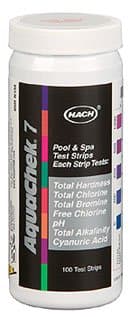
The default first test kit
AquaChek Silver 7-Way Test Strips (100 count)
AquaChek
Seven readings in fifteen seconds, including the two that beginners never measure and then fight all summer: total alkalinity and cyanuric acid.
#ad how this is funded · price as of October 8, 2026
Key specs
- Tests
- Free chlorine, total chlorine, bromine, pH, total alkalinity, total hardness, cyanuric acid
- Free chlorine range
- 0-20 ppm
- pH range
- 6.2-8.4
- Total alkalinity range
- 0-240 ppm
- Cyanuric acid range
- 0-300 ppm
- Read time
- 15 seconds
- Count
- 100 strips
How it scoresour reading of published specs, not a test result
- Accuracy
- 7.0
- Ease
- 9.5
- Coverage
- 9.5
- Cost per use
- 9.0
- Value
- 9.2
Overall 8.9 / 10
What works
- Covers cyanuric acid, which most cheap strips omit and which is the reason chlorine stops working in a stabilized pool
- pH range spans 6.2-8.4, comfortably bracketing the CDC's recommended 7.0-7.8
- 15 seconds and a color chart printed on the bottle — no separate booklet to lose
- 100 strips is a full season of twice-weekly testing with room to spare
What doesn't
- Strips are a comparison against a printed color chart, so they are directional rather than precise
- Reading them in bright sun is harder than it should be
- The bottle must be kept sealed and dry or the strips degrade quietly
Skip it if: Fine adjustment. If you are chasing a stubborn problem and need a number rather than a color band, a liquid reagent kit is the tool.
What it costs to run: 100 strips at twice-weekly testing covers roughly two seasons for one pool. The real saving is upstream: knowing your alkalinity stops you buying pH adjuster you did not need.
One honest season: The cheapest setup that genuinely works for a season of real swimming. Nothing spare, nothing missing.
Specs from: CDC — home pool and hot tub water treatment and testing
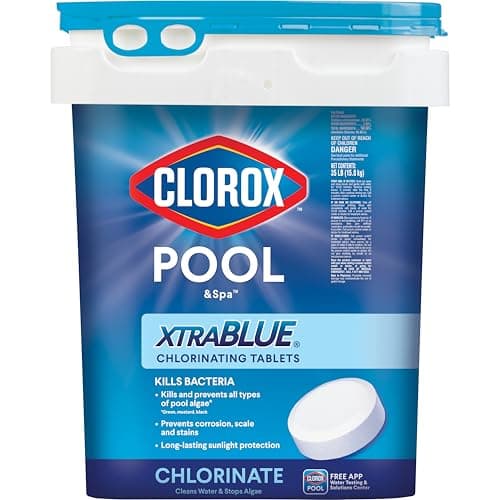
The default chlorine source
Clorox Pool&Spa 3-Inch Chlorinating Tablets
Clorox Pool&Spa
Stabilized trichlor tablets in a floating dispenser is the standard answer for a seasonal above-ground pool, and this is the standard version of it.
#ad how this is funded · price as of October 8, 2026
Key specs
- Type
- Stabilized trichlor, 3-inch tablets
- Contains stabilizer
- Yes — cyanuric acid is part of trichlor
- Dosing
- Per manufacturer instructions, by pool volume
- CDC target
- At least 2 ppm free chlorine when using a stabilizer
How it scoresour reading of published specs, not a test result
- Effectiveness
- 9.0
- Ease
- 9.0
- Water impact
- 6.0
- Cost per season
- 8.5
- Value
- 8.5
Overall 8.5 / 10
What works
- Dissolves slowly, so a floating dispenser meters chlorine out over days rather than hours
- Stabilized, so sunlight does not destroy your chlorine within an afternoon
- Widely stocked, so you are never hunting for it in July
What doesn't
- Every tablet adds cyanuric acid, and in a pool you never fully drain that accumulates until chlorine stops responding
- Trichlor is acidic and will pull your pH down over a season
- Tablets must be kept dry and sealed or they degrade and gas off
Skip it if: A small pool that is topped up rather than drained. Cyanuric acid only leaves with the water, so in a 1,500-gallon pool it climbs fast.
What it costs to run: The standing chemical cost of the season, and it scales directly with gallons. Watch the cyanuric acid reading on your test strip: once it is high, you are buying chlorine that cannot work, which is the most common invisible waste in a first pool year.
One honest season: The cheapest setup that genuinely works for a season of real swimming. Nothing spare, nothing missing.
Specs from: CDC — free chlorine target with cyanuric acid
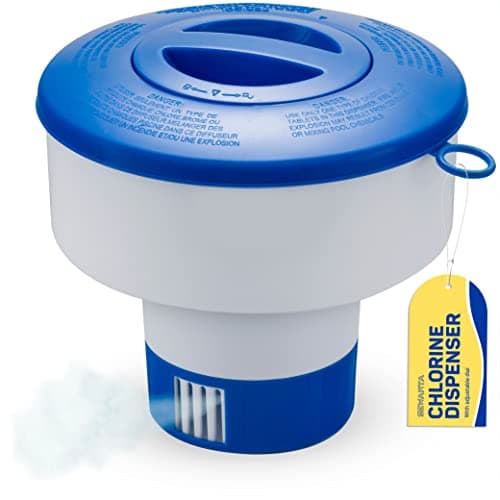
Making tablets work properly
Floating Chlorine Tablet Dispenser
Various
Two dollars of plastic that decides whether your chlorine dissolves evenly over days or sits in a corner bleaching your liner. Buy it with the tablets, not after.
#ad how this is funded · price as of October 8, 2026
Key specs
- Function
- Holds 3-inch tablets, meters dissolution rate
- Adjustment
- Vented base, adjustable on most models
- Compatibility
- Standard 3-inch tablets
How it scoresour reading of published specs, not a test result
- Effectiveness
- 8.0
- Ease
- 9.5
- Water impact
- 9.0
- Cost per season
- 9.8
- Value
- 9.5
Overall 9.0 / 10
What works
- Adjustable venting lets you slow or speed dissolution to match the weather
- Keeps tablets off the liner, which is what causes bleach spots
- Trivially cheap and lasts years
What doesn't
- Drifts to one end of the pool in wind, so distribution is uneven without circulation
- Must be removed before swimming with small children
- Cheap ones crack after a season in UV
Skip it if: Being left in an empty or unfiltered pool. Without circulation it creates a concentrated pocket rather than an even dose.
What it costs to run: The cheapest item on this site and one of the highest-return: even dissolution means you use fewer tablets to hold the same free chlorine level.
One honest season: The cheapest setup that genuinely works for a season of real swimming. Nothing spare, nothing missing.
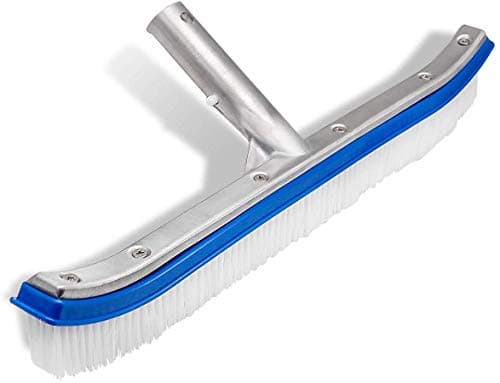
The job that prevents algae rather than treating it
Pool Wall Brush with Nylon Bristles
Various
Shares the telescopic pole you already own and prevents more chemical spend than anything else you can buy for the money. Nylon bristles, always, on a vinyl liner.
#ad how this is funded · price as of October 8, 2026
Key specs
- Typical width
- 18 inches is the common size
- Bristles
- Nylon for vinyl liners — never stainless on vinyl
- Head
- Plastic or aluminum backed; curved ends reach corners
- Fitting
- Standard telescopic pole connection
How it scoresour reading of published specs, not a test result
- Sizing fit
- 8.5
- Running cost
- 10.0
- Maintenance
- 9.0
- Build
- 7.5
- Value
- 9.5
Overall 8.9 / 10
What works
- Lifts the biofilm that becomes visible algae, before you can see it
- Shares the pole with the skimmer net and the vacuum head, so it adds no storage
- Curved ends actually reach the wall-to-floor corner where algae starts
- No running cost and nothing to replace
What doesn't
- Wide heads are harder to control on a curved above-ground wall
- Cheap heads shed bristles into the pool, which then load the filter
- Needs a pole long enough to reach the middle, which is bought separately
- Stainless-bristle versions exist and will damage a vinyl liner — read the label
Skip it if: Anything on the floor that needs removing rather than disturbing. Brushing lifts it; a vacuum takes it out.
What it costs to run: A few dollars, once, and it lasts seasons. Measured against a bottle of algaecide and a heavy shock, it is the cheapest chemistry on this site.
Several seasons: Buy-once. Built and warranted to come back out of the box for a few years, if you store it properly.
Specs from: 18-inch nylon pool wall brush — current Amazon listing and published specifications
Questions people actually ask
What do I need to buy with an above-ground pool?
Are pool starter kits worth buying?
What chlorine level should a new pool have?
Do I need shock straight away?
Sources
Read next
- Equipment, sized to your pool and costed by the wattPumps, filters, vacuums, heaters and ladders - matched to your gallons and priced by what they draw.
- First-time pool owner: the complete first monthThe pillar guide: day-one shopping list, the four water readings, the weekly routine and the week-three problem everybody gets.
- Pool maintenance for beginners, in twenty minutes a weekThe complete weekly routine in order, what each step is actually for, and the things you can safely ignore.
- The cheapest pool setup that actually works for a yearA complete, deliberately minimal first-year setup: the pool, the pump, the testing, the chlorine and the one tool you will use most.
- The best pool test stripsTest strips compared on parameter coverage - specifically whether they read cyanuric acid, which most cheap strips omit.
- The best chlorine tablets for an above-ground poolTrichlor tablets compared on available chlorine and stabilizer load, with the season-quantity arithmetic for your pool size.
- Equipment for a small pool, where most advice is written for a big oneThe equipment a small above-ground pool actually needs, what to skip, and why turnover arithmetic makes the supplied pump adequate more often than people expect.
- What to buy before you open, not halfway throughThe six-item spring shopping list, in the order the opening sequence needs them, plus what to leave until you have a reading.