Pool Care & Chemistry
Pool shock: what else you are adding decides which one to buy
Every shock adds chlorine. They also add calcium or cyanuric acid, permanently, and that side effect is what should pick the product rather than the price per pound.
Heads up: we earn a commission if you buy through the links on this page, at no extra cost to you. It never decides the ranking — here is how we pick and here is the full disclosure. Prices are checked automatically; last verified October 8, 2026.
Quick picks
Segmented before it is ranked — the right answer depends on which of these you actually are. Tap any row for the full write-up.
The default for a vinyl pool
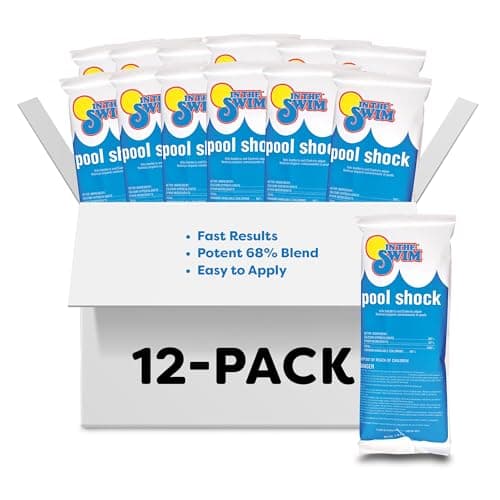
Sixty-eight percent cal-hypo in pre-measured pound bags, 65% available chlorine, and a published dose that matches a 10,000 gallon pool exactly.
| # | Product | Best for | Score | Price |
|---|---|---|---|---|
| 1 | In The Swim Pool Shock, 68% Cal-Hypo, 12 x 1 lb Sixty-eight percent calcium hypochlorite in pre-measured pound bags, with a published dose and a published re-entry rule. It adds calcium and no stabilizer, which is the right trade for most above-ground pools. | The default shock for a vinyl poolOne honest season | 8.4out of 10 |
Read the label, then dose
The same chemistry with a full EPA-registered label behind it - including a pre-mixing prohibition that contradicts common vinyl-pool advice.
| # | Product | Best for | Score | Price |
|---|---|---|---|---|
| 1 | 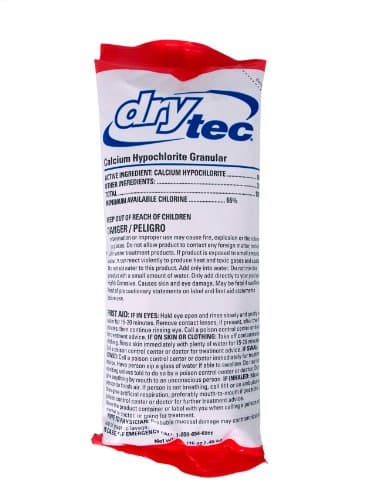 DryTec Calcium Hypochlorite Pool Shock, 1 lb The same 68% cal-hypo chemistry with a full EPA-registered label behind it. That label prohibits pre-mixing, which directly contradicts the advice given for other cal-hypo products — follow the bag you bought. | Reading the actual EPA label before you doseOne honest season | 8.2out of 10 |
Available everywhere
Lower available chlorine than the pro-grade bags, but published chemistry and stocked where people actually shop on a Sunday.
| # | Product | Best for | Score | Price |
|---|---|---|---|---|
| 1 | 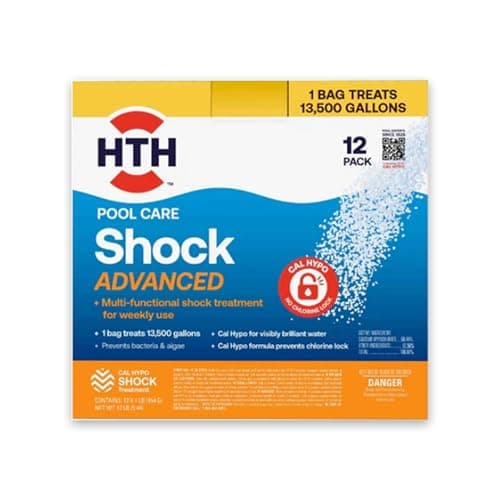 HTH Pool Care Shock Advanced Lower available chlorine than the pro-grade cal-hypo here, but HTH publishes its analysis and its dose, and it is stocked where people actually shop. | A grocery-aisle shock with published chemistryOne honest season | 7.9out of 10 |
Hard water
Calcium-free dichlor. It adds cyanuric acid instead, which is the right trade in hard fill water and the wrong one if your stabilizer is already high.
| # | Product | Best for | Score | Price |
|---|---|---|---|---|
| 1 | 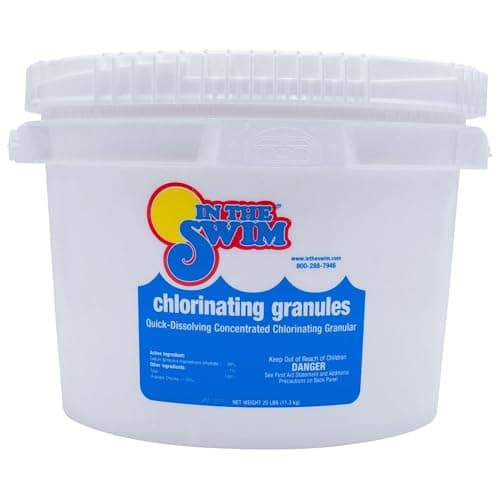 In The Swim Sodium Dichlor Chlorine Shock Granules, 25 lb The calcium-free alternative. Dichlor adds cyanuric acid instead of calcium, which is exactly right for a hard-water pool and exactly wrong for one whose CYA is already high. | Hard water, and pools that need stabilizer anywaySeveral seasons | 8.3out of 10 |
Back in the water fastest
A dichlor shock whose label permits swimming after 15 minutes subject to a test. The weakest available chlorine here, and the most convenient.
| # | Product | Best for | Score | Price |
|---|---|---|---|---|
| 1 | 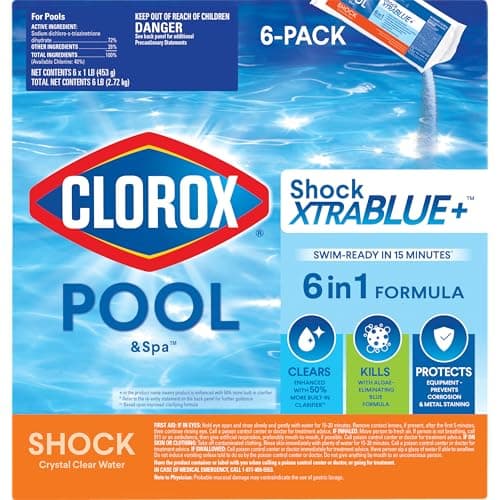 Clorox Pool&Spa Shock XtraBlue Plus A dichlor shock whose label permits swimming 15 minutes after application, subject to testing. The lowest available chlorine here at 40%, and the fastest back into the pool. | Back in the water in fifteen minutesOne honest season | 7.7out of 10 |
The short version
- Cal-hypo adds calcium. Dichlor adds cyanuric acid. Both are permanent until you dilute the pool. That is the real decision.
- Available chlorine ranges from 40% to 65% here. You are buying oxidizer, not powder, so compare on that figure.
- The labels disagree about pre-dissolving. One retailer tells vinyl-pool owners to pre-dissolve; an EPA label for the same chemistry prohibits it. Follow the bag you bought.
- Re-entry is a number, not a wait. Labels prohibit swimming above 4 ppm chlorine; CDC asks for at least 1 ppm, or 2 ppm in a stabilized pool.
Shock is a job, not a product
Shocking means raising free chlorine far above its normal level, fast, to burn through chloramines and organic load. Our shock guide covers when to do it and why half-doses fail. This page is about which bag to buy, and that turns on chemistry rather than brand.
There are two families in ordinary use. Calcium hypochlorite — cal-hypo — is unstabilized and carries calcium. Sodium dichlor is stabilized and carries cyanuric acid. Everything else on the shelf is a variation on one of those two, and the choice between them has consequences that outlast the dose.
What each one leaves behind
Cal-hypo leaves calcium. That is fine, and even helpful, in soft water. In hard fill water it accumulates, and calcium does not leave a pool except by draining and replacing water. The DryTec label instructs owners to maintain calcium hardness above 200 ppm, which tells you the product assumes it is contributing. Our calcium hardness guide explains why a vinyl pool tolerates more of this than a plaster one, and where the limit is.
Dichlor leaves cyanuric acid. CYA protects chlorine from sunlight, which is genuinely useful up to a point. Past that point it slows the chlorine down until a pool tests fine and behaves as though it has none. CYA also only leaves by dilution. Our cyanuric acid guide is the full story, and it is the single most common way a well-maintained above-ground pool ends up in trouble in August.
So the rule is simple and it is not about brands: if your fill water is hard, lean dichlor; if your stabilizer is climbing, lean cal-hypo; and if you use chlorine tablets, which are also stabilized, assume your CYA is rising already.
| Product | Chemistry | Available chlorine | Published dose | Adds |
|---|---|---|---|---|
| In The Swim Cal-Hypo | 68% calcium hypochlorite | 65% minimum | 1 lb per 10,000 gal (5-10 ppm) | Calcium |
| DryTec | 68% calcium hypochlorite | 65% minimum | 10-20 oz per 10,000 gal | Calcium |
| HTH Shock Advanced | 56.44% calcium hypochlorite | 54% minimum | 1 lb per 13,500 gal | Calcium |
| In The Swim Dichlor | 99% sodium dichlor | 56% stabilized | 21 oz per 10,000 gal to shock | Cyanuric acid |
| Clorox Shock XtraBlue Plus | 72% sodium dichlor | 40% | 1 lb per 12,000 gal | Cyanuric acid |
The pre-dissolving contradiction
Here is a genuine conflict worth knowing about before you open a bag. In The Swim tells vinyl-pool owners to pre-dissolve calcium hypochlorite in a bucket of water, which is long-standing advice intended to stop undissolved granules bleaching the liner. The EPA-registered label for DryTec’s cal-hypo says the opposite: do not pre-mix this product before adding it to your pool, and warns that exposure to small amounts of water can cause a violent reaction.
Both are defensible. Cal-hypo genuinely does react hard with a little water, and the bleaching risk to vinyl is genuinely real. The resolution is not to pick a side from an article: the label on the product you bought is the legally binding instruction, and it is the one to follow. If your bag prohibits pre-mixing, broadcast it over the deep end with the pump running instead, and brush the floor afterwards.
When you can get back in
Every EPA label here answers this with a number rather than a clock. Re-entry is prohibited above 4 ppm free chlorine, and the labels tell you to test before getting in. The Clorox dichlor product adds a 15 minute minimum before re-entry, subject to that test, which is the fastest published figure in this roundup. HTH’s own guidance suggests 8 to 24 hours for its cal-hypo.
The CDC’s home pool guidance sets the floor from the other direction: at least 1 ppm free chlorine in pools, at least 2 ppm where a stabilizer is in use, and pH 7.0 to 7.8. It publishes no post-shock waiting time at all. So the honest answer to “how long after shocking can we swim” is: until a test says between 1 and 4 ppm, and no sooner.
What a pound of each actually delivers
- In The Swim cal-hypo, published
- 65% available chlorine
- HTH Shock Advanced, published
- 54% available chlorine
- Clorox XtraBlue Plus, published
- 40% available chlorine
1 lb × 0.65 = 0.65 lb | 1 lb × 0.54 = 0.54 lb | 1 lb × 0.40 = 0.40 lb of available chlorine
A pound of the strongest delivers about 60% more oxidizer than a pound of the weakest
Matching the product to the pool
A vinyl above-ground pool on municipal water: cal-hypo, in pre-measured pound bags. The 65% products deliver the most oxidizer per bag, and one bag per 10,000 gallons is arithmetic you can do in your head.
Hard fill water, or a pool already high in calcium: dichlor, and watch the stabilizer. If you also use tablets, test CYA monthly rather than annually.
A pool that gets shocked often — heavy use, lots of children, a hot climate: alternate. Using one family exclusively is how pools end up at either extreme. Our weekly routine covers how often shocking is really needed, which for most pools is less often than the shelf suggests.
A small frame pool: buy the smallest quantity you can. A 25 lb tub of anything is a storage and safety problem on a 3,000 gallon pool, and opened oxidizer degrades.
How we picked
We have not tested these products. Every chemistry figure here is read off a manufacturer page or the EPA-registered label, and where the two disagree we have said so. One widely sold HTH product was excluded because the model number on the listing does not correspond to anything on HTH’s own site; the Shock Advanced product here is the one whose published analysis we could actually verify.
When to shock, and when not to
Shocking is a response, not a schedule. The cases that genuinely call for it are a chloramine smell, water that has gone dull or cloudy with no chemistry explanation, a heavy bather load, a storm that has dumped organic material into the pool, and the start of an algae problem. Our shock guide covers the diagnosis, and our chlorine smell guide covers the most misunderstood of those signals.
The cases that do not call for shock are just as important, because shocking the wrong problem costs money and adds either calcium or stabilizer for nothing. Cloudy water from high alkalinity and precipitating calcium is a balance problem, not an oxidizer problem. A pool on well water that has just been topped up may stain rather than clear, as our well water guide explains. And a pool whose chlorine reads fine but does nothing is usually a cyanuric acid problem, where more dichlor makes it worse.
Timing is the other half. Chlorine is consumed by ultraviolet light, which is why stabilized products exist at all — In The Swim describes its dichlor as containing an ultraviolet inhibitor. Shocking an unstabilized product into a pool at midday in July spends part of the dose on the sun rather than on the water.
Dosing from your real volume
Every dose on every label is per gallon, and most pool owners are working from a number on a box rather than the water in the yard. A frame pool filled to 90% of its rated capacity, as the manufacturers instruct, holds less than the headline figure, and that is the number your doses should be based on. Our sizing guide covers working it out honestly.
Shock for a 4,545 gallon rectangular pool
- Pool volume, Intex published at 90% fill
- 4,545 gal
- In The Swim cal-hypo published dose
- 1 lb per 10,000 gal for 5-10 ppm
- Clorox dichlor published dose
- 1 lb per 12,000 gal
4,545 ÷ 10,000 = 0.45 lb cal-hypo | 4,545 ÷ 12,000 = 0.38 lb dichlor
Under half a bag either way — and a 1 lb bag is a full dose plus most of a second
Storing it without creating a hazard
Pool shock is an oxidizer, and the CDC’s pool chemical guidance is specific: store chemicals in original, manufacturer-labeled containers; store each one separately in a dedicated location; keep incompatible chemicals apart; and keep them below 95°F, in low humidity, out of direct sunlight, and protected from getting wet.
The last of those is not a formality with cal-hypo. The EPA label for the DryTec product warns that if it is exposed to small amounts of water it can react violently. A damp shed floor, a leaking roof or a bag stored under a dripping tap is the scenario that guidance exists to prevent.
Shelf life is the reason to buy in proportion rather than in bulk. Published figures put properly stored cal-hypo shock at more than five years, while improperly stored bags can dissolve in 12 to 24 months. Our winter storage guide covers what should and should not be kept over the closed season.
One habit is worth more than any of this: never mix two products, even two shocks. Dichlor labels here explicitly prohibit mixing with other chemicals, warning of a violent reaction, and the commonest version of that mistake is tipping a new bag into a scoop that still has the last product in it.
A word on liquid chlorine
Liquid chlorine is the fourth option, and it is deliberately not in this roundup. It works, it adds neither calcium nor stabilizer, and it is what many commercial pools use. What rules it out for most above-ground owners is shelf life: published figures put losses at up to 50% of potency within six months and 90% within a year.
For a seasonal pool buying in small quantities, that means paying for chlorine that degrades before it is used. Granular shock keeps for years when stored properly, which is the practical reason it dominates the backyard market.
The picks, in full
Scores are our own reading of published specifications. They are not test results — we have not tested these products and we do not claim to.
Pick #1 · The default shock for a vinyl pool
In The Swim Pool Shock, 68% Cal-Hypo, 12 x 1 lb
In The Swim
Sixty-eight percent calcium hypochlorite in pre-measured pound bags, with a published dose and a published re-entry rule. It adds calcium and no stabilizer, which is the right trade for most above-ground pools.
#ad how this is funded · price as of October 8, 2026
Key specs
- Active
- Calcium hypochlorite, 68%
- Available chlorine
- 65% minimum
- Stabilizer
- None — non-stabilized, adds no cyanuric acid
- Calcium
- Yes, it is a calcium-based shock
- Dose
- One 1 lb bag per 10,000 gal gives 5-10 ppm free chlorine in a clean, balanced pool
- Pre-dissolve
- In The Swim says vinyl pools should pre-dissolve in a bucket first
- Swim again
- Not until free chlorine is back to 1-4 ppm
How it scoresour reading of published specs, not a test result
- Effectiveness
- 9.0
- Ease
- 8.0
- Water impact
- 7.0
- Cost per season
- 8.5
- Value
- 8.5
Overall 8.4 / 10
What works
- Pre-measured 1 lb bags, so dosing a 10,000 gallon pool is one bag and no scale
- Adds no cyanuric acid, which matters because CYA only leaves a pool by dilution
- Published dose and published re-entry level, both on the product page
- The strongest available-chlorine figure of the shocks here at 65% minimum
What doesn't
- Adds calcium every time, which accumulates in hard-water areas
- Undissolved granules can bleach a vinyl liner, hence the pre-dissolve instruction
- Not stabilized, so in strong sun the chlorine it adds burns off quickly
- Twelve pounds of oxidizer needs proper, separated storage
Skip it if: Hard water. If your calcium hardness is already high, a calcium-based shock pushes it further, and our calcium hardness guide explains why that is hard to undo without draining.
What it costs to run: Shock is bought by available chlorine, not by the pound. At 65% available chlorine this delivers more oxidizer per bag than the 54% and 40% products here, which is the comparison to make before price.
One honest season: The cheapest setup that genuinely works for a season of real swimming. Nothing spare, nothing missing.
Specs from: In The Swim — pool shock treatment 1 lb bags, published analysis and dose
Pick #2 · Reading the actual EPA label before you dose
DryTec Calcium Hypochlorite Pool Shock, 1 lb
DryTec
The same 68% cal-hypo chemistry with a full EPA-registered label behind it. That label prohibits pre-mixing, which directly contradicts the advice given for other cal-hypo products — follow the bag you bought.
#ad how this is funded · price as of October 8, 2026
Key specs
- Active
- Calcium hypochlorite 68%; other ingredients 32%
- Available chlorine
- 65% minimum
- Dose
- 10-20 oz per 10,000 gal for 5-10 ppm available chlorine
- Pre-dissolve
- Prohibited — the label says add directly to the pool or skimmer, do not pre-mix
- Calcium
- Label directs keeping calcium hardness above 200 ppm
- Re-entry
- Prohibited above 4 ppm chlorine
- Registration
- EPA Reg. No. 1258-427
How it scoresour reading of published specs, not a test result
- Effectiveness
- 9.0
- Ease
- 7.5
- Water impact
- 7.0
- Cost per season
- 8.5
- Value
- 8.0
Overall 8.2 / 10
What works
- A published, EPA-registered label you can read in full before buying
- Same 65% minimum available chlorine as the strongest shock here
- Directions distinguish stabilized from unstabilized pools, which most labels do not
- Single-pound packs, so there is no measuring
What doesn't
- The label prohibits pre-mixing, which conflicts with the pre-dissolve advice common for vinyl pools
- Cal-hypo reacts violently with small amounts of water, so damp storage is genuinely dangerous
- Adds calcium with every dose
- No stabilizer, so summer sun consumes the chlorine quickly
Skip it if: Improvisation. This is a label-driven product: the dose, the method and the re-entry level are all printed, and the label is the authority rather than general pool advice.
What it costs to run: Price it per ppm, not per bag: 10 to 20 ounces treats 10,000 gallons to 5-10 ppm, so a pound bag is roughly one to two shock doses on a typical above-ground pool.
One honest season: The cheapest setup that genuinely works for a season of real swimming. Nothing spare, nothing missing.
Specs from: EPA — master label, calcium hypochlorite EPA Reg. No. 1258-427 (dose, pre-mix prohibition, re-entry), PoolSupplies.com — DryTec 68% calcium hypochlorite shock, 1 lb listing
Pick #3 · A grocery-aisle shock with published chemistry
HTH Pool Care Shock Advanced
HTH
Lower available chlorine than the pro-grade cal-hypo here, but HTH publishes its analysis and its dose, and it is stocked where people actually shop.
#ad how this is funded · price as of October 8, 2026
Key specs
- Active
- Calcium hypochlorite, 56.44%
- Available chlorine
- 54% minimum
- Stabilizer
- None — HTH states it adds no cyanuric acid
- Dose
- 1 lb bag per 13,500 gal
- Pre-dissolve
- Prohibited by the label
- Swim again
- Free chlorine 1-4 ppm; HTH's own guidance says 8 to 24 hours
- Registration
- EPA Reg. No. 1258-1343
How it scoresour reading of published specs, not a test result
- Effectiveness
- 8.0
- Ease
- 8.5
- Water impact
- 7.0
- Cost per season
- 7.5
- Value
- 8.0
Overall 7.9 / 10
What works
- Sold nearly everywhere, which matters when the water goes cloudy on a holiday weekend
- Publishes both the percentage and the EPA label, unlike most supermarket shock
- No cyanuric acid, so it does not push a pool toward chlorine lock
- Dose is stated per 13,500 gallons, a size that suits mid-range above-ground pools
What doesn't
- 54% available chlorine against 65% for the pro-grade cal-hypo — you are buying less oxidizer per pound
- The 'Super Shock' name used on some listings does not match any product on HTH's own site
- Adds calcium like every cal-hypo
- HTH's own 8 to 24 hour wait is longer than a dichlor product needs
Skip it if: Value per pound of oxidizer. If shock is a regular part of your routine rather than an emergency purchase, the higher-percentage products cost less per unit of chlorine delivered.
What it costs to run: One bag per 13,500 gallons makes this convenient but not cheap per ppm. For a 5,000 gallon frame pool most of a bag is spare, and opened oxidizer does not store as well as sealed.
One honest season: The cheapest setup that genuinely works for a season of real swimming. Nothing spare, nothing missing.
Specs from: HTH — Pool Care Shock Advanced, published analysis and dose, EPA — label for EPA Reg. No. 1258-1343 (analysis, dose, re-entry)
Pick #4 · Hard water, and pools that need stabilizer anyway
In The Swim Sodium Dichlor Chlorine Shock Granules, 25 lb
In The Swim
The calcium-free alternative. Dichlor adds cyanuric acid instead of calcium, which is exactly right for a hard-water pool and exactly wrong for one whose CYA is already high.
#ad how this is funded · price as of October 8, 2026
Key specs
- Active
- 99% sodium dichloro-s-triazinetrione dihydrate
- Available chlorine
- 56%, stabilized
- Stabilizer
- Yes — contains a UV inhibitor, so it raises cyanuric acid
- Calcium
- None — calcium-free formula
- Routine dose
- 3 oz per 10,000 gal every other day or as needed
- Shock dose
- 21 oz per 10,000 gal for superchlorination
- Method
- Broadcast over the deepest part; no pre-dissolving required
How it scoresour reading of published specs, not a test result
- Effectiveness
- 8.5
- Ease
- 9.0
- Water impact
- 6.5
- Cost per season
- 8.5
- Value
- 8.5
Overall 8.3 / 10
What works
- Adds no calcium, which makes it the right shock for hard fill water
- Stabilized, so the chlorine it adds survives sunlight far better than cal-hypo's
- Broadcast directly, with no bucket and no pre-dissolving step
- A 25 lb tub covers routine dosing and shock treatment from one product
What doesn't
- Every dose raises cyanuric acid, and CYA only comes down by draining and refilling
- 56% available chlorine, below the pro-grade cal-hypo figure
- A 25 lb tub is a lot of oxidizer to store safely for a small pool
- Near-neutral in the tub, but repeated use drives the stabilizer up faster than owners expect
Skip it if: Pools that already have high cyanuric acid. Above roughly the mid range, adding more stabilizer is how a pool ends up with chlorine that tests fine and does nothing.
What it costs to run: Cheap per dose, expensive in consequences if it is your only chlorine. Track CYA through the season; our cyanuric acid guide explains why the dilution bill arrives later.
Several seasons: Buy-once. Built and warranted to come back out of the box for a few years, if you store it properly.
Specs from: In The Swim — granular chlorine sodium dichlor 25 lb, published analysis and dose rates
Pick #5 · Back in the water in fifteen minutes
Clorox Pool&Spa Shock XtraBlue Plus
Clorox Pool&Spa
A dichlor shock whose label permits swimming 15 minutes after application, subject to testing. The lowest available chlorine here at 40%, and the fastest back into the pool.
#ad how this is funded · price as of October 8, 2026
Key specs
- Active
- Sodium dichloro-s-triazinetrione dihydrate, 72%
- Available chlorine
- 40%
- Stabilizer
- Yes — dichlor, so it raises cyanuric acid
- Calcium
- None in the ingredient statement
- Dose
- 1 lb per 12,000 gal; the 13.4 oz pre-measured bag treats 10,000 gal
- Winterizing dose
- 1 lb per 6,000 gal
- Swim again
- Label permits 15 minutes, after testing; never above 4 ppm
- Pre-dissolve
- Prohibited — do not pre-dissolve or feed through the skimmer
How it scoresour reading of published specs, not a test result
- Effectiveness
- 7.0
- Ease
- 9.5
- Water impact
- 7.0
- Cost per season
- 7.0
- Value
- 7.5
Overall 7.7 / 10
What works
- The fastest published re-entry of any shock here, at 15 minutes subject to a test
- Pre-measured bags sized to 10,000 gallons, which suits most above-ground pools exactly
- Calcium-free, so it will not push calcium hardness up
- Published winterizing dose as well as a summer one
What doesn't
- 40% available chlorine is the weakest here — you are buying more packaging per unit of oxidizer
- Raises cyanuric acid with every dose, like all dichlor
- The label prohibits pre-dissolving and skimmer feeding, which not everyone reads
- Clorox's own product page publishes no chemistry; the figures come from the EPA label
Skip it if: Serious oxidation. At 40% available chlorine this is a maintenance shock and a convenience product, not the thing to reach for when a pool has gone green.
What it costs to run: The 15-minute re-entry is what you are paying for. Measured per ppm of chlorine delivered, it is the most expensive shock in this roundup by a clear margin.
One honest season: The cheapest setup that genuinely works for a season of real swimming. Nothing spare, nothing missing.
Specs from: EPA — label for EPA Reg. No. 67262-46 (analysis, dose, 15-minute re-entry), Clorox Pool&Spa — Shock XtraBlue Plus product page
Questions people actually ask
Which is better, cal-hypo or dichlor shock?
How long after shocking can you swim?
Should I pre-dissolve shock before adding it?
How much shock does a 10,000 gallon pool need?
Does shock raise cyanuric acid?
Sources
- In The Swim — pool shock treatment 1 lb bags, published analysis and dose
- EPA — master label, calcium hypochlorite EPA Reg. No. 1258-427
- EPA — label for EPA Reg. No. 67262-46 (dichlor, 15-minute re-entry)
- In The Swim — sodium dichlor granules, published analysis and dose rates
- CDC — home pool and hot tub water treatment and testing
Read next
- Pool care, from someone who assumes you have never done thisThe weekly routine, the four numbers that matter, and the fix for the week the water turns.
- Pool shock: use enough, once, and use the right kindCal-hypo versus dichlor, correct dosing, and the counter-intuitive reason a chlorine smell means you need more chlorine.
- Cyanuric acid: the reading that explains your chlorineWhy an outdoor pool needs stabilizer, why tablets add it whether you want them to or not, and the only way to bring it back down.
- Calcium hardness: the reading a vinyl pool can mostly ignoreWhy the fourth reading matters less on a vinyl above-ground pool, the two cases where it genuinely does, and how to test it.
- Pool algae: brush, shock, filter, then rebalanceThe correct order for clearing green water, how to tell algae from pollen, and why algaecide prevents rather than cures.
- The best chlorine tablets for an above-ground poolTrichlor tablets compared on available chlorine and stabilizer load, with the season-quantity arithmetic for your pool size.
- Cloudy pool water: work out which of four problems you haveA diagnostic decision tree for cloudy water - four causes, how to tell them apart, and the correct fix for each.
- What a season of pool chemicals actually adds up toSeason chemical quantities computed from published dosing for four pool volumes, plus the shopping list that is genuinely necessary.
- Hard water changes which chemicals you buy, not how often you testWhat hard fill water actually does to an above-ground pool, why vinyl tolerates it better than plaster, and the one chemical choice that stops it getting worse.