Pool Equipment
Floater or feeder: the same tablets, metered two different ways
A floating dispenser costs less than a bag of tablets. A feeder costs more than the tablets it holds and turns dosing into a dial setting. Both beat throwing tablets in the skimmer.

Heads up: we earn a commission if you buy through the links on this page, at no extra cost to you. It never decides the ranking — here is how we pick and here is the full disclosure. Prices are checked automatically; last verified October 8, 2026.
Quick picks
Segmented before it is ranked — the right answer depends on which of these you actually are. Tap any row for the full write-up.
If this is your first season
A vented floating dispenser holds standard 3-inch tablets and adjusts with a twist. It is the cheapest correct way to use tablets.
| # | Product | Best for | Score | Price |
|---|---|---|---|---|
| 1 | 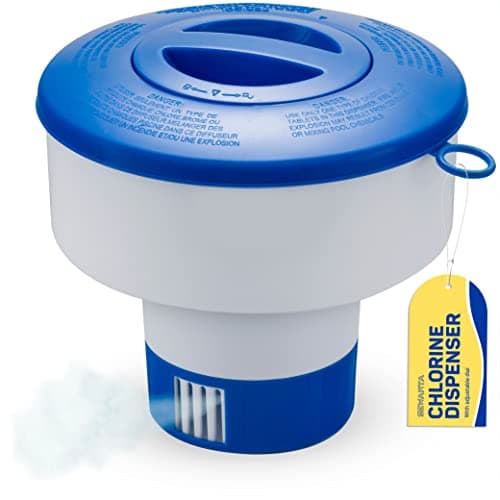 Floating Chlorine Tablet Dispenser Two dollars of plastic that decides whether your chlorine dissolves evenly over days or sits in a corner bleaching your liner. Buy it with the tablets, not after. | Making tablets work properlyOne honest season | 9.0out of 10 |
If you want a dial instead of a guess
An off-line feeder holds 4.2 lb of tablets, plumbs beside the return and meters the feed with a valve. It also keeps tablets out of the pool entirely.
| # | Product | Best for | Score | Price |
|---|---|---|---|---|
| 1 | 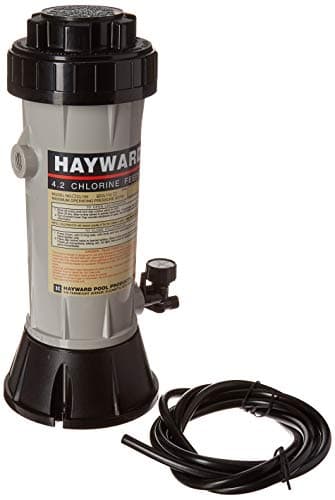 Off-Line Automatic Chlorine Feeder A tablet canister plumbed into the return line with an adjustable feed dial. It does what a floating dispenser does, with a rate you set rather than one the tablet decides. | Steady chlorination without a floaterSeveral seasons | 7.8out of 10 |
The short version
- Never put tablets in the skimmer basket. That is the practice both of these products exist to replace.
- A floater is a few dollars and works. Vented, adjustable, and it takes the same 3-inch tablets.
- A feeder meters by dial and holds 4.2 lb. It is the answer for a bigger pool or a week away.
- Both raise cyanuric acid, because trichlor tablets are stabilized. That is the real long-run cost of either.
The practice both of these replace
Putting tablets in the skimmer basket is common and it is the wrong answer. With the pump off, the skimmer and the pipework beyond it sit full of concentrated, acidic dissolved trichlor, which attacks metal parts and fittings. It also dumps a slug of chlorine into the pool when the pump restarts.
A floater or a feeder both solve that, by holding the tablets where the dissolution rate is controlled and the concentrate is diluted immediately.
What each one is
A floating dispenser is a vented plastic container that holds 3-inch tablets and drifts on the surface, with an adjustable base that sets how much water passes over them. Our floater roundup covers the models.
An off-line feeder is plumbed into the return line beside it rather than into it, holds 4.2 lb of tablets on the common above-ground unit, and meters the feed with a dial valve. It fits above-ground filter systems through a universal adapter kit and has a corrosion-resistant housing. Our feeder roundup has the detail.
| Floating dispenser | Off-line feeder | |
|---|---|---|
| Tablet capacity | A few tablets | 4.2 lb on the common above-ground unit |
| Dose control | Vented base, adjustable | Dial valve sets feed rate |
| Installation | None - drop it in | Plumbed beside the return, adapter kit |
| Tablets in the pool | Yes, floating | No - tablets never enter the water |
| Refill interval | Often weekly | Longer, by capacity |
| Cost | Less than a bag of tablets | Several times the floater |
The liner question
A floater can park itself against the wall or in a corner and sit there, holding a concentrated tablet against vinyl for hours. That is a genuine bleaching and weakening risk, and it is the main practical argument for a feeder on a vinyl pool — our liner guide covers what damages vinyl.
It is manageable: nudge the floater away from the wall when you pass, and take it out before a long absence. But it is a habit you have to keep, and a feeder removes the need for it entirely because the tablets are never in the pool.
What neither one fixes
Cyanuric acid. Trichlor tablets are stabilized, so every tablet either device dissolves adds CYA that only leaves by replacing water. That is the same regardless of how you meter them, and it is why our stabilizer guide matters more than the choice on this page.
If your CYA is already climbing, the answer is not a different dispenser — it is alternating with an unstabilized product, covered in our shock roundup, or diluting.
Who should buy which
Floater for a first season, a small pool, or anyone testing whether tablets suit their routine at all. It is cheap enough that being wrong costs nothing.
Feeder for a larger pool, a vinyl liner you want to protect, or a household that travels — capacity and a dial beat a floater you have to refill and reposition. Our vacation guide covers the week-away case.
Setting either one correctly
Both devices meter by exposing more or less of the tablet to moving water, and both are usually set wrong on day one — too open, which burns through tablets and spikes chlorine, or shut so far that nothing dissolves.
Start nearly closed
Open the vent or the dial a quarter, run the pool for two days, then test. It is far easier to open up than to pull chlorine back out.Test at the same time of day
Chlorine readings move with sunlight and bather load. Comparing Tuesday morning with Saturday evening tells you nothing.Adjust one step at a time
One change, two days, one test. Chasing the reading with daily adjustments is how people end up dosing blind.Keep the floater away from the wall
Nudge it toward the middle when you pass, and take it out before you leave for a week.Empty either one before you close the pool
A feeder or floater left loaded over winter is concentrated tablet sitting against plastic for five months.
What goes wrong with each
Floaters get stuck. They park in a corner, behind a ladder, or against the skimmer where they starve the rest of the pool and over-chlorinate one spot. They also get picked up and put on the deck by children, at which point the pool has no sanitizer until someone notices.
Feeders fail differently: a dial left open after a shock, or a unit that is not drained before winter. They are plumbed, so a leak is a leak on your equipment pad rather than a nuisance in the water.
The stabilizer arithmetic neither solves
Trichlor tablets are about half stabilizer by the time you account for what dissolves, and cyanuric acid does not evaporate, break down or get filtered out. It accumulates until the only way down is replacing water, as our draining guide explains.
That is the real long-run cost of tablet chlorination in either device, and it is why our tablets against liquid comparison matters more over a few seasons than the choice between a floater and a feeder. Test cyanuric acid monthly rather than annually, and alternate with an unstabilized shock when it starts to climb.
Handling tablets safely
Trichlor tablets are an oxidizer and they are handled far too casually. CDC guidance on pool chemicals is to keep them in the original labeled container, store each product separately away from incompatible chemicals, and keep them below 95°F, dry and out of direct sun.
Three habits follow. Never mix products or reuse a scoop between them. Never stack a tablet bucket next to shock in a hot shed. And close the bucket properly, because trichlor gives off fumes in a confined space and a damp bucket is a genuine hazard rather than a theoretical one.
When you load either device, do it out of the pool, dry-handed, and put the lid back on the bucket before you walk away. Our storage guide covers what keeps over winter, and tablets stored sealed at a stable temperature keep well — published figures put trichlor at 98% of available chlorine after three years in those conditions.
The honest recommendation
Start with a floater. It costs less than the tablets it holds, it works, and if tablets turn out not to suit your routine you have lost nothing.
Move to a feeder when one of three things is true: the pool is big enough that a floater needs refilling more often than you will do it, you travel and need capacity, or you have found a bleached patch on the liner where the floater parks. Each of those is a specific reason rather than an upgrade for its own sake, which is how this site treats equipment generally.
What to buy
Scores are our own reading of published specifications. They are not test results — we have not tested these products and we do not claim to.
Making tablets work properly
Floating Chlorine Tablet Dispenser
Various
Two dollars of plastic that decides whether your chlorine dissolves evenly over days or sits in a corner bleaching your liner. Buy it with the tablets, not after.
#ad how this is funded · price as of October 8, 2026
Key specs
- Function
- Holds 3-inch tablets, meters dissolution rate
- Adjustment
- Vented base, adjustable on most models
- Compatibility
- Standard 3-inch tablets
How it scoresour reading of published specs, not a test result
- Effectiveness
- 8.0
- Ease
- 9.5
- Water impact
- 9.0
- Cost per season
- 9.8
- Value
- 9.5
Overall 9.0 / 10
What works
- Adjustable venting lets you slow or speed dissolution to match the weather
- Keeps tablets off the liner, which is what causes bleach spots
- Trivially cheap and lasts years
What doesn't
- Drifts to one end of the pool in wind, so distribution is uneven without circulation
- Must be removed before swimming with small children
- Cheap ones crack after a season in UV
Skip it if: Being left in an empty or unfiltered pool. Without circulation it creates a concentrated pocket rather than an even dose.
What it costs to run: The cheapest item on this site and one of the highest-return: even dissolution means you use fewer tablets to hold the same free chlorine level.
One honest season: The cheapest setup that genuinely works for a season of real swimming. Nothing spare, nothing missing.
Steady chlorination without a floater
Off-Line Automatic Chlorine Feeder
Hayward
A tablet canister plumbed into the return line with an adjustable feed dial. It does what a floating dispenser does, with a rate you set rather than one the tablet decides.
Key specs
- Capacity
- 4.2 lb of tablets on the common above-ground unit
- Tablets
- 3 in trichlor
- Type
- Off-line — plumbed beside the return, not into it
- Control
- Dial valve sets the feed rate
- Fitting
- Universal adapter kit for above-ground filter systems
- Construction
- Corrosion-resistant housing
How it scoresour reading of published specs, not a test result
- Sizing fit
- 7.0
- Running cost
- 8.5
- Maintenance
- 7.5
- Build
- 8.5
- Value
- 7.5
Overall 7.8 / 10
What works
- Feed rate is a dial rather than a guess, which a floating dispenser cannot offer
- Holds several days of tablets, so the routine becomes weekly rather than daily
- Off-line design means it is not in the pressure path if it fails
- The above-ground version ships with adapters for the common filter systems
What doesn't
- It is plumbing — a permanent installation on the equipment pad, not a purchase you drop in
- Trichlor tablets add cyanuric acid, exactly as a floater does
- Concentrated tablet solution is hard on fittings if the feed rate is set too high
- Has to be drained and cleared at closing like everything else in the line
Skip it if: A pool that is dismantled every autumn. The installation only pays back on a pool that stays plumbed year after year.
What it costs to run: It changes how tablets are delivered, not how many you use. The tablet bill is the same one our chlorine tablet roundup prices; what you are buying is control and fewer trips to the pool.
Several seasons: Buy-once. Built and warranted to come back out of the box for a few years, if you store it properly.
Specs from: Hayward CL110ABG off-line above-ground chemical feeder — Amazon listing
Questions people actually ask
Can I just put chlorine tablets in the skimmer?
Will a floating dispenser stain or bleach the liner?
How many tablets does a feeder hold?
Do both raise cyanuric acid?
Read next
- Equipment, sized to your pool and costed by the wattPumps, filters, vacuums, heaters and ladders - matched to your gallons and priced by what they draw.
- The floating dispenser, and why it prevents more than it costsWhat to look for in a floating chlorine dispenser, why loose tablets damage liners, and the tablet arithmetic by pool size.
- The feeder turns a guess into a dialOff-line automatic chlorine feeders compared with floating dispensers on control, capacity and installation, and whether they suit a seasonal pool.
- The best chlorine tablets for an above-ground poolTrichlor tablets compared on available chlorine and stabilizer load, with the season-quantity arithmetic for your pool size.
- Tablets or liquid: the difference is what else goes inTrichlor tablets against liquid chlorine on stabilizer, convenience, storage and cost, for a seasonal above-ground pool.
- Cyanuric acid: the reading that explains your chlorineWhy an outdoor pool needs stabilizer, why tablets add it whether you want them to or not, and the only way to bring it back down.
- The liner is the most expensive thing you can wreck in an afternoonBeaded, overlap and unibead liners explained, what gauge in mil buys, and the patch kit that turns a leak into a fifteen-minute job.