Pool Care & Chemistry · Best Chlorine Tablets
The best chlorine tablets for an above-ground pool
Trichlor tablets are close to a commodity. What separates them is available chlorine percentage, and what nobody tells you is what they do to your cyanuric acid.
Heads up: we earn a commission if you buy through the links on this page, at no extra cost to you. It never decides the ranking — here is how we pick and here is the full disclosure. Prices are checked automatically; last verified October 18, 2026.
Quick picks
Segmented before it is ranked — the right answer depends on which of these you actually are. Tap any row for the full write-up.
The routine sanitizer
Stabilized 3-inch tablets in a floating dispenser. Compare on available chlorine percentage — these are close to interchangeable otherwise.
| # | Product | Best for | Score | Price |
|---|---|---|---|---|
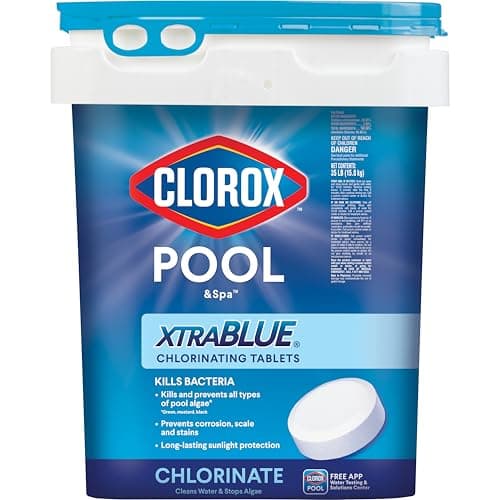
| 1 | Clorox Pool&Spa 3-Inch Chlorinating Tablets Stabilized trichlor tablets in a floating dispenser is the standard answer for a seasonal above-ground pool, and this is the standard version of it. | The default chlorine sourceOne honest season | 8.5out of 10 | |
| 2 | 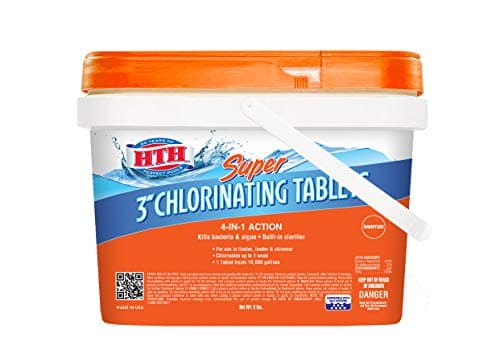 HTH 3-Inch Chlorinating Tablets Functionally the same product as any other stabilized trichlor tablet. Buy on price per pound of available chlorine, not on the label. | The direct alternativeOne honest season | 8.4out of 10 | |
| 3 | 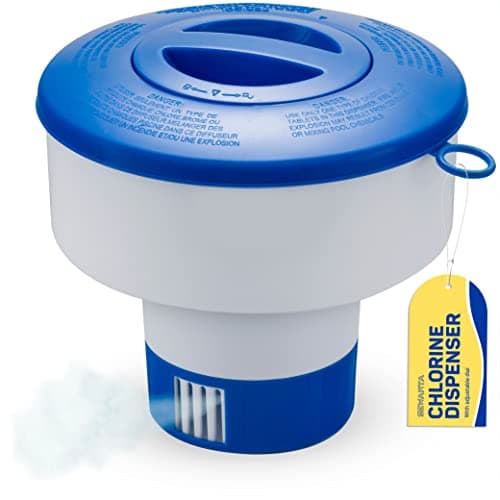 Floating Chlorine Tablet Dispenser Two dollars of plastic that decides whether your chlorine dissolves evenly over days or sits in a corner bleaching your liner. Buy it with the tablets, not after. | Making tablets work properlyOne honest season | 9.0out of 10 |
For when tablets are the wrong tool
Unstabilized shock for a bloom, because your cyanuric acid is probably already high.
| # | Product | Best for | Score | Price |
|---|---|---|---|---|
| 1 | No image Calcium Hypochlorite Pool Shock Unstabilized, fast-acting and strong. This is the tool for an algae bloom precisely because it does not add more cyanuric acid to a pool that probably already has too much. | Actually clearing a green poolOne honest season | 8.6out of 10 |
The short version
- Trichlor tablets are a commodity. Compare available chlorine percentage and bucket size, then buy the cheaper one.
- Every tablet adds cyanuric acid, and it only leaves with the water. In a small pool that is topped up, this is the thing that eventually bites.
- Published dosing is two tablets weekly per 10,000 gallons — about 6 tablets a season for a 12ft pool, 24 for an 18ft one.
- A floating dispenser is not optional. Loose tablets bleach a permanent pale patch into the liner.
What actually differs between brands
Very little, and it is worth saying plainly rather than manufacturing distinctions. Stabilized 3-inch trichlor tablets are the same chemistry from every maker. Two things genuinely vary:
Available chlorine percentage, printed on the label. This is the real basis for comparing value — a cheaper bucket with a lower percentage is not cheaper per unit of sanitizer.
Individual wrapping. Wrapped tablets keep better once the bucket is open, and trichlor degrades and gasses off when it gets damp. In a humid climate this is worth something real.
Everything else — blue speckles, clarifier claims, brand — is marketing. Compare the percentage and the count, and buy whichever costs less per tablet.
How many you need
Clorox Pool&Spa publishes two tablets weekly per 10,000 gallons, adjusted by testing. That makes the season arithmetic straightforward:
| Pool | Gallons | Tablets/week | Tablets/season |
|---|---|---|---|
| Intex Easy Set 12ft | 1,485 | 0.30 | ≈ 5 |
| Intex Prism Frame 12ft | 1,718 | 0.34 | ≈ 6 |
| Bestway Steel Pro MAX 15ft | 3,955 | 0.79 | ≈ 14 |
| Intex Ultra XTR 18ft | 6,981 | 1.40 | ≈ 24 |
Note what that means for bucket sizing: a small pool genuinely does not need a 35-pound bucket, and trichlor stored badly for a year is trichlor you throw away. Buy roughly a season’s worth unless you have somewhere genuinely dry to keep the rest.
The cyanuric acid problem
This is the part the category does not discuss and it is the most important thing on this page.
Trichlor is stabilized, meaning each tablet carries cyanuric acid. That is a feature outdoors — without it, UV destroys your free chlorine within hours. But cyanuric acid does not get consumed the way chlorine does. It accumulates, and it only leaves the pool when the water does.
Why small pools hit this faster
- Small pool
- 1,718 gallons
- Large pool
- 6,981 gallons
- Stabilizer added
- proportional to tablets used
Same chlorine concentration needs ~4× fewer tablets in the small pool — but into ~4× less water
Cyanuric acid concentration rises at a similar rate, and the small pool has far less water to dilute it
When cyanuric acid gets too high, the only fix is dilution: partially drain and refill, at $6.06 per 1,000 gallons nationally. There is no chemical that removes it. Knowing this in advance is what stops you spending a summer adding chlorine that cannot work.
The other thing trichlor does
It is acidic, so it pushes pH down steadily across a season. That is not a defect, it is chemistry — but it means you will need a pH increaser, and it is why the day-one shopping list includes one. The CDC’s published pH range is 7.0–7.8, and chlorine below that range starts corroding equipment while chlorine above it stops working properly.
If tablets and their stabilizer load are becoming a recurring problem, the alternative worth understanding is a salt system — which does not replace chlorine, it just generates it without the cyanuric acid.
Tablets need somewhere to sit, and dropping them in the skimmer is the habit that corrodes equipment. Our floating chlorine dispenser roundup covers the alternative, which costs very little and is the difference between a steady dose and a spike.
If you would rather set a feed rate than trust a floating dispenser’s vent ring, there is hardware for that. Our automatic chlorine feeder roundup covers off-line feeders, what the dial actually buys you, and why it makes no difference at all to the stabilizer these tablets carry.
The picks, in full
Scores are our own reading of published specifications. They are not test results — we have not tested these products and we do not claim to.
Pick #1 · The default chlorine source
Clorox Pool&Spa 3-Inch Chlorinating Tablets
Clorox Pool&Spa
Stabilized trichlor tablets in a floating dispenser is the standard answer for a seasonal above-ground pool, and this is the standard version of it.
#ad how this is funded · price as of October 18, 2026
Key specs
- Type
- Stabilized trichlor, 3-inch tablets
- Contains stabilizer
- Yes — cyanuric acid is part of trichlor
- Dosing
- Per manufacturer instructions, by pool volume
- CDC target
- At least 2 ppm free chlorine when using a stabilizer
How it scoresour reading of published specs, not a test result
- Effectiveness
- 9.0
- Ease
- 9.0
- Water impact
- 6.0
- Cost per season
- 8.5
- Value
- 8.5
Overall 8.5 / 10
What works
- Dissolves slowly, so a floating dispenser meters chlorine out over days rather than hours
- Stabilized, so sunlight does not destroy your chlorine within an afternoon
- Widely stocked, so you are never hunting for it in July
What doesn't
- Every tablet adds cyanuric acid, and in a pool you never fully drain that accumulates until chlorine stops responding
- Trichlor is acidic and will pull your pH down over a season
- Tablets must be kept dry and sealed or they degrade and gas off
Skip it if: A small pool that is topped up rather than drained. Cyanuric acid only leaves with the water, so in a 1,500-gallon pool it climbs fast.
What it costs to run: The standing chemical cost of the season, and it scales directly with gallons. Watch the cyanuric acid reading on your test strip: once it is high, you are buying chlorine that cannot work, which is the most common invisible waste in a first pool year.
One honest season: The cheapest setup that genuinely works for a season of real swimming. Nothing spare, nothing missing.
Specs from: CDC — free chlorine target with cyanuric acid
Pick #2 · The direct alternative
HTH 3-Inch Chlorinating Tablets
HTH
Functionally the same product as any other stabilized trichlor tablet. Buy on price per pound of available chlorine, not on the label.
Key specs
- Type
- Stabilized trichlor, 3-inch tablets
- Contains stabilizer
- Yes
- Compare on
- Available chlorine percentage stated on the label
How it scoresour reading of published specs, not a test result
- Effectiveness
- 9.0
- Ease
- 9.0
- Water impact
- 6.0
- Cost per season
- 8.8
- Value
- 8.5
Overall 8.4 / 10
What works
- Chemically equivalent to competing trichlor tablets — this is a commodity
- Widely available in large buckets, which is the cheaper format
- Long shelf life if the bucket stays sealed and dry
What doesn't
- Same cyanuric acid accumulation as every other trichlor product
- Same downward pH pressure over a season
- Bucket sizes are often larger than a small seasonal pool will use in a year
Skip it if: Being different. If you are comparing trichlor brands you are comparing price, and you should be.
What it costs to run: Cost per season is decided by the available-chlorine percentage on the label and the bucket size, not the brand. Compare those two numbers and buy the cheaper one.
One honest season: The cheapest setup that genuinely works for a season of real swimming. Nothing spare, nothing missing.
Pick #3 · Making tablets work properly
Floating Chlorine Tablet Dispenser
Various
Two dollars of plastic that decides whether your chlorine dissolves evenly over days or sits in a corner bleaching your liner. Buy it with the tablets, not after.
#ad how this is funded · price as of October 18, 2026
Key specs
- Function
- Holds 3-inch tablets, meters dissolution rate
- Adjustment
- Vented base, adjustable on most models
- Compatibility
- Standard 3-inch tablets
How it scoresour reading of published specs, not a test result
- Effectiveness
- 8.0
- Ease
- 9.5
- Water impact
- 9.0
- Cost per season
- 9.8
- Value
- 9.5
Overall 9.0 / 10
What works
- Adjustable venting lets you slow or speed dissolution to match the weather
- Keeps tablets off the liner, which is what causes bleach spots
- Trivially cheap and lasts years
What doesn't
- Drifts to one end of the pool in wind, so distribution is uneven without circulation
- Must be removed before swimming with small children
- Cheap ones crack after a season in UV
Skip it if: Being left in an empty or unfiltered pool. Without circulation it creates a concentrated pocket rather than an even dose.
What it costs to run: The cheapest item on this site and one of the highest-return: even dissolution means you use fewer tablets to hold the same free chlorine level.
One honest season: The cheapest setup that genuinely works for a season of real swimming. Nothing spare, nothing missing.
Pick #4 · Actually clearing a green pool
Calcium Hypochlorite Pool Shock
Various (compare available chlorine %)
Unstabilized, fast-acting and strong. This is the tool for an algae bloom precisely because it does not add more cyanuric acid to a pool that probably already has too much.
Key specs
- Type
- Calcium hypochlorite, unstabilized
- Adds stabilizer
- No
- Adds
- Calcium hardness
- Dosing
- By pool volume, per the bag
How it scoresour reading of published specs, not a test result
- Effectiveness
- 9.5
- Ease
- 6.5
- Water impact
- 7.0
- Cost per season
- 9.0
- Value
- 8.8
Overall 8.6 / 10
What works
- No cyanuric acid added, so it does not worsen the problem it is usually solving
- Fast and strong enough to actually break an algae bloom in one treatment when dosed properly
- Cheap per pound of available chlorine
What doesn't
- Adds calcium hardness, which matters in hard-water areas
- Must be dissolved properly or it will bleach a vinyl liner where it settles
- Needs careful storage — it is a genuine oxidizer, not a household product
Skip it if: Routine daily chlorination. This is the emergency tool; tablets are the routine.
What it costs to run: The single most cost-effective way to fix a green pool, and the most commonly under-dosed. Half a dose twice does not equal a full dose once — it just wastes the bag.
One honest season: The cheapest setup that genuinely works for a season of real swimming. Nothing spare, nothing missing.
Pick #5 · The default first test kit
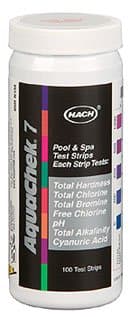
AquaChek Silver 7-Way Test Strips (100 count)
AquaChek
Seven readings in fifteen seconds, including the two that beginners never measure and then fight all summer: total alkalinity and cyanuric acid.
#ad how this is funded · price as of October 18, 2026
Key specs
- Tests
- Free chlorine, total chlorine, bromine, pH, total alkalinity, total hardness, cyanuric acid
- Free chlorine range
- 0-20 ppm
- pH range
- 6.2-8.4
- Total alkalinity range
- 0-240 ppm
- Cyanuric acid range
- 0-300 ppm
- Read time
- 15 seconds
- Count
- 100 strips
How it scoresour reading of published specs, not a test result
- Ease
- 9.5
- Value
- 9.2
Overall 8.9 / 10
What works
- Covers cyanuric acid, which most cheap strips omit and which is the reason chlorine stops working in a stabilized pool
- pH range spans 6.2-8.4, comfortably bracketing the CDC's recommended 7.0-7.8
- 15 seconds and a color chart printed on the bottle — no separate booklet to lose
- 100 strips is a full season of twice-weekly testing with room to spare
What doesn't
- Strips are a comparison against a printed color chart, so they are directional rather than precise
- Reading them in bright sun is harder than it should be
- The bottle must be kept sealed and dry or the strips degrade quietly
Skip it if: Fine adjustment. If you are chasing a stubborn problem and need a number rather than a color band, a liquid reagent kit is the tool.
What it costs to run: 100 strips at twice-weekly testing covers roughly two seasons for one pool. The real saving is upstream: knowing your alkalinity stops you buying pH adjuster you did not need.
One honest season: The cheapest setup that genuinely works for a season of real swimming. Nothing spare, nothing missing.
Specs from: CDC — home pool and hot tub water treatment and testing
Questions people actually ask
How many chlorine tablets do I need for my pool?
Which chlorine tablets are best?
Do chlorine tablets raise cyanuric acid?
Can I put chlorine tablets directly in the pool?
Sources
Read next
- Pool care, from someone who assumes you have never done thisThe weekly routine, the four numbers that matter, and the fix for the week the water turns.
- The best pool test stripsTest strips compared on parameter coverage - specifically whether they read cyanuric acid, which most cheap strips omit.
- Pool shock: use enough, once, and use the right kindCal-hypo versus dichlor, correct dosing, and the counter-intuitive reason a chlorine smell means you need more chlorine.
- Salt vs chlorine: a saltwater pool is a chlorine poolWhat a salt chlorine generator actually does, the honest cost comparison over several seasons, and when it does not make sense.
- What upkeep costs, separated from everything elseChemicals by published dosing, cartridge replacement intervals, and the honest weekly time commitment.
- Floater or feeder: the same tablets, metered two different waysFloating dispensers against off-line tablet feeders: capacity, dose control, what each does to a vinyl liner, and why neither belongs in the skimmer basket.