Seasonal Care · Best Opening Kit
What to buy before you open, not halfway through
Opening a pool is a sequence, and every gap in the shopping list stops the sequence dead for a day. Six items, bought in April, save the fortnight.
Heads up: we earn a commission if you buy through the links on this page, at no extra cost to you. It never decides the ranking — here is how we pick and here is the full disclosure. Prices are checked automatically; last verified October 8, 2026.
Quick picks
Segmented before it is ranked — the right answer depends on which of these you actually are. Tap any row for the full write-up.
Buy these before you lift the cover
Nothing else on the list is useful until you can read the water and remove what is floating on it. These two come first and they come home together.
| # | Product | Best for | Score | Price |
|---|---|---|---|---|
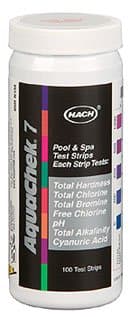
| 1 | AquaChek Silver 7-Way Test Strips (100 count) Seven readings in fifteen seconds, including the two that beginners never measure and then fight all summer: total alkalinity and cyanuric acid. | The default first test kitOne honest season | 8.9out of 10 | |
| 2 | 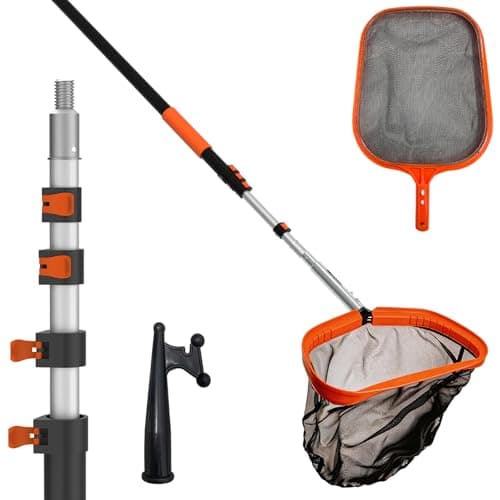 Skimmer Net with Telescopic Pole Catching leaves while they float is a two-minute job. Catching them after they sink is a vacuum session and a filter clean. Buy this first. | The five-dollar tool you use mostSeveral seasons | 8.8out of 10 |
The three the sequence needs on day one
Balance, then sanitize, then filter. Discovering you are missing any of these mid-opening costs you a day each.
| # | Product | Best for | Score | Price |
|---|---|---|---|---|
| 1 | No image Alkalinity Increaser (sodium bicarbonate) The most under-bought chemical in the category. If your pH will not stay put, this is almost always the actual fix, and it is chemically just baking soda. | Fixing the number beginners skipOne honest season | 9.0out of 10 | |
| 2 | No image Calcium Hypochlorite Pool Shock Unstabilized, fast-acting and strong. This is the tool for an algae bloom precisely because it does not add more cyanuric acid to a pool that probably already has too much. | Actually clearing a green poolOne honest season | 8.6out of 10 | |
| 3 | No image Type A Replacement Filter Cartridges (multipack) Buy them in a multipack before you need them. A pool running on an exhausted cartridge is a cloudy pool, and the fix is a two-dollar part you did not have. | The consumable you will actually buy repeatedlyOne honest season | 8.2out of 10 |
For the week after, not the day
Once the water is clear you switch from resetting it to holding it, and these two are what hold it steadily rather than in weekly bursts.
| # | Product | Best for | Score | Price |
|---|---|---|---|---|
| 1 | 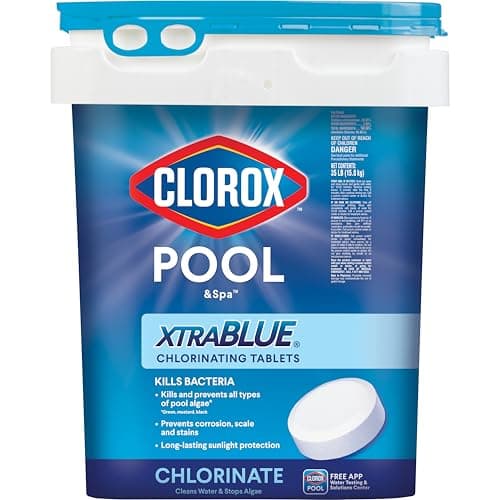 Clorox Pool&Spa 3-Inch Chlorinating Tablets Stabilized trichlor tablets in a floating dispenser is the standard answer for a seasonal above-ground pool, and this is the standard version of it. | The default chlorine sourceOne honest season | 8.5out of 10 | |
| 2 | 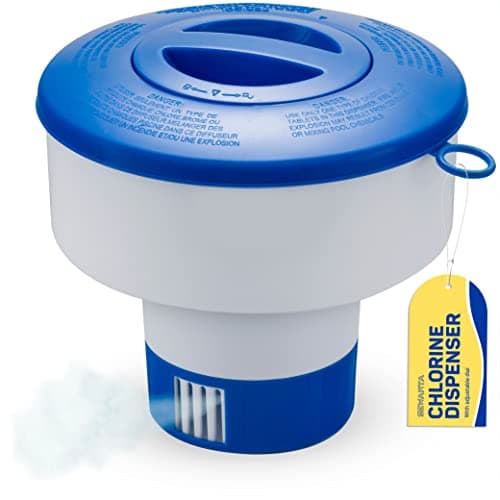 Floating Chlorine Tablet Dispenser Two dollars of plastic that decides whether your chlorine dissolves evenly over days or sits in a corner bleaching your liner. Buy it with the tablets, not after. | Making tablets work properlyOne honest season | 9.0out of 10 |
The short version
- Opening is a sequence, and a missing item stops it. Every gap in the list costs a day, and the pool sits half-open while you make a trip.
- Test strips and a net come first, because you cannot make a single decision until you can read the water and clear the surface.
- Buy alkalinity increaser before pH increaser. Alkalinity is what holds pH still, and correcting in the wrong order means correcting twice.
- Skip the specialist products until you have a reading. Clarifier, algaecide and stain treatments are answers to problems you may not have.
Why the list matters more than the products
Opening a pool is not one job, it is a chain: clear the cover, remove it, top up, run the pump, test, balance, shock, filter, retest. Each link depends on the one before it, which means a missing item does not slow the process down proportionally — it stops it completely until you have been to a shop.
That is why people report openings taking a fortnight. It is rarely the water; it is three separate trips made on three separate days, with the pool sitting half-open in between while whatever is growing in it carries on growing. Our opening guide is the procedure; this page is the list to have in the shed before you start it.
The six, in the order the sequence needs them
1. Seven-way test strips. Nothing else on this list can be used intelligently without a reading. Seven-way rather than five-way matters because the extra reading is cyanuric acid — and after a winter of dilution, or a season of tablets before it, that number is genuinely useful. One bottle covers a season comfortably. Our test kit roundup covers the options.
2. A skimmer net on a telescopic pole. The first physical job of the season is getting the winter off the surface, and you cannot do it with anything else. Buy the pole to reach the middle of your pool; it also carries the brush and the vacuum head later. Our manual tools page covers the set.
3. Alkalinity increaser. Spring water is diluted water, and total alkalinity is almost always the first thing to correct. Sodium bicarbonate raises it with minimal pH movement, which is exactly what you want as a first move. Buy this before pH increaser, because with alkalinity restored you frequently need less of the latter — our pH and alkalinity guide explains why the order is not optional.
4. Shock. Opening involves one deliberately heavy dose, not a weekly maintenance level, and half a dose achieves close to nothing. Calcium hypochlorite is unstabilized and hits hard, which is what you want on water that has sat all winter; it adds calcium hardness rather than cyanuric acid. Our shock guide covers the choice and the hardness guide covers the consequence.
5. A new filter cartridge. Not a rinse of last year’s. The cartridge is about to do the hardest work it will do all season, catching everything the shock has killed, and starting that with a tired one guarantees a slow opening. Our cartridge guide covers the interval.
6. Tablets and a floating dispenser. These are for the week after rather than the day, but buy them in the same trip. Once the water is clear you switch from resetting it to holding it, and a dispenser meters the tablets steadily instead of delivering a weekly burst that lets the level sawtooth.
| Step | What it needs | If you do not have it |
|---|---|---|
| Clear and remove the cover | Skimmer net and pole | You cannot start |
| Top up and start the pump | Nothing new | — |
| Test | Seven-way strips | Every later step is guesswork |
| Correct alkalinity, then pH | Alkalinity increaser | Corrections will not hold |
| Shock | Cal-hypo or dichlor | The water does not reset |
| Filter until clear | A new cartridge | Days rather than hours |
| Hold it there | Tablets and dispenser | Sawtooth chlorine, hazy water |
What to leave until you have a reading
The pool aisle in April is designed to sell you the whole shelf, and most of it is a response to a specific symptom you may not have.
Clarifier is worth owning eventually but it is not an opening product — it aggregates fine particles so a filter can catch them, and it does nothing at all if the real problem is a tired cartridge. Our clarifier guide covers the three-way diagnosis first.
Algaecide is a preventive rather than a cure. If you lift the cover on green water, that is a shock job, and algaecide dosed into an active bloom is largely wasted — see our algae guide.
pH increaser, stain treatments and specialist chemicals all wait for a number. Buy them when the strip tells you to, not because the display suggested it.
The one thing that changes the whole list
How you closed. A pool that was closed properly — cold water, clean, balanced, covered with an air pillow underneath — opens on this six-item list in a morning. A pool that was closed warm and dirty opens on the same list plus a full drain, a refill and a fortnight.
That is the strongest argument on this page for reading our winterizing guide in October rather than this page in April, and the cost of a bad close puts numbers on the difference. For a first opening with no history to go on, our first-time owner guide is the wider version of this list.
What we are scoring
We have not tested these products and do not claim to. The scores are our reading of published product documentation and of how each item fits the opening sequence specifically. Where a product type’s performance depends on your own water, we say so rather than ranking it. Our methodology page sets out how that works across the site.
The picks, in full
Scores are our own reading of published specifications. They are not test results — we have not tested these products and we do not claim to.
Pick #1 · The default first test kit
AquaChek Silver 7-Way Test Strips (100 count)
AquaChek
Seven readings in fifteen seconds, including the two that beginners never measure and then fight all summer: total alkalinity and cyanuric acid.
#ad how this is funded · price as of October 8, 2026
Key specs
- Tests
- Free chlorine, total chlorine, bromine, pH, total alkalinity, total hardness, cyanuric acid
- Free chlorine range
- 0-20 ppm
- pH range
- 6.2-8.4
- Total alkalinity range
- 0-240 ppm
- Cyanuric acid range
- 0-300 ppm
- Read time
- 15 seconds
- Count
- 100 strips
How it scoresour reading of published specs, not a test result
- Accuracy
- 7.0
- Ease
- 9.5
- Coverage
- 9.5
- Cost per use
- 9.0
- Value
- 9.2
Overall 8.9 / 10
What works
- Covers cyanuric acid, which most cheap strips omit and which is the reason chlorine stops working in a stabilized pool
- pH range spans 6.2-8.4, comfortably bracketing the CDC's recommended 7.0-7.8
- 15 seconds and a color chart printed on the bottle — no separate booklet to lose
- 100 strips is a full season of twice-weekly testing with room to spare
What doesn't
- Strips are a comparison against a printed color chart, so they are directional rather than precise
- Reading them in bright sun is harder than it should be
- The bottle must be kept sealed and dry or the strips degrade quietly
Skip it if: Fine adjustment. If you are chasing a stubborn problem and need a number rather than a color band, a liquid reagent kit is the tool.
What it costs to run: 100 strips at twice-weekly testing covers roughly two seasons for one pool. The real saving is upstream: knowing your alkalinity stops you buying pH adjuster you did not need.
One honest season: The cheapest setup that genuinely works for a season of real swimming. Nothing spare, nothing missing.
Specs from: CDC — home pool and hot tub water treatment and testing
Pick #2 · The five-dollar tool you use most
Skimmer Net with Telescopic Pole
Various
Catching leaves while they float is a two-minute job. Catching them after they sink is a vacuum session and a filter clean. Buy this first.
Key specs
- Type
- Flat skimmer or deep leaf rake
- Pole
- Telescopic, sized to reach the middle of your pool
- Frame
- Plastic or aluminum
How it scoresour reading of published specs, not a test result
- Retention
- 8.5
- Durability
- 7.0
- Handling
- 9.0
- Running cost
- 10.0
- Value
- 9.5
Overall 8.8 / 10
What works
- The single most-used tool in pool ownership and among the cheapest
- Removing debris before it sinks prevents most of the work that follows
- A deep leaf rake handles far more per pass than a flat skimmer
What doesn't
- Cheap plastic frames snap where the pole attaches, which is the standard failure
- Telescopic poles seize with hard water unless rinsed
- A too-short pole means you cannot reach the middle, which makes it useless
Skip it if: Anything on the floor. This is a surface tool and pretending otherwise is how debris ends up in the filter.
What it costs to run: Free to use and it directly reduces your chemical bill: organic debris consumes chlorine as it breaks down, so removing leaves is the cheapest sanitizer saving there is.
Several seasons: Buy-once. Built and warranted to come back out of the box for a few years, if you store it properly.
Pick #3 · Fixing the number beginners skip
Alkalinity Increaser (sodium bicarbonate)
Various
The most under-bought chemical in the category. If your pH will not stay put, this is almost always the actual fix, and it is chemically just baking soda.
Key specs
- Active
- Sodium bicarbonate
- Raises
- Total alkalinity, with minimal pH movement
- Common target range
- 80-120 ppm (industry convention, not a CDC figure)
How it scoresour reading of published specs, not a test result
- Effectiveness
- 9.0
- Ease
- 8.0
- Water impact
- 9.0
- Cost per season
- 9.8
- Value
- 9.5
Overall 9.0 / 10
What works
- Raises alkalinity with only a small effect on pH, which is exactly what you want
- Extremely cheap — it is sodium bicarbonate
- Fixing alkalinity first stops the endless pH chase that eats a first season
What doesn't
- Works slowly and needs circulation, so it is not a same-afternoon fix
- Easy to overshoot, and bringing alkalinity back down is more work than raising it
- The 80-120 ppm target is an industry convention rather than a published federal standard, so treat it as guidance
Skip it if: Emergencies. Nothing about alkalinity is urgent; it is the thing you fix first and then stop thinking about.
What it costs to run: Pennies per dose, and it is the cheapest lever on your whole chemical bill: stable alkalinity means stable pH, and stable pH means the chlorine you already bought actually works.
One honest season: The cheapest setup that genuinely works for a season of real swimming. Nothing spare, nothing missing.
Pick #4 · Actually clearing a green pool
Calcium Hypochlorite Pool Shock
Various (compare available chlorine %)
Unstabilized, fast-acting and strong. This is the tool for an algae bloom precisely because it does not add more cyanuric acid to a pool that probably already has too much.
Key specs
- Type
- Calcium hypochlorite, unstabilized
- Adds stabilizer
- No
- Adds
- Calcium hardness
- Dosing
- By pool volume, per the bag
How it scoresour reading of published specs, not a test result
- Effectiveness
- 9.5
- Ease
- 6.5
- Water impact
- 7.0
- Cost per season
- 9.0
- Value
- 8.8
Overall 8.6 / 10
What works
- No cyanuric acid added, so it does not worsen the problem it is usually solving
- Fast and strong enough to actually break an algae bloom in one treatment when dosed properly
- Cheap per pound of available chlorine
What doesn't
- Adds calcium hardness, which matters in hard-water areas
- Must be dissolved properly or it will bleach a vinyl liner where it settles
- Needs careful storage — it is a genuine oxidizer, not a household product
Skip it if: Routine daily chlorination. This is the emergency tool; tablets are the routine.
What it costs to run: The single most cost-effective way to fix a green pool, and the most commonly under-dosed. Half a dose twice does not equal a full dose once — it just wastes the bag.
One honest season: The cheapest setup that genuinely works for a season of real swimming. Nothing spare, nothing missing.
Pick #5 · The consumable you will actually buy repeatedly
Type A Replacement Filter Cartridges (multipack)
Various
Buy them in a multipack before you need them. A pool running on an exhausted cartridge is a cloudy pool, and the fix is a two-dollar part you did not have.
Key specs
- Type
- Type A — the most common Intex format
- Replacement interval
- Every 2 weeks in heavy use, per Intex guidance
- Between changes
- Rinse, do not scrub
How it scoresour reading of published specs, not a test result
- Sizing fit
- 9.0
- Running cost
- 7.0
- Maintenance
- 8.5
- Build
- 7.0
- Value
- 8.5
Overall 8.2 / 10
What works
- Type A is the most widely stocked cartridge format in the US
- Multipacks cost a fraction of buying singles
- Having a spare turns a cloudy week into a five-minute fix
What doesn't
- It is a genuine recurring cost that nobody includes in the purchase price
- Aftermarket quality varies noticeably
- Rinsing extends life but does not restore a cartridge that is done
Skip it if: Being restored. Once the pleats are permanently gray and stiff, rinsing is not saving it.
What it costs to run: The line item most people leave out of their pool budget. Count how many you use in your first season and you have your real annual filtration cost — this is exactly the number the cost-to-run guide asks you to record.
One honest season: The cheapest setup that genuinely works for a season of real swimming. Nothing spare, nothing missing.
Pick #6 · The default chlorine source
Clorox Pool&Spa 3-Inch Chlorinating Tablets
Clorox Pool&Spa
Stabilized trichlor tablets in a floating dispenser is the standard answer for a seasonal above-ground pool, and this is the standard version of it.
#ad how this is funded · price as of October 8, 2026
Key specs
- Type
- Stabilized trichlor, 3-inch tablets
- Contains stabilizer
- Yes — cyanuric acid is part of trichlor
- Dosing
- Per manufacturer instructions, by pool volume
- CDC target
- At least 2 ppm free chlorine when using a stabilizer
How it scoresour reading of published specs, not a test result
- Effectiveness
- 9.0
- Ease
- 9.0
- Water impact
- 6.0
- Cost per season
- 8.5
- Value
- 8.5
Overall 8.5 / 10
What works
- Dissolves slowly, so a floating dispenser meters chlorine out over days rather than hours
- Stabilized, so sunlight does not destroy your chlorine within an afternoon
- Widely stocked, so you are never hunting for it in July
What doesn't
- Every tablet adds cyanuric acid, and in a pool you never fully drain that accumulates until chlorine stops responding
- Trichlor is acidic and will pull your pH down over a season
- Tablets must be kept dry and sealed or they degrade and gas off
Skip it if: A small pool that is topped up rather than drained. Cyanuric acid only leaves with the water, so in a 1,500-gallon pool it climbs fast.
What it costs to run: The standing chemical cost of the season, and it scales directly with gallons. Watch the cyanuric acid reading on your test strip: once it is high, you are buying chlorine that cannot work, which is the most common invisible waste in a first pool year.
One honest season: The cheapest setup that genuinely works for a season of real swimming. Nothing spare, nothing missing.
Specs from: CDC — free chlorine target with cyanuric acid
Pick #7 · Making tablets work properly
Floating Chlorine Tablet Dispenser
Various
Two dollars of plastic that decides whether your chlorine dissolves evenly over days or sits in a corner bleaching your liner. Buy it with the tablets, not after.
#ad how this is funded · price as of October 8, 2026
Key specs
- Function
- Holds 3-inch tablets, meters dissolution rate
- Adjustment
- Vented base, adjustable on most models
- Compatibility
- Standard 3-inch tablets
How it scoresour reading of published specs, not a test result
- Effectiveness
- 8.0
- Ease
- 9.5
- Water impact
- 9.0
- Cost per season
- 9.8
- Value
- 9.5
Overall 9.0 / 10
What works
- Adjustable venting lets you slow or speed dissolution to match the weather
- Keeps tablets off the liner, which is what causes bleach spots
- Trivially cheap and lasts years
What doesn't
- Drifts to one end of the pool in wind, so distribution is uneven without circulation
- Must be removed before swimming with small children
- Cheap ones crack after a season in UV
Skip it if: Being left in an empty or unfiltered pool. Without circulation it creates a concentrated pocket rather than an even dose.
What it costs to run: The cheapest item on this site and one of the highest-return: even dissolution means you use fewer tablets to hold the same free chlorine level.
One honest season: The cheapest setup that genuinely works for a season of real swimming. Nothing spare, nothing missing.
Questions people actually ask
What do I need to open my pool in spring?
Should I buy algaecide before opening the pool?
Do I need a new filter cartridge every spring?
What order do I add chemicals when opening a pool?
Sources
Read next
- Closing, covering and opening againWinterizing, covers and spring opening - the four weeks of the year that decide whether you own a pool next summer.
- Opening an above-ground pool in springThe spring sequence in order, why cloudy water at opening is normal, and the two timing errors that cause green openings.
- Pool closing kits: buy one the first year, then stopWhat is in a closing kit, whether the bundle premium is justified, and how to buy separately once you know your water.
- The midsummer reset, and the drift it fixesThe four things that drift by midsummer, and the one-afternoon reset that gets the second half of the season back to week-one effort.
- First-time pool owner: the complete first monthThe pillar guide: day-one shopping list, the four water readings, the weekly routine and the week-three problem everybody gets.
- pH and alkalinity, and why yours will not stay putWhy pH drifts, what total alkalinity actually does, and the order of operations that turns a season of chasing into one adjustment.
- What a season of pool chemicals actually adds up toSeason chemical quantities computed from published dosing for four pool volumes, plus the shopping list that is genuinely necessary.
- Year two, and the lines that disappearWhich pool costs are one-off and which recur, with a year-one and year-two comparison for the same pool.