Pool Care & Chemistry
High alkalinity, cloudy water, and the pH you cannot hold down
Two symptoms, one cause. Water that keeps going milky while pH creeps upward is usually carrying more carbonate alkalinity than it can hold - and the fix is arithmetic, not a bottle of clarifier.
Heads up: we earn a commission if you buy through the links on this page, at no extra cost to you. It never decides the ranking — here is how we pick and here is the full disclosure. Prices are checked automatically; last verified October 8, 2026.
The short version
- High alkalinity and cloudy water are the same event. Excess carbonate alkalinity pushes pH up, and rising pH tips calcium carbonate out of solution as a white haze.
- Check the cyanuric acid correction first. On a trichlor pool a chunk of your total alkalinity reading is cyanurate, not carbonate — the PHTA publishes the arithmetic, and it frequently moves a “high” number back into range.
- The dosing is published, so this is arithmetic: about 2.1 lb of 94% sodium bisulfate per 10,000 gallons drops total alkalinity by roughly 10 ppm.
- Acid alone is half the job. It lowers pH and alkalinity together; aeration then brings pH back up without putting the alkalinity back.
What the two symptoms have in common
The pattern people describe is consistent: the water keeps going slightly milky, pH reads high no matter how much acid goes in, and adding clarifier helps for a day. All three are the same mechanism seen from different angles.
Total alkalinity is the water’s buffering capacity — its resistance to pH change. That is normally the thing you want, and our pH and alkalinity guide is largely about why too little of it makes pH impossible to hold. Too much of it does something different. The PHTA’s fact sheet on the subject puts it plainly: at excessively high carbonate alkalinity, the pH of the water tends to drift upward.
And pH drifting upward is what produces the haze. Orenda Technologies describes the sequence for cloudy water directly: too much carbonate alkalinity drives the pH ceiling higher than desired, and as pH rises through the week the water passes into a scale-forming condition and becomes oversaturated with calcium carbonate. Water that cannot hold any more calcium carbonate releases it — first as a fine white cloud in the water, later as dust on the floor or hard scale at the water line.
Before you treat it: is your alkalinity actually high?
This is the step that saves most people a bottle of acid, and it applies specifically to pools dosed with the three-inch trichlor tablets that are the default in this category.
Trichlor and dichlor release cyanuric acid, and the PHTA notes that the cyanurate system is itself a weak buffer that contributes to the total alkalinity concentration. So your test result is measuring two different things added together: carbonate alkalinity, which is the part that drives pH and scaling, and cyanurate, which is along for the ride. The number that matters for cloudiness and for saturation is the carbonate part.
The PHTA publishes a working approximation: subtract roughly one third of the cyanuric acid concentration from the total alkalinity reading. Their own worked example uses a pool at pH 7.4 with 110 ppm total alkalinity and 100 ppm cyanuric acid.
The correction, on the PHTA's own example
- Measured total alkalinity [PHTA]
- 110 ppm
- Cyanuric acid
- 100 ppm
- Correction factor at pH 7.4
- 0.31
110 − (100 × 0.31) = 110 − 31 = 79 ppm carbonate alkalinity
A reading of 110 is really about 79 ppm of the alkalinity that matters
What the published ranges actually are
Most numbers you will see quoted for total alkalinity are industry convention rather than a standard. There is a real published standard, and it is worth knowing what it says — and what it is for.
| Situation | Published figure | Note |
|---|---|---|
| Standard range | 60-180 ppm as CaCO3 | Minimum and maximum in the standard |
| Ideal with trichlor or dichlor | 100-120 ppm | These sanitizers push pH down, so more buffer helps |
| Ideal with cal-hypo or a salt cell | 80-100 ppm | These push pH up, so less buffer is wanted |
| Biguanide pools | 80-150 ppm | A different sanitizer chemistry entirely |
Two things fall out of that table for a seasonal above-ground pool. If you dose with trichlor tablets — which our tablets versus liquid guide treats as the sensible default — the published ideal is the higher band, 100 to 120 ppm, precisely because those tablets are acidic and drag pH down all season. A reading of 120 is not a problem to fix; it is where you want to be.
And the standard’s maximum is 180. A great deal of the anxiety about “high alkalinity” online concerns readings between 120 and 150, which are inside the published range and, once corrected for cyanuric acid, frequently sit close to ideal.
Why cloudiness is a three-way relationship
Alkalinity is not acting alone. Taylor Technologies, whose drop-count kits are the reference tool for this kind of diagnosis, describes the saturation index as combining calcium hardness, pH and total alkalinity corrected for cyanuric acid, with total dissolved solids and water temperature playing smaller parts. Their summary of the practical consequence is the useful sentence: water with high calcium hardness gets cloudy unless the alkalinity and/or pH are low enough to compensate.
On their scale, an index of +0.5 or more trends toward scaling — conditions right for calcium carbonate to come out of solution and deposit as scale — and −0.3 or less trends toward corrosive. Orenda puts the clouding threshold a little lower, at an index above +0.30.
For a seasonal above-ground pool that matters in one specific way: calcium hardness is the third leg, and the usual reason it is elevated is calcium hypochlorite shock, which adds calcium every time it is used. If you have been shocking with cal-hypo all summer and the water has started to haze, the alkalinity may be the visible half of a hardness story — our calcium hardness guide covers the other half, including why a vinyl pool can otherwise mostly ignore that reading.
Lowering it: the dosing is published
There is exactly one way to reduce total alkalinity in a home pool, and it is acid. Nothing else in the aisle does it. The PHTA publishes the quantity, which turns this from guesswork into arithmetic: approximately 2.1 lbs of sodium bisulfate (94%) or 1.6 pints of muriatic acid (31%) will reduce the total alkalinity of 10,000 gallons of water by 10 ppm.
Dry acid needed to drop alkalinity, by pool volume
- Published dosing [PHTA]
- 2.1 lb of 94% sodium bisulfate per 10,000 gal per 10 ppm
- Worked example volume
- 3,955 gallons
- Target drop
- 10 ppm
2.1 × (3,955 ÷ 10,000) = 0.83 lb per 10 ppm
About 0.83 lb of dry acid drops a 15-foot pool by 10 ppm
| Pool | Gallons | Per 10 ppm drop |
|---|---|---|
| Intex Easy Set 12ft x 30in | 1,485 | ≈ 0.31 lb |
| Intex Prism Frame 12ft x 30in | 1,718 | ≈ 0.36 lb |
| Bestway Steel Pro MAX 15ft x 42in | 3,955 | ≈ 0.83 lb |
| Intex Ultra XTR 18ft x 52in | 6,981 | ≈ 1.47 lb |
Note how small those numbers are. A pool of this size does not need a bucket of anything, which is also why overshooting is so easy — the difference between a correct dose and a damaging one is a matter of ounces on a 12-foot pool.
The step almost nobody mentions: aeration
Acid lowers total alkalinity and pH together. That is a problem, because pH is probably already where you want it or higher, and pushing it below the CDC’s published range of 7.2 to 7.8 gives you aggressive water that is hard on a vinyl liner and on metal fittings.
The way out is a physical process rather than a chemical one. Aeration — anything that agitates the surface and makes small bubbles — accelerates carbon dioxide off-gassing, and as CO₂ leaves the water the pH rises. Crucially it raises pH without adding alkalinity back, because nothing is being added to the water at all.
So the procedure is a cycle: acid brings both numbers down, aeration brings pH back up and leaves alkalinity where the acid put it, and you repeat until alkalinity is where you want it and pH has settled in range.
Test properly, and correct for cyanuric acid
Total alkalinity, pH and cyanuric acid, from a sample at elbow depth away from the return. Subtract about a third of the CYA reading from the total alkalinity to get the carbonate figure. If that lands inside 100 to 120 ppm on a trichlor pool, stop here — you do not have a high alkalinity problem. Our testing mistakes guide covers taking a sample that means something.Work out the dose for one step, not the whole gap
Use the table above for a 10 or 20 ppm drop rather than the full correction. Small, repeated additions are the whole method; a single large dose is how pH ends up below 7.0.Dissolve the dry acid in a bucket first
Never broadcast granules across a vinyl liner — undissolved acid sitting on vinyl bleaches and weakens it. Dissolve in a bucket of pool water, then pour the solution slowly around the pool with the pump running.Let it circulate, then re-test
Give it a full turnover before believing any reading — gallons divided by your pump’s published system flow rate, which is about 5.3 hours on a 3,955-gallon pool with a 750 GPH system. Our pump sizing guide has the method.Now aerate, to bring pH back without the alkalinity
Angle the return jet upward so it breaks the surface, and leave the pump running. Anything that agitates the surface works; more small bubbles means faster CO₂ off-gassing and a faster pH rise. This is the step that makes the whole thing possible, and it costs nothing but pump hours.Repeat the cycle over days, not hours
A mildly elevated pool may need one cycle; a badly elevated one takes several days. Do not try to do the whole correction at once, and if pH is already below 7.2 while alkalinity is still high, aerate first and add no more acid until pH has come back up.
Dry acid or muriatic acid on a vinyl pool
Both are published in the PHTA dosing above, and both work. For a backyard above-ground pool the practical answer is dry acid, for handling reasons rather than chemistry ones: it is granular, so there are no fumes to manage, no chemical-resistant container to store and no risk of a splash while pouring from a jug.
The trade-off is real and worth stating. Sodium bisulfate adds sulfate to the water every time you use it, and sulfate accumulates in water you keep. On a permanent pool that is a genuine long-term consideration. On a seasonal above-ground pool that is drained and stored each autumn, the count resets every year — the same quiet advantage that makes dilution such a cheap tool here, and the same one our calcium hardness guide points at.
What not to reach for
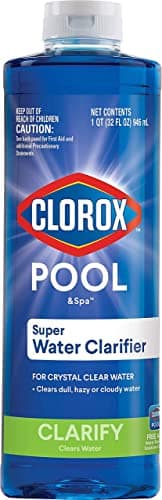
Clarifier. It aggregates fine particles so the filter can catch them, which is genuinely useful for the other kind of cloudy water. It does nothing about calcium carbonate coming out of solution, because the cause is water chemistry rather than particle size — and it will keep coming out until the balance changes. Our clarifier guide covers the three-way diagnosis for haze.
More shock. If you are using calcium hypochlorite you are adding calcium, which is one of the three legs of the saturation relationship. Shocking a scale-forming pool moves it in the wrong direction. Our shock guide covers picking between cal-hypo and dichlor.
pH decreaser on its own, repeatedly. Without the aeration step you will drive pH down, watch alkalinity buffer it straight back up, and repeat until the water is aggressive and the alkalinity has barely moved. That loop is the single most common way this correction goes wrong.
Alkalinity increaser. Obvious in hindsight, but it is the bottle most people already own from opening the pool, and sodium bicarbonate is what raises the number you are trying to lower. It belongs in the shed for spring, not this week.
How to keep it there
Once the numbers are where you want them, the maintenance version is short. Test total alkalinity, pH and cyanuric acid together rather than pH alone, so you can see the correction rather than the symptom. Expect trichlor tablets to push pH down steadily across a season, which is the drift that alkalinity is buffering in the first place. And correct alkalinity before pH, every time — the PHTA is explicit that total alkalinity should be corrected before adjusting pH or sanitizer levels, which is the same order of operations our pH and alkalinity guide has always argued for, now with a published standard behind it.
If cyanuric acid is what pushed the reading up in the first place, the mid-season reset is the scheduled version of the dilution fix, and it deals with several drifting numbers at once — our midsummer reset guide is that afternoon.
What to buy
Scores are our own reading of published specifications. They are not test results — we have not tested these products and we do not claim to.
Bringing high alkalinity and pH back down
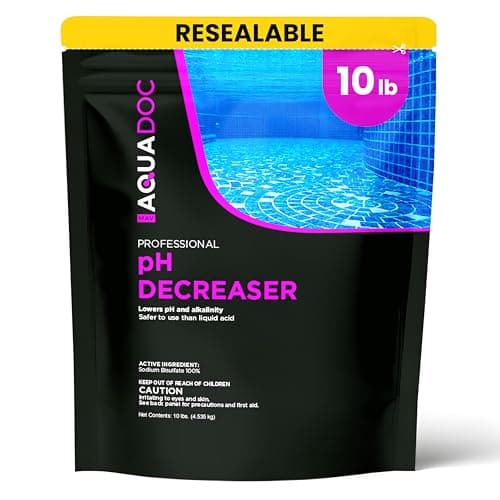
pH Decreaser (sodium bisulfate)
Various
Dry acid, sold as pH minus or pH down. It is the only practical way to lower total alkalinity in a home pool, and it lowers pH on the way past whether you wanted that or not.
#ad how this is funded · price as of October 8, 2026
Key specs
- Active
- Sodium bisulfate (dry acid)
- Lowers
- Total alkalinity and pH together
- Published dosing
- ≈2.1 lb of 94% per 10,000 gal drops TA ≈10 ppm (PHTA)
- Form
- Granular — dissolve in a bucket of pool water first
- Adds
- Sulfate, which accumulates in water you keep
How it scoresour reading of published specs, not a test result
- Effectiveness
- 9.0
- Ease
- 6.5
- Water impact
- 6.5
- Cost per season
- 9.0
- Value
- 8.5
Overall 8.0 / 10
What works
- The only realistic way to bring total alkalinity down; nothing else in the aisle does it
- Granular rather than liquid, so no fumes and far easier to store than muriatic acid
- Published dosing means the amount is arithmetic rather than guesswork
- A single small container covers several corrections on a pool this size
What doesn't
- Lowers pH as well as alkalinity, so it usually needs a second step to bring pH back
- Adds sulfate to the water every time it is used
- Must be dissolved first — dropping granules straight in risks bleaching a vinyl liner
- Easy to overshoot; the correction is far harder to reverse than to make
Skip it if: Lowering alkalinity without touching pH. Nothing does that in one step — it takes acid followed by aeration.
What it costs to run: Cheap per correction and rarely needed on a seasonal pool, because the water is replaced each year. Its real cost is the afternoon of acid-then-aerate cycles, not the container.
One honest season: The cheapest setup that genuinely works for a season of real swimming. Nothing spare, nothing missing.
Specs from: PHTA — Total Alkalinity in Pool and Spa Water (fact sheet), CDC — recommended pH range for pools
When you need a number, not a color band
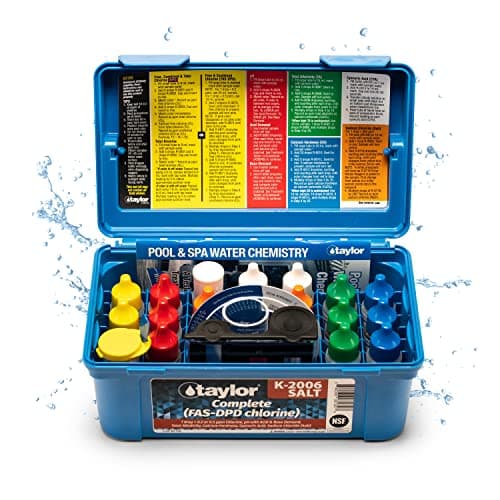
Taylor K-2006 Complete Test Kit (FAS-DPD)
Taylor Technologies
The reference kit. It uses a drop-count titration for free chlorine, which gives you an actual figure rather than a shade of pink. Overkill for a 1,500-gallon pool and indispensable when something has gone properly wrong.
#ad how this is funded · price as of October 8, 2026
Key specs
- Method
- FAS-DPD drop-count titration
- Measures
- Free and combined chlorine, pH, alkalinity, calcium hardness, cyanuric acid
- Resolution
- Reads to 0.2 ppm free chlorine with the standard 10 mL sample
- Format
- Reagent bottles and graduated comparators
How it scoresour reading of published specs, not a test result
- Accuracy
- 9.8
- Ease
- 5.5
- Coverage
- 9.5
- Cost per use
- 7.0
- Value
- 8.0
Overall 8.3 / 10
What works
- Distinguishes free from combined chlorine, which is the single most useful thing a test can tell you when water smells of chlorine
- Gives a numeric result you can act on precisely rather than a color to interpret
- Reagents are individually replaceable, so the kit is a multi-season purchase
What doesn't
- Considerably more expensive than strips and more of a ritual to use
- Reagents have a shelf life and do expire
- Genuinely more kit than a small seasonal pool needs
Skip it if: Casual weekly checks. If it is a five-minute job you will skip it, and a test you skip is worse than a rough one you actually do.
What it costs to run: The reagents are the running cost, not the kit. For most seasonal above-ground owners this is a second purchase made in year two after a bad algae summer, not a first one.
Several seasons: Buy-once. Built and warranted to come back out of the box for a few years, if you store it properly.
Specs from: Taylor Technologies
The default first test kit
AquaChek Silver 7-Way Test Strips (100 count)
AquaChek
Seven readings in fifteen seconds, including the two that beginners never measure and then fight all summer: total alkalinity and cyanuric acid.
#ad how this is funded · price as of October 8, 2026
Key specs
- Tests
- Free chlorine, total chlorine, bromine, pH, total alkalinity, total hardness, cyanuric acid
- Free chlorine range
- 0-20 ppm
- pH range
- 6.2-8.4
- Total alkalinity range
- 0-240 ppm
- Cyanuric acid range
- 0-300 ppm
- Read time
- 15 seconds
- Count
- 100 strips
How it scoresour reading of published specs, not a test result
- Accuracy
- 7.0
- Ease
- 9.5
- Coverage
- 9.5
- Cost per use
- 9.0
- Value
- 9.2
Overall 8.9 / 10
What works
- Covers cyanuric acid, which most cheap strips omit and which is the reason chlorine stops working in a stabilized pool
- pH range spans 6.2-8.4, comfortably bracketing the CDC's recommended 7.0-7.8
- 15 seconds and a color chart printed on the bottle — no separate booklet to lose
- 100 strips is a full season of twice-weekly testing with room to spare
What doesn't
- Strips are a comparison against a printed color chart, so they are directional rather than precise
- Reading them in bright sun is harder than it should be
- The bottle must be kept sealed and dry or the strips degrade quietly
Skip it if: Fine adjustment. If you are chasing a stubborn problem and need a number rather than a color band, a liquid reagent kit is the tool.
What it costs to run: 100 strips at twice-weekly testing covers roughly two seasons for one pool. The real saving is upstream: knowing your alkalinity stops you buying pH adjuster you did not need.
One honest season: The cheapest setup that genuinely works for a season of real swimming. Nothing spare, nothing missing.
Specs from: CDC — home pool and hot tub water treatment and testing
Cloudy water that is chemically fine
Pool Water Clarifier
Various
Clumps particles too small for your filter into ones it can catch. Genuinely useful for the specific case where your chemistry reads correct and the water is still milky.
Key specs
- Function
- Coagulant — aggregates fine particles for filtration
- Requires
- A running filter; it does nothing on its own
- Typical treatment
- Dose, then run the filter continuously
How it scoresour reading of published specs, not a test result
- Effectiveness
- 7.5
- Ease
- 8.5
- Water impact
- 8.0
- Cost per season
- 8.5
- Value
- 7.5
Overall 7.8 / 10
What works
- Fixes the exact case where chemistry is balanced and the water still will not clear
- Cheap and quick when it is the right tool
- Works with the filter you already have rather than needing a better one
What doesn't
- Does nothing at all if the actual problem is low chlorine or a blocked filter
- Overdosing makes cloudiness worse, which is a genuinely counterintuitive failure
- Loads the filter, so it needs cleaning right after
Skip it if: Being the first thing you reach for. Test the water before you use this — most cloudy pools are a chemistry problem wearing a clarity costume.
What it costs to run: A few dollars a bottle, and worth it only when the decision tree points here. Reaching for clarifier first is how people spend twenty dollars solving a problem that a longer pump run would have fixed for free.
A few weekends: Fine for a heatwave and a toddler. Treat it as consumable, not as a pool — it will not survive a winter in the yard.
Fixing the number beginners skip
Alkalinity Increaser (sodium bicarbonate)
Various
The most under-bought chemical in the category. If your pH will not stay put, this is almost always the actual fix, and it is chemically just baking soda.
Key specs
- Active
- Sodium bicarbonate
- Raises
- Total alkalinity, with minimal pH movement
- Common target range
- 80-120 ppm (industry convention, not a CDC figure)
How it scoresour reading of published specs, not a test result
- Effectiveness
- 9.0
- Ease
- 8.0
- Water impact
- 9.0
- Cost per season
- 9.8
- Value
- 9.5
Overall 9.0 / 10
What works
- Raises alkalinity with only a small effect on pH, which is exactly what you want
- Extremely cheap — it is sodium bicarbonate
- Fixing alkalinity first stops the endless pH chase that eats a first season
What doesn't
- Works slowly and needs circulation, so it is not a same-afternoon fix
- Easy to overshoot, and bringing alkalinity back down is more work than raising it
- The 80-120 ppm target is an industry convention rather than a published federal standard, so treat it as guidance
Skip it if: Emergencies. Nothing about alkalinity is urgent; it is the thing you fix first and then stop thinking about.
What it costs to run: Pennies per dose, and it is the cheapest lever on your whole chemical bill: stable alkalinity means stable pH, and stable pH means the chlorine you already bought actually works.
One honest season: The cheapest setup that genuinely works for a season of real swimming. Nothing spare, nothing missing.
Questions people actually ask
Does high alkalinity cause cloudy pool water?
How do I lower total alkalinity in a pool?
How do you lower alkalinity without lowering pH?
What should total alkalinity be in an above-ground pool?
Why is my alkalinity high when I have not added anything?
Sources
Read next
- Pool care, from someone who assumes you have never done thisThe weekly routine, the four numbers that matter, and the fix for the week the water turns.
- pH and alkalinity, and why yours will not stay putWhy pH drifts, what total alkalinity actually does, and the order of operations that turns a season of chasing into one adjustment.
- Cloudy pool water: work out which of four problems you haveA diagnostic decision tree for cloudy water - four causes, how to tell them apart, and the correct fix for each.
- Calcium hardness: the reading a vinyl pool can mostly ignoreWhy the fourth reading matters less on a vinyl above-ground pool, the two cases where it genuinely does, and how to test it.
- Cyanuric acid: the reading that explains your chlorineWhy an outdoor pool needs stabilizer, why tablets add it whether you want them to or not, and the only way to bring it back down.
- What the color of your pool is telling youEvery common pool water appearance, what causes it, the first thing to check, and where to go next.
- The best pool test stripsTest strips compared on parameter coverage - specifically whether they read cyanuric acid, which most cheap strips omit.
- What it costs to fill a pool, and to keep it fullOne fill priced for four common pool volumes at the national average water rate, plus why every gallon you add has to be re-balanced.
- Borates: the buffer most pools never addWhat borates do to pH and algae, the 30 to 50 ppm range published by industry chemists, how to test, and the safety and labeling caveats nobody mentions.