Seasonal Care
The midsummer reset, and the drift it fixes
Nothing has gone wrong. That is the point. Eight weeks of small compromises add up to a pool that takes twice the chemicals to hold in the same place.

Heads up: we earn a commission if you buy through the links on this page, at no extra cost to you. It never decides the ranking — here is how we pick and here is the full disclosure. Prices are checked automatically; last verified October 8, 2026.
The short version
- Four things drift, and none of them announces itself: stabilizer climbs, the cartridge tires, film builds on the walls, and the routine slips.
- Rising cyanuric acid is the usual culprit behind a pool that needs more chlorine in July than it did in June.
- A partial drain is cheap here and fixes the drift directly — about $8 of water to replace a third of a 3,955-gallon pool.
- It is one afternoon. Doing it in July buys back the second half of the season; skipping it is how August becomes a chemistry argument.
What actually drifts
Nothing dramatic happens to a pool in midsummer. What happens is accumulation, and it is invisible because every individual week looked fine. By about week eight most seasonal pools have quietly moved in four directions at once, and the symptom people notice is that the water takes more work to hold in the same place than it did in June.
| What drifted | How it shows up | The reset |
|---|---|---|
| Cyanuric acid climbing | Chlorine reads adequate, water still struggles | Partial drain and refill |
| Cartridge past its useful life | Weak return flow; haze that will not clear | New cartridge, not another rinse |
| Biofilm on the walls | Slightly slick walls; algae keeps almost happening | Brush everything, then shock at dusk |
| The routine slipping | Testing once a week instead of twice | Restart the schedule deliberately |
Drift one: stabilizer, which only ever goes up
If you have been dosing with three-inch trichlor tablets since opening, you have been adding cyanuric acid every week whether you wanted to or not — it is part of the tablet chemistry. It does not evaporate, it is not consumed, and it does not break down. It leaves only in water you remove.
The signature is distinctive and it is worth learning: free chlorine reads at a perfectly respectable level while the water is not behaving. That is bound chlorine — present but sluggish. People respond by adding more chlorine, which adds more stabilizer, which makes it worse. Our cyanuric acid guide covers the mechanism in full.
The only reliable fix is dilution, and on a seasonal above-ground pool that is genuinely cheap — which is the quiet advantage of a small pool over a permanent one.
Diluting a third of the pool
- Pool volume
- 3,955 gallons
- Fraction replaced
- one third
- US average water price [EPA WaterSense]
- $6.06 / 1,000 gal
3,955 ÷ 3 = 1,318 gal 1.318 kgal × $6.06 = $7.99
About $8 of water, and the reading drops by roughly a third
Drift two: the cartridge you have been rinsing since June
A cartridge that has been rinsed repeatedly looks serviceable and is not. Intex guidance for Type A cartridges is replacement roughly every two weeks in heavy use, and a rinse only ever removes surface loading — the material driven deep into the pleats stays there and keeps reducing flow.
The test is simple: if a rinse no longer restores the return flow the following day, the media is finished. Midsummer is exactly when this becomes true for the first time, and it is also when people start buying clarifier to fix what is mechanically a blocked filter. Put a new cartridge in first, run the pump, and reassess — our cartridge guide covers the rinse-versus- replace question and the cloudy water guide covers the diagnosis.
Drift three: the film you cannot see yet
Biofilm builds on walls and floor continuously, and it is established well before it is visible as green. The reliable sign is a wall that feels slightly slick rather than squeaky, and the reliable second sign is water boatmen — small darting insects that are there because there is something to graze on, as our pool bugs guide explains.
Brushing is what deals with it, and brushing before shocking rather than after is what makes the shock effective, because the chlorine can then reach what you have loosened. Do the whole wall, do the water line specifically, and do the floor.
The reset, as an afternoon
Test everything first, and write it down
A seven-way strip: free chlorine, pH, total alkalinity, cyanuric acid, hardness. Writing it down matters because the point of this afternoon is to compare against where you were in June, and nobody remembers. Our test kit roundup covers what to use.Skim, brush every surface, then vacuum
In that order, so what you brush off gets vacuumed rather than settling again. Take the water line seriously — it is where film is heaviest and where liners fail first.Drain a third if stabilizer has climbed
This is the substantive step and the one people skip because it feels wasteful. It is about $8 of water on a mid-size pool and it resets the number that is making everything else harder. Drain from the bottom, spread the discharge, and do not send it all at one patch of ground.Refill and re-balance in the usual order
Total alkalinity first, because it is what holds pH still, then pH into the CDC’s published 7.2 to 7.8 range, then chlorine. Adding in the other order is why corrections do not hold — our pH and alkalinity guide is the detail.Fit a new cartridge and shock at dusk
New media, then a proper shock in the evening with the pump running, because sunlight destroys unstabilized chlorine quickly. Then filter continuously overnight. Our shock guide covers dosing and which product suits your stabilizer level.Restart the routine deliberately
Twice-weekly testing, weekly brush and vacuum, dispenser refilled. Write the days on something. The routine slipping is the fourth drift and it is the one that causes the other three — our weekly schedule is the version to pin up.
When the reset is not enough
Two situations where midsummer is telling you something bigger. If chlorine demand has risen sharply rather than gradually, something is consuming it — a bloom that has not shown color yet, or a heavy bather load such as a dog swimming regularly, which our dogs in the pool guide covers.
And if the water clears and then goes hazy again within days, that pattern is usually a sawtoothing chlorine level rather than a product problem — the fix is a floating dispenser metering tablets steadily instead of a weekly burst, as our clarifier guide sets out.
Why July rather than August
Because the reset buys you the rest of the season, and the rest of the season shrinks every week you leave it. There is also a practical argument: a pool that finishes the summer in good condition is a pool that closes cleanly, and a clean close is what decides whether next April is a morning or a fortnight. Our winterizing guide covers the close, and the cost of a bad close prices the alternative.
What to buy
Scores are our own reading of published specifications. They are not test results — we have not tested these products and we do not claim to.
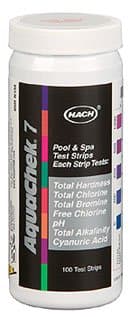
The default first test kit
AquaChek Silver 7-Way Test Strips (100 count)
AquaChek
Seven readings in fifteen seconds, including the two that beginners never measure and then fight all summer: total alkalinity and cyanuric acid.
#ad how this is funded · price as of October 8, 2026
Key specs
- Tests
- Free chlorine, total chlorine, bromine, pH, total alkalinity, total hardness, cyanuric acid
- Free chlorine range
- 0-20 ppm
- pH range
- 6.2-8.4
- Total alkalinity range
- 0-240 ppm
- Cyanuric acid range
- 0-300 ppm
- Read time
- 15 seconds
- Count
- 100 strips
How it scoresour reading of published specs, not a test result
- Accuracy
- 7.0
- Ease
- 9.5
- Coverage
- 9.5
- Cost per use
- 9.0
- Value
- 9.2
Overall 8.9 / 10
What works
- Covers cyanuric acid, which most cheap strips omit and which is the reason chlorine stops working in a stabilized pool
- pH range spans 6.2-8.4, comfortably bracketing the CDC's recommended 7.0-7.8
- 15 seconds and a color chart printed on the bottle — no separate booklet to lose
- 100 strips is a full season of twice-weekly testing with room to spare
What doesn't
- Strips are a comparison against a printed color chart, so they are directional rather than precise
- Reading them in bright sun is harder than it should be
- The bottle must be kept sealed and dry or the strips degrade quietly
Skip it if: Fine adjustment. If you are chasing a stubborn problem and need a number rather than a color band, a liquid reagent kit is the tool.
What it costs to run: 100 strips at twice-weekly testing covers roughly two seasons for one pool. The real saving is upstream: knowing your alkalinity stops you buying pH adjuster you did not need.
One honest season: The cheapest setup that genuinely works for a season of real swimming. Nothing spare, nothing missing.
Specs from: CDC — home pool and hot tub water treatment and testing
The consumable you will actually buy repeatedly
Type A Replacement Filter Cartridges (multipack)
Various
Buy them in a multipack before you need them. A pool running on an exhausted cartridge is a cloudy pool, and the fix is a two-dollar part you did not have.
Key specs
- Type
- Type A — the most common Intex format
- Replacement interval
- Every 2 weeks in heavy use, per Intex guidance
- Between changes
- Rinse, do not scrub
How it scoresour reading of published specs, not a test result
- Sizing fit
- 9.0
- Running cost
- 7.0
- Maintenance
- 8.5
- Build
- 7.0
- Value
- 8.5
Overall 8.2 / 10
What works
- Type A is the most widely stocked cartridge format in the US
- Multipacks cost a fraction of buying singles
- Having a spare turns a cloudy week into a five-minute fix
What doesn't
- It is a genuine recurring cost that nobody includes in the purchase price
- Aftermarket quality varies noticeably
- Rinsing extends life but does not restore a cartridge that is done
Skip it if: Being restored. Once the pleats are permanently gray and stiff, rinsing is not saving it.
What it costs to run: The line item most people leave out of their pool budget. Count how many you use in your first season and you have your real annual filtration cost — this is exactly the number the cost-to-run guide asks you to record.
One honest season: The cheapest setup that genuinely works for a season of real swimming. Nothing spare, nothing missing.
Actually clearing a green pool
Calcium Hypochlorite Pool Shock
Various (compare available chlorine %)
Unstabilized, fast-acting and strong. This is the tool for an algae bloom precisely because it does not add more cyanuric acid to a pool that probably already has too much.
Key specs
- Type
- Calcium hypochlorite, unstabilized
- Adds stabilizer
- No
- Adds
- Calcium hardness
- Dosing
- By pool volume, per the bag
How it scoresour reading of published specs, not a test result
- Effectiveness
- 9.5
- Ease
- 6.5
- Water impact
- 7.0
- Cost per season
- 9.0
- Value
- 8.8
Overall 8.6 / 10
What works
- No cyanuric acid added, so it does not worsen the problem it is usually solving
- Fast and strong enough to actually break an algae bloom in one treatment when dosed properly
- Cheap per pound of available chlorine
What doesn't
- Adds calcium hardness, which matters in hard-water areas
- Must be dissolved properly or it will bleach a vinyl liner where it settles
- Needs careful storage — it is a genuine oxidizer, not a household product
Skip it if: Routine daily chlorination. This is the emergency tool; tablets are the routine.
What it costs to run: The single most cost-effective way to fix a green pool, and the most commonly under-dosed. Half a dose twice does not equal a full dose once — it just wastes the bag.
One honest season: The cheapest setup that genuinely works for a season of real swimming. Nothing spare, nothing missing.
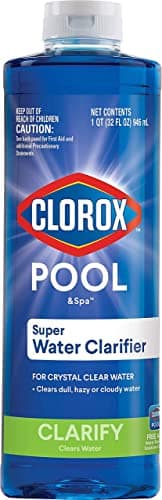
Cloudy water that is chemically fine
Pool Water Clarifier
Various
Clumps particles too small for your filter into ones it can catch. Genuinely useful for the specific case where your chemistry reads correct and the water is still milky.
Key specs
- Function
- Coagulant — aggregates fine particles for filtration
- Requires
- A running filter; it does nothing on its own
- Typical treatment
- Dose, then run the filter continuously
How it scoresour reading of published specs, not a test result
- Effectiveness
- 7.5
- Ease
- 8.5
- Water impact
- 8.0
- Cost per season
- 8.5
- Value
- 7.5
Overall 7.8 / 10
What works
- Fixes the exact case where chemistry is balanced and the water still will not clear
- Cheap and quick when it is the right tool
- Works with the filter you already have rather than needing a better one
What doesn't
- Does nothing at all if the actual problem is low chlorine or a blocked filter
- Overdosing makes cloudiness worse, which is a genuinely counterintuitive failure
- Loads the filter, so it needs cleaning right after
Skip it if: Being the first thing you reach for. Test the water before you use this — most cloudy pools are a chemistry problem wearing a clarity costume.
What it costs to run: A few dollars a bottle, and worth it only when the decision tree points here. Reaching for clarifier first is how people spend twenty dollars solving a problem that a longer pump run would have fixed for free.
A few weekends: Fine for a heatwave and a toddler. Treat it as consumable, not as a pool — it will not survive a winter in the yard.
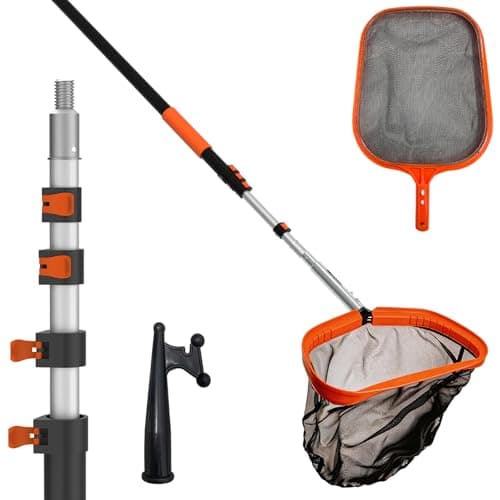
The five-dollar tool you use most
Skimmer Net with Telescopic Pole
Various
Catching leaves while they float is a two-minute job. Catching them after they sink is a vacuum session and a filter clean. Buy this first.
Key specs
- Type
- Flat skimmer or deep leaf rake
- Pole
- Telescopic, sized to reach the middle of your pool
- Frame
- Plastic or aluminum
How it scoresour reading of published specs, not a test result
- Retention
- 8.5
- Durability
- 7.0
- Handling
- 9.0
- Running cost
- 10.0
- Value
- 9.5
Overall 8.8 / 10
What works
- The single most-used tool in pool ownership and among the cheapest
- Removing debris before it sinks prevents most of the work that follows
- A deep leaf rake handles far more per pass than a flat skimmer
What doesn't
- Cheap plastic frames snap where the pole attaches, which is the standard failure
- Telescopic poles seize with hard water unless rinsed
- A too-short pole means you cannot reach the middle, which makes it useless
Skip it if: Anything on the floor. This is a surface tool and pretending otherwise is how debris ends up in the filter.
What it costs to run: Free to use and it directly reduces your chemical bill: organic debris consumes chlorine as it breaks down, so removing leaves is the cheapest sanitizer saving there is.
Several seasons: Buy-once. Built and warranted to come back out of the box for a few years, if you store it properly.
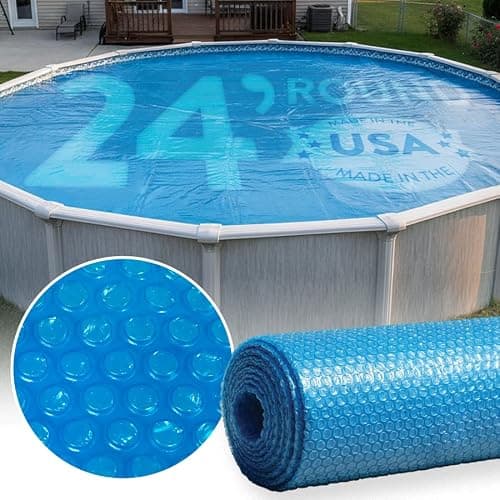
The single highest-return accessory here
Bubble Solar Cover for Above-Ground Pools
Various
It cuts evaporation, and evaporation is simultaneously your water bill, your chemical bill and your heat loss. Nothing else on this site reduces three costs at once.
#ad how this is funded · price as of October 8, 2026
Key specs
- Construction
- Bubble sheet, thickness published in mil
- Thickness
- Higher mil lasts longer — 12 mil and 16 mil are common
- Fit
- Cut to size; buy oversize and trim
- Orientation
- Bubbles face down, toward the water
How it scoresour reading of published specs, not a test result
- Retention
- 9.0
- Durability
- 7.0
- Handling
- 6.0
- Running cost
- 9.8
- Value
- 9.5
Overall 9.0 / 10
What works
- Reduces evaporation, which is the mechanism behind the water, chemical and heat savings all at once
- Cheap relative to everything it saves
- Can be cut to fit any pool shape, so sizing is forgiving
What doesn't
- Awkward to get on and off without a reel, and awkward is how covers end up unused
- Degrades in UV like every vinyl product
- Not a safety cover and will not support weight — this is important
Skip it if: Being a safety barrier. A solar cover looks solid and is not; a child or pet on it goes through and under.
What it costs to run: The one accessory with a clear payback. Every gallon that does not evaporate is a gallon you do not replace at the EPA WaterSense national average of $6.06 per 1,000 gallons, and it is chlorine you do not re-dose. If you buy one thing from this hub, buy this.
Several seasons: Buy-once. Built and warranted to come back out of the box for a few years, if you store it properly.
Specs from: EPA WaterSense — cost per 1,000 gallons
Questions people actually ask
Why does my pool need more chlorine in July than in June?
Should I drain part of my pool mid-season?
How do I know when a filter cartridge is finished?
Should I brush the pool before or after shocking?
Sources
Read next
- Closing, covering and opening againWinterizing, covers and spring opening - the four weeks of the year that decide whether you own a pool next summer.
- Opening an above-ground pool in springThe spring sequence in order, why cloudy water at opening is normal, and the two timing errors that cause green openings.
- How to winterize an above-ground poolThe correct closing sequence, the freeze damage that ends pools, and why a cracked pump housing is entirely preventable.
- The weekly pool routine, and how little time it really takesThe daily, weekly and monthly jobs written as a schedule, with the kit each one needs and roughly how long it takes.
- Cyanuric acid: the reading that explains your chlorineWhy an outdoor pool needs stabilizer, why tablets add it whether you want them to or not, and the only way to bring it back down.
- Filter cartridges: the consumable nobody budgets forThe replacement interval, the rinse-versus-scrub question, and how the cartridge treadmill compares with a sand filter across a season.
- What it costs to fill a pool, and to keep it fullOne fill priced for four common pool volumes at the national average water rate, plus why every gallon you add has to be re-balanced.