Pool Care & Chemistry · Best Clarifier
Pool clarifiers, and the three cases where one is the wrong answer
A clarifier does not clean water. It clumps the particles together so your filter can finally catch them - which means it is useless if the filter is the problem.
Heads up: we earn a commission if you buy through the links on this page, at no extra cost to you. It never decides the ranking — here is how we pick and here is the full disclosure. Prices are checked automatically; last verified October 8, 2026.
Quick picks
Segmented before it is ranked — the right answer depends on which of these you actually are. Tap any row for the full write-up.
If the water is cloudy but chemically fine
Particles too small for the filter to catch. This is the case a clarifier was actually designed for, and it works well when the filter is healthy.
| # | Product | Best for | Score | Price |
|---|---|---|---|---|
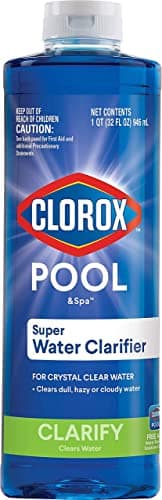
| 1 | Pool Water Clarifier Clumps particles too small for your filter into ones it can catch. Genuinely useful for the specific case where your chemistry reads correct and the water is still milky. | Cloudy water that is chemically fineA few weekends | 7.8out of 10 |
If the water is green or turning
A clarifier will not touch this. Shock first to kill it, filter it out, then use a preventive algaecide to stop it coming back.
| # | Product | Best for | Score | Price |
|---|---|---|---|---|
| 1 | No image Calcium Hypochlorite Pool Shock Unstabilized, fast-acting and strong. This is the tool for an algae bloom precisely because it does not add more cyanuric acid to a pool that probably already has too much. | Actually clearing a green poolOne honest season | 8.6out of 10 | |
| 2 | 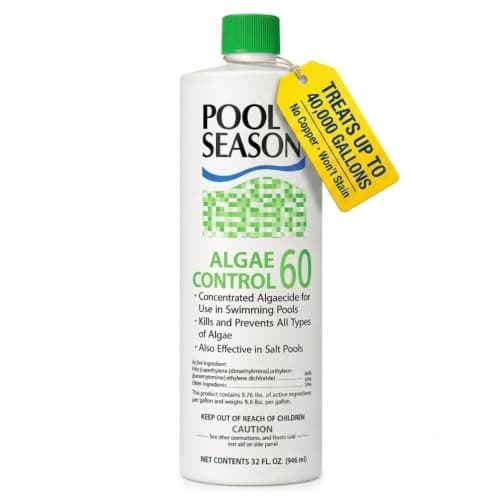 Pool Algaecide (polyquat 60) Polyquat is the non-foaming, non-staining choice and it is far better at stopping algae than at killing an established bloom. Use it as insurance and as part of closing. | Preventing algae, not curing itOne honest season | 8.0out of 10 |
If chlorine keeps running out mid-week
The cheapest fix in the aisle, and the one nobody suggests: meter the tablets properly instead of dosing in bursts.
| # | Product | Best for | Score | Price |
|---|---|---|---|---|
| 1 | 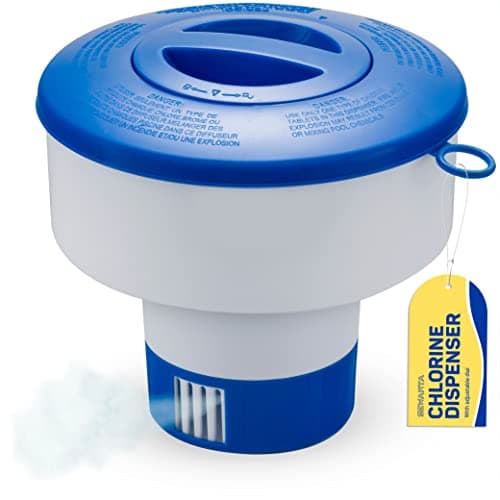 Floating Chlorine Tablet Dispenser Two dollars of plastic that decides whether your chlorine dissolves evenly over days or sits in a corner bleaching your liner. Buy it with the tablets, not after. | Making tablets work properlyOne honest season | 9.0out of 10 |
The short version
- A clarifier is a coagulant, not a cleaner. It aggregates fine particles so the filter can catch them, and it does nothing at all on its own.
- It requires a running filter. If the cartridge is clogged, a clarifier is money poured into a pool that cannot use it.
- Green water is not a clarifier problem. That is a sanitizer problem, and the order is shock first, filter second, algaecide afterwards to prevent a repeat.
- These are our reading of published product documentation, not test results. We have not tested any of them and do not claim to.
Diagnose before you dose
Cloudy water has three common causes and only one of them is a clarifier’s job. Spending two minutes on the diagnosis saves an entire weekend and a good deal of money, because the wrong product does not simply fail — it delays the right one.
| What you see | Likely cause | What to reach for |
|---|---|---|
| Milky or hazy, chemistry tests fine | Particles too fine for the filter | Clarifier, with the filter running continuously |
| Green tint, chlorine low | Algae has established | Shock, then filter, then preventive algaecide |
| Cloudy and the filter pressure is odd | Clogged or exhausted cartridge | Rinse or replace the cartridge first |
| Clears then returns every few days | Chlorine is running out between doses | A floating dispenser to meter tablets evenly |
What a clarifier actually does
Pool water can be perfectly sanitized and still look like dishwater, because filters have a particle size below which they simply do not catch anything. A clarifier is a coagulant: it makes very fine suspended particles clump into larger ones that the filter can then trap. The chemistry is doing nothing to the water except making it filterable.
Which means the filter is not an optional part of the treatment, it is the treatment. Dose, then run the pump continuously — not on its usual schedule — and expect to rinse or replace the cartridge afterwards, because it is about to catch everything it has been missing. If your cartridge was already due for replacement, do that first and you may not need the clarifier at all. Our cartridge guide covers the interval and the rinse-versus-scrub question, and our filter roundup covers the filtration itself.
When it is algae, not haze
Green water is a sanitizer failure and no coagulant fixes it. The sequence is: brush the walls, shock heavily enough to actually kill the bloom, run the filter until it clears, then dose a preventive algaecide to reduce the chance of a repeat. Polyquat algaecide is a preventive rather than a cure — it is non-foaming, unlike quat products, and contains no metals, unlike copper-based ones, which is why it is the sensible default for a vinyl-lined pool. Our algae guide is the full recovery procedure.
Do not do these in the wrong order. Algaecide dosed into water that is already green is largely wasted; shock dosed into water full of leaves is largely wasted too. Skim and brush, then shock, then filter, then prevent.
The cheap fix people skip
If your water clears and then goes hazy again every few days, the problem is usually not the products at all — it is that the chlorine level is sawtoothing between doses. Published trichlor dosing is two three-inch tablets a week per 10,000 gallons, and a floating dispenser meters that out steadily instead of delivering it in a burst every Saturday. It is the least expensive item on this page and it prevents more cloudy water than the rest of them combined.
The related check is stabilizer. If chlorine keeps disappearing regardless of how you dose it, read our cyanuric acid guide before buying anything else — unstabilized chlorine in full sun can be gone by evening.
What we are not claiming
We have not tested any of these products, we do not have a laboratory, and we are not going to pretend a scored comparison is an experiment. The scores below are our reading of published product documentation — what the active ingredient is, what the manufacturer says it does, and what it demands of your filtration. Where a product type’s performance genuinely depends on your own water, we say so instead of ranking it. Our methodology page sets out how that works across the site.
The picks, in full
Scores are our own reading of published specifications. They are not test results — we have not tested these products and we do not claim to.
Pick #1 · Cloudy water that is chemically fine
Pool Water Clarifier
Various
Clumps particles too small for your filter into ones it can catch. Genuinely useful for the specific case where your chemistry reads correct and the water is still milky.
Key specs
- Function
- Coagulant — aggregates fine particles for filtration
- Requires
- A running filter; it does nothing on its own
- Typical treatment
- Dose, then run the filter continuously
How it scoresour reading of published specs, not a test result
- Effectiveness
- 7.5
- Ease
- 8.5
- Water impact
- 8.0
- Cost per season
- 8.5
- Value
- 7.5
Overall 7.8 / 10
What works
- Fixes the exact case where chemistry is balanced and the water still will not clear
- Cheap and quick when it is the right tool
- Works with the filter you already have rather than needing a better one
What doesn't
- Does nothing at all if the actual problem is low chlorine or a blocked filter
- Overdosing makes cloudiness worse, which is a genuinely counterintuitive failure
- Loads the filter, so it needs cleaning right after
Skip it if: Being the first thing you reach for. Test the water before you use this — most cloudy pools are a chemistry problem wearing a clarity costume.
What it costs to run: A few dollars a bottle, and worth it only when the decision tree points here. Reaching for clarifier first is how people spend twenty dollars solving a problem that a longer pump run would have fixed for free.
A few weekends: Fine for a heatwave and a toddler. Treat it as consumable, not as a pool — it will not survive a winter in the yard.
Pick #2 · Actually clearing a green pool
Calcium Hypochlorite Pool Shock
Various (compare available chlorine %)
Unstabilized, fast-acting and strong. This is the tool for an algae bloom precisely because it does not add more cyanuric acid to a pool that probably already has too much.
Key specs
- Type
- Calcium hypochlorite, unstabilized
- Adds stabilizer
- No
- Adds
- Calcium hardness
- Dosing
- By pool volume, per the bag
How it scoresour reading of published specs, not a test result
- Effectiveness
- 9.5
- Ease
- 6.5
- Water impact
- 7.0
- Cost per season
- 9.0
- Value
- 8.8
Overall 8.6 / 10
What works
- No cyanuric acid added, so it does not worsen the problem it is usually solving
- Fast and strong enough to actually break an algae bloom in one treatment when dosed properly
- Cheap per pound of available chlorine
What doesn't
- Adds calcium hardness, which matters in hard-water areas
- Must be dissolved properly or it will bleach a vinyl liner where it settles
- Needs careful storage — it is a genuine oxidizer, not a household product
Skip it if: Routine daily chlorination. This is the emergency tool; tablets are the routine.
What it costs to run: The single most cost-effective way to fix a green pool, and the most commonly under-dosed. Half a dose twice does not equal a full dose once — it just wastes the bag.
One honest season: The cheapest setup that genuinely works for a season of real swimming. Nothing spare, nothing missing.
Pick #3 · Preventing algae, not curing it
Pool Algaecide (polyquat 60)
Various
Polyquat is the non-foaming, non-staining choice and it is far better at stopping algae than at killing an established bloom. Use it as insurance and as part of closing.
Key specs
- Type
- Polyquaternium (polyquat 60)
- Foaming
- Non-foaming, unlike quat algaecides
- Metal content
- None, unlike copper-based algaecides
How it scoresour reading of published specs, not a test result
- Effectiveness
- 7.5
- Ease
- 9.0
- Water impact
- 9.0
- Cost per season
- 7.5
- Value
- 8.0
Overall 8.0 / 10
What works
- Does not foam, which the cheaper quat products do
- No copper, so no risk of the metal staining a vinyl liner
- The standard product in a winterizing routine, for good reason
What doesn't
- Poor at killing an established bloom — shock does that job
- More expensive than copper-based alternatives
- Easy to over-rely on instead of maintaining chlorine
Skip it if: Rescuing a green pool. Brush and shock first; algaecide is what stops it coming back.
What it costs to run: One of the few chemicals where buying the better version is clearly right — a copper algaecide that stains a liner costs vastly more than the few dollars it saved.
One honest season: The cheapest setup that genuinely works for a season of real swimming. Nothing spare, nothing missing.
Pick #4 · Making tablets work properly
Floating Chlorine Tablet Dispenser
Various
Two dollars of plastic that decides whether your chlorine dissolves evenly over days or sits in a corner bleaching your liner. Buy it with the tablets, not after.
#ad how this is funded · price as of October 8, 2026
Key specs
- Function
- Holds 3-inch tablets, meters dissolution rate
- Adjustment
- Vented base, adjustable on most models
- Compatibility
- Standard 3-inch tablets
How it scoresour reading of published specs, not a test result
- Effectiveness
- 8.0
- Ease
- 9.5
- Water impact
- 9.0
- Cost per season
- 9.8
- Value
- 9.5
Overall 9.0 / 10
What works
- Adjustable venting lets you slow or speed dissolution to match the weather
- Keeps tablets off the liner, which is what causes bleach spots
- Trivially cheap and lasts years
What doesn't
- Drifts to one end of the pool in wind, so distribution is uneven without circulation
- Must be removed before swimming with small children
- Cheap ones crack after a season in UV
Skip it if: Being left in an empty or unfiltered pool. Without circulation it creates a concentrated pocket rather than an even dose.
What it costs to run: The cheapest item on this site and one of the highest-return: even dissolution means you use fewer tablets to hold the same free chlorine level.
One honest season: The cheapest setup that genuinely works for a season of real swimming. Nothing spare, nothing missing.
Questions people actually ask
What does pool clarifier actually do?
Will clarifier fix a green pool?
Clarifier or flocculant for an above-ground pool?
How long does a clarifier take to work?
Sources
Read next
- Pool care, from someone who assumes you have never done thisThe weekly routine, the four numbers that matter, and the fix for the week the water turns.
- Cloudy pool water: work out which of four problems you haveA diagnostic decision tree for cloudy water - four causes, how to tell them apart, and the correct fix for each.
- Pool algae: brush, shock, filter, then rebalanceThe correct order for clearing green water, how to tell algae from pollen, and why algaecide prevents rather than cures.
- Pool shock: use enough, once, and use the right kindCal-hypo versus dichlor, correct dosing, and the counter-intuitive reason a chlorine smell means you need more chlorine.
- Filter cartridges: the consumable nobody budgets forThe replacement interval, the rinse-versus-scrub question, and how the cartridge treadmill compares with a sand filter across a season.
- Pool filters: the consumable nobody budgets forCartridge replacement intervals, what rinsing does and does not achieve, and when sand becomes the cheaper answer.
- Floc or clarifier: your filter decides, not your waterThe mechanism difference between flocculant and clarifier, why most above-ground pools cannot use floc at all, and when neither is the right answer.