Pool Care & Chemistry
Tablets or liquid: the difference is what else goes in
Both put chlorine in the water. One also puts cyanuric acid in, permanently, every single week - and by August that is the whole story.
Heads up: we earn a commission if you buy through the links on this page, at no extra cost to you. It never decides the ranking — here is how we pick and here is the full disclosure. Prices are checked automatically; last verified October 8, 2026.
The short version
- Trichlor tablets are stabilized chlorine. Every tablet adds cyanuric acid as well as chlorine, and cyanuric acid never leaves except in water you remove.
- Liquid chlorine adds no stabilizer at all, which is both its main advantage and, in an open sunlit pool with no stabilizer present, its main problem.
- Tablets meter themselves; liquid does not. A dispenser holds a level steadily where liquid delivers a spike that decays.
- The right answer changes across a season — tablets early, liquid later if stabilizer has climbed.
The chemistry difference in one paragraph
A three-inch trichlor tablet is chlorine chemically bonded with a stabilizer. When it dissolves you get both: sanitizer, and cyanuric acid that protects it from ultraviolet light. That protection is essential outdoors — without it, an afternoon of sun strips most of your free chlorine before evening.
Liquid chlorine is unstabilized. It sanitizes and adds nothing else of consequence to a vinyl pool. In a pool that already has stabilizer in the water, that is close to ideal. In a freshly filled pool with none, it is a sanitizer with no sunscreen.
| Form | Adds stabilizer? | Adds calcium? | Meters itself? |
|---|---|---|---|
| Trichlor 3-inch tablets | Yes, every dose | No | Yes, in a dispenser |
| Liquid chlorine | No | No | No — dose and decay |
| Calcium hypochlorite (shock) | No | Yes | No |
| Dichlor granular (shock) | Yes | No | No |
Why tablets are the sensible default
Three reasons, and the third is the one people underrate.
They carry their own sunscreen. A new pool filled from the tap has no stabilizer, and tablets build it up over the first few weeks without you having to think about it.
They store well. A sealed bucket of tablets keeps from one season to the next. Liquid chlorine degrades in storage, and degrades faster in heat and light — a bottle that has spent a hot fortnight in a shed is weaker than the label says.
They meter themselves. This matters more than the chemistry. A floating dispenser releases tablets steadily, holding a level. Liquid delivers a spike that decays over days, so the pool spends part of every week under-sanitized — and that mid-week trough is where cloudy water and algae start. Published trichlor dosing is two three-inch tablets a week per 10,000 gallons, which on a 3,955-gallon pool is a little under one tablet a week. Our chemical cost guide has the counts by volume.
When liquid becomes the better answer
Mid-season, on a pool where stabilizer has climbed. This is the situation our cyanuric acid guide describes: free chlorine reads respectably while the water misbehaves, because bound chlorine is sluggish. Adding more tablets makes it worse, since each one adds more stabilizer.
Switching routine dosing to liquid chlorine stops the number climbing while keeping the water sanitized. It is the standard mid-season correction, and it pairs naturally with a partial drain — the drain brings the stabilizer down, the liquid keeps it there. Our midsummer reset guide is the whole procedure.
The other case is a fully shaded pool, where UV loss is low enough that stabilizer matters less. That is rare in this category and worth verifying rather than assuming.
| Situation | Use | Why |
|---|---|---|
| New fill, no stabilizer yet | Tablets | Builds UV protection while sanitizing |
| Normal running, stabilizer fine | Tablets in a dispenser | Steady level, no mid-week trough |
| Stabilizer high, water misbehaving | Liquid | Sanitizes without adding more stabilizer |
| After a partial drain | Liquid, then reassess | Keeps the reading down while it settles |
| Green water or heavy load | Neither — shock | Maintenance dosing does not reset a pool |
Handling and storage, which is not a footnote
Liquid chlorine is a strong bleach. It stains clothing instantly and permanently, it is heavy to carry, and it wants a cool dark place away from anything metal. It also loses strength over weeks rather than months, so buying a season’s worth in April is a false economy.
Tablets are easier in every one of those respects, with one caution of their own: keep the bucket sealed, dry and away from any other pool chemical. Mixing chlorine products, or getting water into a part-used bucket, is the genuinely hazardous mistake in this category and it is worth taking literally.
The practical answer for most seasonal pools
Start the season on tablets in a floating dispenser. Test cyanuric acid monthly along with everything else — a seven-way strip covers it in fifteen seconds. If the number climbs to the point where chlorine stops behaving, do a partial drain and switch routine dosing to liquid for the rest of the season.
That sequence uses each form where it is strongest, and it costs nothing extra to follow because you were going to buy both a dispenser and a shock product anyway. Our weekly schedule is where it slots in.
What to buy
Scores are our own reading of published specifications. They are not test results — we have not tested these products and we do not claim to.
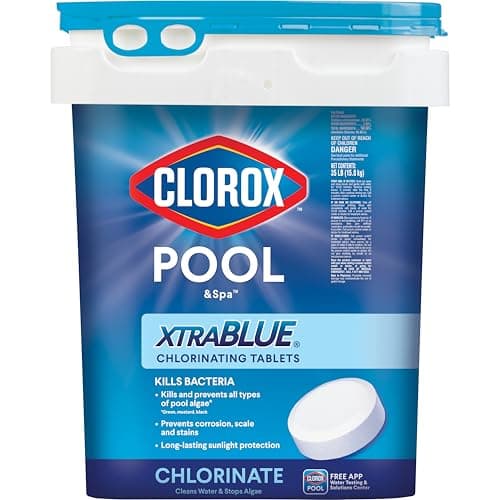
The default chlorine source
Clorox Pool&Spa 3-Inch Chlorinating Tablets
Clorox Pool&Spa
Stabilized trichlor tablets in a floating dispenser is the standard answer for a seasonal above-ground pool, and this is the standard version of it.
#ad how this is funded · price as of October 8, 2026
Key specs
- Type
- Stabilized trichlor, 3-inch tablets
- Contains stabilizer
- Yes — cyanuric acid is part of trichlor
- Dosing
- Per manufacturer instructions, by pool volume
- CDC target
- At least 2 ppm free chlorine when using a stabilizer
How it scoresour reading of published specs, not a test result
- Effectiveness
- 9.0
- Ease
- 9.0
- Water impact
- 6.0
- Cost per season
- 8.5
- Value
- 8.5
Overall 8.5 / 10
What works
- Dissolves slowly, so a floating dispenser meters chlorine out over days rather than hours
- Stabilized, so sunlight does not destroy your chlorine within an afternoon
- Widely stocked, so you are never hunting for it in July
What doesn't
- Every tablet adds cyanuric acid, and in a pool you never fully drain that accumulates until chlorine stops responding
- Trichlor is acidic and will pull your pH down over a season
- Tablets must be kept dry and sealed or they degrade and gas off
Skip it if: A small pool that is topped up rather than drained. Cyanuric acid only leaves with the water, so in a 1,500-gallon pool it climbs fast.
What it costs to run: The standing chemical cost of the season, and it scales directly with gallons. Watch the cyanuric acid reading on your test strip: once it is high, you are buying chlorine that cannot work, which is the most common invisible waste in a first pool year.
One honest season: The cheapest setup that genuinely works for a season of real swimming. Nothing spare, nothing missing.
Specs from: CDC — free chlorine target with cyanuric acid
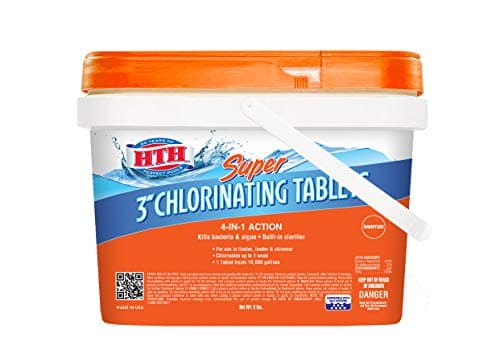
The direct alternative
HTH 3-Inch Chlorinating Tablets
HTH
Functionally the same product as any other stabilized trichlor tablet. Buy on price per pound of available chlorine, not on the label.
#ad how this is funded · price as of October 8, 2026
Key specs
- Type
- Stabilized trichlor, 3-inch tablets
- Contains stabilizer
- Yes
- Compare on
- Available chlorine percentage stated on the label
How it scoresour reading of published specs, not a test result
- Effectiveness
- 9.0
- Ease
- 9.0
- Water impact
- 6.0
- Cost per season
- 8.8
- Value
- 8.5
Overall 8.4 / 10
What works
- Chemically equivalent to competing trichlor tablets — this is a commodity
- Widely available in large buckets, which is the cheaper format
- Long shelf life if the bucket stays sealed and dry
What doesn't
- Same cyanuric acid accumulation as every other trichlor product
- Same downward pH pressure over a season
- Bucket sizes are often larger than a small seasonal pool will use in a year
Skip it if: Being different. If you are comparing trichlor brands you are comparing price, and you should be.
What it costs to run: Cost per season is decided by the available-chlorine percentage on the label and the bucket size, not the brand. Compare those two numbers and buy the cheaper one.
One honest season: The cheapest setup that genuinely works for a season of real swimming. Nothing spare, nothing missing.
Actually clearing a green pool
Calcium Hypochlorite Pool Shock
Various (compare available chlorine %)
Unstabilized, fast-acting and strong. This is the tool for an algae bloom precisely because it does not add more cyanuric acid to a pool that probably already has too much.
Key specs
- Type
- Calcium hypochlorite, unstabilized
- Adds stabilizer
- No
- Adds
- Calcium hardness
- Dosing
- By pool volume, per the bag
How it scoresour reading of published specs, not a test result
- Effectiveness
- 9.5
- Ease
- 6.5
- Water impact
- 7.0
- Cost per season
- 9.0
- Value
- 8.8
Overall 8.6 / 10
What works
- No cyanuric acid added, so it does not worsen the problem it is usually solving
- Fast and strong enough to actually break an algae bloom in one treatment when dosed properly
- Cheap per pound of available chlorine
What doesn't
- Adds calcium hardness, which matters in hard-water areas
- Must be dissolved properly or it will bleach a vinyl liner where it settles
- Needs careful storage — it is a genuine oxidizer, not a household product
Skip it if: Routine daily chlorination. This is the emergency tool; tablets are the routine.
What it costs to run: The single most cost-effective way to fix a green pool, and the most commonly under-dosed. Half a dose twice does not equal a full dose once — it just wastes the bag.
One honest season: The cheapest setup that genuinely works for a season of real swimming. Nothing spare, nothing missing.
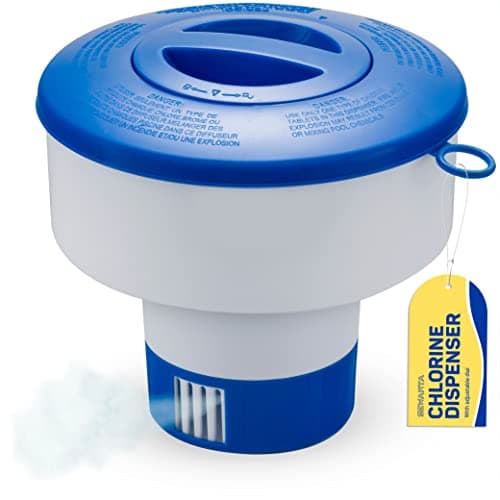
Making tablets work properly
Floating Chlorine Tablet Dispenser
Various
Two dollars of plastic that decides whether your chlorine dissolves evenly over days or sits in a corner bleaching your liner. Buy it with the tablets, not after.
#ad how this is funded · price as of October 8, 2026
Key specs
- Function
- Holds 3-inch tablets, meters dissolution rate
- Adjustment
- Vented base, adjustable on most models
- Compatibility
- Standard 3-inch tablets
How it scoresour reading of published specs, not a test result
- Effectiveness
- 8.0
- Ease
- 9.5
- Water impact
- 9.0
- Cost per season
- 9.8
- Value
- 9.5
Overall 9.0 / 10
What works
- Adjustable venting lets you slow or speed dissolution to match the weather
- Keeps tablets off the liner, which is what causes bleach spots
- Trivially cheap and lasts years
What doesn't
- Drifts to one end of the pool in wind, so distribution is uneven without circulation
- Must be removed before swimming with small children
- Cheap ones crack after a season in UV
Skip it if: Being left in an empty or unfiltered pool. Without circulation it creates a concentrated pocket rather than an even dose.
What it costs to run: The cheapest item on this site and one of the highest-return: even dissolution means you use fewer tablets to hold the same free chlorine level.
One honest season: The cheapest setup that genuinely works for a season of real swimming. Nothing spare, nothing missing.
The default first test kit
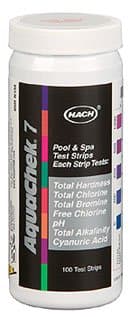
AquaChek Silver 7-Way Test Strips (100 count)
AquaChek
Seven readings in fifteen seconds, including the two that beginners never measure and then fight all summer: total alkalinity and cyanuric acid.
#ad how this is funded · price as of October 8, 2026
Key specs
- Tests
- Free chlorine, total chlorine, bromine, pH, total alkalinity, total hardness, cyanuric acid
- Free chlorine range
- 0-20 ppm
- pH range
- 6.2-8.4
- Total alkalinity range
- 0-240 ppm
- Cyanuric acid range
- 0-300 ppm
- Read time
- 15 seconds
- Count
- 100 strips
How it scoresour reading of published specs, not a test result
- Accuracy
- 7.0
- Ease
- 9.5
- Coverage
- 9.5
- Cost per use
- 9.0
- Value
- 9.2
Overall 8.9 / 10
What works
- Covers cyanuric acid, which most cheap strips omit and which is the reason chlorine stops working in a stabilized pool
- pH range spans 6.2-8.4, comfortably bracketing the CDC's recommended 7.0-7.8
- 15 seconds and a color chart printed on the bottle — no separate booklet to lose
- 100 strips is a full season of twice-weekly testing with room to spare
What doesn't
- Strips are a comparison against a printed color chart, so they are directional rather than precise
- Reading them in bright sun is harder than it should be
- The bottle must be kept sealed and dry or the strips degrade quietly
Skip it if: Fine adjustment. If you are chasing a stubborn problem and need a number rather than a color band, a liquid reagent kit is the tool.
What it costs to run: 100 strips at twice-weekly testing covers roughly two seasons for one pool. The real saving is upstream: knowing your alkalinity stops you buying pH adjuster you did not need.
One honest season: The cheapest setup that genuinely works for a season of real swimming. Nothing spare, nothing missing.
Specs from: CDC — home pool and hot tub water treatment and testing
Questions people actually ask
Is liquid chlorine better than tablets for a pool?
Do chlorine tablets raise cyanuric acid?
Can I put chlorine tablets directly in the pool?
How long does liquid chlorine last in storage?
Sources
Read next
- Pool care, from someone who assumes you have never done thisThe weekly routine, the four numbers that matter, and the fix for the week the water turns.
- The best chlorine tablets for an above-ground poolTrichlor tablets compared on available chlorine and stabilizer load, with the season-quantity arithmetic for your pool size.
- Cyanuric acid: the reading that explains your chlorineWhy an outdoor pool needs stabilizer, why tablets add it whether you want them to or not, and the only way to bring it back down.
- Pool shock: use enough, once, and use the right kindCal-hypo versus dichlor, correct dosing, and the counter-intuitive reason a chlorine smell means you need more chlorine.
- Bromine or chlorine: sunlight settles itWhy bromine works in a covered hot tub and struggles in an open pool, what it costs, and when it is still the right answer.
- The weekly pool routine, and how little time it really takesThe daily, weekly and monthly jobs written as a schedule, with the kit each one needs and roughly how long it takes.
- What a season of pool chemicals actually adds up toSeason chemical quantities computed from published dosing for four pool volumes, plus the shopping list that is genuinely necessary.