Pool Care & Chemistry
pH and alkalinity, and why yours will not stay put
If you are adjusting pH every week and it keeps drifting back, you are treating the symptom. The number you have not measured is alkalinity.
Heads up: we earn a commission if you buy through the links on this page, at no extra cost to you. It never decides the ranking — here is how we pick and here is the full disclosure. Prices are checked automatically; last verified October 19, 2026.
The short version
- Alkalinity is pH’s shock absorber. Low alkalinity means pH will not hold, whatever you add.
- Fix alkalinity first, then pH. The reverse order is a season of chemicals and no progress.
- The CDC publishes a pH range of 7.0–7.8 and notes chlorine works poorly above 8.0.
- Trichlor tablets push pH down all season. That is expected chemistry, not a fault.
What each one actually is
pH is how acidic or basic the water is right now. It is a snapshot, and it moves.
Total alkalinity is the water’s capacity to resist that movement. Think of it as a shock absorber: high alkalinity means pH shrugs off things that would otherwise move it, low alkalinity means every rainstorm, every chemical addition and every hot afternoon sends it somewhere new.
That relationship is the entire content of this page. When people say “my pH will not stay put”, they are describing low alkalinity, and adding more pH adjuster is treating the symptom.
The target numbers, and where they come from
| Reading | Target | Source | What happens outside |
|---|---|---|---|
| pH | 7.0–7.8 | CDC | Above 8.0 chlorine works poorly; below 7.0 corrodes |
| Total alkalinity | 80–120 ppm | Industry convention | Low: pH swings. High: pH resists correction |
| Free chlorine (stabilized) | At least 2 ppm | CDC | Below: algae gets an opening |
We looked for a published federal total alkalinity range and did not find one. The CDC publishes free chlorine and pH targets for home pools and does not address alkalinity. The widely used 80–120 ppm figure comes from industry practice, and we would rather tell you that than present a trade convention as a standard. It is still the right number to aim for.
Fixing alkalinity
Raising it is easy and cheap: sodium bicarbonate, which is chemically the same thing as baking soda. It raises alkalinity with only a small effect on pH, which is precisely what you want. Add it with the pump running, distribute it around the pool rather than dumping it in one place, and give it a few hours to circulate before re-testing.
Lowering it is harder, which is why overshooting is worth avoiding. It requires a slow process of adding acid and aerating, and there is no quick version. Add bicarbonate in stages and re-test, rather than trying to fix it in a single dose.
Test all three readings together
Free chlorine, pH and total alkalinity from the same sample. Adjusting one without knowing the other two is guesswork.If alkalinity is below range, fix that and stop
Add sodium bicarbonate with the pump running. Wait several hours, ideally overnight. Do not touch pH yet — alkalinity adjustment moves it slightly and you want to see where it lands on its own.Re-test, then correct pH
Now bring pH into the CDC's 7.0–7.8 range. With alkalinity correct, this adjustment holds instead of drifting back.Re-test and correct chlorine last
Chlorine dosed into badly balanced water is chlorine wasted, which is why it goes last rather than first.Re-check in three days
If pH has held, you are done for the season barring heavy rain. If it has drifted again, alkalinity is still low — add more bicarbonate rather than more pH adjuster.
Why your pH drifts down over a season
Because trichlor tablets are acidic. If you are sanitizing with 3-inch tablets, which nearly every above-ground owner is, pH will drift downward steadily all summer. That is expected chemistry rather than a problem, and it is why a pH increaser belongs on the day-one shopping list.
Rain drives it the other way in some regions and further down in others depending on local rainfall chemistry. Either way, a test after heavy rain is worth more than a test on a calm week.
For what to actually buy to move these two readings — and why buying a pH adjuster before an alkalinity one means doing the job twice — see our pH and alkalinity balancer roundup.
What to buy
Scores are our own reading of published specifications. They are not test results — we have not tested these products and we do not claim to.
Fixing the number beginners skip
Alkalinity Increaser (sodium bicarbonate)
Various
The most under-bought chemical in the category. If your pH will not stay put, this is almost always the actual fix, and it is chemically just baking soda.
Key specs
- Active
- Sodium bicarbonate
- Raises
- Total alkalinity, with minimal pH movement
- Common target range
- 80-120 ppm (industry convention, not a CDC figure)
How it scoresour reading of published specs, not a test result
- Effectiveness
- 9.0
- Ease
- 8.0
- Water impact
- 9.0
- Cost per season
- 9.8
- Value
- 9.5
Overall 9.0 / 10
What works
- Raises alkalinity with only a small effect on pH, which is exactly what you want
- Extremely cheap — it is sodium bicarbonate
- Fixing alkalinity first stops the endless pH chase that eats a first season
What doesn't
- Works slowly and needs circulation, so it is not a same-afternoon fix
- Easy to overshoot, and bringing alkalinity back down is more work than raising it
- The 80-120 ppm target is an industry convention rather than a published federal standard, so treat it as guidance
Skip it if: Emergencies. Nothing about alkalinity is urgent; it is the thing you fix first and then stop thinking about.
What it costs to run: Pennies per dose, and it is the cheapest lever on your whole chemical bill: stable alkalinity means stable pH, and stable pH means the chlorine you already bought actually works.
One honest season: The cheapest setup that genuinely works for a season of real swimming. Nothing spare, nothing missing.
Bringing pH back up after a season of trichlor
pH Increaser (sodium carbonate)
Various
One of two bottles every pool owner ends up with. Trichlor tablets push pH down all season, and this is what pushes it back.
Key specs
- Active
- Sodium carbonate (soda ash)
- Raises
- pH, and total alkalinity somewhat
- CDC pH target
- 7.0-7.8
How it scoresour reading of published specs, not a test result
- Effectiveness
- 8.5
- Ease
- 8.5
- Water impact
- 8.0
- Cost per season
- 9.5
- Value
- 8.8
Overall 8.5 / 10
What works
- Cheap, stable and does exactly one thing
- Also nudges total alkalinity up, which is often what actually needed fixing
- A single container lasts most seasonal pools a full year
What doesn't
- Overdosing clouds the water for a day or two
- Raises alkalinity as well as pH, which is not always what you want
- Needs to be added with the pump running or it settles
Skip it if: Raising alkalinity on its own without moving pH. Use sodium bicarbonate for that.
What it costs to run: A few dollars a season. The expensive mistake is not this bottle, it is failing to fix alkalinity first and then using this one repeatedly all summer.
One honest season: The cheapest setup that genuinely works for a season of real swimming. Nothing spare, nothing missing.
Specs from: CDC — recommended pH range for pools
The default first test kit
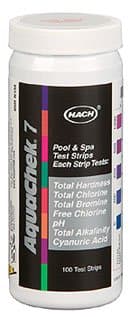
AquaChek Silver 7-Way Test Strips (100 count)
AquaChek
Seven readings in fifteen seconds, including the two that beginners never measure and then fight all summer: total alkalinity and cyanuric acid.
#ad how this is funded · price as of October 19, 2026
Key specs
- Tests
- Free chlorine, total chlorine, bromine, pH, total alkalinity, total hardness, cyanuric acid
- Free chlorine range
- 0-20 ppm
- pH range
- 6.2-8.4
- Total alkalinity range
- 0-240 ppm
- Cyanuric acid range
- 0-300 ppm
- Read time
- 15 seconds
- Count
- 100 strips
How it scoresour reading of published specs, not a test result
- Ease
- 9.5
- Value
- 9.2
Overall 8.9 / 10
What works
- Covers cyanuric acid, which most cheap strips omit and which is the reason chlorine stops working in a stabilized pool
- pH range spans 6.2-8.4, comfortably bracketing the CDC's recommended 7.0-7.8
- 15 seconds and a color chart printed on the bottle — no separate booklet to lose
- 100 strips is a full season of twice-weekly testing with room to spare
What doesn't
- Strips are a comparison against a printed color chart, so they are directional rather than precise
- Reading them in bright sun is harder than it should be
- The bottle must be kept sealed and dry or the strips degrade quietly
Skip it if: Fine adjustment. If you are chasing a stubborn problem and need a number rather than a color band, a liquid reagent kit is the tool.
What it costs to run: 100 strips at twice-weekly testing covers roughly two seasons for one pool. The real saving is upstream: knowing your alkalinity stops you buying pH adjuster you did not need.
One honest season: The cheapest setup that genuinely works for a season of real swimming. Nothing spare, nothing missing.
Specs from: CDC — home pool and hot tub water treatment and testing
The default chlorine source
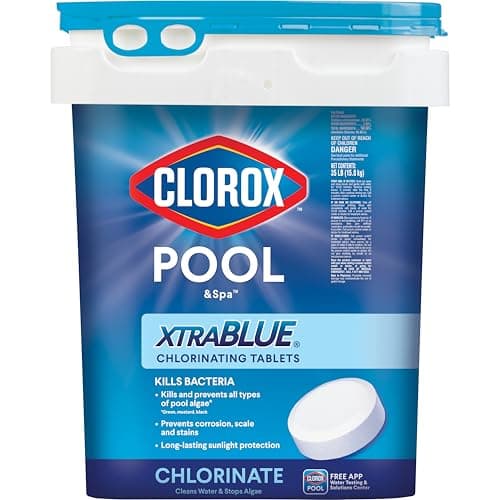
Clorox Pool&Spa 3-Inch Chlorinating Tablets
Clorox Pool&Spa
Stabilized trichlor tablets in a floating dispenser is the standard answer for a seasonal above-ground pool, and this is the standard version of it.
#ad how this is funded · price as of October 19, 2026
Key specs
- Type
- Stabilized trichlor, 3-inch tablets
- Contains stabilizer
- Yes — cyanuric acid is part of trichlor
- Dosing
- Per manufacturer instructions, by pool volume
- CDC target
- At least 2 ppm free chlorine when using a stabilizer
How it scoresour reading of published specs, not a test result
- Effectiveness
- 9.0
- Ease
- 9.0
- Water impact
- 6.0
- Cost per season
- 8.5
- Value
- 8.5
Overall 8.5 / 10
What works
- Dissolves slowly, so a floating dispenser meters chlorine out over days rather than hours
- Stabilized, so sunlight does not destroy your chlorine within an afternoon
- Widely stocked, so you are never hunting for it in July
What doesn't
- Every tablet adds cyanuric acid, and in a pool you never fully drain that accumulates until chlorine stops responding
- Trichlor is acidic and will pull your pH down over a season
- Tablets must be kept dry and sealed or they degrade and gas off
Skip it if: A small pool that is topped up rather than drained. Cyanuric acid only leaves with the water, so in a 1,500-gallon pool it climbs fast.
What it costs to run: The standing chemical cost of the season, and it scales directly with gallons. Watch the cyanuric acid reading on your test strip: once it is high, you are buying chlorine that cannot work, which is the most common invisible waste in a first pool year.
One honest season: The cheapest setup that genuinely works for a season of real swimming. Nothing spare, nothing missing.
Specs from: CDC — free chlorine target with cyanuric acid
Questions people actually ask
Should I fix alkalinity or pH first in a pool?
What should pool alkalinity be?
Why does my pool pH keep dropping?
Can I use baking soda to raise pool alkalinity?
Sources
Read next
- Pool care, from someone who assumes you have never done thisThe weekly routine, the four numbers that matter, and the fix for the week the water turns.
- First-time pool owner: the complete first monthThe pillar guide: day-one shopping list, the four water readings, the weekly routine and the week-three problem everybody gets.
- The best pool test stripsTest strips compared on parameter coverage - specifically whether they read cyanuric acid, which most cheap strips omit.
- Cloudy pool water: work out which of four problems you haveA diagnostic decision tree for cloudy water - four causes, how to tell them apart, and the correct fix for each.
- The best chlorine tablets for an above-ground poolTrichlor tablets compared on available chlorine and stabilizer load, with the season-quantity arithmetic for your pool size.
- Borates: the buffer most pools never addWhat borates do to pH and algae, the 30 to 50 ppm range published by industry chemists, how to test, and the safety and labeling caveats nobody mentions.