Pool Costs
What it costs to fill a pool, and to keep it full
The fill is a smaller number than people expect. The top-ups across a hot summer are a larger one than people expect, and a cover changes both.

Heads up: we earn a commission if you buy through the links on this page, at no extra cost to you. It never decides the ranking — here is how we pick and here is the full disclosure. Prices are checked automatically; last verified October 8, 2026.
The short version
- At the EPA WaterSense national average of $6.06 per 1,000 gallons, one fill runs from about $9 for a 12-foot pool to about $42 for an 18-foot one.
- The fill is the small number. The top-ups, and the re-balancing each one needs, are the part nobody budgets for.
- A solar cover is the evaporation control, and it is the cheapest item in this hub that pays for itself twice — less water and less heat lost.
- Your own water rate is on your bill and may differ substantially from the national average. The arithmetic here is set up so you can substitute it.
One fill, priced
This is one of the few pool costs that is genuinely simple. Take the manufacturer’s published capacity in gallons, divide by 1,000, and multiply by your water rate. The EPA WaterSense program uses a national average of $6.06 per 1,000 gallons in its own calculator, which is the figure we use throughout this site so that every page is consistent.
| Pool | Published gallons | Cost of one fill |
|---|---|---|
| Intex Easy Set 12ft x 30in | 1,485 | $9.00 |
| Intex Prism Frame 12ft x 30in | 1,718 | $10.41 |
| Bestway Steel Pro MAX 15ft x 42in | 3,955 | $23.96 |
| Intex Ultra XTR 18ft x 52in | 6,981 | $42.30 |
The part people do not budget for
A pool does not get filled once. It gets filled once and then topped up all summer, because water leaves by evaporation, by splash-out, by backwashing a sand filter and by the water that comes out on wet swimmers and towels. Evaporation is the largest of those and the least visible, and it scales with surface area, air temperature, humidity and wind — which is precisely why we are not going to print a national gallons-per-week figure as though it applied to your yard.
What we can say is that top-up water is not free in two separate ways. It costs what the table above says per thousand gallons, and every gallon added is a gallon that has to be re-balanced — fresh water dilutes your chlorine, your stabilizer and your alkalinity. A pool that loses and replaces a meaningful fraction of its volume across a summer is quietly consuming more chemicals as well as more water.
The cover is the answer to both
A bubble solar cover sits on the surface and does two things at once: it cuts evaporation dramatically while the pool is not in use, and it holds daytime heat that would otherwise be lost overnight. On a seasonal above-ground pool it is the single highest-return accessory we cover, and it is inexpensive.
Two practical notes. Bubbles face down, toward the water — this is the most common installation mistake and it undoes most of the benefit. And covers are sold to be cut to size, so buy oversize and trim to your pool rather than hunting for an exact fit. A reel is optional but it decides whether the cover actually gets used, because a wet cover wrestled off by hand twice a day stops being used by July. Our solar cover roundup covers thickness and fitting, and extending the season covers what the same cover does for temperature.
Refilling deliberately, not just topping up
There is one case where you will replace water on purpose rather than by accident: bringing down cyanuric acid. Stabilizer accumulates through a season of trichlor tablets and cannot be removed chemically, so the fix is dilution — drain a third, refill, and the reading falls by roughly a third.
On a seasonal above-ground pool that is a genuinely cheap fix. A third of a 3,955-gallon pool is about 1,300 gallons, which is roughly $8 of water at the national average. This is one of the real advantages of a small pool over a large one, and our cyanuric acid guide explains when to do it.
Diluting to fix high stabilizer
- Pool volume
- 3,955 gallons
- Fraction replaced
- one third
- US average water price [EPA WaterSense]
- $6.06 / 1,000 gal
3,955 ÷ 3 = 1,318 gal 1.318 kgal × $6.06 = $7.99
About $8 of water to cut the reading by roughly a third
Filling the pool without damaging it
Two things worth knowing on filling day. Fill slowly enough to watch the liner settle and smooth out wrinkles as the water rises, because a wrinkle set under several thousand pounds of water is there for the season. And make sure a ground cloth is under the pool before you start — once there is water in it, nothing about what is underneath can be corrected. Our setup guide covers the sequence properly.
For the whole picture rather than just the water line, our annual cost-to-run guide assembles electricity, water, chemicals and consumables into a single worksheet you can redo with your own rates.
What to buy
Scores are our own reading of published specifications. They are not test results — we have not tested these products and we do not claim to.
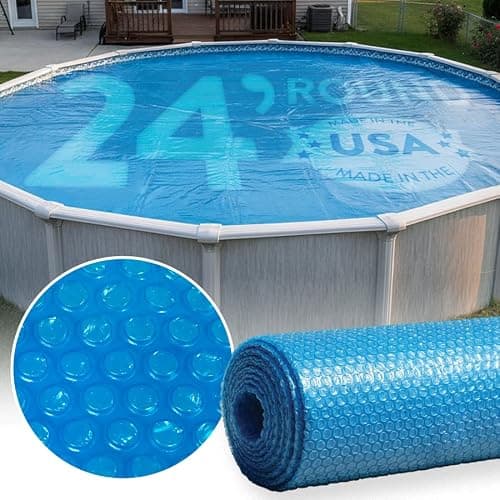
The single highest-return accessory here
Bubble Solar Cover for Above-Ground Pools
Various
It cuts evaporation, and evaporation is simultaneously your water bill, your chemical bill and your heat loss. Nothing else on this site reduces three costs at once.
#ad how this is funded · price as of October 8, 2026
Key specs
- Construction
- Bubble sheet, thickness published in mil
- Thickness
- Higher mil lasts longer — 12 mil and 16 mil are common
- Fit
- Cut to size; buy oversize and trim
- Orientation
- Bubbles face down, toward the water
How it scoresour reading of published specs, not a test result
- Retention
- 9.0
- Durability
- 7.0
- Handling
- 6.0
- Running cost
- 9.8
- Value
- 9.5
Overall 9.0 / 10
What works
- Reduces evaporation, which is the mechanism behind the water, chemical and heat savings all at once
- Cheap relative to everything it saves
- Can be cut to fit any pool shape, so sizing is forgiving
What doesn't
- Awkward to get on and off without a reel, and awkward is how covers end up unused
- Degrades in UV like every vinyl product
- Not a safety cover and will not support weight — this is important
Skip it if: Being a safety barrier. A solar cover looks solid and is not; a child or pet on it goes through and under.
What it costs to run: The one accessory with a clear payback. Every gallon that does not evaporate is a gallon you do not replace at the EPA WaterSense national average of $6.06 per 1,000 gallons, and it is chlorine you do not re-dose. If you buy one thing from this hub, buy this.
Several seasons: Buy-once. Built and warranted to come back out of the box for a few years, if you store it properly.
Specs from: EPA WaterSense — cost per 1,000 gallons
Making sure the cover actually gets used
Solar Cover Reel for Above-Ground Pools
Various
A cover that takes two people and ten minutes to move gets left off. A reel makes it a one-person, one-minute job, which is the difference between owning a cover and using one.
Key specs
- Function
- Rolls the solar cover on and off
- Fit
- Must match pool diameter and wall type
- Mounting
- Freestanding or wall-mounted depending on model
How it scoresour reading of published specs, not a test result
- Retention
- 7.0
- Durability
- 7.5
- Handling
- 9.5
- Running cost
- 8.5
- Value
- 7.0
Overall 7.7 / 10
What works
- Turns cover use from a chore into a habit, which is where all the savings actually are
- Keeps the cover off the ground, which is what shortens its life
- One-person operation
What doesn't
- Frequently costs more than the cover it handles
- Takes up permanent space beside the pool
- Sizing must match the pool exactly, and returns are awkward
Skip it if: A small pool. Under about 12 feet the cover is light enough to handle by hand and the reel is a solution to a problem you do not have.
What it costs to run: Only justified on larger pools. The value is not the reel, it is the cover getting used every night instead of most nights — quantify it by how often you would actually bother otherwise.
Several seasons: Buy-once. Built and warranted to come back out of the box for a few years, if you store it properly.
Protecting the liner from below
Pool Ground Cloth / Under-Pool Pad
Various
Most liner punctures come from underneath, from a stone or a root you did not see. A ground cloth is the cheapest way to avoid the most expensive repair in above-ground pool ownership.
Key specs
- Function
- Barrier between ground and liner
- Sizing
- Should extend past the pool footprint
- Included with
- Some kits — check before buying separately
How it scoresour reading of published specs, not a test result
- Retention
- 8.0
- Durability
- 7.5
- Handling
- 8.5
- Running cost
- 10.0
- Value
- 9.0
Overall 8.5 / 10
What works
- Prevents the failure mode that ends pools: a puncture in the floor you cannot reach to patch
- Also slows grass and weeds growing up under the pool
- Included free in better kits, so check before you buy one
What doesn't
- Not a substitute for actually clearing stones and roots first
- Thin ones tear during installation before the pool is even up
- Traps moisture, which kills the grass underneath regardless
Skip it if: Fixing uneven ground. It protects against punctures; it does nothing about level, and level is the bigger problem.
What it costs to run: Compare its cost to a liner replacement, which is the single largest unplanned expense in above-ground pool ownership. It is not a close call.
Several seasons: Buy-once. Built and warranted to come back out of the box for a few years, if you store it properly.
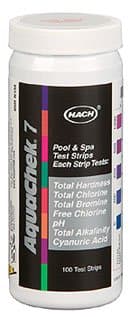
The default first test kit
AquaChek Silver 7-Way Test Strips (100 count)
AquaChek
Seven readings in fifteen seconds, including the two that beginners never measure and then fight all summer: total alkalinity and cyanuric acid.
#ad how this is funded · price as of October 8, 2026
Key specs
- Tests
- Free chlorine, total chlorine, bromine, pH, total alkalinity, total hardness, cyanuric acid
- Free chlorine range
- 0-20 ppm
- pH range
- 6.2-8.4
- Total alkalinity range
- 0-240 ppm
- Cyanuric acid range
- 0-300 ppm
- Read time
- 15 seconds
- Count
- 100 strips
How it scoresour reading of published specs, not a test result
- Accuracy
- 7.0
- Ease
- 9.5
- Coverage
- 9.5
- Cost per use
- 9.0
- Value
- 9.2
Overall 8.9 / 10
What works
- Covers cyanuric acid, which most cheap strips omit and which is the reason chlorine stops working in a stabilized pool
- pH range spans 6.2-8.4, comfortably bracketing the CDC's recommended 7.0-7.8
- 15 seconds and a color chart printed on the bottle — no separate booklet to lose
- 100 strips is a full season of twice-weekly testing with room to spare
What doesn't
- Strips are a comparison against a printed color chart, so they are directional rather than precise
- Reading them in bright sun is harder than it should be
- The bottle must be kept sealed and dry or the strips degrade quietly
Skip it if: Fine adjustment. If you are chasing a stubborn problem and need a number rather than a color band, a liquid reagent kit is the tool.
What it costs to run: 100 strips at twice-weekly testing covers roughly two seasons for one pool. The real saving is upstream: knowing your alkalinity stops you buying pH adjuster you did not need.
One honest season: The cheapest setup that genuinely works for a season of real swimming. Nothing spare, nothing missing.
Specs from: CDC — home pool and hot tub water treatment and testing
Fixing the number beginners skip
Alkalinity Increaser (sodium bicarbonate)
Various
The most under-bought chemical in the category. If your pH will not stay put, this is almost always the actual fix, and it is chemically just baking soda.
Key specs
- Active
- Sodium bicarbonate
- Raises
- Total alkalinity, with minimal pH movement
- Common target range
- 80-120 ppm (industry convention, not a CDC figure)
How it scoresour reading of published specs, not a test result
- Effectiveness
- 9.0
- Ease
- 8.0
- Water impact
- 9.0
- Cost per season
- 9.8
- Value
- 9.5
Overall 9.0 / 10
What works
- Raises alkalinity with only a small effect on pH, which is exactly what you want
- Extremely cheap — it is sodium bicarbonate
- Fixing alkalinity first stops the endless pH chase that eats a first season
What doesn't
- Works slowly and needs circulation, so it is not a same-afternoon fix
- Easy to overshoot, and bringing alkalinity back down is more work than raising it
- The 80-120 ppm target is an industry convention rather than a published federal standard, so treat it as guidance
Skip it if: Emergencies. Nothing about alkalinity is urgent; it is the thing you fix first and then stop thinking about.
What it costs to run: Pennies per dose, and it is the cheapest lever on your whole chemical bill: stable alkalinity means stable pH, and stable pH means the chlorine you already bought actually works.
One honest season: The cheapest setup that genuinely works for a season of real swimming. Nothing spare, nothing missing.
Questions people actually ask
How much does it cost to fill an above-ground pool?
Is it cheaper to fill a pool with a water truck?
How much water does a pool lose to evaporation?
Do I need to re-balance the water after topping up?
Sources
Read next
- What a pool actually costs, with the arithmetic shownPurchase, electricity, chemicals, water and replacement parts - added up, sourced, and shown as arithmetic you can redo.
- What an above-ground pool actually costs to run for a yearElectricity, chemicals, water and consumables for a full season - every input sourced, every calculation shown, and every assumption named.
- What an above-ground pool costs to buyThe purchase side: what is in the kit, what is not, and the day-one spend that turns a cheap pool into a not-cheap one.
- The best solar covers, and why this is the one thing to buyBubble covers compared on thickness and sizing, plus the arithmetic that makes this the highest-return purchase in the hub.
- What size pool your backyard can actually takeThe three-foot rule, the level-ground tolerance, and a table matching yard size to pool size with the running cost attached.
- Cyanuric acid: the reading that explains your chlorineWhy an outdoor pool needs stabilizer, why tablets add it whether you want them to or not, and the only way to bring it back down.
- Trucking water in, priced against the hosePublished per-load rates from real water haulers, converted to cost per gallon and compared with hose filling, plus the surcharges nobody mentions until the invoice.