Pool Care & Chemistry
Borates: the buffer most pools never add
Borates hold pH still and make algae harder work. They are also the one additive where the cheapest route involves a product whose maker never mentions swimming pools.
Heads up: we earn a commission if you buy through the links on this page, at no extra cost to you. It never decides the ranking — here is how we pick and here is the full disclosure. Prices are checked automatically; last verified October 8, 2026.
The short version
- Borates buffer against rising pH. That is the main benefit, and it is most useful in a pool whose pH climbs constantly.
- 30 to 50 ppm is the published effective range, with 50 ppm described as the maximum.
- Borates are algaestatic, not an algaecide. They make algae harder work; they do not clear a green pool.
- The cheap route is off-label. The laundry borax people use is not marketed for pools by its manufacturer, and we do not link it as a pool product.
What borates actually do
Two things, according to published pool chemistry. Orenda describes the pH mechanism as boric acid buffering against increasing pH by taking or giving away a hydroxide ion, and the algae mechanism as borates disrupting cell wall development, metabolism and cell division.
The pH effect is the one that matters most in practice. A pool with high alkalinity or an aerated water feature has pH that climbs no matter what you do, and our high alkalinity guide covers why chasing it with acid is a treadmill. Borates do not replace correct alkalinity; they resist the drift on top of it.
The algae effect is real but modest, and the word to hold on to is algaestatic rather than algaecidal. Borates make it harder for algae to establish. They will not clear an existing bloom, which is a job for the process in our algae guide.
AquaChek, which makes the test strips, summarizes the whole case as borate working as a buffer to help control pH, aid in algae prevention and contribute to water clarity and a softer feel of the water.
The range, and the ceiling
Orenda publishes that borates are most effective between 30 and 50 ppm, and that 50 ppm is the maximum level in a pool. AquaChek’s strips read 0 to 80 ppm, which covers the working range with headroom to tell you when you have gone too far.
There is no way to know where you are without testing, because borate does not appear on any standard multi-way strip. That is the single most important practical point on this page: if you are going to run borates, you need the dedicated strips, or you are dosing an invisible parameter by arithmetic alone and hoping.
The product question, answered honestly
There are three chemical routes published by Orenda: borax, which is sodium tetraborate decahydrate; sodium tetraborate pentahydrate; and boric acid. The tetraborate forms raise pH as they dissolve and therefore need acid added alongside them to bring pH back; boric acid does not.
The widely repeated home method uses laundry borax with muriatic acid to correct the pH rise. Here is the caveat that most pool articles omit: 20 Mule Team publishes its product as sodium tetraborate and lists its uses as cleaning, laundry, odor control and crafting. Swimming pools appear nowhere on its site. It is not sold, labeled or approved as a pool chemical, and we are not going to link a laundry product as one.
Orenda’s own framing on this is worth repeating: products used in recreational water should be EPA registered, NSF-50 or NSF-60 certified. That is the standard a purpose-made pool borate product meets and a box of laundry booster does not. If you use the borax route — and many experienced pool owners do — you are making an informed off-label choice, not following a manufacturer instruction, and the acid handling that goes with it is the genuinely hazardous part.
Who should bother, and who should not
Worth considering if your pH climbs relentlessly despite correct alkalinity, if you run a salt system — salt cells drive pH up as a matter of course — or if you have an aerated feature. Our pH and alkalinity guide covers the diagnosis that tells you whether this is your pool.
Not worth it for the average seasonal frame pool. A 3,000 gallon pool that is emptied at the end of summer gets most of the benefit from simply testing weekly, and the money is better spent on a cover. Borates are an addition to a well-run pool, not a substitute for running it well.
Skip entirely if you are not going to test. An untested borate level is an unknown you have introduced deliberately, and the ceiling exists for a reason.
If you do add them
Fix alkalinity first
Borates buffer on top of carbonate alkalinity; they do not replace it. A pool with alkalinity out of range should be corrected before anything is added.Work out the dose from your real volume
Dosing is per gallon, so the number has to be right. Our sizing guide covers working out an honest volume rather than the number on the box.Add gradually, and test as you go
Aim for the lower end of 30 to 50 ppm first. There is no practical way to remove borates except dilution, so undershooting is the recoverable error.Correct pH afterwards if you used a tetraborate
Borax raises pH as it dissolves. Acid handling is the dangerous step here - eye protection, never into a confined space, never mixed with anything else.Retest monthly
Borate is not on general test strips, so it needs its own. Levels fall as water is splashed out and replaced.
Used this way, borates are a quiet improvement to a pool that already runs well: steadier pH, slightly less chlorine demand from nuisance algae, and water that feels softer. They are not a chlorine alternative, which is a separate and much-oversold category covered in our chlorine alternatives comparison.
What borates will not do
Three claims circulate about borates that are worth separating from the two published mechanisms.
They are not a sanitizer. A borate pool still needs chlorine at the levels health authorities publish — CDC guidance for home pools is at least 1 ppm free chlorine, or at least 2 ppm where a stabilizer is in use, with pH between 7.0 and 7.8.
They are not an algaecide. Algaestatic means algae find it harder to establish, not that an existing bloom clears. Our algaecide roundup covers the products that do that job, and the honest framing there is the same: insurance rather than rescue.
They do not replace alkalinity. Carbonate alkalinity is still the primary buffer, and a pool with alkalinity out of range does not become stable because borates were added on top. Our alkalinity guide is the prerequisite.
There is also a regulatory wrinkle worth knowing if you are comparing branded products. One well-known pool borate product was previously sold as an EPA-registered algistat, and its current version is not an EPA-registered product. That does not make it ineffective as a buffer, but it does mean claims about algae on the box and claims on a registration are two different things.
What to buy
Scores are our own reading of published specifications. They are not test results — we have not tested these products and we do not claim to.
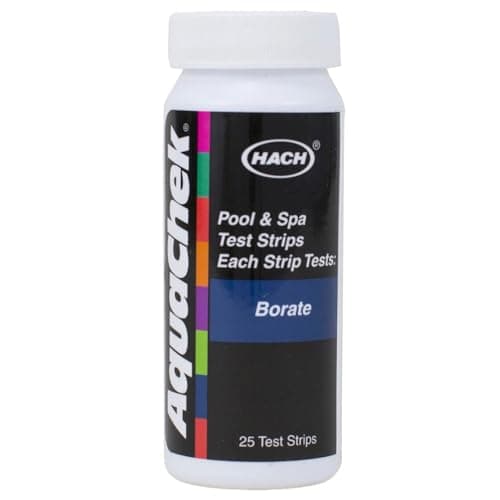
The only way to know your borate level
AquaChek Borate Test Strips
AquaChek
A single-parameter strip reading 0 to 80 ppm. If you are going to run borates at all, this is the instrument that makes it a measurement rather than a guess.
#ad how this is funded · price as of October 8, 2026
Key specs
- Measures
- Borate only
- Range
- 0 to 80 ppm
- Strips
- 25 per bottle, per retailer listings
- Read time
- Hold level for 15 seconds, per retailer instructions; not published by AquaChek
- Other parameters
- None — borate is the only pad
- Part number
- 562012
How it scoresour reading of published specs, not a test result
- Accuracy
- 8.0
- Ease
- 9.0
- Coverage
- 5.5
- Cost per use
- 8.5
- Value
- 8.0
Overall 7.8 / 10
What works
- Covers the useful range in full: industry guidance puts borates at 30 to 50 ppm with a 50 ppm ceiling
- Single-parameter strips are simpler to read accurately than a seven-way pad
- Cheap relative to the chemistry it is checking
- Borate is not on any general test strip, so without this you are dosing blind
What doesn't
- Tests nothing else, so it is a second bottle alongside your normal strips
- AquaChek does not publish the strip count or the read time on its own product page
- Strips degrade with humidity like every test strip; cap them immediately
- Only worth owning if you are actually running borates
Skip it if: Routine testing. This is a supplementary strip for one parameter; your weekly chlorine, pH and alkalinity checks still need a proper kit or a multi-way strip.
What it costs to run: Twenty-five tests is a season or more of monthly checks. Against the cost of overdosing a 10,000 gallon pool past the 50 ppm ceiling, it is trivial.
One honest season: The cheapest setup that genuinely works for a season of real swimming. Nothing spare, nothing missing.
Specs from: AquaChek — borate test strips, published range and purpose, Leslie's — AquaChek borate test strips listing, published strip count and part number
Questions people actually ask
What level of borates should a pool have?
Do borates replace chlorine?
Is laundry borax the same as pool borate?
Are borates safe for dogs?
How do I test borate levels?
Sources
Read next
- Pool care, from someone who assumes you have never done thisThe weekly routine, the four numbers that matter, and the fix for the week the water turns.
- pH and alkalinity, and why yours will not stay putWhy pH drifts, what total alkalinity actually does, and the order of operations that turns a season of chasing into one adjustment.
- High alkalinity, cloudy water, and the pH you cannot hold downWhy high total alkalinity clouds water and drives pH up, the published dosing to bring it down, and the cyanuric acid correction that shows whether yours is genuinely high.
- Pool algae: brush, shock, filter, then rebalanceThe correct order for clearing green water, how to tell algae from pollen, and why algaecide prevents rather than cures.
- Algaecide is insurance, not a rescueThe three algaecide chemistries compared for a vinyl above-ground pool, and the sequence that actually clears a bloom.
- The best pool test stripsTest strips compared on parameter coverage - specifically whether they read cyanuric acid, which most cheap strips omit.
- Chlorine alternatives, and the ones that are chlorine wearing a hatSalt, mineral systems, UV, ozone and biguanide assessed for a seasonal above-ground pool, with what each actually replaces.