Seasonal Care
The pool year on one page
Nearly everything that goes wrong with a seasonal pool goes wrong because something was done at the wrong time of year, not because it was done badly.

Heads up: we earn a commission if you buy through the links on this page, at no extra cost to you. It never decides the ranking — here is how we pick and here is the full disclosure. Prices are checked automatically; last verified October 8, 2026.
The short version
- Two dates decide the year: when you open, and when you close. Everything else is routine.
- Close on water temperature, not on the calendar. Closing warm is the most expensive mistake in this hub.
- Take the pool down early enough to recover the lawn if it comes down at all — grass needs growing season.
- The midsummer reset is the one job nobody schedules, and it buys back the second half of the season.
How to use this
Month names are a convenience — your season depends on your climate, and the triggers that actually matter are water temperature and use rather than dates. Read the shape rather than the labels, and treat the weekly routine in our weekly schedule as the constant underneath all of it.
| When | Jobs | Decision due |
|---|---|---|
| Late winter | Order what you are missing; check the cover and hoses | Are you opening early or on time? |
| Early spring | Buy the opening list before you lift the cover | Treat or drain, if it is green |
| Spring | Open: clear the cover, top up, run, test, balance, shock, filter | Fresh cartridge and a new strip bottle |
| Late spring | Routine settles in; solar cover on overnight | Is the pump run time right for your turnover? |
| Early summer | Twice-weekly testing; weekly brush and vacuum | Nothing — this is the easy stretch |
| Midsummer | The reset: test everything, brush, new cartridge, drain a third if needed | Has cyanuric acid climbed? |
| Late summer | Heatwave routine: test daily, check the level daily | Shock before busy weekends, not after |
| Early autumn | Leaf season: skim twice daily, empty the basket every time | Take-down date, if it comes down |
| Autumn | Close: clean thoroughly, balance, dose, lower level, cover, pillow | Wait for consistently cold water |
| Late autumn | Recover the lawn; store or secure everything | Sell it in spring rather than now, if selling |
Spring: the month that decides how long opening takes
Opening is a chain of dependent steps, so a missing item does not slow it down proportionally — it stops it until you have been to a shop. Six things want to be in the shed before you lift the cover: seven-way test strips, a net on a telescopic pole, alkalinity increaser, a shock product, a fresh filter cartridge, and tablets with a floating dispenser. Our spring shopping list is the detail.
Then the sequence itself: clear the cover before you move it, top up, get the pump running, test, correct total alkalinity then pH, shock at dusk, and filter until clear. Our opening guide is the procedure and the green opening guide covers the morning where it has gone wrong — including the drain-versus-treat decision, which is genuinely close on a pool this size.
Midsummer: the job nobody puts in the calendar
By about week eight, four things have drifted quietly: cyanuric acid has climbed if you have been dosing with tablets, the cartridge is past the point where rinsing helps, a biofilm has established on the walls, and the routine has slipped from twice-weekly to whenever.
None of them announces itself, and together they turn an easy pool into a demanding one. An afternoon in July — test everything, brush thoroughly, new cartridge, drain a third if stabilizer has climbed, re-balance in order, shock at dusk — buys back the rest of the season. Our midsummer reset guide is the sequence, and it is the highest-value scheduled job of the year.
Late summer: the weather does the work
A heatwave attacks a small pool from three directions at once — faster chlorine loss, faster evaporation and faster algae growth — in the week of heaviest use. Test daily rather than twice weekly, check the water level daily because evaporation quietly takes the skimmer out of its operating window, and shock at dusk after busy days. Our heatwave guide covers it.
Storms are the other late-summer event, and the headline is counter-intuitive: do not drain the pool. The water is the ballast holding the structure down. Secure everything loose, remove the solar cover and the ladder, kill the power to the pump, and leave the level alone — our storm preparation guide is the checklist, and after heavy rain is the recovery.
Autumn: two dates, and they are not the same date
This is where most of the year’s money is won or lost, and it hinges on separating two decisions that people merge.
When to stop swimming is a comfort decision, and a solar cover pushes it later. When to close is a water-temperature decision, and it is not the same day. Closing while the water is still biologically active leaves a pool fermenting under a cover for five months, which is how people find a swamp in April — our cost of a bad close prices exactly that morning.
If the pool comes down rather than staying up, a third date appears: vinyl folded in cold weather cracks along the folds, so there is a window where the water is cold enough to close and the air is still mild enough to fold the liner. That window closes earlier than people expect. Our take-down guide covers it, and the lawn guide adds the fourth consideration: grass needs growing season to recover, and October has none.
| Date | Triggered by | Consequence of getting it wrong |
|---|---|---|
| Stop swimming | Comfort | None — a cover pushes it later |
| Take the pool down | Mild air for folding vinyl | Cracked folds next summer |
| Close a pool that stays up | Consistently cold water | Green water in April |
| Reseed the lawn | Remaining growing season | A bare circle until spring |
Winter: two things worth doing
For a pool that stays up, check the cover after storms and clear standing water off it — a puddle on a cover is weight the cover was not designed to carry, and it is a still-water habitat sitting above your pool.
For everyone, late winter is when to check what you are missing and order it before the seasonal rush. Hoses harden with ultraviolet exposure and crack at the fittings, covers develop splits, and the cartridge multipack you meant to buy is cheaper in February than in May. Our winter cover care guide covers looking after the cover, and the budget worksheet is a reasonable thing to fill in while there is nothing else to do.
What to buy
Scores are our own reading of published specifications. They are not test results — we have not tested these products and we do not claim to.
The default first test kit
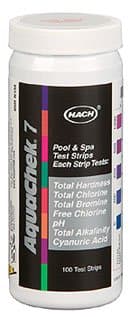
AquaChek Silver 7-Way Test Strips (100 count)
AquaChek
Seven readings in fifteen seconds, including the two that beginners never measure and then fight all summer: total alkalinity and cyanuric acid.
#ad how this is funded · price as of October 8, 2026
Key specs
- Tests
- Free chlorine, total chlorine, bromine, pH, total alkalinity, total hardness, cyanuric acid
- Free chlorine range
- 0-20 ppm
- pH range
- 6.2-8.4
- Total alkalinity range
- 0-240 ppm
- Cyanuric acid range
- 0-300 ppm
- Read time
- 15 seconds
- Count
- 100 strips
How it scoresour reading of published specs, not a test result
- Accuracy
- 7.0
- Ease
- 9.5
- Coverage
- 9.5
- Cost per use
- 9.0
- Value
- 9.2
Overall 8.9 / 10
What works
- Covers cyanuric acid, which most cheap strips omit and which is the reason chlorine stops working in a stabilized pool
- pH range spans 6.2-8.4, comfortably bracketing the CDC's recommended 7.0-7.8
- 15 seconds and a color chart printed on the bottle — no separate booklet to lose
- 100 strips is a full season of twice-weekly testing with room to spare
What doesn't
- Strips are a comparison against a printed color chart, so they are directional rather than precise
- Reading them in bright sun is harder than it should be
- The bottle must be kept sealed and dry or the strips degrade quietly
Skip it if: Fine adjustment. If you are chasing a stubborn problem and need a number rather than a color band, a liquid reagent kit is the tool.
What it costs to run: 100 strips at twice-weekly testing covers roughly two seasons for one pool. The real saving is upstream: knowing your alkalinity stops you buying pH adjuster you did not need.
One honest season: The cheapest setup that genuinely works for a season of real swimming. Nothing spare, nothing missing.
Specs from: CDC — home pool and hot tub water treatment and testing
The default chlorine source
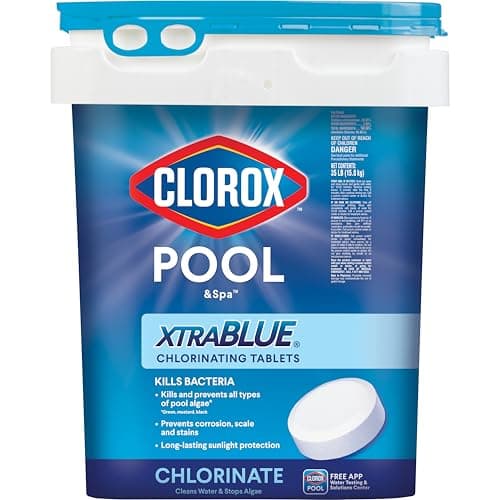
Clorox Pool&Spa 3-Inch Chlorinating Tablets
Clorox Pool&Spa
Stabilized trichlor tablets in a floating dispenser is the standard answer for a seasonal above-ground pool, and this is the standard version of it.
#ad how this is funded · price as of October 8, 2026
Key specs
- Type
- Stabilized trichlor, 3-inch tablets
- Contains stabilizer
- Yes — cyanuric acid is part of trichlor
- Dosing
- Per manufacturer instructions, by pool volume
- CDC target
- At least 2 ppm free chlorine when using a stabilizer
How it scoresour reading of published specs, not a test result
- Effectiveness
- 9.0
- Ease
- 9.0
- Water impact
- 6.0
- Cost per season
- 8.5
- Value
- 8.5
Overall 8.5 / 10
What works
- Dissolves slowly, so a floating dispenser meters chlorine out over days rather than hours
- Stabilized, so sunlight does not destroy your chlorine within an afternoon
- Widely stocked, so you are never hunting for it in July
What doesn't
- Every tablet adds cyanuric acid, and in a pool you never fully drain that accumulates until chlorine stops responding
- Trichlor is acidic and will pull your pH down over a season
- Tablets must be kept dry and sealed or they degrade and gas off
Skip it if: A small pool that is topped up rather than drained. Cyanuric acid only leaves with the water, so in a 1,500-gallon pool it climbs fast.
What it costs to run: The standing chemical cost of the season, and it scales directly with gallons. Watch the cyanuric acid reading on your test strip: once it is high, you are buying chlorine that cannot work, which is the most common invisible waste in a first pool year.
One honest season: The cheapest setup that genuinely works for a season of real swimming. Nothing spare, nothing missing.
Specs from: CDC — free chlorine target with cyanuric acid
The consumable you will actually buy repeatedly
Type A Replacement Filter Cartridges (multipack)
Various
Buy them in a multipack before you need them. A pool running on an exhausted cartridge is a cloudy pool, and the fix is a two-dollar part you did not have.
Key specs
- Type
- Type A — the most common Intex format
- Replacement interval
- Every 2 weeks in heavy use, per Intex guidance
- Between changes
- Rinse, do not scrub
How it scoresour reading of published specs, not a test result
- Sizing fit
- 9.0
- Running cost
- 7.0
- Maintenance
- 8.5
- Build
- 7.0
- Value
- 8.5
Overall 8.2 / 10
What works
- Type A is the most widely stocked cartridge format in the US
- Multipacks cost a fraction of buying singles
- Having a spare turns a cloudy week into a five-minute fix
What doesn't
- It is a genuine recurring cost that nobody includes in the purchase price
- Aftermarket quality varies noticeably
- Rinsing extends life but does not restore a cartridge that is done
Skip it if: Being restored. Once the pleats are permanently gray and stiff, rinsing is not saving it.
What it costs to run: The line item most people leave out of their pool budget. Count how many you use in your first season and you have your real annual filtration cost — this is exactly the number the cost-to-run guide asks you to record.
One honest season: The cheapest setup that genuinely works for a season of real swimming. Nothing spare, nothing missing.
The single highest-return accessory here
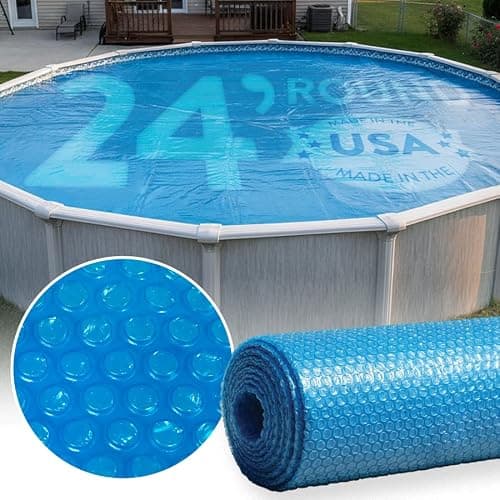
Bubble Solar Cover for Above-Ground Pools
Various
It cuts evaporation, and evaporation is simultaneously your water bill, your chemical bill and your heat loss. Nothing else on this site reduces three costs at once.
#ad how this is funded · price as of October 8, 2026
Key specs
- Construction
- Bubble sheet, thickness published in mil
- Thickness
- Higher mil lasts longer — 12 mil and 16 mil are common
- Fit
- Cut to size; buy oversize and trim
- Orientation
- Bubbles face down, toward the water
How it scoresour reading of published specs, not a test result
- Retention
- 9.0
- Durability
- 7.0
- Handling
- 6.0
- Running cost
- 9.8
- Value
- 9.5
Overall 9.0 / 10
What works
- Reduces evaporation, which is the mechanism behind the water, chemical and heat savings all at once
- Cheap relative to everything it saves
- Can be cut to fit any pool shape, so sizing is forgiving
What doesn't
- Awkward to get on and off without a reel, and awkward is how covers end up unused
- Degrades in UV like every vinyl product
- Not a safety cover and will not support weight — this is important
Skip it if: Being a safety barrier. A solar cover looks solid and is not; a child or pet on it goes through and under.
What it costs to run: The one accessory with a clear payback. Every gallon that does not evaporate is a gallon you do not replace at the EPA WaterSense national average of $6.06 per 1,000 gallons, and it is chlorine you do not re-dose. If you buy one thing from this hub, buy this.
Several seasons: Buy-once. Built and warranted to come back out of the box for a few years, if you store it properly.
Specs from: EPA WaterSense — cost per 1,000 gallons
A first close, when you do not know what you need
Pool Winterizing / Closing Chemical Kit
Various
A box with the closing chemicals pre-matched to a pool size. Worth the small premium the first year purely because the failure mode of buying separately is missing one thing on the day.
Key specs
- Typically contains
- Winter algaecide, shock or oxidizer, and a stain/scale preventer
- Sized by
- Pool volume in gallons — buy to your actual number
- Timing
- Applied at closing, with the pump running, before covering
How it scoresour reading of published specs, not a test result
- Retention
- 8.0
- Durability
- 8.0
- Handling
- 9.0
- Running cost
- 7.5
- Value
- 8.0
Overall 8.0 / 10
What works
- Pre-matched to a volume, so the dosing decision is made for you
- Nothing missing on closing day, which is the actual value
- Polyquat-based kits avoid the liner-staining risk of copper algaecides
What doesn't
- Costs more than the same chemicals bought individually
- Kits are sized in broad volume bands, so you may be over-treating
- Some kits include products a small seasonal pool genuinely does not need
Skip it if: Year two onward. Once you know what your water actually does over a winter, buying the two things you need is cheaper.
What it costs to run: Pay the premium in year one and buy separately afterward. The kit's real value is that it prevents the expensive mistake of closing a pool with something missing.
One honest season: The cheapest setup that genuinely works for a season of real swimming. Nothing spare, nothing missing.
Questions people actually ask
When should I open my pool?
When should I close my pool for winter?
What is the one pool job people forget?
When should I take the pool down if it does not stay up?
Sources
Read next
- Closing, covering and opening againWinterizing, covers and spring opening - the four weeks of the year that decide whether you own a pool next summer.
- Opening an above-ground pool in springThe spring sequence in order, why cloudy water at opening is normal, and the two timing errors that cause green openings.
- What to buy before you open, not halfway throughThe six-item spring shopping list, in the order the opening sequence needs them, plus what to leave until you have a reading.
- The midsummer reset, and the drift it fixesThe four things that drift by midsummer, and the one-afternoon reset that gets the second half of the season back to week-one effort.
- Leaf season, and the three weeks that decide next AprilHow to keep a pool usable through autumn leaf fall, and why what you let sink now decides how your spring opening goes.
- How to winterize an above-ground poolThe correct closing sequence, the freeze damage that ends pools, and why a cracked pump housing is entirely preventable.
- The weekly pool routine, and how little time it really takesThe daily, weekly and monthly jobs written as a schedule, with the kit each one needs and roughly how long it takes.
- Every line of a pool budget, and exactly where each number comes fromA fill-in-the-blanks pool budget with the formula and the source for every line, for year one and year two.