Pool Costs
The bill a bad close sends you in April
Closing costs an afternoon. Closing badly costs a full drain, a fortnight of chemicals, a stack of cartridges and, in the worst case, a liner.
Heads up: we earn a commission if you buy through the links on this page, at no extra cost to you. It never decides the ranking — here is how we pick and here is the full disclosure. Prices are checked automatically; last verified October 8, 2026.
The short version
- The expensive part of a pool year happens in October, and the bill arrives in April.
- A full drain and refill on a 3,955-gallon pool is about $24 of water plus re-dosing the whole thing from tap water.
- An air pillow costs almost nothing and prevents the only failure that ends the pool — ice pushing directly against the wall.
- Closing warm is the single most common mistake. A pool closed while the water is still biologically active spends five months turning into a swamp under the cover.
The four bills, in rising order of pain
A bad close does not produce one failure, it produces a cascade, and each stage is more expensive than the last. Knowing where you are on this ladder in April tells you what the autumn actually cost you.
| What went wrong | What you find in April | The bill |
|---|---|---|
| Closed while the water was warm | Green water under the cover | Heavy shock, days of filtering, several cartridges |
| Debris left in the pool | Stained liner and a floor of sludge | Vacuum to waste, more shock, top-up water |
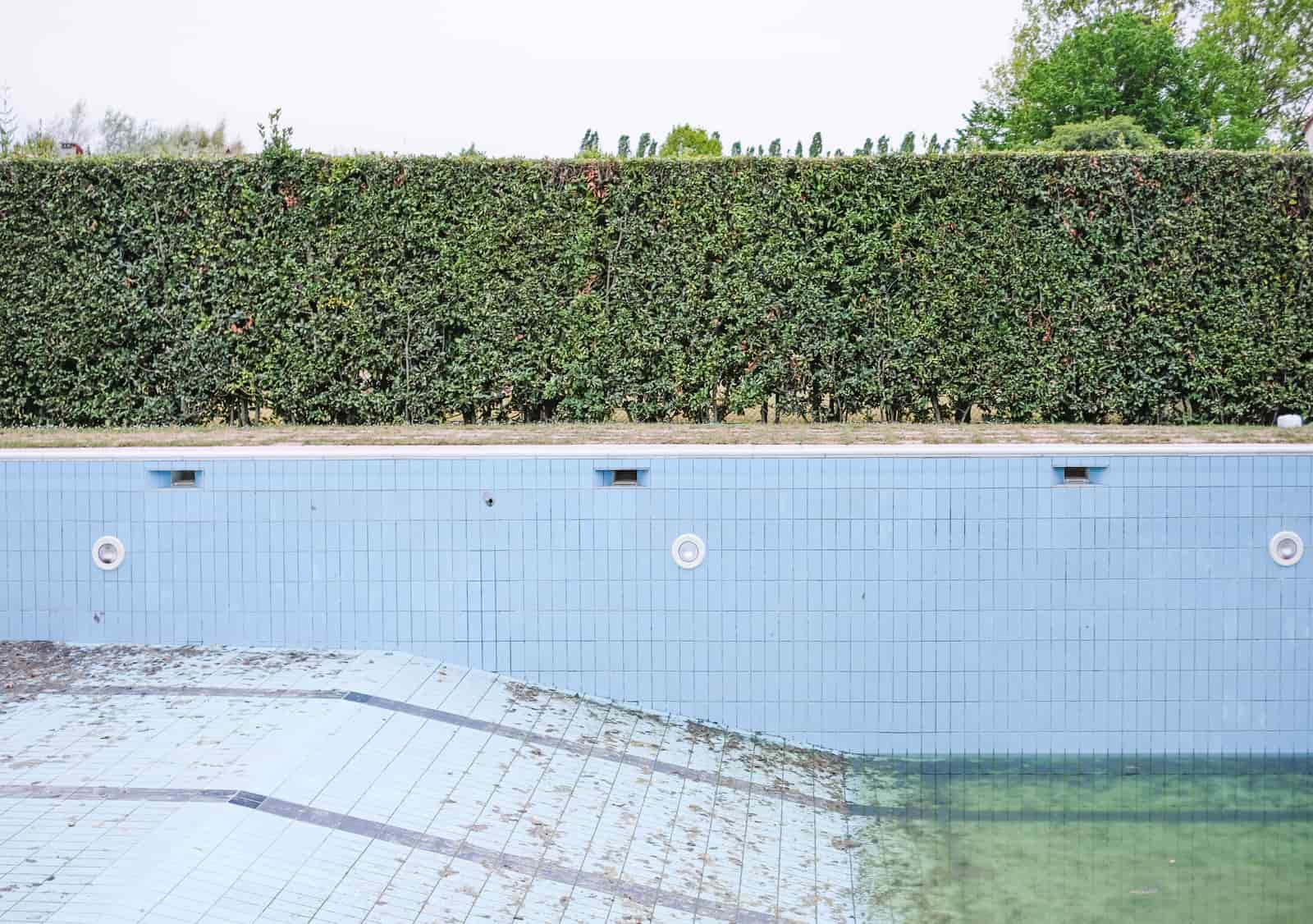
| Water too dirty to save | Full drain and refill | ≈ $24 of water, plus dosing from scratch |
| No air pillow, ice against the wall | Bulged or split wall, torn liner | A new liner, or a new pool |
Bill one: the water was still alive
This is the most common mistake and it is a timing error rather than a technique error. Closing a pool while the water is still warm leaves it biologically active under a cover, in the dark, with no circulation and a chlorine level that falls to zero within weeks. Five months of that is how people lift a cover in April and find a swamp.
The fix costs nothing: wait for consistently cold water rather than a cold week. Our winterizing guide puts this first for exactly this reason, and the recovery, if you are already here, is the algae sequence — brush, shock heavily at dusk, filter continuously, then dose a preventive algaecide, as our algae guide sets out.
Bill two: what you left in it
Organic material left in a pool over winter does not sit still. It decomposes, consumes whatever chlorine is left, stains the liner where it settles, and produces a layer of sludge that a filter cannot handle. That is a vacuum-to-waste job in April, which means losing water as well as time, and it is frequently what turns a recoverable pool into a drainable one.
Prevention is a skim, a brush and a vacuum on closing day — the same half hour you would spend on a normal week. Our liner stains guide covers what the leftover material does to the vinyl, and it is the cheapest hour in this whole article.
Bill three: the full drain
At some point the water is not worth saving, and this is where a real number attaches. Draining and refilling means paying for the water twice in one year and re-dosing the pool from tap water — alkalinity, then pH, then chlorine, then stabilizer.
What a spring drain-and-refill costs
- Pool volume
- 3,955 gallons
- US average water price [EPA WaterSense]
- $6.06 / 1,000 gal
- Chemistry
- Full re-dose from tap water
3.955 kgal × $6.06 = $23.96, plus a full re-dose
About $24 of water, and a season starting from zero
It is worth saying plainly that on a seasonal above-ground pool this is not a catastrophe. It is an annoying afternoon and about twenty-five dollars. On an inground pool the same decision is a very different conversation, which is why so much closing advice reads as more dramatic than it needs to be for our readers.
Bill four: the one that ends the pool
Everything above is recoverable. This one is not. Water expands when it freezes, and a pool left up over winter with no air pillow gives that expansion nowhere to go except outward, against the wall. The result is a bulged or split wall and a torn liner, and at that point you are pricing a replacement liner or a replacement pool.
An air pillow costs almost nothing. It sits centered under the winter cover and absorbs the expansion, moving the load away from the wall. Inflate it to roughly 60 percent — a fully inflated pillow bursts, at which point it is not doing anything.
The pools that come down instead
If your pool is a soft-side or a small frame pool that gets dismantled each autumn, none of the ice risk applies — but a different bill does. A liner packed away damp grows mildew that will not come out, and vinyl folded in cold weather cracks along the folds. Both produce the same April discovery and the same replacement-liner conversation.
Our take-down and storage guide is the routine for those, and it is the same principle as everything on this page: an hour of care in October, or a bill in April.
What a good close actually costs
An afternoon, a closing chemical dose sized to your gallons, and the cover and pillow you already own from last year. Against that, the cheapest bad outcome on this page is a stack of cartridges and a fortnight of your spring, and the dearest is a new liner. Our opening guide is what a good close makes possible: lift the cover, top up, balance, swim.
What to buy
Scores are our own reading of published specifications. They are not test results — we have not tested these products and we do not claim to.
A first close, when you do not know what you need
Pool Winterizing / Closing Chemical Kit
Various
A box with the closing chemicals pre-matched to a pool size. Worth the small premium the first year purely because the failure mode of buying separately is missing one thing on the day.
Key specs
- Typically contains
- Winter algaecide, shock or oxidizer, and a stain/scale preventer
- Sized by
- Pool volume in gallons — buy to your actual number
- Timing
- Applied at closing, with the pump running, before covering
How it scoresour reading of published specs, not a test result
- Retention
- 8.0
- Durability
- 8.0
- Handling
- 9.0
- Running cost
- 7.5
- Value
- 8.0
Overall 8.0 / 10
What works
- Pre-matched to a volume, so the dosing decision is made for you
- Nothing missing on closing day, which is the actual value
- Polyquat-based kits avoid the liner-staining risk of copper algaecides
What doesn't
- Costs more than the same chemicals bought individually
- Kits are sized in broad volume bands, so you may be over-treating
- Some kits include products a small seasonal pool genuinely does not need
Skip it if: Year two onward. Once you know what your water actually does over a winter, buying the two things you need is cheaper.
What it costs to run: Pay the premium in year one and buy separately afterward. The kit's real value is that it prevents the expensive mistake of closing a pool with something missing.
One honest season: The cheapest setup that genuinely works for a season of real swimming. Nothing spare, nothing missing.
Five months of weather, not one night
Winter Cover for Above-Ground Pools
Various
A structural product, not a summer one. Its job is carrying snow and blocking light for a whole winter, and a solar cover pressed into that role will be in shreds by February.
Key specs
- Construction
- Woven polyethylene, weight published in mil or scrim count
- Securing
- Cable and winch, or wraparound straps
- Overlap
- Needs genuine overlap past the wall — check the stated size against your pool
- Not the same as
- A solar cover or a safety cover
How it scoresour reading of published specs, not a test result
- Retention
- 8.5
- Durability
- 8.0
- Handling
- 6.5
- Running cost
- 9.0
- Value
- 8.5
Overall 8.3 / 10
What works
- Blocks light for the whole winter, which is what stops algae in a closed pool
- Cable-and-winch securing survives wind that lifts a strapped cover
- Buying the heavier scrim genuinely doubles the number of winters you get
What doesn't
- Needs a way to shed or pump off standing water, or the weight tears it
- Bulky to store in summer
- Not a safety cover — it will not support a person and must not be treated as if it will
Skip it if: A pool you take down each autumn. If the pool comes apart, the cover is money spent on nothing.
What it costs to run: This is insurance rather than a saving. A torn cover in January means an opening in April that costs a full shock treatment and a week of filtration to fix, which is more than the better cover cost.
Several seasons: Buy-once. Built and warranted to come back out of the box for a few years, if you store it properly.
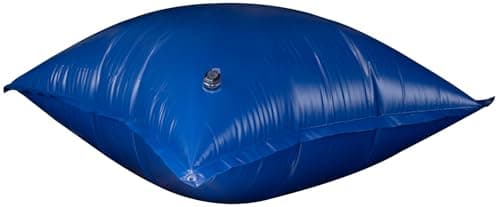
Stopping ice from pushing on the wall
Winter Air Pillow for Above-Ground Pools
Various
A few dollars of inflatable that gives expanding ice something compressible to push against instead of your pool wall. In a freezing climate this is not optional.
#ad how this is funded · price as of October 8, 2026
Key specs
- Function
- Absorbs ice expansion; centers the load away from the wall
- Inflation
- Inflate to roughly 60% — a fully inflated pillow bursts
- Placement
- Centered under the winter cover
How it scoresour reading of published specs, not a test result
- Retention
- 8.0
- Durability
- 6.5
- Handling
- 9.0
- Running cost
- 10.0
- Value
- 9.0
Overall 8.4 / 10
What works
- Extremely cheap relative to the wall or liner it protects
- Also stops rainwater and snowmelt pooling in the center of the cover
- Reusable for several winters if it survives one
What doesn't
- Cheap ones deflate mid-winter, which is when it matters
- Must be tethered or it drifts to the edge and does nothing
- Over-inflating is the most common mistake and it destroys the pillow
Skip it if: Climates that do not freeze. If your water never ices over, this is solving a problem you do not have.
What it costs to run: The cheapest insurance in this entire site against the most expensive winter failure. Inflate to about 60% and tether it.
One honest season: The cheapest setup that genuinely works for a season of real swimming. Nothing spare, nothing missing.
Actually clearing a green pool
Calcium Hypochlorite Pool Shock
Various (compare available chlorine %)
Unstabilized, fast-acting and strong. This is the tool for an algae bloom precisely because it does not add more cyanuric acid to a pool that probably already has too much.
Key specs
- Type
- Calcium hypochlorite, unstabilized
- Adds stabilizer
- No
- Adds
- Calcium hardness
- Dosing
- By pool volume, per the bag
How it scoresour reading of published specs, not a test result
- Effectiveness
- 9.5
- Ease
- 6.5
- Water impact
- 7.0
- Cost per season
- 9.0
- Value
- 8.8
Overall 8.6 / 10
What works
- No cyanuric acid added, so it does not worsen the problem it is usually solving
- Fast and strong enough to actually break an algae bloom in one treatment when dosed properly
- Cheap per pound of available chlorine
What doesn't
- Adds calcium hardness, which matters in hard-water areas
- Must be dissolved properly or it will bleach a vinyl liner where it settles
- Needs careful storage — it is a genuine oxidizer, not a household product
Skip it if: Routine daily chlorination. This is the emergency tool; tablets are the routine.
What it costs to run: The single most cost-effective way to fix a green pool, and the most commonly under-dosed. Half a dose twice does not equal a full dose once — it just wastes the bag.
One honest season: The cheapest setup that genuinely works for a season of real swimming. Nothing spare, nothing missing.
When the liner has failed, not before
Replacement Above-Ground Pool Liner
Various
The one repair that is genuinely worth doing rather than replacing the whole pool, provided the frame is sound. Measure twice: liner fit is unforgiving.
Key specs
- Types
- Overlap, beaded and unibead — they are not interchangeable
- Measure
- Diameter and wall height, exactly
- Gauge
- Published in mil — thicker lasts longer and is harder to fit
How it scoresour reading of published specs, not a test result
- Retention
- 8.0
- Durability
- 8.0
- Handling
- 5.5
- Running cost
- 9.0
- Value
- 8.0
Overall 7.9 / 10
What works
- Far cheaper than replacing a pool whose frame is still good
- A thicker gauge liner outlasts the original on most budget kits
- Beaded liners can be replaced without dismantling the top rail
What doesn't
- Overlap, beaded and unibead are different fitting systems and buying the wrong one is a total loss
- Fitting is a warm-day job — cold vinyl will not stretch into place
- A liner failure often reveals a frame or base problem that caused it
Skip it if: A pool whose frame is corroded. Replacing the liner in a failing frame just moves the failure a few months out.
What it costs to run: The largest single unplanned expense of above-ground pool ownership, and it is mostly preventable: a ground cloth, a level base and a winter close done properly are what decide whether you ever buy one.
Several seasons: Buy-once. Built and warranted to come back out of the box for a few years, if you store it properly.
Questions people actually ask
What happens if you close a pool badly?
How much does it cost to refill a pool in spring?
Do I really need an air pillow under the winter cover?
When should I close my pool?
Sources
Read next
- What a pool actually costs, with the arithmetic shownPurchase, electricity, chemicals, water and replacement parts - added up, sourced, and shown as arithmetic you can redo.
- What upkeep costs, separated from everything elseChemicals by published dosing, cartridge replacement intervals, and the honest weekly time commitment.
- Liner replacement: the big occasional cost, and how to avoid itOverlap, beaded and unibead are not interchangeable - plus the three habits that decide whether you ever need a replacement.
- What it costs to fill a pool, and to keep it fullOne fill priced for four common pool volumes at the national average water rate, plus why every gallon you add has to be re-balanced.
- How to winterize an above-ground poolThe correct closing sequence, the freeze damage that ends pools, and why a cracked pump housing is entirely preventable.
- Pool closing kits: buy one the first year, then stopWhat is in a closing kit, whether the bundle premium is justified, and how to buy separately once you know your water.
- Opening an above-ground pool in springThe spring sequence in order, why cloudy water at opening is normal, and the two timing errors that cause green openings.
- What closing an above-ground pool costsPublished closing-service prices compared against the DIY list, with the part of the bill that recurs separated from the part that amortizes.