Seasonal Care
Before the storm: secure it, do not empty it
The instinct is to lower the water. It is the wrong instinct - the water is the ballast holding the whole structure down.
Heads up: we earn a commission if you buy through the links on this page, at no extra cost to you. It never decides the ranking — here is how we pick and here is the full disclosure. Prices are checked automatically; last verified October 8, 2026.
The short version
- Do not drain the pool. The water is the ballast. An empty or part-empty pool is a large light structure in high wind.
- Everything loose becomes a projectile — floats, the ladder, the net, furniture, the solar cover.
- Disconnect the pump and bring it in if you can, and kill the power at the outlet either way.
- Take the solar cover off, do not tie it down. It is designed to float, not to be a sail.
The instinct to resist
The first idea people have when serious weather is forecast is to lower the water, on the reasoning that the pool will overflow. It is understandable and it is backwards.
Water is what holds an above-ground pool in place. A 15-foot pool holding 3,955 gallons is about 16 tons of ballast sitting on the frame, and it is the reason a light bolted structure stays where you put it in a gale. Remove a substantial part of that and you have a large, light, wind-catching object with a liner that is no longer under even load.
Rain overflowing the pool is a manageable nuisance — it dilutes and acidifies the water, which is a morning of chemistry rather than a disaster, as our after heavy rain guide covers. A pool that moves is not.
The checklist, in the order that matters
Clear everything loose out of and around the pool
Floats, toys, the net and pole, the vacuum head, chairs, tables, the thermometer. Anything that can be picked up by wind is a projectile, and anything left in the pool is going to be against a liner in a storm. Bring it inside, not just to the side of the house.Take the solar cover off and put it away
A bubble cover is designed to float freely; it is not designed to be secured and it makes an excellent sail. Remove it, fold it loosely and store it. Do not attempt to tie it down — you will lose the cover and possibly whatever you tied it to.Remove the ladder
It lifts out, it is light, and in wind it is a heavy object next to a vinyl liner. It also removes the way into the pool, which is a sensible state to leave things in when nobody is going to be watching. Our ladder guide covers why removability is a feature worth having anyway.Kill the power, then disconnect the pump
Switch off at the outlet first, then unplug. If the pump can be disconnected and brought inside, do that — it is the most damage-prone item in the system and the easiest to protect. Our electrical safety guide covers why nothing should be left energized beside a pool in weather.Shock the pool before it hits, if there is time
A storm dilutes your chlorine and delivers a large organic load at the same time. Going in with a healthy level rather than a mid-week trough means the pool is far better placed the next morning. Dusk, with the pump running, before you disconnect it.Leave the water level alone
Or, at most, lower it slightly if it is already near the top of the skimmer opening. Do not empty the pool, and do not drop it below the middle of the skimmer — that is both unnecessary and, for the pump you are about to reconnect, unhelpful.Photograph everything
Two minutes, from several angles, including the surrounding ground and any existing damage. If there is an insurance conversation afterwards, this is the evidence that makes it short.
| Item | Action | Why |
|---|---|---|
| Pool water | Leave it | It is the ballast holding the structure down |
| Solar cover | Remove and store | Designed to float, not to be tied; acts as a sail |
| Winter cover | Only if properly secured and it is closing time | Not a storm measure on an open pool |
| Ladder | Remove | Light, heavy enough to damage the liner, and it is the way in |
| Pump and hoses | Power off, disconnect, bring in if possible | Most damage-prone part of the system |
| Floats and toys | Bring indoors | Projectiles, and liner damage if left in |
| Furniture and umbrellas | Bring indoors | The classic source of pool damage in wind |
What about the winter cover?
A winter cover is built for months of weather and is secured with a cable and winch or wraparound straps, so it is a genuinely robust piece of kit. But putting one on for a storm in the middle of a season is not usually the right move: a cover on an open pool with warm water is the start of the biological problem our cost of a bad close guide describes, and fitting one properly is not a job to rush in a rising wind.
If the storm is arriving at the end of the season and you were closing soon anyway, then bringing the close forward is a reasonable decision — and our winterizing guide is the sequence. If it is July, secure everything else and leave the pool open.
Afterwards
Do the safety checks before the chemistry. Look for downed power lines and do not approach the pool or any electrical equipment if there is any doubt — that is an emergency call, not a homeowner assessment. Check the pool structure for movement, leaning or bulging before anyone gets in, and check the ground around it for washout or undermining, which is where a storm does its quiet damage.
Then the water. A storm dilutes chemistry, pushes pH and alkalinity down and delivers whatever was on the surrounding ground into the pool. The recovery order matters: debris out first, then circulation, then test everything, correct total alkalinity, then pH, then shock at dusk and filter continuously. Our after heavy rain guide is the full sequence, and the cartridge will need attention afterwards.
Reconnecting the pump
Check the housing and hoses for damage before restoring power, make sure the water level is back at the middle of the skimmer opening, and prime it properly rather than switching it on and hoping — these pumps are cooled by the water passing through them and running dry damages them quickly. Our pump troubleshooting guide has the priming sequence, and the pump lifespan guide covers why running dry is the fastest way to end one.
What to buy
Scores are our own reading of published specifications. They are not test results — we have not tested these products and we do not claim to.
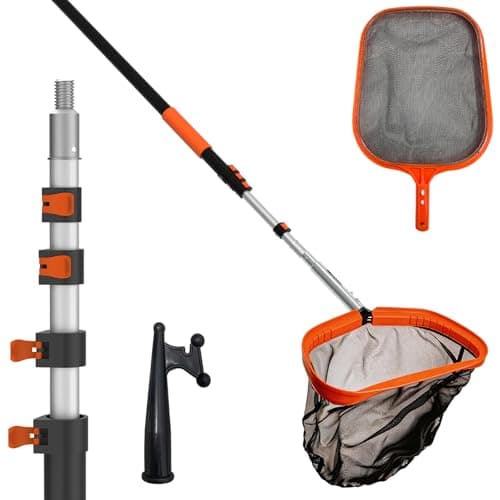
The five-dollar tool you use most
Skimmer Net with Telescopic Pole
Various
Catching leaves while they float is a two-minute job. Catching them after they sink is a vacuum session and a filter clean. Buy this first.
Key specs
- Type
- Flat skimmer or deep leaf rake
- Pole
- Telescopic, sized to reach the middle of your pool
- Frame
- Plastic or aluminum
How it scoresour reading of published specs, not a test result
- Retention
- 8.5
- Durability
- 7.0
- Handling
- 9.0
- Running cost
- 10.0
- Value
- 9.5
Overall 8.8 / 10
What works
- The single most-used tool in pool ownership and among the cheapest
- Removing debris before it sinks prevents most of the work that follows
- A deep leaf rake handles far more per pass than a flat skimmer
What doesn't
- Cheap plastic frames snap where the pole attaches, which is the standard failure
- Telescopic poles seize with hard water unless rinsed
- A too-short pole means you cannot reach the middle, which makes it useless
Skip it if: Anything on the floor. This is a surface tool and pretending otherwise is how debris ends up in the filter.
What it costs to run: Free to use and it directly reduces your chemical bill: organic debris consumes chlorine as it breaks down, so removing leaves is the cheapest sanitizer saving there is.
Several seasons: Buy-once. Built and warranted to come back out of the box for a few years, if you store it properly.
Making sure the cover actually gets used
Solar Cover Reel for Above-Ground Pools
Various
A cover that takes two people and ten minutes to move gets left off. A reel makes it a one-person, one-minute job, which is the difference between owning a cover and using one.
Key specs
- Function
- Rolls the solar cover on and off
- Fit
- Must match pool diameter and wall type
- Mounting
- Freestanding or wall-mounted depending on model
How it scoresour reading of published specs, not a test result
- Retention
- 7.0
- Durability
- 7.5
- Handling
- 9.5
- Running cost
- 8.5
- Value
- 7.0
Overall 7.7 / 10
What works
- Turns cover use from a chore into a habit, which is where all the savings actually are
- Keeps the cover off the ground, which is what shortens its life
- One-person operation
What doesn't
- Frequently costs more than the cover it handles
- Takes up permanent space beside the pool
- Sizing must match the pool exactly, and returns are awkward
Skip it if: A small pool. Under about 12 feet the cover is light enough to handle by hand and the reel is a solution to a problem you do not have.
What it costs to run: Only justified on larger pools. The value is not the reel, it is the cover getting used every night instead of most nights — quantify it by how often you would actually bother otherwise.
Several seasons: Buy-once. Built and warranted to come back out of the box for a few years, if you store it properly.
Five months of weather, not one night
Winter Cover for Above-Ground Pools
Various
A structural product, not a summer one. Its job is carrying snow and blocking light for a whole winter, and a solar cover pressed into that role will be in shreds by February.
Key specs
- Construction
- Woven polyethylene, weight published in mil or scrim count
- Securing
- Cable and winch, or wraparound straps
- Overlap
- Needs genuine overlap past the wall — check the stated size against your pool
- Not the same as
- A solar cover or a safety cover
How it scoresour reading of published specs, not a test result
- Retention
- 8.5
- Durability
- 8.0
- Handling
- 6.5
- Running cost
- 9.0
- Value
- 8.5
Overall 8.3 / 10
What works
- Blocks light for the whole winter, which is what stops algae in a closed pool
- Cable-and-winch securing survives wind that lifts a strapped cover
- Buying the heavier scrim genuinely doubles the number of winters you get
What doesn't
- Needs a way to shed or pump off standing water, or the weight tears it
- Bulky to store in summer
- Not a safety cover — it will not support a person and must not be treated as if it will
Skip it if: A pool you take down each autumn. If the pool comes apart, the cover is money spent on nothing.
What it costs to run: This is insurance rather than a saving. A torn cover in January means an opening in April that costs a full shock treatment and a week of filtration to fix, which is more than the better cover cost.
Several seasons: Buy-once. Built and warranted to come back out of the box for a few years, if you store it properly.
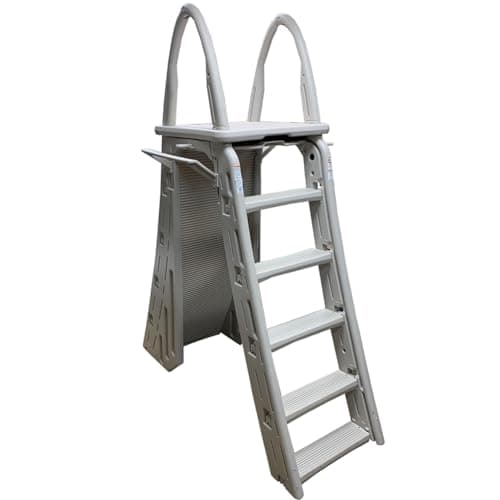
Getting in and out safely
A-Frame Above-Ground Pool Ladder
Various
Read the published weight limit before anything else. It is frequently lower than buyers assume, and it is the one spec on a ladder that genuinely matters.
#ad how this is funded · price as of October 8, 2026
Key specs
- Critical spec
- Published weight capacity — check it against every adult who will use it
- Height match
- Must match your wall height, not approximate it
- Safety feature
- Removable or lockable outer steps on better models
How it scoresour reading of published specs, not a test result
- Sizing fit
- 8.5
- Running cost
- 10.0
- Maintenance
- 8.5
- Build
- 7.5
- Value
- 8.5
Overall 8.4 / 10
What works
- Removable outer steps genuinely prevent unsupervised access, which is a real safety layer
- Resin frames do not corrode the way early steel ladders did
- Correctly matched height is far more stable than a too-tall ladder
What doesn't
- Weight limits are often lower than people expect and are easy to overlook in a listing
- A ladder sized for a 42-inch wall is wrong on a 52-inch wall and vice versa
- Cheap models flex enough to feel alarming
Skip it if: Being a barrier on its own. The CPSC's guidance treats barriers, supervision and alarms as layers; a removable step is one layer, not the answer.
What it costs to run: Buy it with the pool. Kits that include a ladder are frequently cheaper than the pool-plus-ladder bought separately, and this is one of the accessories that makes a cheap-looking kit expensive.
Several seasons: Buy-once. Built and warranted to come back out of the box for a few years, if you store it properly.
Specs from: CPSC — Pool Safely
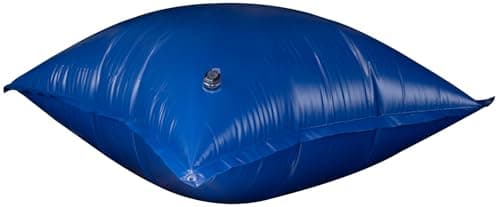
Stopping ice from pushing on the wall
Winter Air Pillow for Above-Ground Pools
Various
A few dollars of inflatable that gives expanding ice something compressible to push against instead of your pool wall. In a freezing climate this is not optional.
#ad how this is funded · price as of October 8, 2026
Key specs
- Function
- Absorbs ice expansion; centers the load away from the wall
- Inflation
- Inflate to roughly 60% — a fully inflated pillow bursts
- Placement
- Centered under the winter cover
How it scoresour reading of published specs, not a test result
- Retention
- 8.0
- Durability
- 6.5
- Handling
- 9.0
- Running cost
- 10.0
- Value
- 9.0
Overall 8.4 / 10
What works
- Extremely cheap relative to the wall or liner it protects
- Also stops rainwater and snowmelt pooling in the center of the cover
- Reusable for several winters if it survives one
What doesn't
- Cheap ones deflate mid-winter, which is when it matters
- Must be tethered or it drifts to the edge and does nothing
- Over-inflating is the most common mistake and it destroys the pillow
Skip it if: Climates that do not freeze. If your water never ices over, this is solving a problem you do not have.
What it costs to run: The cheapest insurance in this entire site against the most expensive winter failure. Inflate to about 60% and tether it.
One honest season: The cheapest setup that genuinely works for a season of real swimming. Nothing spare, nothing missing.
Questions people actually ask
Should I drain my pool before a storm?
What should I do with my pool before a hurricane or severe storm?
Should I cover my pool during a storm?
What should I check after a storm before swimming?
Sources
Read next
- Closing, covering and opening againWinterizing, covers and spring opening - the four weeks of the year that decide whether you own a pool next summer.
- A freeze is forecast and the pool is still openWhat to protect first when a cold snap arrives before closing day, why the equipment is at risk before the pool is, and when to just close early.
- How to winterize an above-ground poolThe correct closing sequence, the freeze damage that ends pools, and why a cracked pump housing is entirely preventable.
- The morning after a storm, in the right orderWhy rain wrecks pool chemistry three ways at once, and the recovery sequence that gets the water back in a day rather than a week.
- What an above-ground pool can and cannot sit onEvery common surface assessed, with the load per square foot each pool size actually applies - the number that rules a deck in or out.
- The electrical side, which is the one part of a pool you should not improviseGFCI protection, extension cords, timers and heater circuits - what is a homeowner job around a pool and what is not.
- Pool pump problems, diagnosed in the cheapest orderThe five-check diagnostic sequence for an above-ground pool pump, from free fixes to the point at which it is genuinely the motor.