Pool Costs
Every line of a pool budget, and exactly where each number comes from
Our other cost pages work through one example. This is the blank version, so you can put your own gallons, your own rates and your own pool into it.

Heads up: we earn a commission if you buy through the links on this page, at no extra cost to you. It never decides the ranking — here is how we pick and here is the full disclosure. Prices are checked automatically; last verified October 8, 2026.
The short version
- Three numbers unlock the whole thing: your pool’s published gallons, your water rate, and your electricity rate.
- Two of them are on your own bills. The national averages we publish are a fallback, not a substitute.
- Keep one-off and recurring in separate columns. Merging them is why published pool costs look alarming.
- Where a price moves, we give the quantity instead — multiply by what you actually pay.
Before you start: find three numbers
Your pool’s published capacity in gallons. On the box, in the manual or on the manufacturer’s specification page. If it is not published anywhere — which happens — you cannot compute the chemical or water lines honestly, and that absence is itself worth noting.
Your water rate, per 1,000 gallons. On your water bill. Our fallback is the EPA WaterSense national average of $6.06 per 1,000 gallons. Note whether your utility also bills sewerage on metered volume, which can effectively double it.
Your electricity rate, per kWh. On your electricity bill. Our fallback is the EIA US residential average of 18.34 cents per kWh for June 2026.
Column A: the one-off lines (year one only)
| Line | Needed? | Note |
|---|---|---|
| The pool | Yes | Sets every recurring line below via its gallons |
| Filter pump | Yes, if not in the kit | Size by gallons ÷ system flow rate |
| Ground cloth | Yes | Cheap; protects against the commonest failure |
| Ladder | Yes on 42in+ walls | Match the wall height; read the weight capacity |
| Solar cover | Strongly recommended | Saves water, chemicals and heat together |
| Cover reel | Strongly recommended | Decides whether the cover is actually used |
| Winter cover | If the pool stays up | Needs genuine overlap past the wall |
| Air pillow | If the pool stays up | Replace most winters |
| Skimmer net and telescopic pole | Yes | Also carries the brush and vacuum head |
| Wall brush | Yes | Shares the pole |
| Manual vacuum head and hose | Yes | No running cost at all |
| Floating dispenser | Yes | Cheapest item that prevents the most problems |
| Pump timer | Yes | Pays back within a season |
Column B: the recurring lines (every year)
The four formulas, in the order to fill them in
- Water
- (gallons ÷ 1,000) × your water rate
- Electricity
- watts × hours/day × days ÷ 1,000 × your rate
- Chlorine tablets [Clorox Pool&Spa]
- 2 × (gallons ÷ 10,000) × weeks in your season
- Cartridges
- weeks in season ÷ replacement interval
Season total = water + electricity + (tablets × your price) + (cartridges × your price) + shock + balancers
Four computable lines, plus two you price at your own shelf
| Line | Formula or quantity | Yours |
|---|---|---|
| Water — one fill | (gallons ÷ 1,000) × your rate | ________ |
| Water — top-ups | Measure once, then estimate | ________ |
| Pump electricity | W × h × days ÷ 1,000 × rate | ________ |
| Chlorine tablets | 2 × (gal ÷ 10,000) × weeks | ________ |
| Shock | A few doses; more in a bad summer | ________ |
| Alkalinity and pH balancers | Occasional | ________ |
| Filter cartridges | weeks ÷ interval (≈ 2 weeks heavy use) | ________ |
| Test strips | One 100-strip bottle per season | ________ |
| Heater, if any | kW × h × days × rate | ________ |
Column C: the lines that appear later
Not every year, but not never. Budgeting for them once means they are not a surprise in year four.
A replacement solar cover after a few seasons of ultraviolet exposure. An air pillow most winters. A replacement liner, eventually — the one genuinely large item, and the one whose timing you influence most through ground preparation and chemistry. Our replacement parts guide is the schedule and the liner guide covers the big one.
And one avoidable line that dwarfs the rest when it happens: the spring bill from a bad autumn close. Our cost of a bad close prices it.
The last step, which is the point
Once column B is filled in, divide it by the number of times somebody will genuinely get in the water. That figure — cost per swim — is the only one that answers whether the pool was a good idea, and it moves far more with use than with any saving you can make on the running cost.
Count honestly rather than optimistically: the gap between planned use and actual use is where this whole calculation lives. Our cost per swim guide has the arithmetic, and the year two guide shows why doing this for year two rather than year one is the fair comparison.
What to buy
Scores are our own reading of published specifications. They are not test results — we have not tested these products and we do not claim to.
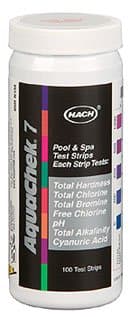
The default first test kit
AquaChek Silver 7-Way Test Strips (100 count)
AquaChek
Seven readings in fifteen seconds, including the two that beginners never measure and then fight all summer: total alkalinity and cyanuric acid.
#ad how this is funded · price as of October 8, 2026
Key specs
- Tests
- Free chlorine, total chlorine, bromine, pH, total alkalinity, total hardness, cyanuric acid
- Free chlorine range
- 0-20 ppm
- pH range
- 6.2-8.4
- Total alkalinity range
- 0-240 ppm
- Cyanuric acid range
- 0-300 ppm
- Read time
- 15 seconds
- Count
- 100 strips
How it scoresour reading of published specs, not a test result
- Accuracy
- 7.0
- Ease
- 9.5
- Coverage
- 9.5
- Cost per use
- 9.0
- Value
- 9.2
Overall 8.9 / 10
What works
- Covers cyanuric acid, which most cheap strips omit and which is the reason chlorine stops working in a stabilized pool
- pH range spans 6.2-8.4, comfortably bracketing the CDC's recommended 7.0-7.8
- 15 seconds and a color chart printed on the bottle — no separate booklet to lose
- 100 strips is a full season of twice-weekly testing with room to spare
What doesn't
- Strips are a comparison against a printed color chart, so they are directional rather than precise
- Reading them in bright sun is harder than it should be
- The bottle must be kept sealed and dry or the strips degrade quietly
Skip it if: Fine adjustment. If you are chasing a stubborn problem and need a number rather than a color band, a liquid reagent kit is the tool.
What it costs to run: 100 strips at twice-weekly testing covers roughly two seasons for one pool. The real saving is upstream: knowing your alkalinity stops you buying pH adjuster you did not need.
One honest season: The cheapest setup that genuinely works for a season of real swimming. Nothing spare, nothing missing.
Specs from: CDC — home pool and hot tub water treatment and testing
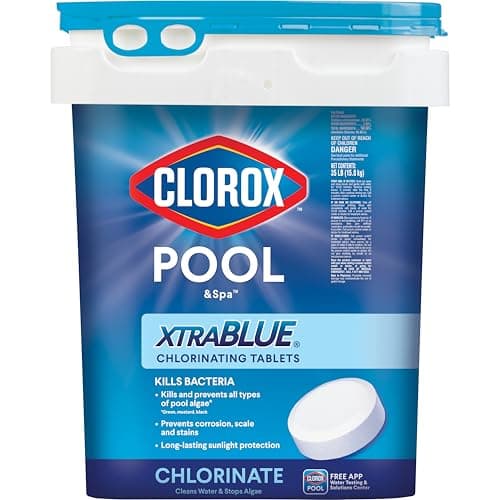
The default chlorine source
Clorox Pool&Spa 3-Inch Chlorinating Tablets
Clorox Pool&Spa
Stabilized trichlor tablets in a floating dispenser is the standard answer for a seasonal above-ground pool, and this is the standard version of it.
#ad how this is funded · price as of October 8, 2026
Key specs
- Type
- Stabilized trichlor, 3-inch tablets
- Contains stabilizer
- Yes — cyanuric acid is part of trichlor
- Dosing
- Per manufacturer instructions, by pool volume
- CDC target
- At least 2 ppm free chlorine when using a stabilizer
How it scoresour reading of published specs, not a test result
- Effectiveness
- 9.0
- Ease
- 9.0
- Water impact
- 6.0
- Cost per season
- 8.5
- Value
- 8.5
Overall 8.5 / 10
What works
- Dissolves slowly, so a floating dispenser meters chlorine out over days rather than hours
- Stabilized, so sunlight does not destroy your chlorine within an afternoon
- Widely stocked, so you are never hunting for it in July
What doesn't
- Every tablet adds cyanuric acid, and in a pool you never fully drain that accumulates until chlorine stops responding
- Trichlor is acidic and will pull your pH down over a season
- Tablets must be kept dry and sealed or they degrade and gas off
Skip it if: A small pool that is topped up rather than drained. Cyanuric acid only leaves with the water, so in a 1,500-gallon pool it climbs fast.
What it costs to run: The standing chemical cost of the season, and it scales directly with gallons. Watch the cyanuric acid reading on your test strip: once it is high, you are buying chlorine that cannot work, which is the most common invisible waste in a first pool year.
One honest season: The cheapest setup that genuinely works for a season of real swimming. Nothing spare, nothing missing.
Specs from: CDC — free chlorine target with cyanuric acid
The consumable you will actually buy repeatedly
Type A Replacement Filter Cartridges (multipack)
Various
Buy them in a multipack before you need them. A pool running on an exhausted cartridge is a cloudy pool, and the fix is a two-dollar part you did not have.
Key specs
- Type
- Type A — the most common Intex format
- Replacement interval
- Every 2 weeks in heavy use, per Intex guidance
- Between changes
- Rinse, do not scrub
How it scoresour reading of published specs, not a test result
- Sizing fit
- 9.0
- Running cost
- 7.0
- Maintenance
- 8.5
- Build
- 7.0
- Value
- 8.5
Overall 8.2 / 10
What works
- Type A is the most widely stocked cartridge format in the US
- Multipacks cost a fraction of buying singles
- Having a spare turns a cloudy week into a five-minute fix
What doesn't
- It is a genuine recurring cost that nobody includes in the purchase price
- Aftermarket quality varies noticeably
- Rinsing extends life but does not restore a cartridge that is done
Skip it if: Being restored. Once the pleats are permanently gray and stiff, rinsing is not saving it.
What it costs to run: The line item most people leave out of their pool budget. Count how many you use in your first season and you have your real annual filtration cost — this is exactly the number the cost-to-run guide asks you to record.
One honest season: The cheapest setup that genuinely works for a season of real swimming. Nothing spare, nothing missing.
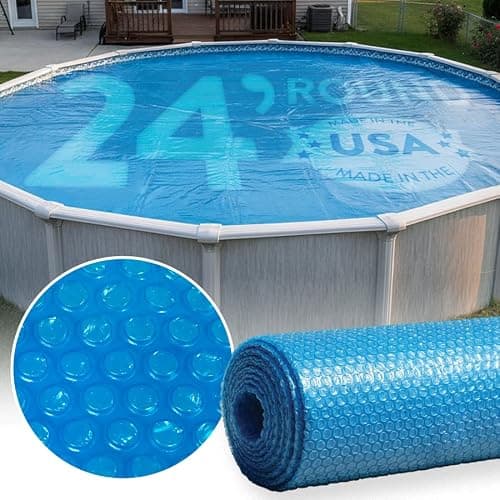
The single highest-return accessory here
Bubble Solar Cover for Above-Ground Pools
Various
It cuts evaporation, and evaporation is simultaneously your water bill, your chemical bill and your heat loss. Nothing else on this site reduces three costs at once.
#ad how this is funded · price as of October 8, 2026
Key specs
- Construction
- Bubble sheet, thickness published in mil
- Thickness
- Higher mil lasts longer — 12 mil and 16 mil are common
- Fit
- Cut to size; buy oversize and trim
- Orientation
- Bubbles face down, toward the water
How it scoresour reading of published specs, not a test result
- Retention
- 9.0
- Durability
- 7.0
- Handling
- 6.0
- Running cost
- 9.8
- Value
- 9.5
Overall 9.0 / 10
What works
- Reduces evaporation, which is the mechanism behind the water, chemical and heat savings all at once
- Cheap relative to everything it saves
- Can be cut to fit any pool shape, so sizing is forgiving
What doesn't
- Awkward to get on and off without a reel, and awkward is how covers end up unused
- Degrades in UV like every vinyl product
- Not a safety cover and will not support weight — this is important
Skip it if: Being a safety barrier. A solar cover looks solid and is not; a child or pet on it goes through and under.
What it costs to run: The one accessory with a clear payback. Every gallon that does not evaporate is a gallon you do not replace at the EPA WaterSense national average of $6.06 per 1,000 gallons, and it is chlorine you do not re-dose. If you buy one thing from this hub, buy this.
Several seasons: Buy-once. Built and warranted to come back out of the box for a few years, if you store it properly.
Specs from: EPA WaterSense — cost per 1,000 gallons
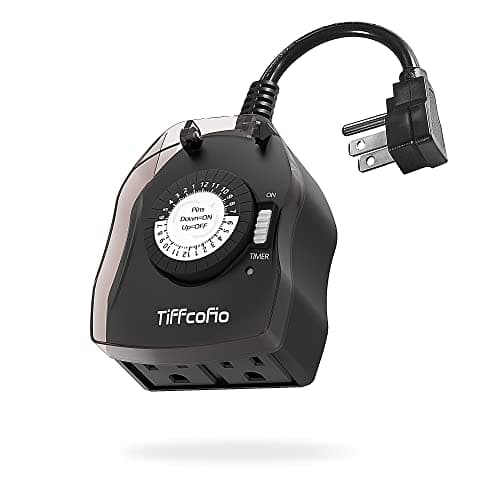
Cutting the electricity bill without cutting filtration
Outdoor Pool Pump Timer
Various
A weatherproof outdoor timer is the highest-return equipment purchase on this site. Most people run the pump too long because remembering to switch it off is a chore.
#ad how this is funded · price as of October 8, 2026
Key specs
- Type
- Outdoor-rated mechanical or digital timer
- Required rating
- Must be rated for the pump's amperage and for outdoor use
- Must not defeat
- The pump's GFCI protection
How it scoresour reading of published specs, not a test result
- Sizing fit
- 8.5
- Running cost
- 9.8
- Maintenance
- 9.0
- Build
- 7.5
- Value
- 9.5
Overall 9.0 / 10
What works
- Turns your filtration from a guess into a schedule
- Pays for itself within a single season on most pools
- Lets you shift running hours to off-peak if your utility has time-of-use rates
What doesn't
- Must be genuinely outdoor-rated and correctly amperage-matched, which cheap indoor timers are not
- Never bypass or defeat the pump's GFCI to fit one
- Mechanical timers drift and need resetting after a power cut
Skip it if: Fixing an undersized pump. Running the wrong pump on a schedule just makes the schedule longer.
What it costs to run: The arithmetic that justifies it: at the EIA's June 2026 US residential average of 18.34 cents per kWh, trimming a 400 W pump from 12 hours to 8 hours a day across a 120-day season saves 192 kWh, or about $35. That is more than the timer costs.
Several seasons: Buy-once. Built and warranted to come back out of the box for a few years, if you store it properly.
Specs from: EIA Electric Power Monthly, Table 5.6.A
Questions people actually ask
What should I include in a pool budget?
How do I calculate my own pool running costs?
Where do I find my pool pump's wattage?
Why do you not publish prices for pool chemicals?
Sources
Read next
- What a pool actually costs, with the arithmetic shownPurchase, electricity, chemicals, water and replacement parts - added up, sourced, and shown as arithmetic you can redo.
- What an above-ground pool actually costs to run for a yearElectricity, chemicals, water and consumables for a full season - every input sourced, every calculation shown, and every assumption named.
- Year two, and the lines that disappearWhich pool costs are one-off and which recur, with a year-one and year-two comparison for the same pool.
- What a season of pool chemicals actually adds up toSeason chemical quantities computed from published dosing for four pool volumes, plus the shopping list that is genuinely necessary.
- What your pool pump costs to run, in watts and dollarsPool pump electricity computed from watts, hours and the EIA national average rate, with a table you can read your own pump off.
- What it costs to fill a pool, and to keep it fullOne fill priced for four common pool volumes at the national average water rate, plus why every gallon you add has to be re-balanced.
- Cost per swim, and why it is the only number that settles the argumentThe running cost divided by realistic use, worked out for three pool sizes, and why the denominator matters more than the numerator.
- What actually wears out, and when you will be buying itThe replacement schedule for an above-ground pool - cartridges, covers, liners and hardware - and which spares are worth keeping on the shelf.
- Trucking water in, priced against the hosePublished per-load rates from real water haulers, converted to cost per gallon and compared with hose filling, plus the surcharges nobody mentions until the invoice.