Seasonal Care
Leaf season, and the three weeks that decide next April
Every leaf that sinks is chlorine demand, a stain waiting to happen, and something the filter has to deal with. The good news is that they all float first.

Heads up: we earn a commission if you buy through the links on this page, at no extra cost to you. It never decides the ranking — here is how we pick and here is the full disclosure. Prices are checked automatically; last verified October 8, 2026.
The short version
- Everything floats before it sinks. Removing leaves at the surface is a two-minute job; removing them from the floor is a vacuum session and a filter clean.
- Sunk leaves are three problems at once — chlorine demand, filter loading, and tannin stains on a vinyl liner.
- A cover on overnight is the highest-return habit of the season. Most leaf fall happens when nobody is watching.
- What you let sink in October is what you find in April. This is the month that decides how the spring opening goes.
Why leaves are worse than they look
A leaf on the surface is a tidiness problem. A leaf on the floor is three separate problems, and they compound.
It consumes chlorine. Organic material decomposing in the water is exactly what your sanitizer is there to deal with, and a floor covered in leaves can hold free chlorine below the CDC’s published minimum of at least 1 ppm — or 2 ppm with a stabilizer in use — no matter how diligently you dose.
It loads the filter. Breaking down leaves become fine particulate that goes straight into the cartridge, which is why autumn shortens the replacement interval that Intex already puts at roughly every two weeks in heavy use.
It stains the liner. Leaf tannin leaves brown patches exactly where the leaves sat, and they can persist. They are organic stains, so they respond to chlorine — our liner stains guide has the tablet test that distinguishes them from metal marks — but the easier answer is not letting them settle.
The autumn routine
| Job | Normal season | Leaf season |
|---|---|---|
| Skim the surface | Most days | Twice a day if under trees |
| Empty the skimmer basket | When you are there | Every skim, without fail |
| Vacuum | Weekly | Whenever the floor is visibly littered |
| Cartridge | Every 1-2 weeks | Check weekly; expect shorter life |
| Cover overnight | Optional | The single most valuable habit |
| Test chlorine | Twice a week | More often — demand rises sharply |
The skimmer, which does the work while you are asleep
Most leaf fall happens overnight and on windy afternoons, which is precisely when nobody is standing beside the pool with a net. That makes the skimmer the primary defense in autumn rather than a supporting one.
Three things decide whether it does its job. The water level has to be at about the middle of the skimmer opening — too high and it stops skimming, too low and the pump draws air. The basket has to be empty, because a full basket throttles flow and produces exactly the symptoms of a failing pump. And the weir flap has to swing freely, because if it sticks open, everything the skimmer caught floats straight back out when the pump stops. Our skimmer guide covers all three.
It is also worth running the pump when leaves arrive rather than on a fixed overnight block. Two shorter daytime runs across the windy part of the day catch far more than one long run at 2am — our run-time guide covers scheduling.
The cover, used differently from summer
In summer a solar cover is about heat and evaporation. In autumn its most valuable property is that it is a lid: leaves land on it rather than in the water, and you lift them off with the cover rather than fishing them out.
Two cautions. Clear the cover before you pull it off, or you tip the whole load into the pool and turn a two-minute job into a vacuum session. And do not let water pool on top of it — a puddle on a cover is a still-water habitat sitting directly above your pool, which is the mosquito problem our pool bugs guide covers.
Deciding when to stop
There is a point where keeping the pool open through leaf fall costs more effort than the remaining swims are worth, and the honest signal is usually the daily skim becoming a chore rather than a habit.
Two things push in opposite directions. Closing early means fewer swims, and our cost per swim guide is clear that the denominator is where the value is. But closing while the water is still warm is the most expensive mistake in this hub, because a biologically active pool under a cover for five months is how people find a swamp in April — our cost of a bad close prices it and the green opening guide is what it looks like.
The rule that resolves it: close on water temperature, not on the calendar and not on leaf fall. Wait for consistently cold water, and use the leaf weeks before that to keep the pool clean rather than to decide the date.
If you take the pool down each autumn
Leaf season interacts with the take-down date in one specific way: vinyl folded in cold weather cracks along the folds, so there is a window where the water is cold enough to close and the air is still mild enough to fold the liner safely.
That window closes earlier than people expect, which argues for not leaving the take-down until the last leaf has fallen. Our take-down guide covers the sequence, and the lawn guide makes the same argument from the other direction: the grass under the pool needs growing season to recover, and October does not have any.
The one job to do before closing
Whatever date you pick, get every leaf out first. Organic material left in a pool over winter decomposes, consumes whatever chlorine is left, stains the liner where it settles and produces a sludge layer the filter cannot handle in spring.
A thorough skim, brush and vacuum on closing day is the same half hour you would spend on a normal week, and it is the difference between an opening that takes a morning and one that takes a fortnight. Our winterizing guide puts it in sequence.
If the leaf fall is heavy enough that this is an annual problem, the fix is a net rather than a routine. Our leaf net roundup covers sizing and mesh, and the yard test that decides whether it is worth buying at all.
What to buy
Scores are our own reading of published specifications. They are not test results — we have not tested these products and we do not claim to.
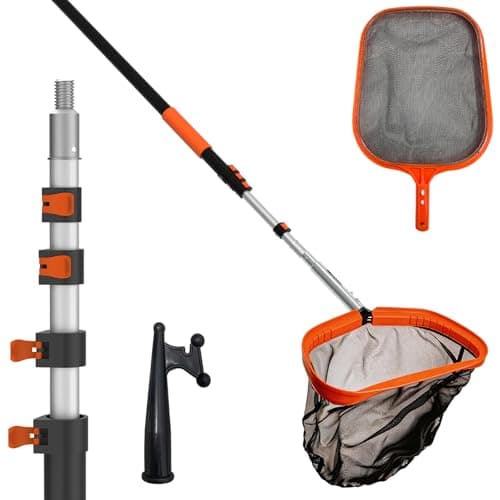
The five-dollar tool you use most
Skimmer Net with Telescopic Pole
Various
Catching leaves while they float is a two-minute job. Catching them after they sink is a vacuum session and a filter clean. Buy this first.
Key specs
- Type
- Flat skimmer or deep leaf rake
- Pole
- Telescopic, sized to reach the middle of your pool
- Frame
- Plastic or aluminum
How it scoresour reading of published specs, not a test result
- Retention
- 8.5
- Durability
- 7.0
- Handling
- 9.0
- Running cost
- 10.0
- Value
- 9.5
Overall 8.8 / 10
What works
- The single most-used tool in pool ownership and among the cheapest
- Removing debris before it sinks prevents most of the work that follows
- A deep leaf rake handles far more per pass than a flat skimmer
What doesn't
- Cheap plastic frames snap where the pole attaches, which is the standard failure
- Telescopic poles seize with hard water unless rinsed
- A too-short pole means you cannot reach the middle, which makes it useless
Skip it if: Anything on the floor. This is a surface tool and pretending otherwise is how debris ends up in the filter.
What it costs to run: Free to use and it directly reduces your chemical bill: organic debris consumes chlorine as it breaks down, so removing leaves is the cheapest sanitizer saving there is.
Several seasons: Buy-once. Built and warranted to come back out of the box for a few years, if you store it properly.
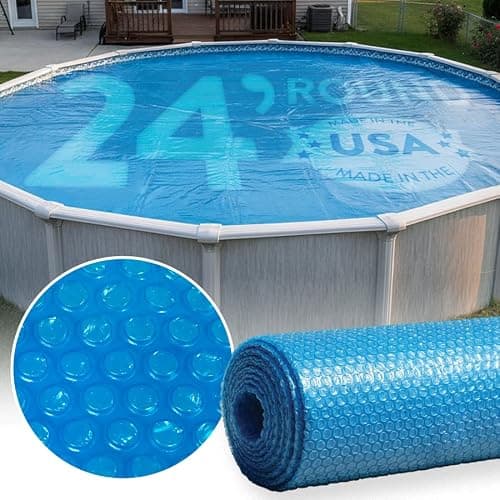
The single highest-return accessory here
Bubble Solar Cover for Above-Ground Pools
Various
It cuts evaporation, and evaporation is simultaneously your water bill, your chemical bill and your heat loss. Nothing else on this site reduces three costs at once.
#ad how this is funded · price as of October 8, 2026
Key specs
- Construction
- Bubble sheet, thickness published in mil
- Thickness
- Higher mil lasts longer — 12 mil and 16 mil are common
- Fit
- Cut to size; buy oversize and trim
- Orientation
- Bubbles face down, toward the water
How it scoresour reading of published specs, not a test result
- Retention
- 9.0
- Durability
- 7.0
- Handling
- 6.0
- Running cost
- 9.8
- Value
- 9.5
Overall 9.0 / 10
What works
- Reduces evaporation, which is the mechanism behind the water, chemical and heat savings all at once
- Cheap relative to everything it saves
- Can be cut to fit any pool shape, so sizing is forgiving
What doesn't
- Awkward to get on and off without a reel, and awkward is how covers end up unused
- Degrades in UV like every vinyl product
- Not a safety cover and will not support weight — this is important
Skip it if: Being a safety barrier. A solar cover looks solid and is not; a child or pet on it goes through and under.
What it costs to run: The one accessory with a clear payback. Every gallon that does not evaporate is a gallon you do not replace at the EPA WaterSense national average of $6.06 per 1,000 gallons, and it is chlorine you do not re-dose. If you buy one thing from this hub, buy this.
Several seasons: Buy-once. Built and warranted to come back out of the box for a few years, if you store it properly.
Specs from: EPA WaterSense — cost per 1,000 gallons
Actual debris, at the lowest cost
Manual Vacuum Head with Telescopic Pole and Hose
Various
Connects to the skimmer and uses the pump you already own. It is slower than a robot, cheaper than everything, and it is what most above-ground pools should have.
Key specs
- Power
- Uses the pool's existing pump suction
- Needs
- A telescopic pole and a vacuum hose of the right length
- Fitting
- Must match the skimmer on your pool
- Consumables
- None beyond the filter it already loads
How it scoresour reading of published specs, not a test result
- Sizing fit
- 8.5
- Running cost
- 9.8
- Maintenance
- 8.0
- Build
- 8.0
- Value
- 9.5
Overall 8.8 / 10
What works
- No batteries, no motor, nothing that can fail electrically
- Lifts real debris, not just silt
- Cheapest capable option, by a wide margin
What doesn't
- You have to prime the hose properly or the pump loses suction
- Loads the filter heavily, so plan to clean it right after
- It is genuinely manual work and takes twenty minutes
Skip it if: A pool without a skimmer connection, which rules out most soft-side inflatables.
What it costs to run: Free to run beyond the pump time you are already paying for. The one hidden cost is filter loading — expect to clean the cartridge immediately after vacuuming.
Several seasons: Buy-once. Built and warranted to come back out of the box for a few years, if you store it properly.
The consumable you will actually buy repeatedly
Type A Replacement Filter Cartridges (multipack)
Various
Buy them in a multipack before you need them. A pool running on an exhausted cartridge is a cloudy pool, and the fix is a two-dollar part you did not have.
Key specs
- Type
- Type A — the most common Intex format
- Replacement interval
- Every 2 weeks in heavy use, per Intex guidance
- Between changes
- Rinse, do not scrub
How it scoresour reading of published specs, not a test result
- Sizing fit
- 9.0
- Running cost
- 7.0
- Maintenance
- 8.5
- Build
- 7.0
- Value
- 8.5
Overall 8.2 / 10
What works
- Type A is the most widely stocked cartridge format in the US
- Multipacks cost a fraction of buying singles
- Having a spare turns a cloudy week into a five-minute fix
What doesn't
- It is a genuine recurring cost that nobody includes in the purchase price
- Aftermarket quality varies noticeably
- Rinsing extends life but does not restore a cartridge that is done
Skip it if: Being restored. Once the pleats are permanently gray and stiff, rinsing is not saving it.
What it costs to run: The line item most people leave out of their pool budget. Count how many you use in your first season and you have your real annual filtration cost — this is exactly the number the cost-to-run guide asks you to record.
One honest season: The cheapest setup that genuinely works for a season of real swimming. Nothing spare, nothing missing.
Five months of weather, not one night
Winter Cover for Above-Ground Pools
Various
A structural product, not a summer one. Its job is carrying snow and blocking light for a whole winter, and a solar cover pressed into that role will be in shreds by February.
Key specs
- Construction
- Woven polyethylene, weight published in mil or scrim count
- Securing
- Cable and winch, or wraparound straps
- Overlap
- Needs genuine overlap past the wall — check the stated size against your pool
- Not the same as
- A solar cover or a safety cover
How it scoresour reading of published specs, not a test result
- Retention
- 8.5
- Durability
- 8.0
- Handling
- 6.5
- Running cost
- 9.0
- Value
- 8.5
Overall 8.3 / 10
What works
- Blocks light for the whole winter, which is what stops algae in a closed pool
- Cable-and-winch securing survives wind that lifts a strapped cover
- Buying the heavier scrim genuinely doubles the number of winters you get
What doesn't
- Needs a way to shed or pump off standing water, or the weight tears it
- Bulky to store in summer
- Not a safety cover — it will not support a person and must not be treated as if it will
Skip it if: A pool you take down each autumn. If the pool comes apart, the cover is money spent on nothing.
What it costs to run: This is insurance rather than a saving. A torn cover in January means an opening in April that costs a full shock treatment and a week of filtration to fix, which is more than the better cover cost.
Several seasons: Buy-once. Built and warranted to come back out of the box for a few years, if you store it properly.
Questions people actually ask
How do I keep leaves out of my pool in autumn?
Do leaves damage a pool?
Can I use a solar cover to keep leaves out all winter?
Should I close the pool when the leaves start falling?
Sources
Read next
- Closing, covering and opening againWinterizing, covers and spring opening - the four weeks of the year that decide whether you own a pool next summer.
- How to winterize an above-ground poolThe correct closing sequence, the freeze damage that ends pools, and why a cracked pump housing is entirely preventable.
- Adding weeks to the season, starting with the cheapest thing firstCover, placement and timing before hardware, plus the kilowatt arithmetic that shows what running an electric heater actually costs.
- You lifted the cover and it is green. First decide, then treat.How to decide between draining and recovering a green pool at opening, and the full recovery sequence if you treat it.
- The skimmer is the cheapest part of the system and the one that stops itHow a skimmer actually works, the water level it needs, and the three silent faults that get blamed on the pump.
- The manual pool tools that do most of the real workNets, poles and vacuum heads compared against powered cleaners for a seasonal above-ground pool, on running cost as well as capability.
- Stains on the liner, and the one test that tells you which kindOrganic or metal? The five-minute test that identifies a liner stain, plus what removes each kind and what prevents both.
- The bill a bad close sends you in AprilThe spring bill produced by a bad autumn close, priced line by line, and the three cheap items that prevent nearly all of it.