Pool Care & Chemistry
The morning after a storm, in the right order
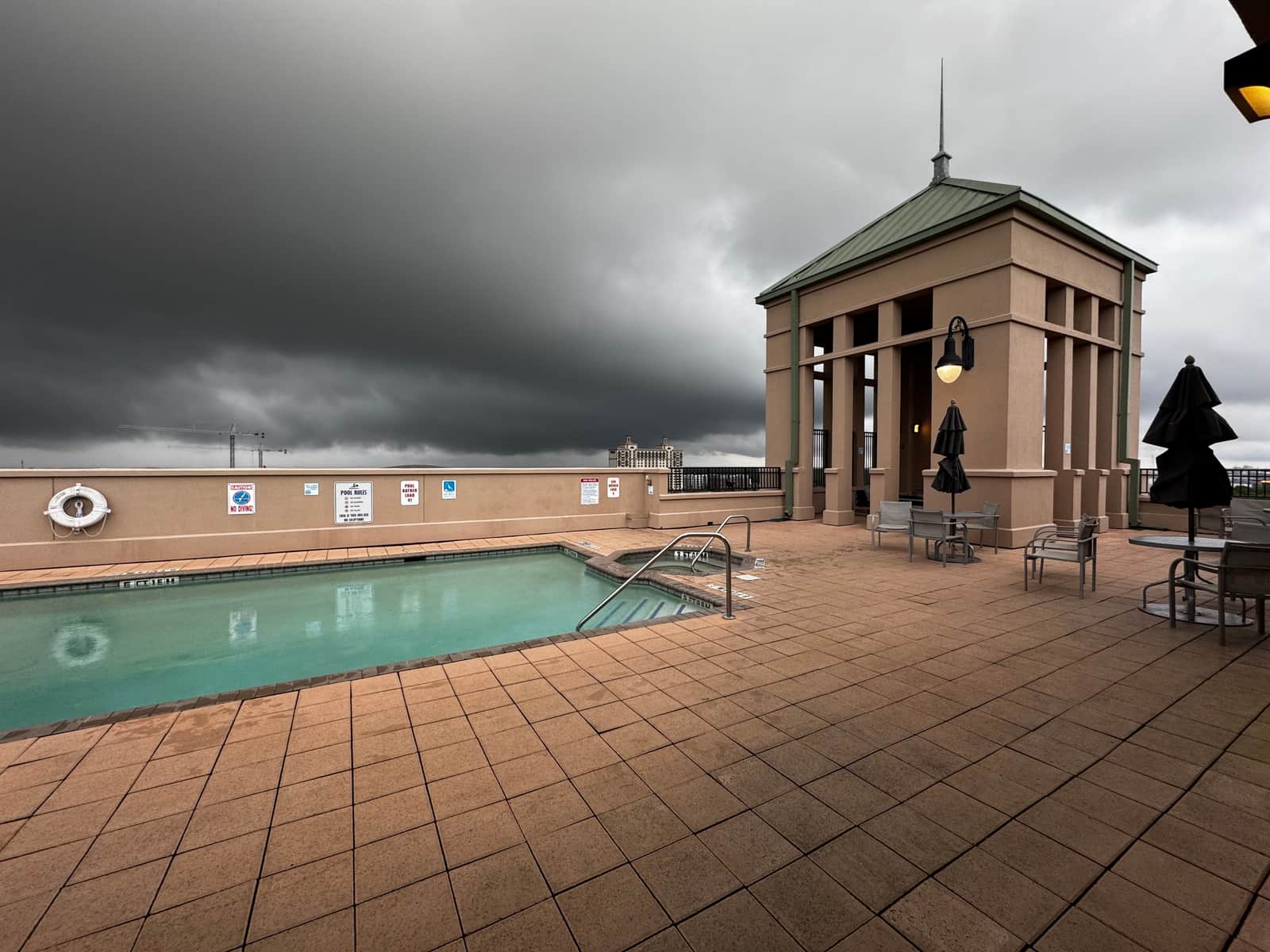
Rain does three things to a pool at once - dilutes it, acidifies it and loads it with organics. Doing the recovery in the wrong order is why it takes a week instead of a day.
Heads up: we earn a commission if you buy through the links on this page, at no extra cost to you. It never decides the ranking — here is how we pick and here is the full disclosure. Prices are checked automatically; last verified October 8, 2026.
The short version
- Rain does three things at once — it dilutes your chemistry, it pushes pH and alkalinity down, and it washes organic material in off everything around the pool.
- Skim and vacuum before you dose anything. Chlorine spent on leaves is chlorine not spent on the water.
- Alkalinity first, then pH, then chlorine. The order matters more after rain than at any other time, because all three moved together.
- Do not drain to the old level in a hurry. Get the chemistry right first; the level is the least urgent thing on the list.
Why a storm is worse than the same volume from a hose
Adding water dilutes a pool, and that alone would be a manageable problem — it is the same thing that happens every time you top up, and our cost-to-fill guide covers the routine version. Rain is worse for two additional reasons.
First, rainwater is not neutral. It tends to sit on the acidic side, so a large volume of it pushes both pH and total alkalinity down at once — and total alkalinity is the thing that was holding pH steady in the first place. That is why post-storm water often will not hold a pH correction: you fixed the symptom while the buffer was still missing.
Second, a storm does not only put water in the pool. It washes whatever was on the lawn, the decking, the cover and the surrounding ground into it — dust, pollen, organic debris, lawn treatment residue. All of that is chlorine demand arriving at exactly the moment your chlorine has been diluted.
The recovery, in order
Clear the debris first
Skim the surface, empty the skimmer basket and the pump basket, and vacuum anything that has settled. Everything organic you remove now is chlorine you do not have to spend later. This step first, always — dosing a pool full of leaves is the single most common way a recovery gets stretched into a week.Get the pump running properly
Check the water level is at the middle of the skimmer opening and that the pump has prime. A storm can drop debris straight into the basket and starve it. Then leave the pump running — this is one of the occasions where continuous circulation is worth the electricity, as our run-time guide covers.Test everything, not just chlorine
A seven-way strip in fifteen seconds: free chlorine, pH, total alkalinity, cyanuric acid, hardness. After a storm all of them have moved, and testing chlorine alone will send you to the wrong product. Our test kit roundup covers what to use.Correct total alkalinity before pH
This is the step people skip and then repeat all week. Alkalinity is what resists pH movement, and rain knocked it down along with everything else. Raise alkalinity with sodium bicarbonate, which moves pH very little, then let it circulate before you look at pH at all. Our pH and alkalinity guide is the detail.Then bring pH back into range
The CDC publishes a pH range of 7.2 to 7.8 for pools. With alkalinity restored, a pH correction will now hold instead of drifting back by Thursday. Add with the pump running so it distributes rather than settling on the liner.Shock, in the evening
Now the chlorine has a fair fight: the debris is gone, the water is buffered and circulating. Shock at dusk rather than midday, because sunlight destroys unstabilized chlorine quickly. Our shock guide covers dosing and which product suits your stabilizer level.Filter, then deal with the cartridge
Run continuously until it clears. Expect the cartridge to load up faster than usual, because it is catching a storm’s worth of material — rinse or replace it afterwards, as our cartridge guide covers. If the water is still hazy with the chemistry correct, that is a clarifier case.
| What rain did | What you see | The fix |
|---|---|---|
| Washed debris in | Leaves, film, grit on the floor | Skim and vacuum, before dosing |
| Lowered total alkalinity | pH will not stay corrected | Sodium bicarbonate, first |
| Lowered pH | Stinging eyes, aggressive water | pH increaser, after alkalinity |
| Diluted chlorine and stabilizer | Free chlorine low or zero | Shock at dusk, pump running |
| Added organic load | Cloudiness 24-48 hours later | Filter continuously; clarifier if needed |
| Raised the water level | Water above the skimmer | Lower it last, once chemistry is right |
The water level, which is the least urgent thing
A storm can push the level above the skimmer opening, at which point the skimmer stops skimming because it is submerged. That is worth correcting, but it is the last job rather than the first, and there is a reason: every gallon you drain takes chemistry with it, so draining after you have dosed means dosing twice.
Get the water right, then bring the level back to the middle of the skimmer opening, then re-test. If the overflow is severe and repeated, the problem is drainage around the pool rather than the pool — our surface guide covers thinking about where water goes before the pool goes in.
Preparing before the storm, which takes two minutes
If heavy rain is forecast, three small things make the morning after much shorter. Put the solar cover on, which keeps a surprising amount of debris out and reduces how much direct rain lands. Make sure the chlorine dispenser is loaded, so the pool is starting from a healthy level rather than a mid-week trough. And clear the leaves that are already around the pool, because those are the ones the wind will deliver.
None of that stops the dilution. All of it reduces the organic load, which is the part that turns a diluted pool into a cloudy one. Our weekly routine covers the normal-week version of the same habits.
What to buy
Scores are our own reading of published specifications. They are not test results — we have not tested these products and we do not claim to.
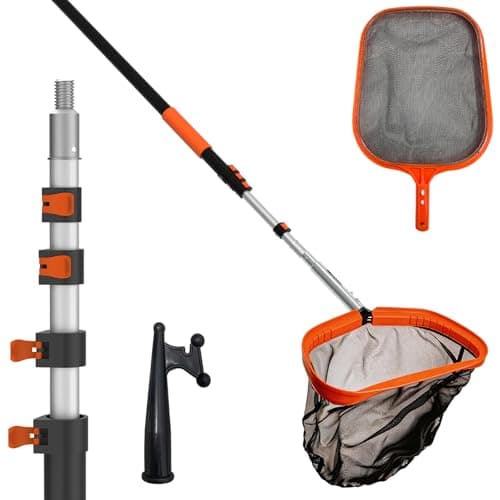
The five-dollar tool you use most
Skimmer Net with Telescopic Pole
Various
Catching leaves while they float is a two-minute job. Catching them after they sink is a vacuum session and a filter clean. Buy this first.
Key specs
- Type
- Flat skimmer or deep leaf rake
- Pole
- Telescopic, sized to reach the middle of your pool
- Frame
- Plastic or aluminum
How it scoresour reading of published specs, not a test result
- Retention
- 8.5
- Durability
- 7.0
- Handling
- 9.0
- Running cost
- 10.0
- Value
- 9.5
Overall 8.8 / 10
What works
- The single most-used tool in pool ownership and among the cheapest
- Removing debris before it sinks prevents most of the work that follows
- A deep leaf rake handles far more per pass than a flat skimmer
What doesn't
- Cheap plastic frames snap where the pole attaches, which is the standard failure
- Telescopic poles seize with hard water unless rinsed
- A too-short pole means you cannot reach the middle, which makes it useless
Skip it if: Anything on the floor. This is a surface tool and pretending otherwise is how debris ends up in the filter.
What it costs to run: Free to use and it directly reduces your chemical bill: organic debris consumes chlorine as it breaks down, so removing leaves is the cheapest sanitizer saving there is.
Several seasons: Buy-once. Built and warranted to come back out of the box for a few years, if you store it properly.
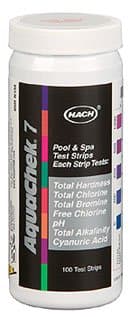
The default first test kit
AquaChek Silver 7-Way Test Strips (100 count)
AquaChek
Seven readings in fifteen seconds, including the two that beginners never measure and then fight all summer: total alkalinity and cyanuric acid.
#ad how this is funded · price as of October 8, 2026
Key specs
- Tests
- Free chlorine, total chlorine, bromine, pH, total alkalinity, total hardness, cyanuric acid
- Free chlorine range
- 0-20 ppm
- pH range
- 6.2-8.4
- Total alkalinity range
- 0-240 ppm
- Cyanuric acid range
- 0-300 ppm
- Read time
- 15 seconds
- Count
- 100 strips
How it scoresour reading of published specs, not a test result
- Accuracy
- 7.0
- Ease
- 9.5
- Coverage
- 9.5
- Cost per use
- 9.0
- Value
- 9.2
Overall 8.9 / 10
What works
- Covers cyanuric acid, which most cheap strips omit and which is the reason chlorine stops working in a stabilized pool
- pH range spans 6.2-8.4, comfortably bracketing the CDC's recommended 7.0-7.8
- 15 seconds and a color chart printed on the bottle — no separate booklet to lose
- 100 strips is a full season of twice-weekly testing with room to spare
What doesn't
- Strips are a comparison against a printed color chart, so they are directional rather than precise
- Reading them in bright sun is harder than it should be
- The bottle must be kept sealed and dry or the strips degrade quietly
Skip it if: Fine adjustment. If you are chasing a stubborn problem and need a number rather than a color band, a liquid reagent kit is the tool.
What it costs to run: 100 strips at twice-weekly testing covers roughly two seasons for one pool. The real saving is upstream: knowing your alkalinity stops you buying pH adjuster you did not need.
One honest season: The cheapest setup that genuinely works for a season of real swimming. Nothing spare, nothing missing.
Specs from: CDC — home pool and hot tub water treatment and testing
Fixing the number beginners skip
Alkalinity Increaser (sodium bicarbonate)
Various
The most under-bought chemical in the category. If your pH will not stay put, this is almost always the actual fix, and it is chemically just baking soda.
Key specs
- Active
- Sodium bicarbonate
- Raises
- Total alkalinity, with minimal pH movement
- Common target range
- 80-120 ppm (industry convention, not a CDC figure)
How it scoresour reading of published specs, not a test result
- Effectiveness
- 9.0
- Ease
- 8.0
- Water impact
- 9.0
- Cost per season
- 9.8
- Value
- 9.5
Overall 9.0 / 10
What works
- Raises alkalinity with only a small effect on pH, which is exactly what you want
- Extremely cheap — it is sodium bicarbonate
- Fixing alkalinity first stops the endless pH chase that eats a first season
What doesn't
- Works slowly and needs circulation, so it is not a same-afternoon fix
- Easy to overshoot, and bringing alkalinity back down is more work than raising it
- The 80-120 ppm target is an industry convention rather than a published federal standard, so treat it as guidance
Skip it if: Emergencies. Nothing about alkalinity is urgent; it is the thing you fix first and then stop thinking about.
What it costs to run: Pennies per dose, and it is the cheapest lever on your whole chemical bill: stable alkalinity means stable pH, and stable pH means the chlorine you already bought actually works.
One honest season: The cheapest setup that genuinely works for a season of real swimming. Nothing spare, nothing missing.
Bringing pH back up after a season of trichlor
pH Increaser (sodium carbonate)
Various
One of two bottles every pool owner ends up with. Trichlor tablets push pH down all season, and this is what pushes it back.
Key specs
- Active
- Sodium carbonate (soda ash)
- Raises
- pH, and total alkalinity somewhat
- CDC pH target
- 7.0-7.8
How it scoresour reading of published specs, not a test result
- Effectiveness
- 8.5
- Ease
- 8.5
- Water impact
- 8.0
- Cost per season
- 9.5
- Value
- 8.8
Overall 8.5 / 10
What works
- Cheap, stable and does exactly one thing
- Also nudges total alkalinity up, which is often what actually needed fixing
- A single container lasts most seasonal pools a full year
What doesn't
- Overdosing clouds the water for a day or two
- Raises alkalinity as well as pH, which is not always what you want
- Needs to be added with the pump running or it settles
Skip it if: Raising alkalinity on its own without moving pH. Use sodium bicarbonate for that.
What it costs to run: A few dollars a season. The expensive mistake is not this bottle, it is failing to fix alkalinity first and then using this one repeatedly all summer.
One honest season: The cheapest setup that genuinely works for a season of real swimming. Nothing spare, nothing missing.
Specs from: CDC — recommended pH range for pools
Actually clearing a green pool
Calcium Hypochlorite Pool Shock
Various (compare available chlorine %)
Unstabilized, fast-acting and strong. This is the tool for an algae bloom precisely because it does not add more cyanuric acid to a pool that probably already has too much.
Key specs
- Type
- Calcium hypochlorite, unstabilized
- Adds stabilizer
- No
- Adds
- Calcium hardness
- Dosing
- By pool volume, per the bag
How it scoresour reading of published specs, not a test result
- Effectiveness
- 9.5
- Ease
- 6.5
- Water impact
- 7.0
- Cost per season
- 9.0
- Value
- 8.8
Overall 8.6 / 10
What works
- No cyanuric acid added, so it does not worsen the problem it is usually solving
- Fast and strong enough to actually break an algae bloom in one treatment when dosed properly
- Cheap per pound of available chlorine
What doesn't
- Adds calcium hardness, which matters in hard-water areas
- Must be dissolved properly or it will bleach a vinyl liner where it settles
- Needs careful storage — it is a genuine oxidizer, not a household product
Skip it if: Routine daily chlorination. This is the emergency tool; tablets are the routine.
What it costs to run: The single most cost-effective way to fix a green pool, and the most commonly under-dosed. Half a dose twice does not equal a full dose once — it just wastes the bag.
One honest season: The cheapest setup that genuinely works for a season of real swimming. Nothing spare, nothing missing.
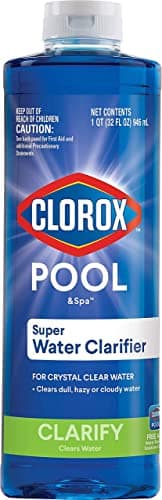
Cloudy water that is chemically fine
Pool Water Clarifier
Various
Clumps particles too small for your filter into ones it can catch. Genuinely useful for the specific case where your chemistry reads correct and the water is still milky.
Key specs
- Function
- Coagulant — aggregates fine particles for filtration
- Requires
- A running filter; it does nothing on its own
- Typical treatment
- Dose, then run the filter continuously
How it scoresour reading of published specs, not a test result
- Effectiveness
- 7.5
- Ease
- 8.5
- Water impact
- 8.0
- Cost per season
- 8.5
- Value
- 7.5
Overall 7.8 / 10
What works
- Fixes the exact case where chemistry is balanced and the water still will not clear
- Cheap and quick when it is the right tool
- Works with the filter you already have rather than needing a better one
What doesn't
- Does nothing at all if the actual problem is low chlorine or a blocked filter
- Overdosing makes cloudiness worse, which is a genuinely counterintuitive failure
- Loads the filter, so it needs cleaning right after
Skip it if: Being the first thing you reach for. Test the water before you use this — most cloudy pools are a chemistry problem wearing a clarity costume.
What it costs to run: A few dollars a bottle, and worth it only when the decision tree points here. Reaching for clarifier first is how people spend twenty dollars solving a problem that a longer pump run would have fixed for free.
A few weekends: Fine for a heatwave and a toddler. Treat it as consumable, not as a pool — it will not survive a winter in the yard.
Questions people actually ask
Does rain ruin pool water?
Should I shock my pool after heavy rain?
Do I need to drain my pool after it rains?
Why did my pool go cloudy two days after a storm?
Sources
Read next
- Pool care, from someone who assumes you have never done thisThe weekly routine, the four numbers that matter, and the fix for the week the water turns.
- The weekly pool routine, and how little time it really takesThe daily, weekly and monthly jobs written as a schedule, with the kit each one needs and roughly how long it takes.
- pH and alkalinity, and why yours will not stay putWhy pH drifts, what total alkalinity actually does, and the order of operations that turns a season of chasing into one adjustment.
- Cloudy pool water: work out which of four problems you haveA diagnostic decision tree for cloudy water - four causes, how to tell them apart, and the correct fix for each.
- Bugs in the pool are a symptom, not an infestationWhat each common pool insect indicates about your water, why insecticide is the wrong tool, and the routine that removes the reason they came.
- Pool shock: use enough, once, and use the right kindCal-hypo versus dichlor, correct dosing, and the counter-intuitive reason a chlorine smell means you need more chlorine.
- How long to run the pump, worked out rather than repeatedRun time derived from your own turnover time, when in the day to run it, and what each hour a day costs across a season.