Pool Care & Chemistry
Pool algae: brush, shock, filter, then rebalance
Algae is a sequence, not a product. Doing the steps in the wrong order is why people shock a green pool three times and still have a green pool.
Heads up: we earn a commission if you buy through the links on this page, at no extra cost to you. It never decides the ranking — here is how we pick and here is the full disclosure. Prices are checked automatically; last verified October 19, 2026.
The short version
- The order is brush, shock, filter, rebalance. Skipping the brushing is why repeat shocking fails.
- Algaecide prevents; shock cures. Using algaecide on an established bloom mostly wastes it.
- Use unstabilized cal-hypo shock for a bloom — a stabilized shock adds cyanuric acid to a pool that likely already has too much.
- Green does not always mean algae. Pollen is the common impostor, and it comes out with the filter rather than with chemicals.
First: is it actually algae?
Pollen is the impostor, especially in spring. Two tells. Pollen tends to sit as a yellow-green film on the surface and along the edges, and it wipes onto your hand rather than staining. Algae grows on surfaces — the walls, the floor, the waterline — and feels slippery.
The definitive test: brush a patch of wall. Algae comes off as a cloud that re-clouds the water. Pollen does not. If it is pollen, the answer is filtration and a skimmer net, not chemicals.
Why algae happened
Almost always one of three things, and knowing which stops it recurring.
Free chlorine fell. The CDC publishes a minimum of 1 ppm free chlorine, or 2 ppm with a stabilizer. Below that, algae has an opening. A heatwave, a heavy bather day or a week away will all do it.
Cyanuric acid climbed too high. Every trichlor tablet adds some. In a pool that gets topped up rather than drained, it accumulates until your chlorine reading looks fine and the chlorine cannot actually do anything. This one is invisible without a test strip that reads cyanuric acid.
The filter was not keeping up. Under-filtered water in summer heat gives algae somewhere to establish before chlorine reaches it.
The sequence
Brush every surface, thoroughly
This is the step people skip and it is the one that decides whether the shock works. Algae growing on a wall is protected by its own biofilm; chlorine cannot reach it until you physically break that up. Brush the walls, the floor and especially the waterline and any corners.Test, and correct pH first
Shock works poorly at high pH. Get pH into the CDC's published 7.0–7.8 range before you shock, or you will be paying for chemical that cannot act.Shock hard, once, with unstabilized shock
Use calcium hypochlorite rather than a stabilized dichlor: cal-hypo adds no cyanuric acid, and high cyanuric acid is frequently why the bloom happened. Dose for your full volume, at night if possible so sunlight does not destroy it before it works. Under-dosing is the single most common failure — more on getting the dose right.Run the filter continuously
24 to 48 hours without stopping. Dead algae is fine particulate and it has to physically come out. Expect the water to go from green to cloudy gray before it goes clear — that transition is the sign it is working.Clean or replace the filter, repeatedly
The cartridge will load heavily and fast. Rinse it, keep going, and expect to replace it after a serious bloom. A blocked filter at this stage stalls the whole recovery.Vacuum the settled debris
Dead algae settles on the floor. Vacuum it out rather than waiting for the filter to catch it, then clean the filter again.Rebalance, then add algaecide to prevent recurrence
Re-test everything, bring alkalinity, pH and chlorine back into range, and only then add a polyquat algaecide as prevention. If cyanuric acid was the root cause, a partial drain and refill is the only way to lower it.
Algaecide: prevention, not cure
Polyquat algaecide is genuinely useful and it is widely misused. It is good at stopping algae establishing and poor at killing an established bloom. Use it as part of the rebalance at the end of the sequence above, and as part of closing the pool for winter, which is where it earns its place most clearly.
Choose polyquat over copper-based algaecides for a vinyl-lined pool: copper can stain a liner permanently, and the staining costs vastly more than the few dollars the cheaper product saved.
Keeping it away
Three habits. Hold free chlorine at or above the published minimum rather than letting it drift and rescuing it. Read your cyanuric acid every few weeks — if it is climbing, a partial drain and refill is the only fix. And brush the waterline weekly, because that is where it always starts. The full routine is in the beginner’s guide.
Once the pool is clear again, the cheap insurance is a maintenance dose of polyquat rather than another rescue. Our algaecide roundup covers which type to keep in the shed and why the copper ones are a poor fit for a vinyl pool.
What to buy
Scores are our own reading of published specifications. They are not test results — we have not tested these products and we do not claim to.
Actually clearing a green pool
Calcium Hypochlorite Pool Shock
Various (compare available chlorine %)
Unstabilized, fast-acting and strong. This is the tool for an algae bloom precisely because it does not add more cyanuric acid to a pool that probably already has too much.
Key specs
- Type
- Calcium hypochlorite, unstabilized
- Adds stabilizer
- No
- Adds
- Calcium hardness
- Dosing
- By pool volume, per the bag
How it scoresour reading of published specs, not a test result
- Effectiveness
- 9.5
- Ease
- 6.5
- Water impact
- 7.0
- Cost per season
- 9.0
- Value
- 8.8
Overall 8.6 / 10
What works
- No cyanuric acid added, so it does not worsen the problem it is usually solving
- Fast and strong enough to actually break an algae bloom in one treatment when dosed properly
- Cheap per pound of available chlorine
What doesn't
- Adds calcium hardness, which matters in hard-water areas
- Must be dissolved properly or it will bleach a vinyl liner where it settles
- Needs careful storage — it is a genuine oxidizer, not a household product
Skip it if: Routine daily chlorination. This is the emergency tool; tablets are the routine.
What it costs to run: The single most cost-effective way to fix a green pool, and the most commonly under-dosed. Half a dose twice does not equal a full dose once — it just wastes the bag.
One honest season: The cheapest setup that genuinely works for a season of real swimming. Nothing spare, nothing missing.
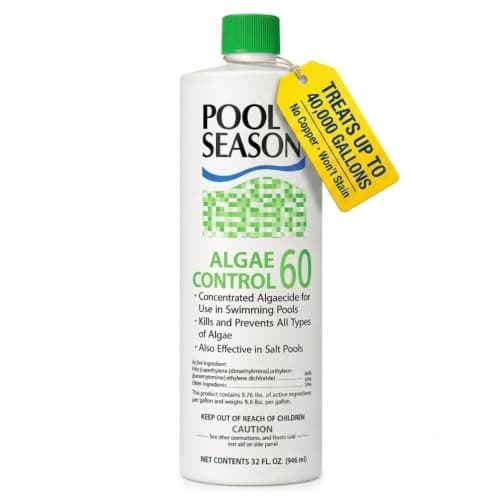
Preventing algae, not curing it
Pool Algaecide (polyquat 60)
Various
Polyquat is the non-foaming, non-staining choice and it is far better at stopping algae than at killing an established bloom. Use it as insurance and as part of closing.
#ad how this is funded · price as of October 19, 2026
Key specs
- Type
- Polyquaternium (polyquat 60)
- Foaming
- Non-foaming, unlike quat algaecides
- Metal content
- None, unlike copper-based algaecides
How it scoresour reading of published specs, not a test result
- Effectiveness
- 7.5
- Ease
- 9.0
- Water impact
- 9.0
- Cost per season
- 7.5
- Value
- 8.0
Overall 8.0 / 10
What works
- Does not foam, which the cheaper quat products do
- No copper, so no risk of the metal staining a vinyl liner
- The standard product in a winterizing routine, for good reason
What doesn't
- Poor at killing an established bloom — shock does that job
- More expensive than copper-based alternatives
- Easy to over-rely on instead of maintaining chlorine
Skip it if: Rescuing a green pool. Brush and shock first; algaecide is what stops it coming back.
What it costs to run: One of the few chemicals where buying the better version is clearly right — a copper algaecide that stains a liner costs vastly more than the few dollars it saved.
One honest season: The cheapest setup that genuinely works for a season of real swimming. Nothing spare, nothing missing.
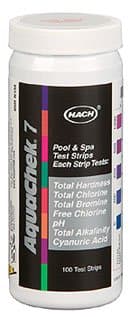
The default first test kit
AquaChek Silver 7-Way Test Strips (100 count)
AquaChek
Seven readings in fifteen seconds, including the two that beginners never measure and then fight all summer: total alkalinity and cyanuric acid.
#ad how this is funded · price as of October 19, 2026
Key specs
- Tests
- Free chlorine, total chlorine, bromine, pH, total alkalinity, total hardness, cyanuric acid
- Free chlorine range
- 0-20 ppm
- pH range
- 6.2-8.4
- Total alkalinity range
- 0-240 ppm
- Cyanuric acid range
- 0-300 ppm
- Read time
- 15 seconds
- Count
- 100 strips
How it scoresour reading of published specs, not a test result
- Ease
- 9.5
- Value
- 9.2
Overall 8.9 / 10
What works
- Covers cyanuric acid, which most cheap strips omit and which is the reason chlorine stops working in a stabilized pool
- pH range spans 6.2-8.4, comfortably bracketing the CDC's recommended 7.0-7.8
- 15 seconds and a color chart printed on the bottle — no separate booklet to lose
- 100 strips is a full season of twice-weekly testing with room to spare
What doesn't
- Strips are a comparison against a printed color chart, so they are directional rather than precise
- Reading them in bright sun is harder than it should be
- The bottle must be kept sealed and dry or the strips degrade quietly
Skip it if: Fine adjustment. If you are chasing a stubborn problem and need a number rather than a color band, a liquid reagent kit is the tool.
What it costs to run: 100 strips at twice-weekly testing covers roughly two seasons for one pool. The real saving is upstream: knowing your alkalinity stops you buying pH adjuster you did not need.
One honest season: The cheapest setup that genuinely works for a season of real swimming. Nothing spare, nothing missing.
Specs from: CDC — home pool and hot tub water treatment and testing
Actual debris, at the lowest cost
Manual Vacuum Head with Telescopic Pole and Hose
Various
Connects to the skimmer and uses the pump you already own. It is slower than a robot, cheaper than everything, and it is what most above-ground pools should have.
Key specs
- Power
- Uses the pool's existing pump suction
- Needs
- A telescopic pole and a vacuum hose of the right length
- Fitting
- Must match the skimmer on your pool
- Consumables
- None beyond the filter it already loads
How it scoresour reading of published specs, not a test result
- Value
- 9.5
Overall 8.8 / 10
What works
- No batteries, no motor, nothing that can fail electrically
- Lifts real debris, not just silt
- Cheapest capable option, by a wide margin
What doesn't
- You have to prime the hose properly or the pump loses suction
- Loads the filter heavily, so plan to clean it right after
- It is genuinely manual work and takes twenty minutes
Skip it if: A pool without a skimmer connection, which rules out most soft-side inflatables.
What it costs to run: Free to run beyond the pump time you are already paying for. The one hidden cost is filter loading — expect to clean the cartridge immediately after vacuuming.
Several seasons: Buy-once. Built and warranted to come back out of the box for a few years, if you store it properly.
The consumable you will actually buy repeatedly
Type A Replacement Filter Cartridges (multipack)
Various
Buy them in a multipack before you need them. A pool running on an exhausted cartridge is a cloudy pool, and the fix is a two-dollar part you did not have.
Key specs
- Type
- Type A — the most common Intex format
- Replacement interval
- Every 2 weeks in heavy use, per Intex guidance
- Between changes
- Rinse, do not scrub
How it scoresour reading of published specs, not a test result
- Value
- 8.5
Overall 8.2 / 10
What works
- Type A is the most widely stocked cartridge format in the US
- Multipacks cost a fraction of buying singles
- Having a spare turns a cloudy week into a five-minute fix
What doesn't
- It is a genuine recurring cost that nobody includes in the purchase price
- Aftermarket quality varies noticeably
- Rinsing extends life but does not restore a cartridge that is done
Skip it if: Being restored. Once the pleats are permanently gray and stiff, rinsing is not saving it.
What it costs to run: The line item most people leave out of their pool budget. Count how many you use in your first season and you have your real annual filtration cost — this is exactly the number the cost-to-run guide asks you to record.
One honest season: The cheapest setup that genuinely works for a season of real swimming. Nothing spare, nothing missing.
Questions people actually ask
How do I get rid of green algae in my pool?
Is it algae or pollen in my pool?
Will algaecide clear a green pool?
Why does my pool keep getting algae?
Sources
Read next
- Pool care, from someone who assumes you have never done thisThe weekly routine, the four numbers that matter, and the fix for the week the water turns.
- Cloudy pool water: work out which of four problems you haveA diagnostic decision tree for cloudy water - four causes, how to tell them apart, and the correct fix for each.
- Pool shock: use enough, once, and use the right kindCal-hypo versus dichlor, correct dosing, and the counter-intuitive reason a chlorine smell means you need more chlorine.
- The best chlorine tablets for an above-ground poolTrichlor tablets compared on available chlorine and stabilizer load, with the season-quantity arithmetic for your pool size.
- Pool filters: the consumable nobody budgets forCartridge replacement intervals, what rinsing does and does not achieve, and when sand becomes the cheaper answer.
- Pool shock: what else you are adding decides which one to buyCal-hypo and dichlor shock compared on available chlorine, what each adds to the water for good, published doses and how long before you can swim.