Pool Costs
What actually wears out, and when you will be buying it
A pool is not one purchase, it is one purchase and a short list of things with clocks on them. Here is the list, in the order you will meet it.
Heads up: we earn a commission if you buy through the links on this page, at no extra cost to you. It never decides the ranking — here is how we pick and here is the full disclosure. Prices are checked automatically; last verified October 8, 2026.
The short version
- The cartridge is the only high-frequency consumable, and Intex guidance is replacement roughly every two weeks in heavy use. Across a 17-week season that is the biggest parts line by a distance.
- Everything else is measured in seasons, not weeks — covers, pillows, ladders and eventually the liner.
- Two spares belong on the shelf before you need them: a filter cartridge and a vinyl repair kit. Both fail on hot weekends.
- The liner is the one big-ticket item, and it is also the one whose life you control most directly through ground preparation and chemistry.
The replacement schedule, in frequency order
Owning a pool for a second and third season is much cheaper than the first, but it is not free, and the difference is parts. Here is what genuinely gets replaced on a seasonal above-ground pool, roughly how often, and why.
| Part | Typical interval | What decides it |
|---|---|---|
| Filter cartridge | ≈ every 2 weeks in heavy use (Intex guidance) | Bather load, debris, whether you skim daily |
| Chlorine and shock | Continuous through the season | Gallons, sun and use — see the chemical guide |
| Solar cover | Seasons, not weeks | Thickness in mil, and whether it is reeled or dragged |
| Winter air pillow | Often one winter | Inflate to about 60% — a full one bursts |
| Winter cover | Several seasons | Weight of the material and how it is secured |
| Ground cloth | Several seasons | Whether it is dried before storage |
| Ladder | Several seasons | Corrosion at joints; check the weight capacity |
| Liner | No manufacturer publishes a figure | Ground prep, chemistry and UV at the water line |
The cartridge is the whole story, financially
On a cartridge-filtered pool this is the recurring parts cost, and it is easy to underestimate because each one is inexpensive. Take Intex’s own guidance of roughly two weeks in heavy use across a 120-day season and the count is not small.
Cartridges for one season
- Season length
- 120 days ≈ 17 weeks
- Replacement interval, heavy use [Intex]
- ≈ every 2 weeks
17 ÷ 2 ≈ 8.5 cartridges
Eight or nine Type A cartridges for a busy season
This is also the argument that sends larger pools toward sand filtration, where the media lasts several seasons and you backwash rather than replace. Our sand versus cartridge comparison works the trade-off through, and the cartridge guide covers the rinse-versus-replace question that decides how many you actually get through.
The two spares worth owning before you need them
A spare cartridge. The moment you need one is always a hot Saturday when nowhere local stocks your size, and a pool running on an exhausted cartridge for three days is a pool that goes cloudy. A multipack solves this and lowers the per-cartridge cost at the same time.
A vinyl repair kit. It handles liners, floats and air beds, it costs very little, and it needs a clean, dry surface plus hours of cure — conditions you can arrange on a planned afternoon and cannot arrange in an emergency. Having one in the shed turns a season-ending puncture into an inconvenience.
The liner, and why we will not print an interval
No manufacturer we checked publishes an expected service life for an above-ground pool liner, so we are not going to invent one. What is publishable is what decides it, and all of it is within your control: grit under the vinyl, ultraviolet exposure at the water line, and water that sits outside the CDC’s published pH range of 7.2 to 7.8 for long stretches.
When it does go, it is the one purchase on this page big enough to change the arithmetic of owning the pool at all, because a replacement liner on a cheap pool can approach the price of a new pool. The types are also not interchangeable — overlap, beaded and unibead are different products and you have to measure diameter and wall height exactly. Our liner replacement guide covers both, and how long they last covers the prevention side.
The parts you cannot buy
One warning that matters most to anyone buying secondhand. Liners, cartridges, ladders and pumps are all readily available. Model-specific frame hardware — pins, T-connectors, uprights — frequently is not, and universal replacements are rare in this category.
Practically, that means: keep the small bag of spare hardware that came with the pool rather than throwing it out with the box, and store frame components dry and together at the end of the season rather than loose in a corner. Our storage guide covers that, and buying used covers checking it on somebody else’s pool.
What this means for the annual budget
Add the parts line to the running costs and you have the real picture: water, electricity, chemicals and cartridges every season, with a cover or a ladder occasionally and a liner rarely. Our annual cost-to-run guide assembles all of it into one worksheet, and the year two guide shows exactly which of these lines you have already paid.
What to buy
Scores are our own reading of published specifications. They are not test results — we have not tested these products and we do not claim to.
The consumable you will actually buy repeatedly
Type A Replacement Filter Cartridges (multipack)
Various
Buy them in a multipack before you need them. A pool running on an exhausted cartridge is a cloudy pool, and the fix is a two-dollar part you did not have.
Key specs
- Type
- Type A — the most common Intex format
- Replacement interval
- Every 2 weeks in heavy use, per Intex guidance
- Between changes
- Rinse, do not scrub
How it scoresour reading of published specs, not a test result
- Sizing fit
- 9.0
- Running cost
- 7.0
- Maintenance
- 8.5
- Build
- 7.0
- Value
- 8.5
Overall 8.2 / 10
What works
- Type A is the most widely stocked cartridge format in the US
- Multipacks cost a fraction of buying singles
- Having a spare turns a cloudy week into a five-minute fix
What doesn't
- It is a genuine recurring cost that nobody includes in the purchase price
- Aftermarket quality varies noticeably
- Rinsing extends life but does not restore a cartridge that is done
Skip it if: Being restored. Once the pleats are permanently gray and stiff, rinsing is not saving it.
What it costs to run: The line item most people leave out of their pool budget. Count how many you use in your first season and you have your real annual filtration cost — this is exactly the number the cost-to-run guide asks you to record.
One honest season: The cheapest setup that genuinely works for a season of real swimming. Nothing spare, nothing missing.
The single highest-return accessory here
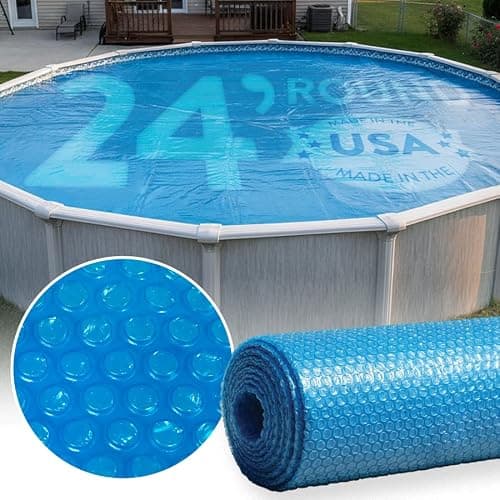
Bubble Solar Cover for Above-Ground Pools
Various
It cuts evaporation, and evaporation is simultaneously your water bill, your chemical bill and your heat loss. Nothing else on this site reduces three costs at once.
#ad how this is funded · price as of October 8, 2026
Key specs
- Construction
- Bubble sheet, thickness published in mil
- Thickness
- Higher mil lasts longer — 12 mil and 16 mil are common
- Fit
- Cut to size; buy oversize and trim
- Orientation
- Bubbles face down, toward the water
How it scoresour reading of published specs, not a test result
- Retention
- 9.0
- Durability
- 7.0
- Handling
- 6.0
- Running cost
- 9.8
- Value
- 9.5
Overall 9.0 / 10
What works
- Reduces evaporation, which is the mechanism behind the water, chemical and heat savings all at once
- Cheap relative to everything it saves
- Can be cut to fit any pool shape, so sizing is forgiving
What doesn't
- Awkward to get on and off without a reel, and awkward is how covers end up unused
- Degrades in UV like every vinyl product
- Not a safety cover and will not support weight — this is important
Skip it if: Being a safety barrier. A solar cover looks solid and is not; a child or pet on it goes through and under.
What it costs to run: The one accessory with a clear payback. Every gallon that does not evaporate is a gallon you do not replace at the EPA WaterSense national average of $6.06 per 1,000 gallons, and it is chlorine you do not re-dose. If you buy one thing from this hub, buy this.
Several seasons: Buy-once. Built and warranted to come back out of the box for a few years, if you store it properly.
Specs from: EPA WaterSense — cost per 1,000 gallons
Protecting the liner from below
Pool Ground Cloth / Under-Pool Pad
Various
Most liner punctures come from underneath, from a stone or a root you did not see. A ground cloth is the cheapest way to avoid the most expensive repair in above-ground pool ownership.
Key specs
- Function
- Barrier between ground and liner
- Sizing
- Should extend past the pool footprint
- Included with
- Some kits — check before buying separately
How it scoresour reading of published specs, not a test result
- Retention
- 8.0
- Durability
- 7.5
- Handling
- 8.5
- Running cost
- 10.0
- Value
- 9.0
Overall 8.5 / 10
What works
- Prevents the failure mode that ends pools: a puncture in the floor you cannot reach to patch
- Also slows grass and weeds growing up under the pool
- Included free in better kits, so check before you buy one
What doesn't
- Not a substitute for actually clearing stones and roots first
- Thin ones tear during installation before the pool is even up
- Traps moisture, which kills the grass underneath regardless
Skip it if: Fixing uneven ground. It protects against punctures; it does nothing about level, and level is the bigger problem.
What it costs to run: Compare its cost to a liner replacement, which is the single largest unplanned expense in above-ground pool ownership. It is not a close call.
Several seasons: Buy-once. Built and warranted to come back out of the box for a few years, if you store it properly.
Not throwing away a float over one hole
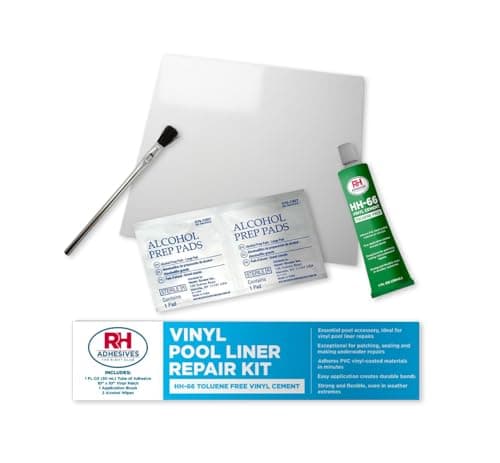
Vinyl Repair Patch Kit
Various
A few dollars of adhesive patches that turn most float failures into a ten-minute fix. The reason people replace floats annually is usually that they did not own one of these.
#ad how this is funded · price as of October 8, 2026
Key specs
- Use
- Vinyl floats, liners, air beds
- Requirement
- Surface must be clean and fully dry
- Cure
- Follow the kit — most need hours before re-inflating
How it scoresour reading of published specs, not a test result
- Material
- 8.0
- Valve
- 8.0
- Capacity
- 7.0
- Storage
- 9.5
- Value
- 9.5
Overall 8.5 / 10
What works
- Fixes the dominant failure mode of the entire floats category
- Also patches a pinhole in a pool liner, which is a far more expensive save
- Lasts indefinitely in the shed
What doesn't
- Will not fix a split seam, only a puncture
- Needs a genuinely dry surface, which is inconvenient poolside
- Cheap kits use adhesive that fails after a season in the water
Skip it if: Seam failures and valve leaks. Those are the end of the float and no patch changes that.
What it costs to run: The highest-leverage few dollars in this hub: one saved float pays for it several times over, and one saved liner pays for it a hundred times over.
Several seasons: Buy-once. Built and warranted to come back out of the box for a few years, if you store it properly.
Getting in and out safely
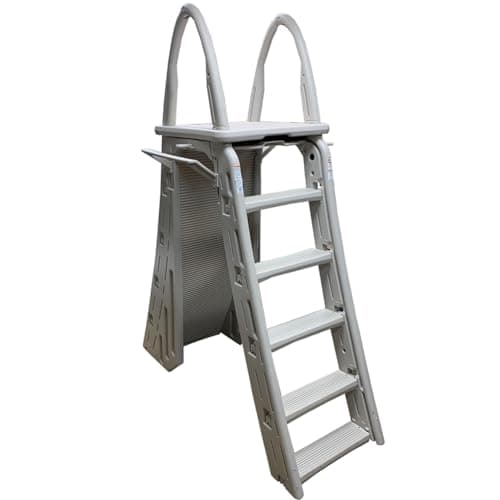
A-Frame Above-Ground Pool Ladder
Various
Read the published weight limit before anything else. It is frequently lower than buyers assume, and it is the one spec on a ladder that genuinely matters.
#ad how this is funded · price as of October 8, 2026
Key specs
- Critical spec
- Published weight capacity — check it against every adult who will use it
- Height match
- Must match your wall height, not approximate it
- Safety feature
- Removable or lockable outer steps on better models
How it scoresour reading of published specs, not a test result
- Sizing fit
- 8.5
- Running cost
- 10.0
- Maintenance
- 8.5
- Build
- 7.5
- Value
- 8.5
Overall 8.4 / 10
What works
- Removable outer steps genuinely prevent unsupervised access, which is a real safety layer
- Resin frames do not corrode the way early steel ladders did
- Correctly matched height is far more stable than a too-tall ladder
What doesn't
- Weight limits are often lower than people expect and are easy to overlook in a listing
- A ladder sized for a 42-inch wall is wrong on a 52-inch wall and vice versa
- Cheap models flex enough to feel alarming
Skip it if: Being a barrier on its own. The CPSC's guidance treats barriers, supervision and alarms as layers; a removable step is one layer, not the answer.
What it costs to run: Buy it with the pool. Kits that include a ladder are frequently cheaper than the pool-plus-ladder bought separately, and this is one of the accessories that makes a cheap-looking kit expensive.
Several seasons: Buy-once. Built and warranted to come back out of the box for a few years, if you store it properly.
Specs from: CPSC — Pool Safely
When the liner has failed, not before
Replacement Above-Ground Pool Liner
Various
The one repair that is genuinely worth doing rather than replacing the whole pool, provided the frame is sound. Measure twice: liner fit is unforgiving.
Key specs
- Types
- Overlap, beaded and unibead — they are not interchangeable
- Measure
- Diameter and wall height, exactly
- Gauge
- Published in mil — thicker lasts longer and is harder to fit
How it scoresour reading of published specs, not a test result
- Retention
- 8.0
- Durability
- 8.0
- Handling
- 5.5
- Running cost
- 9.0
- Value
- 8.0
Overall 7.9 / 10
What works
- Far cheaper than replacing a pool whose frame is still good
- A thicker gauge liner outlasts the original on most budget kits
- Beaded liners can be replaced without dismantling the top rail
What doesn't
- Overlap, beaded and unibead are different fitting systems and buying the wrong one is a total loss
- Fitting is a warm-day job — cold vinyl will not stretch into place
- A liner failure often reveals a frame or base problem that caused it
Skip it if: A pool whose frame is corroded. Replacing the liner in a failing frame just moves the failure a few months out.
What it costs to run: The largest single unplanned expense of above-ground pool ownership, and it is mostly preventable: a ground cloth, a level base and a winter close done properly are what decide whether you ever buy one.
Several seasons: Buy-once. Built and warranted to come back out of the box for a few years, if you store it properly.
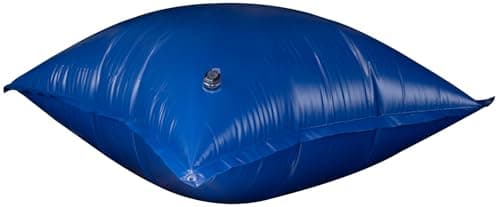
Stopping ice from pushing on the wall
Winter Air Pillow for Above-Ground Pools
Various
A few dollars of inflatable that gives expanding ice something compressible to push against instead of your pool wall. In a freezing climate this is not optional.
#ad how this is funded · price as of October 8, 2026
Key specs
- Function
- Absorbs ice expansion; centers the load away from the wall
- Inflation
- Inflate to roughly 60% — a fully inflated pillow bursts
- Placement
- Centered under the winter cover
How it scoresour reading of published specs, not a test result
- Retention
- 8.0
- Durability
- 6.5
- Handling
- 9.0
- Running cost
- 10.0
- Value
- 9.0
Overall 8.4 / 10
What works
- Extremely cheap relative to the wall or liner it protects
- Also stops rainwater and snowmelt pooling in the center of the cover
- Reusable for several winters if it survives one
What doesn't
- Cheap ones deflate mid-winter, which is when it matters
- Must be tethered or it drifts to the edge and does nothing
- Over-inflating is the most common mistake and it destroys the pillow
Skip it if: Climates that do not freeze. If your water never ices over, this is solving a problem you do not have.
What it costs to run: The cheapest insurance in this entire site against the most expensive winter failure. Inflate to about 60% and tether it.
One honest season: The cheapest setup that genuinely works for a season of real swimming. Nothing spare, nothing missing.
Questions people actually ask
How often do you replace a pool filter cartridge?
What spare parts should I keep for an above-ground pool?
How long does an above-ground pool liner last?
Can you buy replacement frame parts for an above-ground pool?
Sources
Read next
- What a pool actually costs, with the arithmetic shownPurchase, electricity, chemicals, water and replacement parts - added up, sourced, and shown as arithmetic you can redo.
- What upkeep costs, separated from everything elseChemicals by published dosing, cartridge replacement intervals, and the honest weekly time commitment.
- Liner replacement: the big occasional cost, and how to avoid itOverlap, beaded and unibead are not interchangeable - plus the three habits that decide whether you ever need a replacement.
- Year two, and the lines that disappearWhich pool costs are one-off and which recur, with a year-one and year-two comparison for the same pool.
- Filter cartridges: the consumable nobody budgets forThe replacement interval, the rinse-versus-scrub question, and how the cartridge treadmill compares with a sand filter across a season.
- How long an above-ground pool actually lastsRealistic lifespans by pool type, the four failure modes that account for nearly all of them, and the cheap items that add seasons.
- Buying a used pool without buying somebody else's problemThe inspection checklist for a secondhand pool, which faults are cheap and which end the deal, and the parts you will have to buy anyway.