Pool Equipment
What is inside the filter, and how fine it actually filters
Media choice decides three things: how small a particle you catch, how often you buy something, and whether maintenance costs you water or parts.

Heads up: we earn a commission if you buy through the links on this page, at no extra cost to you. It never decides the ranking — here is how we pick and here is the full disclosure. Prices are checked automatically; last verified October 8, 2026.
The short version
- Cartridge media filters finer than sand. That is why a cartridge pool can look clearer than a sand one of similar rating.
- Sand is cleaned; cartridges are replaced. One costs you water, the other costs you parts.
- Glass media is a drop-in sand replacement with a finer nominal rating and a longer life, at a higher price.
- On a small seasonal pool the cartridge usually still wins, and the crossover is around the point a cartridge pump runs out of rating.
What each medium is
Sand is graded silica in a pressure vessel. Water is pushed down through the bed and particles lodge in the spaces between grains. It is cleaned by reversing the flow to lift the bed and send the trapped dirt to waste — the procedure in our backwashing guide — and the media itself lasts several seasons before it needs changing.
Glass media is recycled glass processed to a similar grade and used as a direct substitute for sand in the same vessel. Its nominal filtration is finer, it is lighter for the same volume, and it typically lasts longer. It costs more up front.
Cartridge media is pleated fabric in a housing. The pleating gives a large surface area in a small unit, and it traps finer particles than sand. It cannot be cleaned in the way a sand bed can — it is rinsed, and eventually replaced.
| Sand | Glass | Cartridge | |
|---|---|---|---|
| Filtration fineness | Coarsest | Finer than sand | Finest of the three |
| Maintenance action | Backwash | Backwash | Rinse, then replace |
| Maintenance costs you | Water and chemistry | Water and chemistry | Parts |
| Media replacement | Several seasons | Longer than sand | ≈ every 2 weeks in heavy use |
| Up-front cost | Low | Higher | Lowest hardware cost |
| Suits | Larger pools | Larger pools, longer term | Small seasonal pools |
Fineness, and why it matters less than it sounds
Cartridge media traps smaller particles than sand, which is a genuine advantage and the reason a cartridge pool can look visibly clearer. But the practical picture is more complicated, because filtration performance changes as media loads.
A sand bed actually filters slightly finer as it loads, because the trapped material narrows the gaps — up to the point where the flow drops and it needs backwashing. A cartridge loads the other way: it starts fine and progressively restricts flow, and past a certain point rinsing no longer restores it.
Which means the honest comparison is not medium against medium, it is a well-maintained system against a neglected one. A rinsed-on-schedule cartridge outperforms an unbackwashed sand bed comfortably, and the reverse is equally true. Our cloudy water guide keeps arriving at the same conclusion for that reason.
What each one costs you across a season
This is where the choice actually bites, and the two media charge you in different currencies.
Cartridge costs parts. Intex guidance for Type A cartridges is replacement roughly every two weeks in heavy use, which is eight or nine across a 17-week season. Buying them singly is where this line gets expensive; multipacks bring the per-unit cost down substantially. Our cartridge guide covers stretching the interval honestly, and the replacement parts guide puts it in the annual budget.
Sand costs water. Every backwash sends water to waste and you refill from the tap, which also dilutes chlorine, stabilizer and alkalinity. At the EPA WaterSense national average of $6.06 per 1,000 gallons the water is not expensive, but the re-balancing is a recurring nuisance and the media still needs replacing every few seasons.
Changing sand or glass media
Sand does eventually need replacing rather than backwashing, because the grains round off with use and channels form through the bed — water finds the path of least resistance and stops passing through the media properly. The symptom is a filter that backwashes cleanly and still leaves the water hazy.
Changing it is a straightforward if messy job: drain the vessel, remove the old media without damaging the laterals or standpipe at the bottom, fill with water to cushion the drop, add the new media to the marked level, then backwash and rinse before returning to filter. Glass media drops into the same vessel and the same procedure applies, usually at a slightly lower fill weight for the same volume — follow the manufacturer’s figure rather than matching the sand weight.
What we would use, by pool size
Up to a few thousand gallons: cartridge. The hardware is cheap, the pool is small, and a sand filter is a lot of vessel for 1,700 gallons. The consumable is real but modest, and the fineness advantage is genuine.
Above about 6,000 gallons: sand or glass. This is where cartridge economics turn, because bather load and volume both push the replacement interval down while the pump runs out of published rating — Intex rates the C1000 for pools up to about 6,000 gallons. It is exactly why manufacturers bundle a sand filter with their largest pools. Our large pool equipment guide covers the threshold.
Glass over sand if you already have a sand vessel, are due a media change, and intend to keep the pool for several more seasons. It is a straight substitution with a finer nominal rating and a longer life, and it does not change the procedure.
Our sand versus cartridge comparison works the system-level decision through, and the filter roundup covers the hardware.
What to buy
Scores are our own reading of published specifications. They are not test results — we have not tested these products and we do not claim to.
The consumable you will actually buy repeatedly
Type A Replacement Filter Cartridges (multipack)
Various
Buy them in a multipack before you need them. A pool running on an exhausted cartridge is a cloudy pool, and the fix is a two-dollar part you did not have.
Key specs
- Type
- Type A — the most common Intex format
- Replacement interval
- Every 2 weeks in heavy use, per Intex guidance
- Between changes
- Rinse, do not scrub
How it scoresour reading of published specs, not a test result
- Sizing fit
- 9.0
- Running cost
- 7.0
- Maintenance
- 8.5
- Build
- 7.0
- Value
- 8.5
Overall 8.2 / 10
What works
- Type A is the most widely stocked cartridge format in the US
- Multipacks cost a fraction of buying singles
- Having a spare turns a cloudy week into a five-minute fix
What doesn't
- It is a genuine recurring cost that nobody includes in the purchase price
- Aftermarket quality varies noticeably
- Rinsing extends life but does not restore a cartridge that is done
Skip it if: Being restored. Once the pleats are permanently gray and stiff, rinsing is not saving it.
What it costs to run: The line item most people leave out of their pool budget. Count how many you use in your first season and you have your real annual filtration cost — this is exactly the number the cost-to-run guide asks you to record.
One honest season: The cheapest setup that genuinely works for a season of real swimming. Nothing spare, nothing missing.
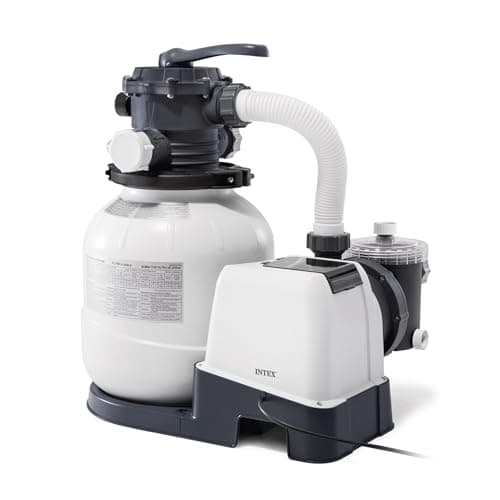
Getting off the cartridge treadmill
Intex Krystal Clear Sand Filter Pump
Intex
Sand filtration replaces a recurring cartridge purchase with a backwash valve and a bag of sand that lasts years. On a pool you intend to keep, the arithmetic favors it.
Key specs
- Media
- Filter sand (or glass media)
- Maintenance
- Backwash rather than rinse-and-replace
- Media life
- Several seasons before replacement
- Wattage
- Not published by Intex
How it scoresour reading of published specs, not a test result
- Sizing fit
- 8.5
- Running cost
- 8.0
- Maintenance
- 8.5
- Build
- 8.0
- Value
- 8.5
Overall 8.4 / 10
What works
- No cartridges to buy, which removes the single largest recurring equipment cost
- Backwashing takes about two minutes versus rinsing a cartridge in the yard
- Sand lasts years rather than weeks
What doesn't
- Backwashing sends water down the drain, and that water has chemicals in it you paid for
- Higher purchase price than a cartridge pump of the same flow
- Heavier and needs a stable, level base of its own
Skip it if: A small seasonal pool that comes down every autumn. The payback period is measured in seasons, so it only works if there will be seasons.
What it costs to run: The comparison to run: cartridge replacements per season versus one bag of sand every few years, plus the water each backwash discards at the EPA WaterSense average of $6.06 per 1,000 gallons. On a pool you will own for three or more years, sand usually wins.
Several seasons: Buy-once. Built and warranted to come back out of the box for a few years, if you store it properly.
Specs from: EPA WaterSense — cost per 1,000 gallons
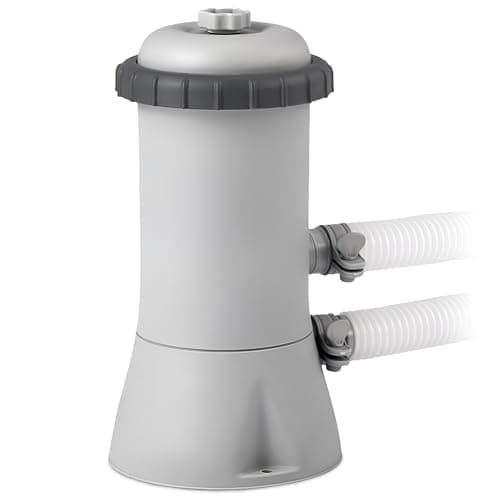
Pools up to about 6,000 gallons
Intex Krystal Clear C1000 Cartridge Filter Pump
Intex
The workhorse replacement pump for mid-size frame pools. 1,000 GPH pump flow, 750 GPH through the system once the cartridge is in the way — and that second number is the one your turnover math needs.
#ad how this is funded · price as of October 8, 2026
Key specs
- Pump flow rate
- 1,000 GPH
- System flow rate
- 750 GPH
- Rated pool size
- Up to 6,000 gallons
- Cartridge
- Type A
- Wattage
- Not published by Intex
How it scoresour reading of published specs, not a test result
- Sizing fit
- 9.0
- Running cost
- 7.0
- Maintenance
- 7.5
- Build
- 7.5
- Value
- 8.5
Overall 8.3 / 10
What works
- Intex publishes both pump flow and system flow, which is more honesty than most of this category offers
- Type A cartridges are the most widely stocked filter consumable in the US
- Sized correctly for the 12ft-15ft frame pools most families own
What doesn't
- Wattage is not published anywhere on the Intex site, so you cannot cost it before purchase
- Cartridge-only, so there is a consumable every few weeks in a busy pool
- GFCI cord length dictates where the pool can go more than people expect
Skip it if: Pools over about 6,000 gallons. Above that you are asking it to run all day to achieve one turnover, which is the expensive way to filter.
What it costs to run: Do the turnover math before you buy: 750 GPH system flow moves 4,000 gallons in 5.3 hours. Two turnovers a day is therefore about 11 hours of running. At the EIA's June 2026 US residential average of 18.34 cents per kWh, every 100 watts of pump draw running 11 hours a day for a 120-day season costs about $24. Find your wattage on the pump label and multiply.
Several seasons: Buy-once. Built and warranted to come back out of the box for a few years, if you store it properly.
Specs from: Intex — Krystal Clear cartridge filter pumps, EIA Electric Power Monthly, Table 5.6.A — US residential average price
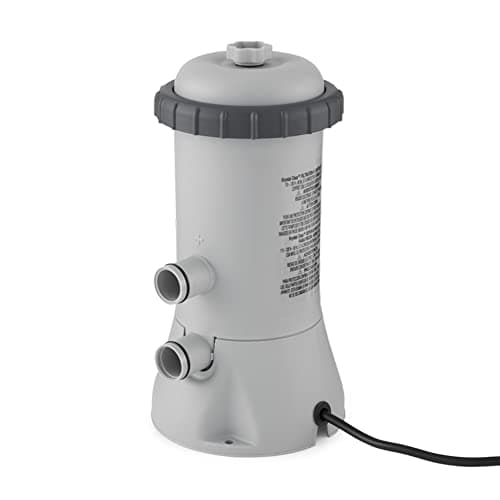
Small frame and inflatable pools
Intex Krystal Clear C530 Cartridge Filter Pump
Intex
530 GPH pump flow, 475 GPH through the system. The right pump for a 12-foot pool and badly undersized for anything much bigger.
#ad how this is funded · price as of October 8, 2026
Key specs
- Pump flow rate
- 530 GPH
- System flow rate
- 475 GPH
- Cartridge
- Type A
- Wattage
- Not published by Intex
How it scoresour reading of published specs, not a test result
- Sizing fit
- 8.0
- Running cost
- 9.0
- Maintenance
- 7.0
- Build
- 7.0
- Value
- 8.5
Overall 8.0 / 10
What works
- Correctly matched to the 12ft Prism Frame and Easy Set pools it ships with
- Smallest pump here that will still genuinely turn over a real pool
- Type A cartridges, which are everywhere
What doesn't
- Undersized the moment you upgrade the pool, and it will not carry over
- No wattage published
- Cartridge needs rinsing frequently in a busy small pool
Skip it if: Anything over about 2,000 gallons. Below that it is right; above it you are running it all day for one turnover.
What it costs to run: 475 GPH system flow turns over 1,718 gallons in about 3.6 hours, so a 7-hour daily run is two full turnovers. That is a genuinely short run time and it is where a small pool's low running cost actually comes from.
One honest season: The cheapest setup that genuinely works for a season of real swimming. Nothing spare, nothing missing.
Specs from: Intex — Krystal Clear cartridge filter pumps
Questions people actually ask
Which filters better, sand or cartridge?
Is glass filter media better than sand?
How often does pool filter sand need changing?
Why is sand coming back into my pool?
Sources
Read next
- Equipment, sized to your pool and costed by the wattPumps, filters, vacuums, heaters and ladders - matched to your gallons and priced by what they draw.
- Sand vs cartridge: it is a maintenance choice, not a quality oneThe honest comparison: consumable cost, backwash water, weekly effort, and the season count where sand starts to win.
- Filter cartridges: the consumable nobody budgets forThe replacement interval, the rinse-versus-scrub question, and how the cartridge treadmill compares with a sand filter across a season.
- Backwashing, and the rinse step everyone skipsThe full backwash and rinse cycle, how to know when it is due, and why every gallon discharged is water you pay for and re-balance.
- Pool filters: the consumable nobody budgets forCartridge replacement intervals, what rinsing does and does not achieve, and when sand becomes the cheaper answer.
- Equipment for a big above-ground pool, where the small-pool answers stop workingThe filtration, timing and cleaning kit for a 6,000-gallon-plus above-ground pool, and why the small-pool defaults stop applying.
- Cloudy pool water: work out which of four problems you haveA diagnostic decision tree for cloudy water - four causes, how to tell them apart, and the correct fix for each.
- What actually wears out, and when you will be buying itThe replacement schedule for an above-ground pool - cartridges, covers, liners and hardware - and which spares are worth keeping on the shelf.
- Sand filters, and the flow rate that is not on the boxSand filter systems from 800 gph to 35 GPM, compared on the flow that actually reaches the pool, how much sand each takes, and which makers void the warranty over media.
- Filter balls: the claims do not agree with each otherFilter balls weighed against sand on the claims sellers publish, the contradictions between them, and what your filter maker says about non-specified media.
- Your filter manual already chose the sandThe grade every above-ground filter manual names, what each bag on the shelf actually publishes, how many bags your tank takes, and where zeolite and glass genuinely fit.