Pool Equipment
Your filter manual already chose the sand
Both Intex and Bestway print the same specification, to the millimeter, in manuals almost nobody opens. Once you have read it, the only questions left are how many bags and whether to use sand at all.
Heads up: we earn a commission if you buy through the links on this page, at no extra cost to you. It never decides the ranking — here is how we pick and here is the full disclosure. Prices are checked automatically; last verified October 8, 2026.
Quick picks
Segmented before it is ranked — the right answer depends on which of these you actually are. Tap any row for the full write-up.
If you want to check the bag against the manual
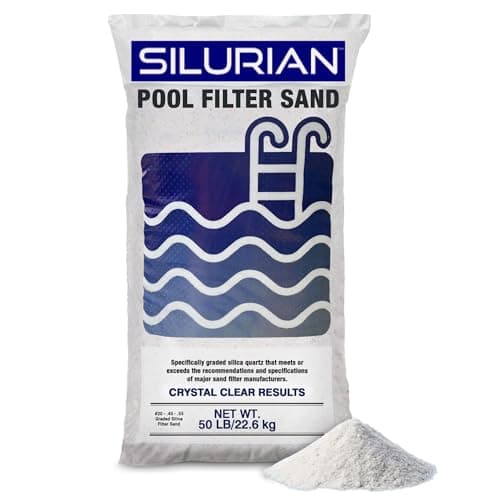
The only listing here that prints a millimeter range rather than a grade nickname, so you can hold it against what your filter actually specifies.
| # | Product | Best for | Score | Price |
|---|---|---|---|---|
| 1 | U.S. Silica Silurian 20 Grade Angular Pool Filter Sand, 50 lb The only bag in this roundup whose seller prints an actual millimeter range on the listing rather than a grade number alone. That is the whole reason to prefer it. | The one that publishes a grain rangeSeveral seasons | 8.8out of 10 |
For a frame-pool tank that takes one small charge
A Bestway Flowclear tank takes about 9 kg. This is the only bag sized for that, instead of leaving most of a 50 lb sack in the shed for four years.
| # | Product | Best for | Score | Price |
|---|---|---|---|---|
| 1 | 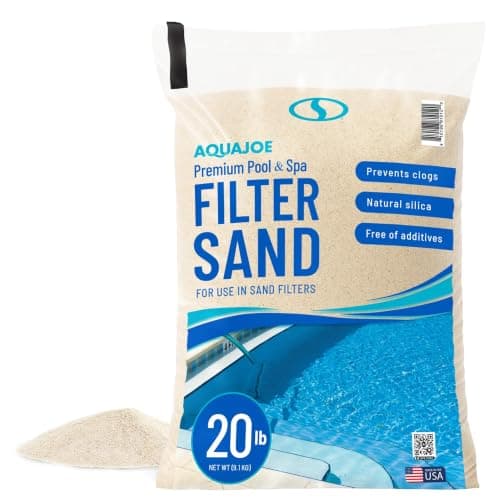 Aqua Joe FLTSAND20 Pool and Spa Filter Sand, 20 lb The bag size nobody else sells. A Bestway Flowclear tank takes about 9 kg, and this is the only product here that does not leave you with most of a 50 lb sack in the shed. | A frame-pool tank that takes one small chargeSeveral seasons | 8.3out of 10 |
Best value once you are buying two or three bags
On a 100 or 120 lb tank the cost per pound stops being a rounding error. This is the cheapest bag we found that still publishes a sieve range.
| # | Product | Best for | Score | Price |
|---|---|---|---|---|
| 1 | 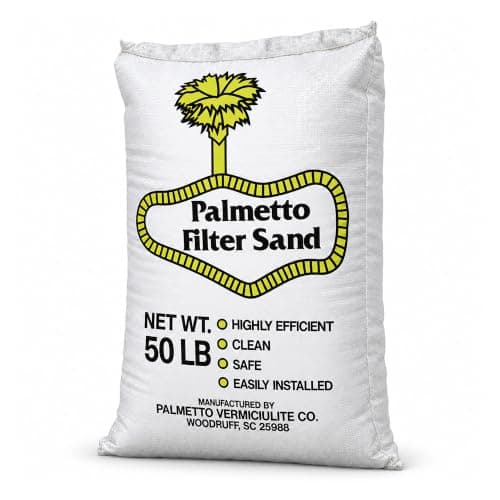 Palmetto Poolfilter-50 Pool Filter Sand, 50 lb The budget option that does not behave like one on paper: a published 20 to 40 sieve range and a stated claim to exceed the American Water Works Association requirement for filter sand. | The cheapest bag that still publishes a sieve rangeSeveral seasons | 8.7out of 10 | |
| 2 | 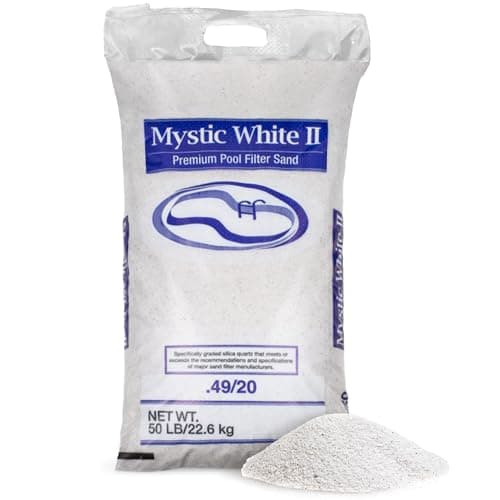 U.S. Silica Mystic White II Premium Pool Filter Sand, 50 lb The bag most pool shops stock, from the producer rather than a repackager. U.S. Silica publishes the grade and the grain shape and nothing else, which is more than most and less than you would like. | The named grade from the company that mines itSeveral seasons | 8.4out of 10 | |
| 3 | 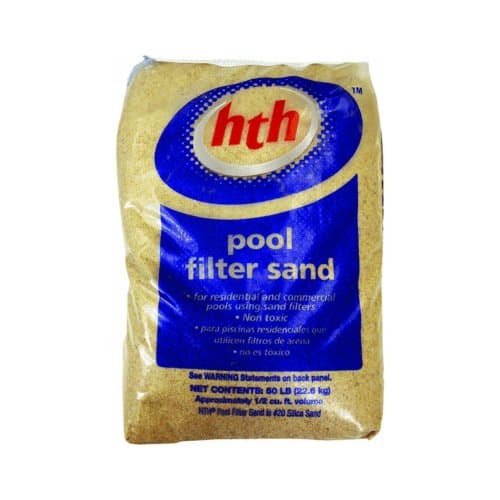 HTH 67074 Pool Filter Sand, 50 lb The most recognized name on the pool aisle and the least specific label in this roundup. It publishes a purity band and a process, and no grade at all. | The shelf brand, if you already buy HTH chemicalsSeveral seasons | 7.4out of 10 |
Instead of sand
Two media sold as drop-in replacements. One has a manufacturer capacity published by a filter maker; the other has better published claims and no approval at all.
| # | Product | Best for | Score | Price |
|---|---|---|---|---|
| 1 |  SPOOLSUPPLI Recycled Glass Pool Filter Media, 40 lb Recycled glass, the only alternative medium an above-ground filter maker gives a capacity for. Intex prints a glass figure beside its sand figure, which is as close to an approval as this category offers. | The one media swap Intex actually publishes a number forSeveral seasons | 7.0out of 10 | |
| 2 | 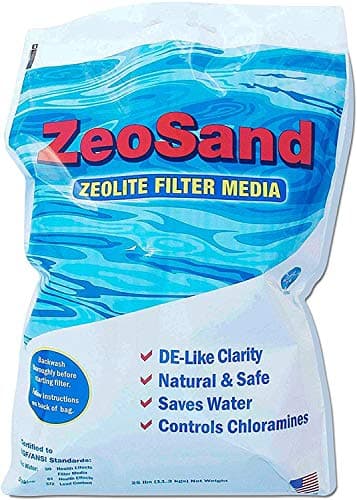 ZeoSand Zeolite Filter Media, 50 lb Natural zeolite, poured into a sand filter in place of sand at half the weight. The published claims are specific and the manufacturer states them itself, which is more than the balls manage. | Finer filtration without leaving the sand-filter formatSeveral seasons | 7.7out of 10 |
The short version
- The grade is not a matter of opinion. Intex and Bestway both specify #20 silica sand at 0.45 to 0.85 mm. Anything sold as #20 grade is claiming to be that.
- The quantity is published and varies by six times. About 9 kg for a Bestway Flowclear, 120 lb for an Intex SX3000. Look it up before you order bags.
- Play sand and beach sand void the warranty. Both makers say so explicitly, and the reason is grading rather than cleanliness.
- Glass is the one approved alternative. Intex publishes a glass capacity per model. Nobody publishes anything for zeolite or for filter balls.
The specification is already written down
This is the rare pool purchase where the manufacturer has done the choosing for you and almost nobody reads the answer. Intex’s sand filter pump manual asks for “No. 20 grade silica sand, with specification of 0.45 to 0.85mm (0.018 to 0.033 inches)”. Bestway’s Flowclear manual asks for “#20 silica sand, 0.45-0.85 mm”. Two companies that agree on very little have published an identical media specification, and Intex repeats it on the product pages too: the spec table for every Krystal Clear sand filter pump lists its capacity as so many pounds of “#20 Silica”.
That makes filter sand a commodity bought to a number rather than a product chosen on reputation. It also makes the shopping surprisingly awkward, because a lot of what is on the shelf does not print the number.
What #20 grade actually describes
Sand is graded by sieve. A #20 grade is sand that passes and is retained across a defined band of mesh sizes, and Intex publishes the translation into millimeters so you do not have to look it up: 0.45 to 0.85 mm. Grains inside that band are coarse enough to let water through at the flow rate the pump produces, and fine enough that the gaps between them trap debris rather than pass it.
Two properties matter beyond the band itself. The first is uniformity: a narrow spread produces an even bed, while a wide one lets small grains fill the spaces between large ones until the bed packs down and the water finds a channel through it. The second is shape. Angular grains interlock and present more edges to passing debris; rounded grains roll against each other and pack tighter. Filter makers specify washed, graded, angular silica for both reasons, which is precisely why the sand in your garden is not a substitute.
What each bag on the shelf actually publishes
Having established that one number decides everything, the interesting finding is how many sellers decline to print it. Here is what each product in this roundup states about itself, with nothing inferred.
| Product | Grade stated | Grain size stated | Shape stated | Bag |
|---|---|---|---|---|
| U.S. Silica Silurian 20 | #20 silica | 0.40 to 0.55 mm | Angular | 50 lb |
| U.S. Silica Mystic White II | #20 grade | Not published | Angular | 50 lb |
| Palmetto Poolfilter-50 | 20 grade | 20 to 40 sieve | Not published | 50 lb |
| Aqua Joe FLTSAND20 | Not published | Not published | Not published | 20 lb |
| HTH 67074 | Not published | Not published | Not published | 50 lb |
The pattern is not the one you would predict. The most recognizable brand on the pool aisle, HTH, publishes no grade and no grain size at all — what it does publish is a purity band of 87 to 99.9% crystalline silica quartz, which spans almost the entire possible range and therefore tells you very little. Palmetto, the cheapest bag we found in stock, publishes a sieve range and claims to exceed the American Water Works Association requirement for pool filter sand. The budget option is the one showing its working.
One honest caveat on the Silurian: its published 0.40 to 0.55 mm sits at the fine end of the 0.45 to 0.85 mm window the manuals describe, and the bottom of it is below that window entirely. In practice a finer bed filters slightly better and runs at slightly higher pressure, which is a trade most people would take. But it is a real difference, and it is only visible because U.S. Silica is the one company here that printed the number.
How many bags you actually need
This is where the money is, and it is the step people skip. Sand capacity is published per filter model, and the spread across the tanks an above-ground pool might carry is enormous.
| Filter | Sand capacity | 50 lb bags | Published glass capacity |
|---|---|---|---|
| Bestway Flowclear 58498E | About 9 kg | One 20 lb bag | Not published |
| Intex SX1500, 10 in tank | 26 lb (12 kg) | One, half unused | 18.5 lb (8.5 kg) |
| Intex SX2100, 12 in tank | 50 lb (23 kg) | Exactly one | 35 lb (16 kg) |
| Hayward ProSeries 16 in | 100 lb | Two | Not published |
| Intex SX3000, 16 in tank | 120 lb (55 kg) | Three, with spare | Not published |
Two things fall out of that table immediately. The first is that a Bestway Flowclear owner buying the default 50 lb bag is buying two and a half times what the tank holds, and the remainder has to stay dry in a shed for the four or five years until the next change. That is the entire argument for the 20 lb bag, and it is the only reason it appears in this roundup.
The second is that a 16 in tank is a three-bag job, which is 150 lb of material to move from a car to a pool pad. People underestimate that, and it is the point at which the lighter alternative media stop being a novelty and start being a reason.
What a full change costs you in effort, not money
- Intex SX3000 published sand capacity [Intex SX3000 specifications]
- 120 lb (55 kg)
- Standard retail bag
- 50 lb
- Bags required
- Three (150 lb bought, 120 lb used)
- Intex published replacement interval [Intex sand filter pump manual]
- Every 4 to 5 years, normal conditions
120 lb needed / 50 lb per bag = 2.4 bags, so three bags, once every four to five years
Under one bag a year, amortized
When to change it, and how you will know
Intex publishes four to five years for residential filters under normal operating conditions, and every two to three years where contamination is high. Its own SX2100 product page is blunter still, describing the unit as needing “virtually no maintenance except replacement of sand every 5 years”.
The calendar is the backstop rather than the trigger. What actually tells you is the pressure gauge: a bed that returns to high pressure within days of a backwash has lost its void space, either because the grains have worn round or because oils and fines have cemented the top layer. Water that will not clear despite correct chemistry is the other sign, and it is the one worth checking against our cloudy water decision tree before you blame the sand, because chemistry is the more common culprit by a wide margin.
The two media sold to replace sand
Both alternatives in this roundup make the same pitch: finer filtration, less weight, longer life. They differ enormously in how much of that is backed by anybody other than the seller.
Glass is the one an above-ground filter maker will put a number on. Intex publishes a glass capacity beside the sand capacity in its own specification tables — 18.5 lb of glass against 26 lb of sand on the SX1500, 35 lb against 50 lb on the SX2100. That is not a formal approval, but it is a manufacturer telling you how much of a medium to load, which no manufacturer does for zeolite or for balls. Worth noting: the seller of the glass media here claims it “requires 20% less than sand”, while Intex’s own two published pairs work out closer to 30% less. The gap is not large, and it is a reminder to load to your filter’s figure rather than the bag’s.
Zeolite has the better published claims and none of the approval. Zeo Inc states 2 to 5 micron filtration against the 20 to 40 microns the trade quotes for sand, a substitution ratio where about 25 lb of ZeoSand replaces 50 lb of silica sand, and a surface area of roughly 26 m2/g against 0.1 to 0.3 m2/g for sand. Those are specific, self-published figures rather than reseller copy, which puts zeolite well ahead of filter balls on evidence. It is still a medium your filter manual does not mention.
Bestway sits in between: its manual sanctions its own branded alternative, instructing owners to “use 0.06 lbs (28 g) Flowclear Polysphere to replace 2.20 lbs (1 kg) sand”. That is an approval for one specific product rather than for a category, and it does not extend to whatever else is sold in a similar bag.
Where the decision actually sits
For a seasonal above-ground pool, sand is the default for reasons that have nothing to do with performance. It is named in every manual, it costs the least, it is available everywhere, and it is the only medium that cannot create an argument if something goes wrong under warranty. The published micron gap between sand and the alternatives is real, but the thing standing between most above-ground pools and clear water is chemistry or turnover, not the last few microns of filtration — which is the same conclusion our filter media guide reaches from the other direction.
Glass earns its place if you are facing a 100 or 120 lb changeover and the weight is a genuine problem, because Intex has published a capacity for it and the charge is about a third lighter. Zeolite earns a look if your water is persistently hazy with everything else correct and you have decided the warranty question does not apply to you.
And if you are still choosing the filter itself rather than the media for it, our sand filter roundup sizes them on system flow rather than pump flow, and our sand versus cartridge comparison covers whether you want a sand filter at all. On most small pools the honest answer is still a cartridge.
The honest recommendation
Open the manual, find the capacity in pounds, and buy that much #20 silica from whoever is cheapest per pound. If the bag prints a millimeter range, that is a reason to prefer it over one that does not, but it is a tiebreaker rather than a decision — every bag here sold as #20 grade is claiming the same specification.
The two purchases genuinely worth thinking about are the 20 lb bag, if you own a small frame tank and would otherwise store 30 lb of sand for half a decade, and glass, if you are staring at three 50 lb bags and Intex has already told you a lighter charge is acceptable. Everything else in this category is the same mineral in a different sack.
The picks, in full
Scores are our own reading of published specifications. They are not test results — we have not tested these products and we do not claim to.
Pick #1 · The one that publishes a grain range
U.S. Silica Silurian 20 Grade Angular Pool Filter Sand, 50 lb
U.S. Silica
The only bag in this roundup whose seller prints an actual millimeter range on the listing rather than a grade number alone. That is the whole reason to prefer it.
#ad how this is funded · price as of October 8, 2026
Key specs
- Grade
- #20 silica, published
- Grain size
- 0.40 to 0.55 mm, published on the retail listing
- Grain shape
- Angular, published
- Processing
- Washed and screened for uniform size, published
- Chemistry
- Stated chemically inert; no effect claimed on water balance or sanitizer
- Bag weight
- 50 lb
- Silica purity
- Not published
How it scoresour reading of published specs, not a test result
- Sizing fit
- 8.5
- Running cost
- 9.0
- Maintenance
- 8.5
- Build
- 9.0
- Value
- 8.8
Overall 8.8 / 10
What works
- A published grain range rather than only a grade name, so you can check it against your filter manual yourself
- Angular grains, which is what filter manufacturers specify and what beach sand is not
- Sold in a straight 50 lb bag, which is exactly one charge for a 12 in frame-pool tank
- The stated inertness matters on a salt pool, where anything reactive in the bed is a long-term problem
What doesn't
- Its published 0.40 to 0.55 mm sits at the fine end of the 0.45 to 0.85 mm window Intex and Bestway both specify
- Silica purity is not published, so you cannot compare it on composition
- No NSF or ANSI certification is stated on the listing
- Fifty pounds is a fifty pound bag, and most people underestimate what carrying two of them is like
Skip it if: Telling you how much to buy. Like every bag here it is sold by weight and says nothing about your filter, which is the number that actually decides the order.
What it costs to run: Sand is bought roughly every four to five years on Intex's own published interval, so the annual cost of the media itself is small. What it costs continuously is backwash water, and that is set by how often you backwash rather than by which bag you bought.
Several seasons: Buy-once. Built and warranted to come back out of the box for a few years, if you store it properly.
Specs from: U.S. Silica Silurian 20 Grade, published listing specifications, Intex — sand filter pump manual, published sand grade
Pick #2 · A frame-pool tank that takes one small charge
Aqua Joe FLTSAND20 Pool and Spa Filter Sand, 20 lb
Aqua Joe
The bag size nobody else sells. A Bestway Flowclear tank takes about 9 kg, and this is the only product here that does not leave you with most of a 50 lb sack in the shed.
#ad how this is funded · price as of October 8, 2026
Key specs
- Bag weight
- 20 lb
- Composition
- Natural silica, free of additives and harsh chemicals, published
- Processing
- Pre-washed and kiln-dried, published
- Grain consistency
- Stated processed for consistent, uniform grain sizing
- Preparation
- Stated as ready to pour without rinsing
- Grade number
- Not published
- Grain size in mm
- Not published
How it scoresour reading of published specs, not a test result
- Sizing fit
- 9.5
- Running cost
- 8.0
- Maintenance
- 9.0
- Build
- 7.5
- Value
- 8.2
Overall 8.3 / 10
What works
- A 20 lb bag is roughly one charge for a Bestway Flowclear tank, whose manual publishes about 9 kg
- Kiln-dried and pre-washed, so the first backwash is shorter and the water clears sooner
- Light enough for one person to carry and tip without help, which no 50 lb bag is
- Explicitly free of additives, which keeps it simple on a salt or stabilized pool
What doesn't
- No published grade and no millimeter range, so it cannot be checked against a filter manual
- Cost per pound is much higher than the 50 lb bags, which is the price of the right size
- On a 50 lb or 120 lb tank you would be buying three to six bags, which makes no sense
- The same line is sold in a 50 lb bag with the same absence of a grade specification
Skip it if: Anything larger than a small frame-pool tank. Above about 26 lb of capacity the arithmetic turns against it immediately.
What it costs to run: This is the rare case where the smaller bag is the cheaper purchase, because the alternative is buying 50 lb to use 20 and storing the rest somewhere dry for four years.
Several seasons: Buy-once. Built and warranted to come back out of the box for a few years, if you store it properly.
Specs from: Aqua Joe FLTSAND20, published listing specifications, Bestway — 58498E Flowclear sand filter manual, published sand capacity
Pick #3 · The cheapest bag that still publishes a sieve range
Palmetto Poolfilter-50 Pool Filter Sand, 50 lb
Palmetto
The budget option that does not behave like one on paper: a published 20 to 40 sieve range and a stated claim to exceed the American Water Works Association requirement for filter sand.
#ad how this is funded · price as of October 8, 2026
Key specs
- Grade
- 20 grade silica, published
- Sieve range
- 20 to 40 sieve, published
- Standard claimed
- Stated to exceed American Water Works Association requirements for pool filter sand
- Composition
- 100% natural silica, no chemicals added, published
- Processing
- Washed; precision screened, published
- Bag weight
- 50 lb
- Grain shape
- Not published
How it scoresour reading of published specs, not a test result
- Sizing fit
- 8.5
- Running cost
- 9.0
- Maintenance
- 8.5
- Build
- 8.0
- Value
- 9.3
Overall 8.7 / 10
What works
- Publishes a sieve range, which is a real specification rather than a grade nickname
- Names a standard it claims to exceed, which almost nothing else in this category does
- Consistently the lowest cost per pound of the #20 bags we found in stock
- No additives, which keeps it uncomplicated on a salt pool or a stabilized one
What doesn't
- Grain shape is not published, and angular versus rounded is the one physical property that changes filtration
- The AWWA claim is the seller's, not a certification mark you can look up
- Bag weight is listed as 49 lb on some retail pages and 50 lb on others
- A 20 to 40 sieve band is wide; the narrower the band, the more even the bed
Skip it if: Reassuring anyone who wants a certificate. It publishes more than the premium bags do and still has nothing you can independently verify.
What it costs to run: On the biggest above-ground tanks you are buying two or three bags, and at that point cost per pound stops being a rounding error. This is the bag where buying the larger multipack actually changes the total.
Several seasons: Buy-once. Built and warranted to come back out of the box for a few years, if you store it properly.
Specs from: Palmetto Poolfilter-50 20# grade, published listing specifications
Pick #4 · The named grade from the company that mines it
U.S. Silica Mystic White II Premium Pool Filter Sand, 50 lb
U.S. Silica
The bag most pool shops stock, from the producer rather than a repackager. U.S. Silica publishes the grade and the grain shape and nothing else, which is more than most and less than you would like.
#ad how this is funded · price as of October 8, 2026
Key specs
- Grade
- #20 grade, published by U.S. Silica
- Grain shape
- Angular, published
- Color
- Bright white, premium grade, published
- Bag weight
- 50 lb
- Grain size in mm
- Not published by U.S. Silica
- Silica purity
- Not published
- Certification
- None stated on the product page
How it scoresour reading of published specs, not a test result
- Sizing fit
- 8.5
- Running cost
- 9.0
- Maintenance
- 8.5
- Build
- 8.5
- Value
- 8.0
Overall 8.4 / 10
What works
- Comes from the company that actually mines and grades the sand rather than a brand that buys it in
- #20 grade and angular shape are both published, which is the pair of facts a filter manual asks for
- Sold in multiple sizes under one grade, so a bigger tank does not mean a different product
- The white color makes it obvious when the bed has gone gray and is due for changing
What doesn't
- U.S. Silica publishes no millimeter range on its own product page, only the grade name
- No purity figure, no uniformity coefficient and no certification is stated anywhere we could find
- Priced above the budget bags for a grade specification that is nominally identical
- Bright white is a cosmetic property, not a filtration one, and it is doing marketing work here
Skip it if: Being compared on numbers. The grade name is the only specification, so a like-for-like comparison against another #20 bag comes down to price and bag size.
What it costs to run: A 50 lb bag is one full charge for a 12 in frame-pool tank and roughly half a charge for a 16 in one. Work out your filter's published capacity before ordering, because the second bag costs its own shipping.
Several seasons: Buy-once. Built and warranted to come back out of the box for a few years, if you store it properly.
Specs from: U.S. Silica — Mystic White II premium swimming pool filter sand, published product page
Pick #5 · The shelf brand, if you already buy HTH chemicals
HTH 67074 Pool Filter Sand, 50 lb
HTH
The most recognized name on the pool aisle and the least specific label in this roundup. It publishes a purity band and a process, and no grade at all.
#ad how this is funded · price as of October 8, 2026
Key specs
- Composition
- 87 to 99.9% crystalline silica quartz, published
- Processing
- Thoroughly washed and specially graded, published
- Salt compatibility
- Stated compatible with salt systems
- Origin
- Made in the USA, published
- Bag weight
- 50 lb
- Grade number
- Not published
- Grain size in mm
- Not published
How it scoresour reading of published specs, not a test result
- Sizing fit
- 7.0
- Running cost
- 9.0
- Maintenance
- 8.5
- Build
- 7.5
- Value
- 6.5
Overall 7.4 / 10
What works
- The only bag here that publishes a silica purity range at all
- Explicitly stated as compatible with salt chlorine generators
- Widely stocked in physical stores, so it is the one you can collect today rather than wait for
- From a chemical brand that a first-pool owner is likely already buying tablets and shock from
What doesn't
- No grade number is published, so you cannot confirm it against the #20 your filter manual names
- No millimeter range either, which makes the grade question unanswerable from the label
- 87 to 99.9% is an extremely wide purity band and tells you almost nothing about the bag in front of you
- Consistently the most expensive 50 lb bag we found, for the least published specification
Skip it if: Being checked against a manual. If your filter specifies #20 silica at 0.45 to 0.85 mm, this label does not let you confirm either number.
What it costs to run: Paying a brand premium on a commodity is a choice, not a mistake, and on one bag every four or five years the absolute difference is small. On a 120 lb tank you are making it three times.
Several seasons: Buy-once. Built and warranted to come back out of the box for a few years, if you store it properly.
Specs from: HTH 67074 filter sand, published listing specifications
Pick #6 · The one media swap Intex actually publishes a number for
SPOOLSUPPLI Recycled Glass Pool Filter Media, 40 lb
SPOOLSUPPLI
Recycled glass, the only alternative medium an above-ground filter maker gives a capacity for. Intex prints a glass figure beside its sand figure, which is as close to an approval as this category offers.
Key specs
- Media
- 100% recycled glass, published
- Filtration claim
- Particles as small as 5 microns, published
- Substitution claim
- Requires 20% less than sand, published by the seller
- Life claim
- Lasts three times longer than sand, published by the seller
- Base layer
- Stated usable with or without a pea gravel base, per your filter maker
- Bag weight
- 40 lb
- Intex published glass capacity
- 18.5 lb on the SX1500 and 35 lb on the SX2100, against 26 lb and 50 lb of sand
How it scoresour reading of published specs, not a test result
- Sizing fit
- 7.5
- Running cost
- 6.0
- Maintenance
- 8.5
- Build
- 8.5
- Value
- 5.5
Overall 7.0 / 10
What works
- Intex publishes a separate glass capacity for its sand filter pumps, so this is the alternative medium with a manufacturer number behind it
- A 5 micron claim against the 20 to 40 microns the trade quotes for sand
- Recycled content, and glass does not break down into fines the way a tired sand bed does
- Lighter charge than sand for the same tank, which is a real difference on a full changeover
What doesn't
- By far the highest cost per pound of anything in this roundup, and it is not close
- The seller's 20% reduction and Intex's own figures disagree: Intex publishes roughly 30% less glass than sand
- Sold in a 40 lb bag, which matches no published filter capacity exactly
- The three-times-longer life claim has no stated basis and no test behind it
Skip it if: Value. On a small frame-pool filter the media cost approaches the cost of the filter, which is difficult to justify for a seasonal pool.
What it costs to run: The arithmetic only starts to work if the three-times-life claim holds, because you are paying several times the price of sand up front. Since nobody publishes a test for that claim, treat the premium as unrecovered until your own bed proves otherwise.
Several seasons: Buy-once. Built and warranted to come back out of the box for a few years, if you store it properly.
Specs from: SPOOLSUPPLI recycled glass filter media, published listing claims, Intex — SX1500 sand filter pump, published sand and glass capacities
Pick #7 · Finer filtration without leaving the sand-filter format
ZeoSand Zeolite Filter Media, 50 lb
Zeo Inc
Natural zeolite, poured into a sand filter in place of sand at half the weight. The published claims are specific and the manufacturer states them itself, which is more than the balls manage.
#ad how this is funded · price as of October 8, 2026
Key specs
- Media
- Natural zeolite
- Filtration claim
- 2 to 5 micron, published by Zeo Inc
- Substitution ratio
- About 25 lb replaces 50 lb of silica sand, published
- Surface area
- About 26 m2/g against 0.1 to 0.3 m2/g for silica sand, published
- Loading instruction
- Add water to the filter before adding the media, published
- Bag weight
- 50 lb, supplied as two 25 lb bags
- Filter maker approval
- Not published by Intex, Bestway or Hayward
How it scoresour reading of published specs, not a test result
- Sizing fit
- 7.5
- Running cost
- 7.0
- Maintenance
- 8.0
- Build
- 8.5
- Value
- 7.5
Overall 7.7 / 10
What works
- The manufacturer publishes its own micron claim, substitution ratio and surface-area figure rather than leaving it to resellers
- Half the weight to carry and store for the same tank, which is a real benefit on a 120 lb charge
- Depth loading rather than surface loading is a genuine filtration mechanism, not a marketing invention
- A 2 to 5 micron claim is far finer than the 20 to 40 micron figure the trade quotes for sand
What doesn't
- No above-ground filter manufacturer we checked publishes an approval for zeolite, and both Intex and Bestway warn that non-specified media can void the warranty
- Costs meaningfully more than an equivalent charge of silica sand
- Micron claims in this category are not independently tested anywhere we could find
- Backwash behavior differs from sand, so the routine you already know changes
Skip it if: A warranty-safe swap. If the filter is new and the warranty matters to you, the manual names silica and nothing else.
What it costs to run: The saving that is real is weight and storage, not money: you carry half as much and store half as much. Silica sand is one of the cheapest things a pool ever needs, so this is an upgrade you buy for clarity, not for economy.
Several seasons: Buy-once. Built and warranted to come back out of the box for a few years, if you store it properly.
Specs from: Zeo Inc — ZeoSand published specifications and substitution ratio, Leslie's — pool filter media types, published micron comparison
Questions people actually ask
Can I use play sand or builder's sand in a pool filter?
What does #20 silica sand mean?
How much sand does my filter need?
How often does filter sand need replacing?
Is glass or zeolite better than sand?
Sources
- Intex — Krystal Clear sand filter pump manual (sand grade, media life, warranty)
- Bestway — 58498E Flowclear sand filter manual (grade, capacity, warranty)
- Intex — SX1500 sand filter pump, published sand and glass capacities
- Intex — SX2100 sand filter pump, published sand and glass capacities
- Intex — SX3000 sand filter pump, published sand capacity
- Hayward — ProSeries 16 in sand filter system, published sand capacity
- Zeo Inc — ZeoSand published specifications
- Leslie's — pool filter media types, published micron comparison
Read next
- Equipment, sized to your pool and costed by the wattPumps, filters, vacuums, heaters and ladders - matched to your gallons and priced by what they draw.
- What is inside the filter, and how fine it actually filtersSand, glass and cartridge media compared on what they trap, how long they last, and what each costs to maintain across a season.
- Sand filters, and the flow rate that is not on the boxSand filter systems from 800 gph to 35 GPM, compared on the flow that actually reaches the pool, how much sand each takes, and which makers void the warranty over media.
- Backwashing, and the rinse step everyone skipsThe full backwash and rinse cycle, how to know when it is due, and why every gallon discharged is water you pay for and re-balance.
- Sand vs cartridge: it is a maintenance choice, not a quality oneThe honest comparison: consumable cost, backwash water, weekly effort, and the season count where sand starts to win.
- Filter balls: the claims do not agree with each otherFilter balls weighed against sand on the claims sellers publish, the contradictions between them, and what your filter maker says about non-specified media.
- Cloudy pool water: work out which of four problems you haveA diagnostic decision tree for cloudy water - four causes, how to tell them apart, and the correct fix for each.
- Sizing a pump: the number on the box is not the number you useTurnover time computed from published system flow rates for common pool volumes, and why an oversized pump costs you money every day.