Pool Equipment
Backwashing, and the rinse step everyone skips
A sand filter cleans itself by reversing the flow and throwing the dirt away. Skip the twenty seconds of rinse afterwards and you send it straight back into the pool.

Heads up: we earn a commission if you buy through the links on this page, at no extra cost to you. It never decides the ranking — here is how we pick and here is the full disclosure. Prices are checked automatically; last verified October 8, 2026.
The short version
- Pump off before the valve moves. Every time. Turning a multiport valve under pressure damages the gasket, and that fault leaks water to waste permanently.
- The rinse cycle is not optional. Twenty to thirty seconds, and without it the filter’s first act on return is to push the loosened debris into your pool.
- Backwash on pressure, not on a calendar. Note the clean reading after each backwash; the next one is due when pressure has risen meaningfully above it.
- Every backwash costs water. It goes to waste, you refill, and the refill dilutes your chemistry — which is the real argument against backwashing more often than needed.
What backwashing actually does
A sand filter works by pushing water down through a bed of media, where dirt is trapped in the spaces between the grains. Over time those spaces fill, the resistance rises and the flow rate falls — the same loading that happens to a cartridge, except that a sand bed can be cleaned rather than replaced.
Backwashing reverses the flow so water goes up through the bed, lifting and separating the grains and carrying the trapped dirt out to waste. That is the whole mechanism, and it is why the media lasts several seasons rather than a fortnight. It is also why a sand filter appeals on a larger pool — the consumable is water and electricity rather than parts. Our sand versus cartridge comparison works that trade-off through properly.
Knowing when it is due
The correct trigger is pressure, not a day of the week. After every backwash and rinse, look at the pressure gauge and note the reading with a clean bed. That figure is your baseline, and it will not be the same as anyone else’s because it depends on your pump, your plumbing and your pool.
When the gauge has risen meaningfully above that baseline, the bed is loaded and the flow has dropped. That is the moment. Backwashing before it is due wastes water and dilutes chemistry for no benefit; leaving it far past is what turns clear water cloudy while the chemistry tests fine — the same mechanism our cloudy water guide describes for cartridges.
| What you see | What it means | What to do |
|---|---|---|
| Pressure well above the clean baseline | The bed is loaded | Backwash, then rinse |
| Pressure rising again within days | Something is loading it fast | Check for algae, or a vacuum session's worth of debris |
| Pressure low, weak return flow | Restriction before the pump | Check the skimmer and pump baskets first |
| Sand appearing in the pool | Damaged lateral or standpipe | Stop; this is a repair, not a backwash |
| Water at waste in FILTER position | Multiport gasket damaged | Usually from moving the valve under pressure |
The rinse step, and why skipping it undoes the job
After a backwash the sand bed has been lifted and churned. The grains have not resettled and there is loose material sitting in the filter that has not yet gone anywhere. If you switch straight back to FILTER, the first thing the pump does is push all of it into your clean pool.
The RINSE position sends water down through the bed in the normal direction but out to waste rather than back to the pool. Twenty to thirty seconds resettles the sand and clears the loose debris. It is the shortest step in the procedure and it is the one that decides whether the pool looks better or worse afterwards.
What a backwash costs you
Water, and then chemistry. Every gallon that goes to waste is a gallon you refill from the tap, and that refill dilutes chlorine, stabilizer and total alkalinity along with everything else. On a small seasonal pool that is not expensive, but it is not free either, and it is the reason to backwash on pressure rather than on habit.
Costing your own backwash, once
- Discharge volume
- measure it once — see the note
- US average water price [EPA WaterSense]
- $6.06 / 1,000 gal
cost = (gallons to waste ÷ 1,000) × your water rate
Measure once, then you know the price of every backwash you do
Backwashing after a vacuum, and the exception
A thorough vacuum sends a season’s worth of settled debris into the filter in twenty minutes, so a backwash immediately afterwards is usually warranted regardless of what the gauge said before you started. Plan the two jobs together — our manual cleaning tools page covers the vacuum side.
The exception is vacuuming up a heavy algae bloom or fine sediment, where sending it through the filter at all is questionable. On systems that offer it, a WASTE position bypasses the bed entirely and sends everything straight out, at the cost of losing that water. On a seasonal pool where a refill is inexpensive, that is frequently the right call — our algae guide covers the recovery sequence.
If you have a cartridge filter instead
None of this applies, and that is the trade. There is no valve, no waste line and no water lost — but there is also nothing to clean the media, so you rinse the cartridge and eventually replace it. Intex guidance is roughly every two weeks in heavy use, and rinsing rather than scrubbing in between, because a brush drives debris into the pleats and damages the media.
Our cartridge guide covers that routine in full, and the pump sizing guide covers why a loading cartridge quietly reduces your effective system flow rate in a way a backwashed sand bed does not.
What to buy
Scores are our own reading of published specifications. They are not test results — we have not tested these products and we do not claim to.
Getting off the cartridge treadmill
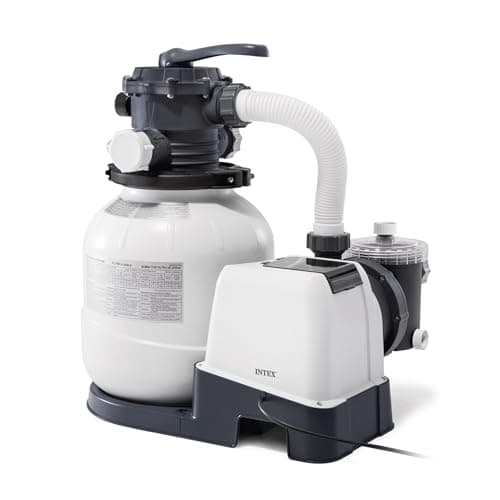
Intex Krystal Clear Sand Filter Pump
Intex
Sand filtration replaces a recurring cartridge purchase with a backwash valve and a bag of sand that lasts years. On a pool you intend to keep, the arithmetic favors it.
Key specs
- Media
- Filter sand (or glass media)
- Maintenance
- Backwash rather than rinse-and-replace
- Media life
- Several seasons before replacement
- Wattage
- Not published by Intex
How it scoresour reading of published specs, not a test result
- Sizing fit
- 8.5
- Running cost
- 8.0
- Maintenance
- 8.5
- Build
- 8.0
- Value
- 8.5
Overall 8.4 / 10
What works
- No cartridges to buy, which removes the single largest recurring equipment cost
- Backwashing takes about two minutes versus rinsing a cartridge in the yard
- Sand lasts years rather than weeks
What doesn't
- Backwashing sends water down the drain, and that water has chemicals in it you paid for
- Higher purchase price than a cartridge pump of the same flow
- Heavier and needs a stable, level base of its own
Skip it if: A small seasonal pool that comes down every autumn. The payback period is measured in seasons, so it only works if there will be seasons.
What it costs to run: The comparison to run: cartridge replacements per season versus one bag of sand every few years, plus the water each backwash discards at the EPA WaterSense average of $6.06 per 1,000 gallons. On a pool you will own for three or more years, sand usually wins.
Several seasons: Buy-once. Built and warranted to come back out of the box for a few years, if you store it properly.
Specs from: EPA WaterSense — cost per 1,000 gallons
Pools up to about 6,000 gallons
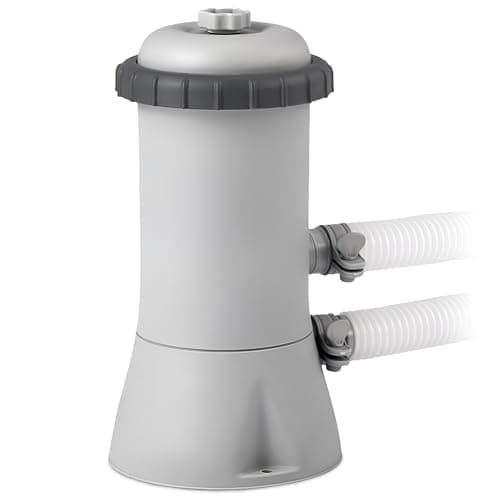
Intex Krystal Clear C1000 Cartridge Filter Pump
Intex
The workhorse replacement pump for mid-size frame pools. 1,000 GPH pump flow, 750 GPH through the system once the cartridge is in the way — and that second number is the one your turnover math needs.
#ad how this is funded · price as of October 8, 2026
Key specs
- Pump flow rate
- 1,000 GPH
- System flow rate
- 750 GPH
- Rated pool size
- Up to 6,000 gallons
- Cartridge
- Type A
- Wattage
- Not published by Intex
How it scoresour reading of published specs, not a test result
- Sizing fit
- 9.0
- Running cost
- 7.0
- Maintenance
- 7.5
- Build
- 7.5
- Value
- 8.5
Overall 8.3 / 10
What works
- Intex publishes both pump flow and system flow, which is more honesty than most of this category offers
- Type A cartridges are the most widely stocked filter consumable in the US
- Sized correctly for the 12ft-15ft frame pools most families own
What doesn't
- Wattage is not published anywhere on the Intex site, so you cannot cost it before purchase
- Cartridge-only, so there is a consumable every few weeks in a busy pool
- GFCI cord length dictates where the pool can go more than people expect
Skip it if: Pools over about 6,000 gallons. Above that you are asking it to run all day to achieve one turnover, which is the expensive way to filter.
What it costs to run: Do the turnover math before you buy: 750 GPH system flow moves 4,000 gallons in 5.3 hours. Two turnovers a day is therefore about 11 hours of running. At the EIA's June 2026 US residential average of 18.34 cents per kWh, every 100 watts of pump draw running 11 hours a day for a 120-day season costs about $24. Find your wattage on the pump label and multiply.
Several seasons: Buy-once. Built and warranted to come back out of the box for a few years, if you store it properly.
Specs from: Intex — Krystal Clear cartridge filter pumps, EIA Electric Power Monthly, Table 5.6.A — US residential average price
The consumable you will actually buy repeatedly
Type A Replacement Filter Cartridges (multipack)
Various
Buy them in a multipack before you need them. A pool running on an exhausted cartridge is a cloudy pool, and the fix is a two-dollar part you did not have.
Key specs
- Type
- Type A — the most common Intex format
- Replacement interval
- Every 2 weeks in heavy use, per Intex guidance
- Between changes
- Rinse, do not scrub
How it scoresour reading of published specs, not a test result
- Sizing fit
- 9.0
- Running cost
- 7.0
- Maintenance
- 8.5
- Build
- 7.0
- Value
- 8.5
Overall 8.2 / 10
What works
- Type A is the most widely stocked cartridge format in the US
- Multipacks cost a fraction of buying singles
- Having a spare turns a cloudy week into a five-minute fix
What doesn't
- It is a genuine recurring cost that nobody includes in the purchase price
- Aftermarket quality varies noticeably
- Rinsing extends life but does not restore a cartridge that is done
Skip it if: Being restored. Once the pleats are permanently gray and stiff, rinsing is not saving it.
What it costs to run: The line item most people leave out of their pool budget. Count how many you use in your first season and you have your real annual filtration cost — this is exactly the number the cost-to-run guide asks you to record.
One honest season: The cheapest setup that genuinely works for a season of real swimming. Nothing spare, nothing missing.
Actual debris, at the lowest cost
Manual Vacuum Head with Telescopic Pole and Hose
Various
Connects to the skimmer and uses the pump you already own. It is slower than a robot, cheaper than everything, and it is what most above-ground pools should have.
Key specs
- Power
- Uses the pool's existing pump suction
- Needs
- A telescopic pole and a vacuum hose of the right length
- Fitting
- Must match the skimmer on your pool
- Consumables
- None beyond the filter it already loads
How it scoresour reading of published specs, not a test result
- Sizing fit
- 8.5
- Running cost
- 9.8
- Maintenance
- 8.0
- Build
- 8.0
- Value
- 9.5
Overall 8.8 / 10
What works
- No batteries, no motor, nothing that can fail electrically
- Lifts real debris, not just silt
- Cheapest capable option, by a wide margin
What doesn't
- You have to prime the hose properly or the pump loses suction
- Loads the filter heavily, so plan to clean it right after
- It is genuinely manual work and takes twenty minutes
Skip it if: A pool without a skimmer connection, which rules out most soft-side inflatables.
What it costs to run: Free to run beyond the pump time you are already paying for. The one hidden cost is filter loading — expect to clean the cartridge immediately after vacuuming.
Several seasons: Buy-once. Built and warranted to come back out of the box for a few years, if you store it properly.
Questions people actually ask
How often should you backwash a sand filter?
Do you have to rinse after backwashing?
Can you turn the multiport valve while the pump is running?
Does backwashing waste a lot of water?
Sources
Read next
- Equipment, sized to your pool and costed by the wattPumps, filters, vacuums, heaters and ladders - matched to your gallons and priced by what they draw.
- Sand vs cartridge: it is a maintenance choice, not a quality oneThe honest comparison: consumable cost, backwash water, weekly effort, and the season count where sand starts to win.
- Filter cartridges: the consumable nobody budgets forThe replacement interval, the rinse-versus-scrub question, and how the cartridge treadmill compares with a sand filter across a season.
- Pool filters: the consumable nobody budgets forCartridge replacement intervals, what rinsing does and does not achieve, and when sand becomes the cheaper answer.
- Pool pump problems, diagnosed in the cheapest orderThe five-check diagnostic sequence for an above-ground pool pump, from free fixes to the point at which it is genuinely the motor.
- What it costs to fill a pool, and to keep it fullOne fill priced for four common pool volumes at the national average water rate, plus why every gallon you add has to be re-balanced.
- Cloudy pool water: work out which of four problems you haveA diagnostic decision tree for cloudy water - four causes, how to tell them apart, and the correct fix for each.
- Sand filters, and the flow rate that is not on the boxSand filter systems from 800 gph to 35 GPM, compared on the flow that actually reaches the pool, how much sand each takes, and which makers void the warranty over media.
- Your filter manual already chose the sandThe grade every above-ground filter manual names, what each bag on the shelf actually publishes, how many bags your tank takes, and where zeolite and glass genuinely fit.