Pool Care & Chemistry
Clear water and safe water are two different things
Clarity is a filtration report. Safety is a sanitizer report. They are produced by different systems and they fail independently, which is why looking at the pool tells you almost nothing.

Heads up: we earn a commission if you buy through the links on this page, at no extra cost to you. It never decides the ranking — here is how we pick and here is the full disclosure. Prices are checked automatically; last verified October 8, 2026.
The short version
- Clarity comes from the filter. Safety comes from the sanitizer. Two systems, two failure modes, no necessary relationship between them.
- A pool with zero chlorine can be perfectly clear for days before anything visible happens.
- Haze is usually harmless — it is fine particles the filter has not caught, and it is a nuisance rather than a hazard.
- The only way to know is to test. This is the entire argument for a routine rather than a glance.
Two systems doing two jobs
A pool has a mechanical system and a chemical one, and they solve different problems.
The filter removes particles. That is all it does. When it is working, the water is clear; when the cartridge is loaded past the point where rinsing helps, the water goes hazy. Nothing about that process disinfects anything — our cartridge guide covers the mechanics.
The sanitizer inactivates what the filter cannot catch. That is a chemical process happening throughout the water, and it produces no visible signal at all. A pool holding the CDC’s published minimum of at least 1 ppm free chlorine looks precisely the same as a pool holding none.
| Looks | Chemistry | Reality |
|---|---|---|
| Clear | Chlorine adequate | Fine — the normal state |
| Clear | Chlorine at zero | The dangerous one, and it looks perfect |
| Hazy | Chlorine adequate | A filter job; not a safety problem |
| Hazy or green | Chlorine at zero | Both systems have failed; do not swim |
The row that matters: clear and unsanitized
This is the combination that catches people out, and it is common rather than exotic. A pool that ran out of chlorine on Tuesday does not turn green on Tuesday evening. It stays clear while algae establishes as a film you cannot see, while whatever entered the water stays in it, and it will look entirely swimmable for days.
By the time the water visibly changes, the failure is several days old. That lag is exactly why a routine beats a glance: you are trying to catch a problem in the window where it is a reading rather than a project.
The row that gets over-treated: hazy and fine
The opposite misreading is just as expensive. Water that has gone slightly milky while the chemistry tests correctly is a filtration story: particles too fine for the filter to catch, or a cartridge that needed replacing a fortnight ago.
That is not a hazard, and it does not want shock. It wants a fresh cartridge and, if the filter is genuinely healthy, a clarifier to aggregate the particles so the filter can catch them. Our cloudy water guide is the diagnosis and the clarifier guide covers the three-way decision between clarifier, shock and a filter change.
What to check instead of looking
Four readings, fifteen seconds with a seven-way strip, twice a week.
Free chlorine — the sanitizer actually available. At least 1 ppm, or at least 2 ppm with a stabilizer in use.
pH — 7.2 to 7.8 published by the CDC. Outside it, chlorine either stops working properly or starts stinging eyes, so a good chlorine number with a bad pH is not the reassurance it looks like.
Total alkalinity — what holds pH still. Correct it first or the pH correction will not last.
Cyanuric acid — the reading that explains the chlorine. High stabilizer means bound, sluggish chlorine that reads well and acts poorly, which is a third way a pool can be reassuring and wrong. Our cyanuric acid guide covers it.
And take the sample properly, because a good reading taken badly is worse than no reading — our testing mistakes guide covers the six ways that goes wrong.
When not to swim
Two straightforward rules that do not depend on judging appearance. Do not swim if free chlorine is at or near zero, whatever the water looks like. And do not swim if you cannot clearly see the bottom of the pool — not because the haze is dangerous, but because you cannot see a person on the floor of a pool you cannot see the floor of, which is a supervision failure rather than a chemistry one.
That second rule is the one worth teaching everyone in the household, and it applies just as much to a small above-ground pool as to a large one. Our children and pool water guide covers the wider supervision picture.
The habit this argues for
Test on a schedule and after events, not when something looks wrong. By the time a pool looks wrong you are days into a problem and into a recovery that costs a weekend rather than a dose. Our weekly schedule is thirty minutes a week, and this page is the argument for why those thirty minutes are not optional even when the water looks perfect.
What to buy
Scores are our own reading of published specifications. They are not test results — we have not tested these products and we do not claim to.
The default first test kit
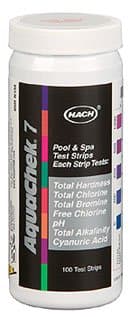
AquaChek Silver 7-Way Test Strips (100 count)
AquaChek
Seven readings in fifteen seconds, including the two that beginners never measure and then fight all summer: total alkalinity and cyanuric acid.
#ad how this is funded · price as of October 8, 2026
Key specs
- Tests
- Free chlorine, total chlorine, bromine, pH, total alkalinity, total hardness, cyanuric acid
- Free chlorine range
- 0-20 ppm
- pH range
- 6.2-8.4
- Total alkalinity range
- 0-240 ppm
- Cyanuric acid range
- 0-300 ppm
- Read time
- 15 seconds
- Count
- 100 strips
How it scoresour reading of published specs, not a test result
- Accuracy
- 7.0
- Ease
- 9.5
- Coverage
- 9.5
- Cost per use
- 9.0
- Value
- 9.2
Overall 8.9 / 10
What works
- Covers cyanuric acid, which most cheap strips omit and which is the reason chlorine stops working in a stabilized pool
- pH range spans 6.2-8.4, comfortably bracketing the CDC's recommended 7.0-7.8
- 15 seconds and a color chart printed on the bottle — no separate booklet to lose
- 100 strips is a full season of twice-weekly testing with room to spare
What doesn't
- Strips are a comparison against a printed color chart, so they are directional rather than precise
- Reading them in bright sun is harder than it should be
- The bottle must be kept sealed and dry or the strips degrade quietly
Skip it if: Fine adjustment. If you are chasing a stubborn problem and need a number rather than a color band, a liquid reagent kit is the tool.
What it costs to run: 100 strips at twice-weekly testing covers roughly two seasons for one pool. The real saving is upstream: knowing your alkalinity stops you buying pH adjuster you did not need.
One honest season: The cheapest setup that genuinely works for a season of real swimming. Nothing spare, nothing missing.
Specs from: CDC — home pool and hot tub water treatment and testing
When you need a number, not a color band
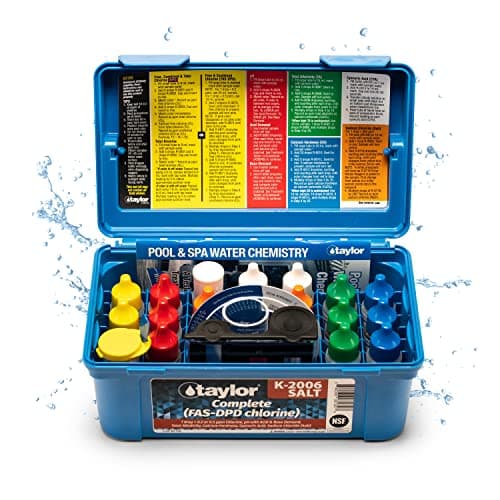
Taylor K-2006 Complete Test Kit (FAS-DPD)
Taylor Technologies
The reference kit. It uses a drop-count titration for free chlorine, which gives you an actual figure rather than a shade of pink. Overkill for a 1,500-gallon pool and indispensable when something has gone properly wrong.
#ad how this is funded · price as of October 8, 2026
Key specs
- Method
- FAS-DPD drop-count titration
- Measures
- Free and combined chlorine, pH, alkalinity, calcium hardness, cyanuric acid
- Resolution
- Reads to 0.2 ppm free chlorine with the standard 10 mL sample
- Format
- Reagent bottles and graduated comparators
How it scoresour reading of published specs, not a test result
- Accuracy
- 9.8
- Ease
- 5.5
- Coverage
- 9.5
- Cost per use
- 7.0
- Value
- 8.0
Overall 8.3 / 10
What works
- Distinguishes free from combined chlorine, which is the single most useful thing a test can tell you when water smells of chlorine
- Gives a numeric result you can act on precisely rather than a color to interpret
- Reagents are individually replaceable, so the kit is a multi-season purchase
What doesn't
- Considerably more expensive than strips and more of a ritual to use
- Reagents have a shelf life and do expire
- Genuinely more kit than a small seasonal pool needs
Skip it if: Casual weekly checks. If it is a five-minute job you will skip it, and a test you skip is worse than a rough one you actually do.
What it costs to run: The reagents are the running cost, not the kit. For most seasonal above-ground owners this is a second purchase made in year two after a bad algae summer, not a first one.
Several seasons: Buy-once. Built and warranted to come back out of the box for a few years, if you store it properly.
Specs from: Taylor Technologies
The default chlorine source
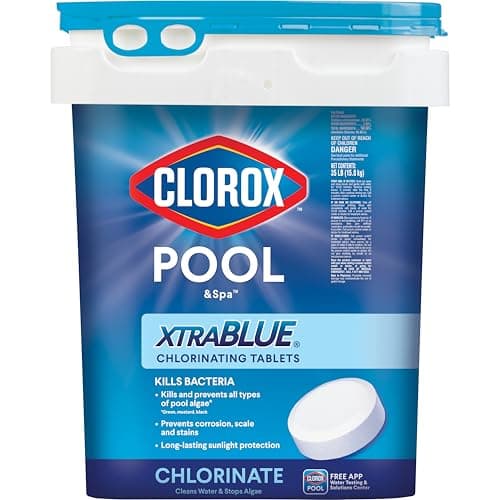
Clorox Pool&Spa 3-Inch Chlorinating Tablets
Clorox Pool&Spa
Stabilized trichlor tablets in a floating dispenser is the standard answer for a seasonal above-ground pool, and this is the standard version of it.
#ad how this is funded · price as of October 8, 2026
Key specs
- Type
- Stabilized trichlor, 3-inch tablets
- Contains stabilizer
- Yes — cyanuric acid is part of trichlor
- Dosing
- Per manufacturer instructions, by pool volume
- CDC target
- At least 2 ppm free chlorine when using a stabilizer
How it scoresour reading of published specs, not a test result
- Effectiveness
- 9.0
- Ease
- 9.0
- Water impact
- 6.0
- Cost per season
- 8.5
- Value
- 8.5
Overall 8.5 / 10
What works
- Dissolves slowly, so a floating dispenser meters chlorine out over days rather than hours
- Stabilized, so sunlight does not destroy your chlorine within an afternoon
- Widely stocked, so you are never hunting for it in July
What doesn't
- Every tablet adds cyanuric acid, and in a pool you never fully drain that accumulates until chlorine stops responding
- Trichlor is acidic and will pull your pH down over a season
- Tablets must be kept dry and sealed or they degrade and gas off
Skip it if: A small pool that is topped up rather than drained. Cyanuric acid only leaves with the water, so in a 1,500-gallon pool it climbs fast.
What it costs to run: The standing chemical cost of the season, and it scales directly with gallons. Watch the cyanuric acid reading on your test strip: once it is high, you are buying chlorine that cannot work, which is the most common invisible waste in a first pool year.
One honest season: The cheapest setup that genuinely works for a season of real swimming. Nothing spare, nothing missing.
Specs from: CDC — free chlorine target with cyanuric acid
Actually clearing a green pool
Calcium Hypochlorite Pool Shock
Various (compare available chlorine %)
Unstabilized, fast-acting and strong. This is the tool for an algae bloom precisely because it does not add more cyanuric acid to a pool that probably already has too much.
Key specs
- Type
- Calcium hypochlorite, unstabilized
- Adds stabilizer
- No
- Adds
- Calcium hardness
- Dosing
- By pool volume, per the bag
How it scoresour reading of published specs, not a test result
- Effectiveness
- 9.5
- Ease
- 6.5
- Water impact
- 7.0
- Cost per season
- 9.0
- Value
- 8.8
Overall 8.6 / 10
What works
- No cyanuric acid added, so it does not worsen the problem it is usually solving
- Fast and strong enough to actually break an algae bloom in one treatment when dosed properly
- Cheap per pound of available chlorine
What doesn't
- Adds calcium hardness, which matters in hard-water areas
- Must be dissolved properly or it will bleach a vinyl liner where it settles
- Needs careful storage — it is a genuine oxidizer, not a household product
Skip it if: Routine daily chlorination. This is the emergency tool; tablets are the routine.
What it costs to run: The single most cost-effective way to fix a green pool, and the most commonly under-dosed. Half a dose twice does not equal a full dose once — it just wastes the bag.
One honest season: The cheapest setup that genuinely works for a season of real swimming. Nothing spare, nothing missing.
Cloudy water that is chemically fine
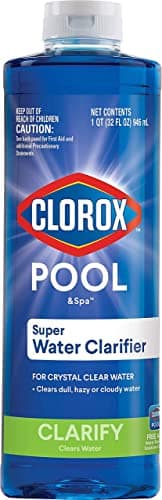
Pool Water Clarifier
Various
Clumps particles too small for your filter into ones it can catch. Genuinely useful for the specific case where your chemistry reads correct and the water is still milky.
Key specs
- Function
- Coagulant — aggregates fine particles for filtration
- Requires
- A running filter; it does nothing on its own
- Typical treatment
- Dose, then run the filter continuously
How it scoresour reading of published specs, not a test result
- Effectiveness
- 7.5
- Ease
- 8.5
- Water impact
- 8.0
- Cost per season
- 8.5
- Value
- 7.5
Overall 7.8 / 10
What works
- Fixes the exact case where chemistry is balanced and the water still will not clear
- Cheap and quick when it is the right tool
- Works with the filter you already have rather than needing a better one
What doesn't
- Does nothing at all if the actual problem is low chlorine or a blocked filter
- Overdosing makes cloudiness worse, which is a genuinely counterintuitive failure
- Loads the filter, so it needs cleaning right after
Skip it if: Being the first thing you reach for. Test the water before you use this — most cloudy pools are a chemistry problem wearing a clarity costume.
What it costs to run: A few dollars a bottle, and worth it only when the decision tree points here. Reaching for clarifier first is how people spend twenty dollars solving a problem that a longer pump run would have fixed for free.
A few weekends: Fine for a heatwave and a toddler. Treat it as consumable, not as a pool — it will not survive a winter in the yard.
Questions people actually ask
Can pool water look clear but be unsafe?
Is cloudy pool water dangerous?
How do I know if my pool is safe to swim in?
Should I swim in a pool I cannot see the bottom of?
Sources
Read next
- Pool care, from someone who assumes you have never done thisThe weekly routine, the four numbers that matter, and the fix for the week the water turns.
- Cloudy pool water: work out which of four problems you haveA diagnostic decision tree for cloudy water - four causes, how to tell them apart, and the correct fix for each.
- Your test result is only as good as how you took itThe six common testing errors that produce misleading readings, and how to take a sample that means something.
- Pool clarifiers, and the three cases where one is the wrong answerClarifier, algaecide and shock compared for cloudy water, with the diagnostic that tells you which one your pool actually needs.
- Small children and pool water, without the scare storiesThe hygiene practices that actually change the risk with toddlers in a backyard pool, and the ones that do not.
- The weekly pool routine, and how little time it really takesThe daily, weekly and monthly jobs written as a schedule, with the kit each one needs and roughly how long it takes.
- Filter cartridges: the consumable nobody budgets forThe replacement interval, the rinse-versus-scrub question, and how the cartridge treadmill compares with a sand filter across a season.