Pool Equipment
Filter balls: the claims do not agree with each other
A few pounds of polyester fiber sold as a replacement for a hundred pounds of sand. The weight saving is real. Almost every number attached to it is a marketing figure, and they contradict each other.
Heads up: we earn a commission if you buy through the links on this page, at no extra cost to you. It never decides the ranking — here is how we pick and here is the full disclosure. Prices are checked automatically; last verified October 8, 2026.
Quick picks
Segmented before it is ranked — the right answer depends on which of these you actually are. Tap any row for the full write-up.
The only one with published limits
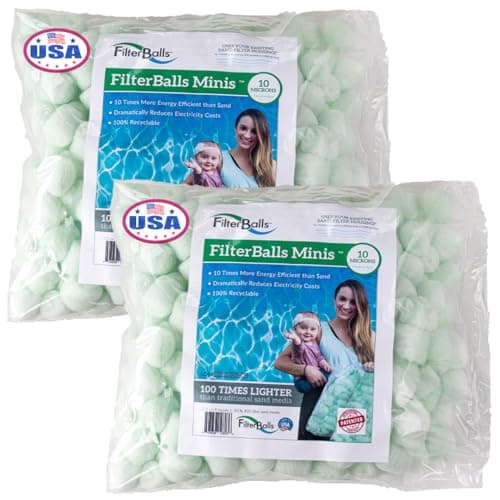
FilterBalls publishes the compatibility rules that matter - filter size and media-bed depth - even though its own equivalence claims vary between channels.
| # | Product | Best for | Score | Price |
|---|---|---|---|---|
| 1 | FilterBalls Minis Filter Media The one filter-ball product with published rules about which filters it suits. Its own equivalence and micron claims vary between its website, its brochure and its retailers, so treat the numbers as marketing rather than specification. | The brand that publishes compatibility limitsSeveral seasons | 7.6out of 10 |
The cheapest experiment
Three pounds, a claim to replace 110 lb of sand, and no published specification of any kind. At this price the trial costs less than a bag of silica.
| # | Product | Best for | Score | Price |
|---|---|---|---|---|
| 1 | 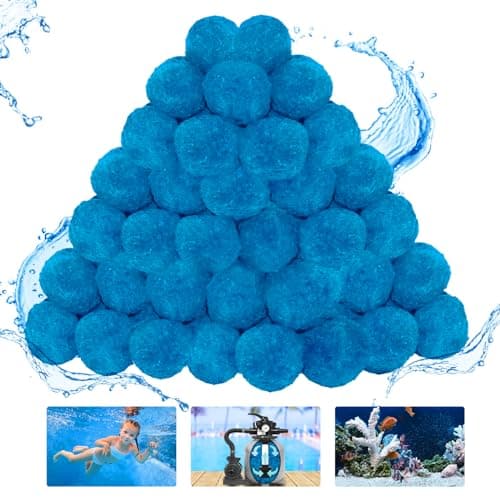 3.1 lb Pool Filter Balls (generic seller) Three pounds of polyester fiber sold as a replacement for 110 lb of sand. Nothing about the claim is verifiable, and at this price that may be an acceptable experiment. | The cheapest way to try the ideaOne honest season | 7.2out of 10 |
For a bigger tank
Four pounds claiming to stand in for 150 lb - the size to look at if your filter is a Hayward rather than a frame-pool unit.
| # | Product | Best for | Score | Price |
|---|---|---|---|---|
| 1 | 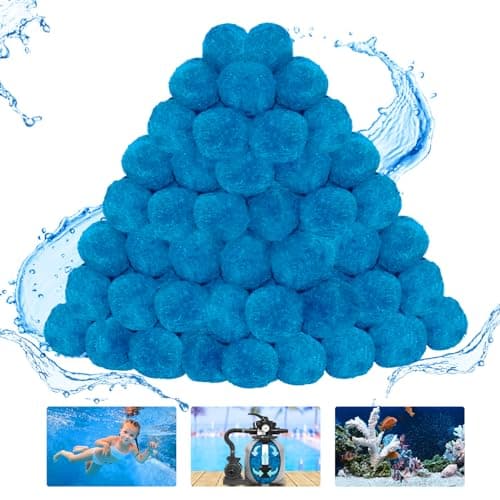 WLLEYAY 4 lb Pool Filter Balls Four pounds claiming to stand in for 150 lb of sand — the largest charge in this roundup, and the one to look at if your tank is a Hayward rather than a frame-pool unit. | Filling a larger tankOne honest season | 7.3out of 10 |
The short version
- The equivalence claims contradict each other. The same brand says half a cubic foot replaces 50 lb of sand on its website and that one pound replaces 100 lb in its brochure.
- Micron claims range from 3.5 to 15 across one brand’s own pages. No independent test data exists that we could find.
- Check your filter’s manual first. Bestway voids warranty for non-specified media. Intex approves glass, with a capacity. Nobody publishes an approval for balls.
- The saving is weight, not money. Sand is cheap. Not carrying 120 lb of it is the real benefit.
What filter balls are
Filter balls are loose polyester fiber, packed into a sand filter in place of silica sand. The pitch is simple and genuinely attractive: a few pounds of fluff instead of two or three heavy bags, easier to load, rinseable, and reusable for several seasons.
The physics are plausible. A tangle of fine fibers presents far more surface area per pound than sharp sand, and fibrous depth filtration is a real technique used elsewhere in water treatment. What is missing is not plausibility. It is evidence.
The numbers do not survive contact with each other
Take one brand, FilterBalls, and read its own channels. Its website says the Minis are packed in half cubic foot bags, approximately equal to 50 lb of sand. Its brochure says one pound replaces 100 lb of sand. Those two statements differ by a factor of two for the same product.
The filtration claims are worse. Across the brand’s own pages and its retailers, the published figures are 3.5 microns, 10 microns and 15 microns. Leslie’s listing for the product manages to print two of those figures on a single page.
Generic sellers are no better, and they are not even consistent about the same physical product: a 3.1 lb bag is sold as replacing 50, 100 or 110 lb of sand depending on the listing, and a 4 lb bag claims 150 lb.
| Product | Weight | Claims to replace | Micron claim | Life claim |
|---|---|---|---|---|
| FilterBalls Minis (website) | 0.5 cu ft bag | 50 lb of sand | Not published | Recycle every 2-5 years |
| FilterBalls (brochure) | 1 lb | 100 lb of sand | 15 microns at 95% first pass | 3-5 years |
| FilterBalls (retailer page) | 0.5 cu ft | 50 lb of sand | 3.5 and 10 microns, both | 3-4 years |
| Generic 3.1 lb seller | 3.1 lb | 110 lb of sand | Not published | Not published |
| WLLEYAY | 4 lb | 150 lb of sand | Not published | Not published |
What sand actually costs you, for comparison
The honest comparison is not cash, it is handling. A sand charge for a frame-pool filter is around 19 to 20 lb, for the Intex 120 lb, and for a Hayward 100 to 150 lb. Silica sand is among the cheapest things you will buy for a pool. What it costs is a trip, a lifting job and, when it is time to change, an unpleasant hour scooping wet sand out of a tank.
Against that, Intex publishes a sand life of four to five years normally, or two to three in dusty conditions. So the recurring job is infrequent. If you are physically able to handle the bags, the case for balls is weaker than the marketing suggests. If you are not, it is the whole argument, and a perfectly good one.
Where they may genuinely help, and where they will not
They may help if lifting is the constraint, if you are filling a small frame-pool tank where a full sand charge is awkward, or if your filter maker has no warranty position to lose — an out-of-warranty unit you own outright.
They will not help if your water is hazy because of chemistry rather than filtration. Fine particulate that a filter cannot catch is a clarifier problem, covered in our clarifier roundup, and cloudiness with a chemistry cause belongs in our cloudy water guide instead. Changing media will not fix either.
They also will not help a filter that is simply too small for the pool. If your turnover arithmetic says you are under-filtered, no medium rescues that — our sand filter roundup covers sizing from the system flow rate rather than the headline number.
Using them without making things worse
Read your filter's manual first
Find what it says about media. If it names a sand grade and warns about alternatives, you are trading a warranty for convenience - make that trade knowingly.Match the charge to the tank, not to the bag
Sellers state a sand equivalence; use it to work out how many bags your tank's sand capacity needs. FilterBalls publishes a 250 lb sand-capacity ceiling and a 12 in minimum media bed.Fill the tank with water first
As with sand, part-filling the tank cushions the laterals at the bottom. Dropping media into a dry tank is how laterals crack.Backwash and watch the pressure gauge
Note the clean starting pressure once the new media is in, and write it on the tank. A clear rise above that baseline is the signal to backwash, whatever the medium - your filter's own manual is where the threshold comes from.Rinse rather than replace
The reusability claim is the one that is easy to verify yourself: pull them, wash them, and see whether flow and pressure return to the baseline.
The honest verdict
We are not going to tell you filter balls are a scam, because the mechanism is real and plenty of owners report clear water with them. We are also not going to repeat a micron rating that a brand cannot keep consistent across three of its own pages.
Treat every number in this category as a claim rather than a specification. Buy them for the weight saving, which is verifiable and immediate. Do not buy them expecting finer filtration than sand, because nobody has published evidence for it that survives reading twice, and do not buy them for a filter whose maker voids the warranty over media.
Glass: the alternative that is actually approved
If the appeal of filter balls is not carrying sand, there is a second option that one manufacturer explicitly endorses. Intex publishes a glass media capacity of 85 lb against 120 lb of sand for the same filter, and its manual describes glass as a better cleaning solution than sand with a particle size of 0.4 to 0.8 mm.
The life figures are the striking part. Intex publishes sand at four to five years under normal conditions, or two to three where the air is dusty, and glass at eight to nine years. So glass is lighter than sand, lasts roughly twice as long, and — unlike filter balls — comes with a manufacturer’s published capacity that tells you exactly how much to buy.
It is still 85 lb rather than four, so it does not solve the lifting problem the way balls claim to. But if your reason for looking at alternative media is performance or media life rather than weight, glass is the option with a manufacturer behind it, and our filter media guide compares the three.
Fitting them without wrecking the laterals
The bottom of a sand filter holds laterals — slotted plastic fingers that let filtered water out while keeping the medium in. They are the fragile part of the filter and they are buried under the media, which is why a media change is the moment they get broken.
Two habits prevent it. Fill the tank part way with water before adding any medium, so the first weight lands in water rather than on plastic. And cap the standpipe before you pour: medium that goes down the center pipe ends up in the pool, and with fiber that means a week of pulling white strands out of the skimmer basket.
The other detail specific to balls is bed depth. FilterBalls publishes a design requirement for a media bed of 12 inches or greater, and a ceiling of housings rated at 250 lb of sand or less. Those two numbers together rule out both the smallest frame-pool tanks and the largest filters, which is a narrower window than the marketing implies.
What happens after the first season
The reusability claim is the one you can test yourself, and it is worth knowing what “reusable” involves. Balls are pulled out, rinsed until the water runs clear, and put back. No seller we checked publishes a washing method beyond that, and none publishes a number of wash cycles before replacement.
What to watch for is flow. Note the clean pressure on the gauge when the new medium goes in, and compare after each wash. Fiber that no longer returns to something near that baseline after rinsing has matted, and matted media is a restriction rather than a filter. That is the point to replace it, whatever the published life claim says.
It is also the point where the economics get clearer. Sand at four to five years, published by the manufacturer, is a known quantity. Filter balls at “two to five years” across a brand’s own pages, with no published wash-cycle limit, are not. If a set lasts two seasons before matting, they cost more per season than the sand they replaced.
What this category would have to publish to be taken seriously
We would change our view on filter balls tomorrow if any seller published three things: a micron rating that does not vary by page, an independent test behind it, and a statement from a filter manufacturer approving the medium in a named housing.
None of that is unreasonable. Intex manages it for glass: a named capacity, a particle size, and a published media life, all on the manufacturer’s own site. The contrast is the honest summary of this category — not that filter balls do not work, but that nobody selling them has been willing to commit to a number and stand behind it.
Until then, buy them for the weight, fit them inside the published bed-depth and housing limits, check your filter’s warranty position first, and judge them on your own pressure gauge rather than on the bag.
A note on where these numbers came from
Everything in this roundup was read off a seller’s own page, because there is nothing else to read. No filter manufacturer publishes a position on filter balls, no seller publishes test data, and the brand with the most detailed claims contradicts itself across its website, its brochure and its retailers.
That is not a reason to avoid the product. It is a reason to treat the numbers as advertising and to judge the result on your own pool: the pressure gauge, how long the water stays clear, and how the media looks after its first wash.
The picks, in full
Scores are our own reading of published specifications. They are not test results — we have not tested these products and we do not claim to.
Pick #1 · The brand that publishes compatibility limits
FilterBalls Minis Filter Media
FilterBalls
The one filter-ball product with published rules about which filters it suits. Its own equivalence and micron claims vary between its website, its brochure and its retailers, so treat the numbers as marketing rather than specification.
#ad how this is funded · price as of October 8, 2026
Key specs
- Pack size
- Half a cubic foot per bag
- Sand equivalence
- Claimed as 50 lb of sand per bag on the maker's site; the brochure claims 1 lb replaces 100 lb
- Filtration claim
- 3.5, 10 and 15 microns all appear across the brand's own channels
- Filter size limit
- Housings rated at 250 lb of sand or less
- Media bed
- Designed for a bed of 12 in or greater
- Life
- Recycle every two to five years, depending which page you read
- Warranty
- Not published
How it scoresour reading of published specs, not a test result
- Sizing fit
- 8.0
- Running cost
- 7.5
- Maintenance
- 8.5
- Build
- 7.0
- Value
- 7.0
Overall 7.6 / 10
What works
- Publishes the compatibility limits — filter size and media-bed depth — that generic sellers do not
- A fraction of the weight of sand, which matters if you are carrying it round the house
- Backwashable and reusable for several seasons rather than a single-season consumable
- A named brand with a support channel behind it, which most filter balls do not have
What doesn't
- The sand-equivalence claim differs by a factor of two between the maker's own website and its brochure
- Micron claims range from 3.5 to 15 across the brand's own pages
- No published warranty
- Your filter maker may not approve it — Bestway voids warranty for media other than the specified sand
Skip it if: Being verified. There is no independent test data behind any filter-ball claim we could find, including this one; the numbers come from sellers only.
What it costs to run: The saving is not the media, it is the handling — the difference between carrying 120 lb of sand and a few pounds of fiber. Priced per season the two are closer than the marketing suggests.
Several seasons: Buy-once. Built and warranted to come back out of the box for a few years, if you store it properly.
Specs from: FilterBalls — Minis replacement bag, published compatibility and pack size, Leslie's — FilterBalls Minis listing, published claims
Pick #2 · The cheapest way to try the idea
3.1 lb Pool Filter Balls (generic seller)
Unbranded
Three pounds of polyester fiber sold as a replacement for 110 lb of sand. Nothing about the claim is verifiable, and at this price that may be an acceptable experiment.
#ad how this is funded · price as of October 8, 2026
Key specs
- Weight
- 3.1 lb
- Sand equivalence
- Claimed to replace 110 lb of filter sand
- Reusable
- Stated as reusable; washing method not published
- Filtration
- Not published
- Life
- Not published
- Compatibility limits
- Not published
How it scoresour reading of published specs, not a test result
- Sizing fit
- 7.0
- Running cost
- 8.0
- Maintenance
- 8.0
- Build
- 6.5
- Value
- 7.5
Overall 7.2 / 10
What works
- Cheap enough that trying filter balls costs less than a bag of sand
- A few pounds to store and carry instead of a hundred
- Rinses rather than being thrown away, unlike a cartridge
- Fits the small tanks on frame-pool sand filters where a full sand charge is awkward
What doesn't
- No published micron rating, no published life, no published compatibility limits
- The 110 lb equivalence has no stated basis, and near-identical products claim 50, 100 or 150 lb
- Unbranded support: there is no manufacturer page to check anything against
- Using it may put your filter's warranty at risk depending on the maker
Skip it if: Anything you need to be sure about. Every specification that would let you compare it to sand is simply absent.
What it costs to run: The honest saving here is weight and storage, not money — a bag of #20 silica is cheap. If the balls last the two or three seasons sand would, the costs roughly meet.
One honest season: The cheapest setup that genuinely works for a season of real swimming. Nothing spare, nothing missing.
Specs from: Amazon listing — 3.1 lb pool filter balls, published title claims
Pick #3 · Filling a larger tank
WLLEYAY 4 lb Pool Filter Balls
WLLEYAY
Four pounds claiming to stand in for 150 lb of sand — the largest charge in this roundup, and the one to look at if your tank is a Hayward rather than a frame-pool unit.
Key specs
- Weight
- 4 lb
- Sand equivalence
- Claimed to replace 150 lb of filter sand
- Reusable
- Stated as reusable; method not published
- Filtration
- Not published
- Life
- Not published on the listing itself
- Compatibility limits
- Not published
How it scoresour reading of published specs, not a test result
- Sizing fit
- 7.5
- Running cost
- 8.0
- Maintenance
- 8.0
- Build
- 6.5
- Value
- 7.5
Overall 7.3 / 10
What works
- The largest claimed charge here, which suits a 150 lb tank like the Hayward 18 in
- Light enough to post, store and handle without help
- Reusable rather than a seasonal consumable
- Cheap relative to a full replacement sand charge
What doesn't
- Same verification problem as every filter ball: no micron rating, no test data, no published life
- Equivalence claims across this category are mutually contradictory and unaudited
- No manufacturer page or support to appeal to
- Your filter maker may treat non-specified media as a warranty problem
Skip it if: Replacing a manufacturer-approved medium where the warranty matters. Intex approves glass and publishes a capacity for it; nobody publishes an approval for balls.
What it costs to run: If you are refilling a 150 lb tank, the sand itself is three bags and a sore back. That is the real trade here, and it is a handling saving rather than a cash one.
One honest season: The cheapest setup that genuinely works for a season of real swimming. Nothing spare, nothing missing.
Specs from: Amazon listing — WLLEYAY 4 lb pool filter balls, published title claims
Questions people actually ask
Do filter balls really replace 100 lb of sand?
Do filter balls filter finer than sand?
Will using filter balls void my filter warranty?
How long do filter balls last?
Can I mix filter balls with sand?
Sources
- FilterBalls — Minis replacement bag, published compatibility limits
- Leslie's — FilterBalls Minis listing, published claims
- Intex — Krystal Clear sand filter pump manual (approved media, sand life)
- Bestway — 58498E Flowclear sand filter manual (media and warranty)
- Leslie's — pool filter media types, published micron comparison
Read next
- Equipment, sized to your pool and costed by the wattPumps, filters, vacuums, heaters and ladders - matched to your gallons and priced by what they draw.
- What is inside the filter, and how fine it actually filtersSand, glass and cartridge media compared on what they trap, how long they last, and what each costs to maintain across a season.
- Sand filters, and the flow rate that is not on the boxSand filter systems from 800 gph to 35 GPM, compared on the flow that actually reaches the pool, how much sand each takes, and which makers void the warranty over media.
- Sand vs cartridge: it is a maintenance choice, not a quality oneThe honest comparison: consumable cost, backwash water, weekly effort, and the season count where sand starts to win.
- Backwashing, and the rinse step everyone skipsThe full backwash and rinse cycle, how to know when it is due, and why every gallon discharged is water you pay for and re-balance.
- Filter cartridges: the consumable that decides whether your water is clearGetting the right cartridge for your pump, how many a season takes, and why buying singly is where this line gets expensive.
- Your filter manual already chose the sandThe grade every above-ground filter manual names, what each bag on the shelf actually publishes, how many bags your tank takes, and where zeolite and glass genuinely fit.