Pool Costs
What closing an above-ground pool costs
Three published price lists, three different numbers, because none of them are selling the same job. Here is what is inside each quote, and what the same work costs you with a Saturday instead.
Heads up: we earn a commission if you buy through the links on this page, at no extra cost to you. It never decides the ranking — here is how we pick and here is the full disclosure. Prices are checked automatically; last verified October 8, 2026.
Quick picks
Segmented before it is ranked — the right answer depends on which of these you actually are. Tap any row for the full write-up.
The two lines that are most of the bill
A cover and a chemical kit. One is bought once and divided across the winters it survives; the other is bought again every autumn. Most people get that backwards.
| # | Product | Best for | Score | Price |
|---|---|---|---|---|
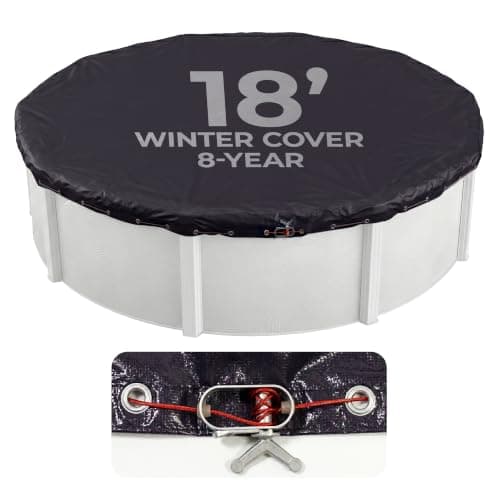
| 1 | Blue Wave Arctic Armor 18-ft Round Above-Ground Winter Cover The cover is the only part of closing you buy once rather than every autumn, and this is the entry tier of a line that publishes its hardware, its overlap and a support term. | The one closing line that is a purchase, not a consumableSeveral seasons | 8.5out of 10 | |
| 2 | 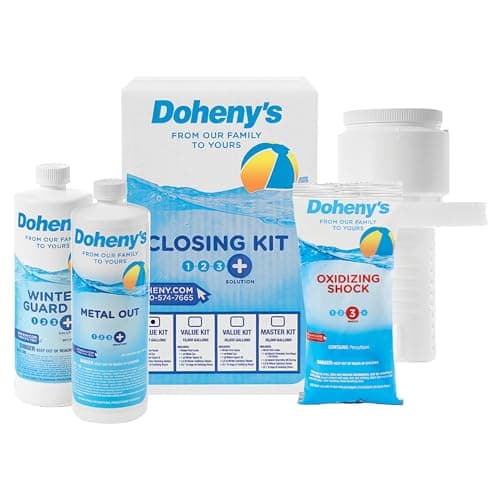 Doheny's Ultimate Pool Closing Kit, up to 7,500 Gallons A closing kit that publishes both its gallon rating and the quantity of every component in it, which is unusual enough in this category to be the reason to pick it. | The annual chemical line, rated by gallons rather than by guessOne honest season | 8.2out of 10 |
The cheap items that prevent the expensive failure
An air pillow and an algaecide are the smallest lines on the list and the two that decide whether April is an afternoon or a project.
| # | Product | Best for | Score | Price |
|---|---|---|---|---|
| 1 | 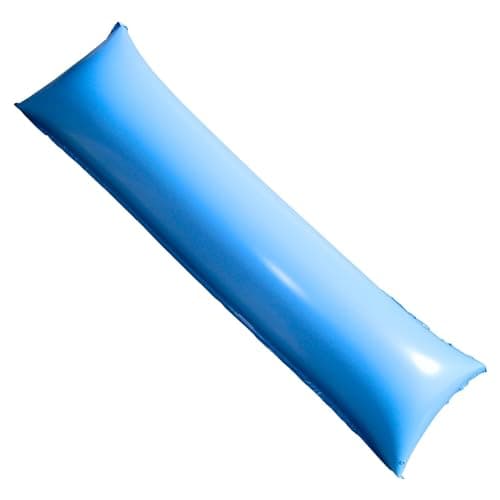 Swimline 4 ft x 8 ft Winter Cover Air Pillow The standard 4 by 8 pillow, rated by the seller as a single-pillow solution up to a 28 foot round. Published gauge figures disagree between listings, which is worth knowing before you pay for 'heavy duty'. | Round pools up to 28 feetOne honest season | 8.2out of 10 | |
| 2 | 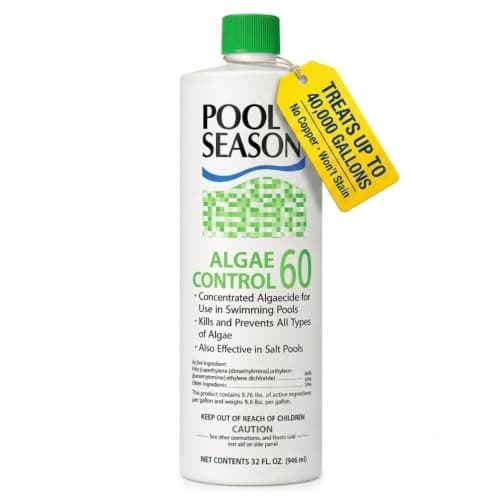 Pool Algaecide (polyquat 60) Polyquat is the non-foaming, non-staining choice and it is far better at stopping algae than at killing an established bloom. Use it as insurance and as part of closing. | Preventing algae, not curing itOne honest season | 8.0out of 10 |
Only if your yard makes you
Neither of these is part of a standard close. Buy them when trees or standing water have already told you that you need them.
| # | Product | Best for | Score | Price |
|---|---|---|---|---|
| 1 | 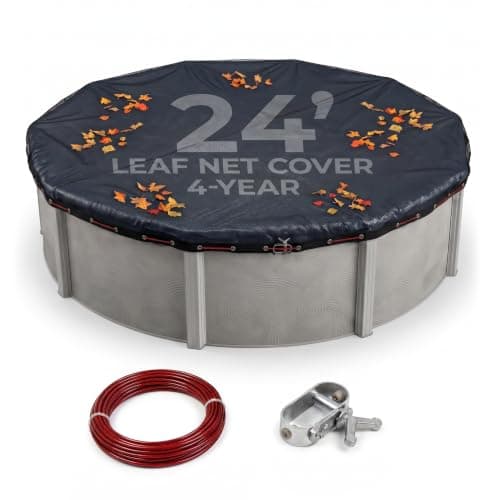 Leaf Net Cover A fine mesh net that sits over the winter cover and lifts off with the leaves on it. On a treed yard it is the difference between dragging a loaded cover and rolling one. | A pool under trees in OctoberSeveral seasons | 8.0out of 10 | |
| 2 | 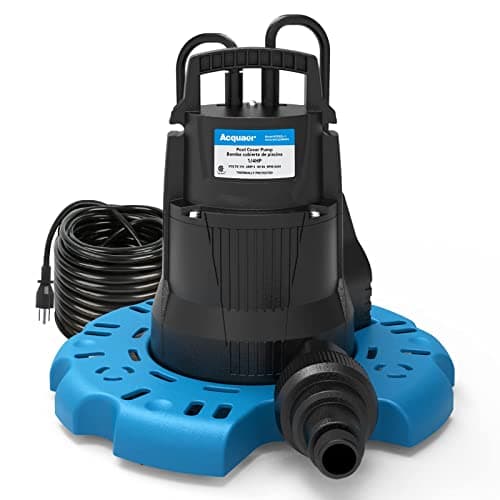 Submersible Pool Cover Pump A small submersible pump that sits on the cover and clears the puddle. It exists because water weight is what destroys winter covers, and sweeping in January is nobody's idea of a Saturday. | Getting standing water off a winter coverSeveral seasons | 7.9out of 10 |
The short version
- Published service prices run about $150 to $400 for an above-ground pool. The spread is inclusions, not geography.
- One quote sells “put on cover only” for $150. That single line is most of the gap between the cheap quote and the expensive one.
- Half the DIY bill is a one-time purchase. The cover amortizes; the chemical kit and the pillow do not.
- The published 65 degrees F rule decides whether any of it works. Closing a warm pool wastes every dollar on this page.
What a service actually charges
Pool closing is one of the few pool services where companies publish a price list rather than quoting on inspection, which makes it unusually easy to check. Here is what three published sources say about an above-ground pool, with the inclusions beside the number because the number on its own is meaningless.
| Source | Published price | What it includes |
|---|---|---|
| Fixr (national) | $150 to $200 | Stated as the average to winterize an above-ground pool |
| Touched By The Sun Pools | $230 plus tax | Liquid closing kit, clean, drain to winter level, plumbing and pump winterized, cover inspected and installed. You remove the ladder. |
| Jayzees, partial close | $300 | Everything below except putting the cover on |
| Jayzees, full close | $400 | Hoses disconnected, return plugged, filter cleaned, equipment winterized, winter chemicals, ladder removed, cover installed |
Read those two Jayzees rows next to each other and the whole category becomes legible. The difference between a $300 close and a $400 close from the same company, on the same pool, is putting the cover on. Jayzees also publishes that line on its own at $150 for “put on cover only”, which is more than the entire national average Fixr quotes for the whole job.
That is not a company being unreasonable. It is the one step that needs two people, a winch and an afternoon, and it is the step most likely to be done badly by the homeowner. But it means a quote is not comparable to another quote until you have read what is in it.
Why the published prices disagree by a factor of two
Three things move the number, and only one of them is your pool.
Whether the cover goes on
The single largest swing. Published full and partial closes from the same company differ by $100, and the same step sold separately is $150.Whether chemicals are included
Touched By The Sun includes a liquid chlorine, algaecide and clarifier kit in its $230. Fixr prices winter chemicals separately at $14 to $60 for algaecide, $15 to $80 for chlorine and $25 to $50 for shock. A quote without chemicals is not a cheaper quote.Whether the equipment is really winterized
Fixr lists draining and lubricating additional equipment at $25 to $35 each. On an above-ground pool there is usually only a pump and a filter, which is why above-ground closes are cheaper than inground ones across every source we checked.
Notice what is not on that list: your pool’s gallons. Closing is priced as labor and a chemical set, not as volume, which is the opposite of how almost everything else in the pool year scales. A 12 ft pool and a 24 ft pool cost roughly the same to close and materially different amounts to run, as our annual running cost guide works through.
The DIY list, and which half of it recurs
Doing it yourself replaces a single invoice with a shopping list and a Saturday. The useful way to read that list is not top to bottom but split in two: what you buy once, and what you buy every autumn.
| Line | Buy it | Where the detail is |
|---|---|---|
| Winter cover | Once, then every several winters | Our winter cover roundup |
| Cable and winch | Once, often in the cover box | Included on the Arctic Armor here |
| Closing chemical kit | Every autumn | Our winterizing kit roundup |
| Air pillow | Every autumn, realistically | Our air pillow roundup |
| Winter plugs or a gizzmo | Once, if your pool has fittings that need them | Our winterizing plug roundup |
| Cover clips or wind guards | Once | Our cover clip roundup |
| Leaf net | Once, only under trees | Our leaf net roundup |
| Cover pump | Once, only if water pools on top | Our cover pump roundup |
Four of those eight lines are optional for most yards, and two more are one-time purchases that come with the cover or last as long as the pool does. What is genuinely annual is a chemical kit and an air pillow. That is the recurring DIY cost of closing an above-ground pool, and it is a long way below every published service price on this page.
The trap is year one, when you are buying the cover at the same time. That is the autumn where paying someone looks competitive, and it is also the autumn where the comparison is least meaningful, because you are comparing a purchase against a service.
Five winters of paying someone, using published prices only
- Fixr published above-ground average, low end [Fixr pool closing costs]
- $150 per close
- Jayzees published full above-ground close [Jayzees published price list]
- $400 per close
- Winters covered
- Five
$150 x 5 = $750 at the cheapest published rate; $400 x 5 = $2,000 at the dearest
$750 to $2,000 over five autumns
The line that is nearly free and decides everything
The same maker publishes its own exclusion, which is rarer still: its kit is stated as not for use on biguanide sanitizer systems, and as compatible with chlorine and salt. Whichever kit you buy, that is the line worth finding on the label before closing day. If you are running a salt pool, our saltwater equipment guide covers what else changes at closing time.
What a bad close costs instead
Every figure above is the cost of closing. The number that actually decides whether closing was worth it is the cost of closing badly, and it is the larger of the two. A full drain and refill alone is real money in water at the EPA WaterSense published rate, before you have re-dosed a pool of tap water from zero, and that is the cheap version of the failure.
Our bad-close bill prices that cascade line by line. The summary is that the three cheapest items on the closing list — an algaecide, an air pillow, and the patience to wait for cold water — prevent nearly all of it.
When paying someone is the right answer
There are three honest cases, and none of them is about money.
The first is a pool you cannot reach around. Getting a cover onto an 18 ft round and winched down is a two-person job, and if there is no second person it is not a job at all. The second is the first autumn, where a service is effectively a lesson: watch what they do, then do it yourself next year. The third is a climate where getting it wrong has a severe consequence rather than an annoying one, which our cold-climate guide goes into.
Outside those, closing is one of the clearest wins on the whole do-it-yourself-or-pay list: a well-defined job, done once a year, with published instructions and no specialist tools.
If the pool comes down instead
A frame pool that is taken down each autumn skips most of this page. There is no cover to buy, no pillow, no plugs and no closing kit, because there is no water to preserve — the cost moves to somewhere to store it and the hours to put it back up in May. Our taking it down and storing it guide covers that path, and our mesh versus solid cover comparison covers the choice if the pool is staying up.
Which of those two you are doing is the single biggest fork in the autumn budget, and it is decided by the pool rather than by preference: most seasonal frame pools are not rated to stay up through a freeze, and most steel-wall pools are not designed to come down at all.
The honest recommendation
Buy the cover, a kit sized to your gallons, and an air pillow, and close it yourself on the first weekend the water is reliably under 65 degrees. That is the whole job, and after the first year it is the cheapest recurring line in the pool calendar.
Pay someone once if the first autumn worries you or if nobody else is home to hold the other side of the cover. Just read what the quote includes before you compare it to another one, because the published lists make it very clear that two closing prices are rarely two prices for the same work. Our step-by-step closing guide is the sequence itself, in the order it has to happen.
The picks, in full
Scores are our own reading of published specifications. They are not test results — we have not tested these products and we do not claim to.
Pick #1 · The one closing line that is a purchase, not a consumable
Blue Wave Arctic Armor 18-ft Round Above-Ground Winter Cover
Blue Wave
The cover is the only part of closing you buy once rather than every autumn, and this is the entry tier of a line that publishes its hardware, its overlap and a support term.
#ad how this is funded · price as of October 8, 2026
Key specs
- Material
- Solid polyethylene, published
- Seams
- Heat-sealed, published
- Overlap
- Extra 4 ft, published
- Hardware included
- Cable, winch and grommets, published
- Support term
- 8-year, published on the listing
- Scrim count
- Not published for this tier; Blue Wave publishes 10x12 for its 12-year cover and 14x14 for its 15-year
- Size
- 18 ft round
How it scoresour reading of published specs, not a test result
- Retention
- 8.5
- Durability
- 8.0
- Handling
- 8.0
- Running cost
- 9.0
- Value
- 8.7
Overall 8.5 / 10
What works
- Cable and winch are in the box, which is the part people discover is missing on closing day
- A published 4 ft overlap, so the cover reaches past the top rail instead of sitting on the water
- Heat-sealed seams rather than stitched, which is what survives a winter of standing water
- A named support term, which the unbranded covers in this size do not carry
What doesn't
- No scrim count is published at this tier, so you cannot compare the fabric against the 12 and 15-year covers on a number
- Eight-year support on a winter cover is a support term, not a performance guarantee
- Round only, and the 18 ft size has to match your pool exactly rather than approximately
- A solid cover holds water and needs a cover pump; it is not the cheapest total answer, only the cheapest cover
Skip it if: Pools under trees. A solid cover under a heavy leaf fall becomes a pond with a cover under it, which is what a leaf net on top is for.
What it costs to run: This is the line that amortizes. A chemical kit and an air pillow are bought every autumn; a cover is bought once and divided across the seasons it survives, which is why the first closing costs far more than the second.
Several seasons: Buy-once. Built and warranted to come back out of the box for a few years, if you store it properly.
Specs from: Blue Wave Arctic Armor 18-ft round winter cover, published listing specifications, Blue Wave — 12-year above-ground winter cover, published scrim, overlap and hardware
Pick #2 · The annual chemical line, rated by gallons rather than by guess
Doheny's Ultimate Pool Closing Kit, up to 7,500 Gallons
Doheny's
A closing kit that publishes both its gallon rating and the quantity of every component in it, which is unusual enough in this category to be the reason to pick it.
Key specs
- Rated for
- Up to 7,500 gallons, published
- Contents
- 1.2 lb winter oxidizing tablets, 1 lb oxidizing shock, 1 pt Metal Out, 1 qt Winter Guard
- Also included
- Floating dispenser and a pool closing guide, published
- Shock type
- Chlorine-free oxidizing shock, published
- Stain and scale
- Metal Out is published as a stain, rust and scale preventer
- Algae control
- Winter Guard algae control, published
- Covers the cover
- No. A kit is chemicals only
How it scoresour reading of published specs, not a test result
- Retention
- 7.5
- Durability
- 7.5
- Handling
- 9.0
- Running cost
- 7.5
- Value
- 8.5
Overall 8.2 / 10
What works
- Publishes a gallon rating, so you can size it to your pool instead of buying the only box on the shelf
- Lists every component and its quantity, which most closing kits do not
- Chlorine-free oxidizing shock, so it does not degrade the algaecide packed alongside it
- The floating dispenser is in the box, which is the part people discover is missing on closing day
What doesn't
- 7,500 gallons is a small rating; a 15 ft or larger pool needs the next size up
- A kit is a bundle at a premium, and the same chemicals can be bought separately once you know your water
- Metal Out addresses staining rather than sanitizing, so it is doing a different job from the shock
- Nothing in the box addresses the cover, the pillow or the plugs, which are the rest of the job
Skip it if: Rescuing a pool that is already green in October. A closing kit preserves water that is balanced and clear; it does not clear water that is not.
What it costs to run: This is the recurring half of a closing. You buy a kit every autumn, so over five winters it costs more in total than the cover does, which is the opposite of what most people assume when they see the two prices side by side.
One honest season: The cheapest setup that genuinely works for a season of real swimming. Nothing spare, nothing missing.
Specs from: Doheny's — Ultimate Pool Closing Kit, published contents by pool size
Pick #3 · Round pools up to 28 feet
Swimline 4 ft x 8 ft Winter Cover Air Pillow
Swimline
The standard 4 by 8 pillow, rated by the seller as a single-pillow solution up to a 28 foot round. Published gauge figures disagree between listings, which is worth knowing before you pay for 'heavy duty'.
Key specs
- Size
- 4 ft x 8 ft
- Material
- Listed as 9-gauge vinyl on two retailer pages; a third listing in the same line says 16-gauge
- Covers
- One pillow for 28 ft round and small oval pools, per the retailer
- Sizes in the line
- 4 x 4 ft, 4 x 8 ft, 4 x 15 ft
- Valve type
- Not published for this model
- Grommets
- Not published for this model number
How it scoresour reading of published specs, not a test result
- Retention
- 8.0
- Durability
- 7.0
- Handling
- 8.5
- Running cost
- 9.0
- Value
- 8.5
Overall 8.2 / 10
What works
- The size most above-ground pools actually need, and the easiest to find in stock
- A published pool-size rating, which many pillow listings skip entirely
- Sold in a range, so a bigger pool can step up rather than buy two
- Cheap enough to replace when it splits, which eventually it will
What doesn't
- Published vinyl gauge conflicts between listings of the same product
- Neither the valve type nor the grommet count is published for this model
- No warranty published
- A single pillow on a large pool spreads ice pressure less evenly than two
Skip it if: Surviving indefinitely. A pillow is a seasonal item that takes the ice load so the wall does not; plan on replacing it rather than nursing a patched one through a second winter.
What it costs to run: The cheapest structural part of a close. Set against the cost of a split wall or a torn cover — the bill our bad-close guide itemizes — a pillow is a few dollars a winter.
One honest season: The cheapest setup that genuinely works for a season of real swimming. Nothing spare, nothing missing.
Specs from: Leslie's — Swimline 4 x 8 air pillow, published size and pool rating, In The Swim — 4 x 8 air pillow for above-ground pool winter covers
Pick #4 · Preventing algae, not curing it
Pool Algaecide (polyquat 60)
Various
Polyquat is the non-foaming, non-staining choice and it is far better at stopping algae than at killing an established bloom. Use it as insurance and as part of closing.
Key specs
- Type
- Polyquaternium (polyquat 60)
- Foaming
- Non-foaming, unlike quat algaecides
- Metal content
- None, unlike copper-based algaecides
How it scoresour reading of published specs, not a test result
- Effectiveness
- 7.5
- Ease
- 9.0
- Water impact
- 9.0
- Cost per season
- 7.5
- Value
- 8.0
Overall 8.0 / 10
What works
- Does not foam, which the cheaper quat products do
- No copper, so no risk of the metal staining a vinyl liner
- The standard product in a winterizing routine, for good reason
What doesn't
- Poor at killing an established bloom — shock does that job
- More expensive than copper-based alternatives
- Easy to over-rely on instead of maintaining chlorine
Skip it if: Rescuing a green pool. Brush and shock first; algaecide is what stops it coming back.
What it costs to run: One of the few chemicals where buying the better version is clearly right — a copper algaecide that stains a liner costs vastly more than the few dollars it saved.
One honest season: The cheapest setup that genuinely works for a season of real swimming. Nothing spare, nothing missing.
Pick #5 · A pool under trees in October
Leaf Net Cover
Various
A fine mesh net that sits over the winter cover and lifts off with the leaves on it. On a treed yard it is the difference between dragging a loaded cover and rolling one.
#ad how this is funded · price as of October 8, 2026
Key specs
- Sizing
- Sold by pool diameter, typically with 3 ft overlap
- Material
- Polyethylene or nylon fine mesh
- Binding
- Around 1.75 in nylon binding with sewn loops
- Fixing
- Grommets, and cable and winch on some
- Position
- Over the winter cover, not instead of it
- Weight
- Light — one person can lift it loaded
How it scoresour reading of published specs, not a test result
- Retention
- 5.0
- Durability
- 8.0
- Handling
- 9.0
- Running cost
- 10.0
- Value
- 8.5
Overall 8.0 / 10
What works
- Lifts off with the whole leaf fall on it, so the winter cover underneath stays clean
- Removes the single largest source of standing water weight on a cover
- Cheap, and it lasts several seasons because nothing stresses it
- Works over a solar cover in autumn too, before the pool is closed
What doesn't
- Useless on a yard with no trees, which is most of the argument against it
- Has to come off before the leaves are wet and heavy, so timing matters
- Fine mesh still passes needles and small debris
- Another large item to dry and store
Skip it if: Being a cover. It stops debris, it does not block light, hold heat, or keep anything out of the water on its own.
What it costs to run: Set against a torn winter cover and a spring opening full of leaf tannin. On a treed yard the payback is one autumn; on a clear yard there is none.
Several seasons: Buy-once. Built and warranted to come back out of the box for a few years, if you store it properly.
Specs from: Above-ground pool leaf nets — current Amazon category listing
Pick #6 · Getting standing water off a winter cover
Submersible Pool Cover Pump
Various
A small submersible pump that sits on the cover and clears the puddle. It exists because water weight is what destroys winter covers, and sweeping in January is nobody's idea of a Saturday.
#ad how this is funded · price as of October 8, 2026
Key specs
- Type
- Submersible, sits on top of the cover
- Operation
- Manual or automatic float switch, by model
- Discharge
- Garden hose thread on most models
- Requirement
- Outdoor-rated, GFCI-protected outlet
How it scoresour reading of published specs, not a test result
- Sizing fit
- 8.0
- Running cost
- 9.0
- Maintenance
- 7.0
- Build
- 7.0
- Value
- 8.5
Overall 7.9 / 10
What works
- Removes the single biggest cause of winter cover failure, which is accumulated water weight
- Automatic models handle rain you were not there for
- Cheap relative to a replacement cover
- Also useful for draining the last few inches of a pool at take-down
What doesn't
- It is an electrical appliance sitting in water outdoors, so the GFCI rules are not optional
- Automatic float switches are the part that fails, usually with debris under them
- Needs storing dry and drained or it freezes and cracks like any other pump
- Cheaper units struggle with the last half inch, which is where debris collects
Skip it if: Being left connected and forgotten all winter. It wants checking after storms, which is when you should be looking at the cover anyway.
What it costs to run: One purchase against the cost of a torn winter cover and the spring opening that follows it. On that comparison it is not a close call.
Several seasons: Buy-once. Built and warranted to come back out of the box for a few years, if you store it properly.
Specs from: Submersible pool cover pumps — current Amazon category listing
Questions people actually ask
How much does it cost to close an above-ground pool?
Is it cheaper to close a pool yourself?
What is actually included in a pool closing service?
Do I need pool antifreeze on an above-ground pool?
What is the cheapest thing on the closing list that matters most?
Sources
- Jayzees Pool and Spa Supplies — published pool closing price list
- Touched By The Sun Pools — published pool closing prices and inclusions
- Fixr — published pool closing cost breakdown
- In The Swim — Basic Pool Closing Kit, published contents and instructions
- Blue Wave — 12-year above-ground winter cover, published specifications
- EIA Electric Power Monthly, Table 5.6.A
- EPA WaterSense — how the calculator works
Read next
- What a pool actually costs, with the arithmetic shownPurchase, electricity, chemicals, water and replacement parts - added up, sourced, and shown as arithmetic you can redo.
- How to winterize an above-ground poolThe correct closing sequence, the freeze damage that ends pools, and why a cracked pump housing is entirely preventable.
- Pool closing kits: buy one the first year, then stopWhat is in a closing kit, whether the bundle premium is justified, and how to buy separately once you know your water.
- The bill a bad close sends you in AprilThe spring bill produced by a bad autumn close, priced line by line, and the three cheap items that prevent nearly all of it.
- The best winter covers for an above-ground poolScrim weight, cable-and-winch versus straps, and the overlap you need - the three specs that decide whether a cover survives a winter.
- Winterizing kits: convenience, correctly sized, or a wasteWhat is inside a winterizing kit, how to size one to your gallons, and the items every kit leaves out.
- What upkeep costs, separated from everything elseChemicals by published dosing, cartridge replacement intervals, and the honest weekly time commitment.
- Taking the pool down without ruining itThe take-down sequence for a seasonal pool: draining responsibly, drying completely, folding warm, and storing where rodents are not.
- What is worth doing yourself, and the two things that are notEvery above-ground pool task sorted into do-it-yourself, worth paying for, and not a DIY decision - with the reasoning for each.