Seasonal Care
Winterizing kits: convenience, correctly sized, or a waste
A kit is the right purchase for most people and it is not a complete closing. Knowing what is in the box and what is missing from it is the whole decision.
Heads up: we earn a commission if you buy through the links on this page, at no extra cost to you. It never decides the ranking — here is how we pick and here is the full disclosure. Prices are checked automatically; last verified October 8, 2026.
Quick picks
Segmented before it is ranked — the right answer depends on which of these you actually are. Tap any row for the full write-up.
The kit
Sized to your actual gallons, not the pool's advertised size. Under-dosing is the most common closing error and it costs you the spring.
| # | Product | Best for | Score | Price |
|---|---|---|---|---|
| 1 | No image Pool Winterizing / Closing Chemical Kit A box with the closing chemicals pre-matched to a pool size. Worth the small premium the first year purely because the failure mode of buying separately is missing one thing on the day. | A first close, when you do not know what you needOne honest season | 8.0out of 10 |
What the kit does not include
Every kit is chemicals. The cover, the pillow and the test kit are separate purchases and all three are necessary.
| # | Product | Best for | Score | Price |
|---|---|---|---|---|
| 1 | No image Winter Cover for Above-Ground Pools A structural product, not a summer one. Its job is carrying snow and blocking light for a whole winter, and a solar cover pressed into that role will be in shreds by February. | Five months of weather, not one nightSeveral seasons | 8.3out of 10 | |
| 2 | 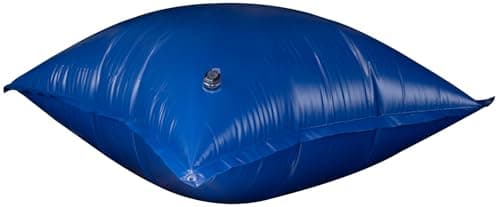 Winter Air Pillow for Above-Ground Pools A few dollars of inflatable that gives expanding ice something compressible to push against instead of your pool wall. In a freezing climate this is not optional. | Stopping ice from pushing on the wallOne honest season | 8.4out of 10 | |
| 3 | 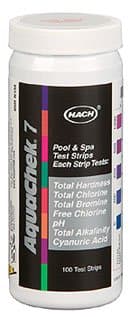 AquaChek Silver 7-Way Test Strips (100 count) Seven readings in fifteen seconds, including the two that beginners never measure and then fight all summer: total alkalinity and cyanuric acid. | The default first test kitOne honest season | 8.9out of 10 |
Worth adding for a leafy yard
If your pool sits under trees, a stronger polyquat algaecide alongside the kit is cheap insurance against the spring you do not want.
| # | Product | Best for | Score | Price |
|---|---|---|---|---|
| 1 | 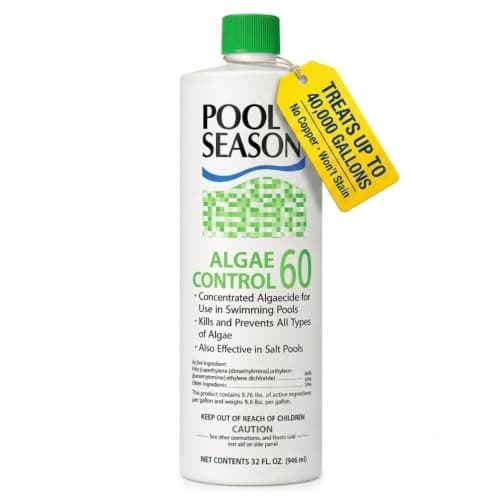 Pool Algaecide (polyquat 60) Polyquat is the non-foaming, non-staining choice and it is far better at stopping algae than at killing an established bloom. Use it as insurance and as part of closing. | Preventing algae, not curing itOne honest season | 8.0out of 10 |
The short version
- A kit is three or four chemicals in a box. An oxidizer, a long-life algaecide, usually a stain and scale inhibitor, sometimes a clarifier.
- Size it to your gallons, not your pool’s name. Kits are sold in gallon bands and under-dosing is the standard closing error.
- Every kit is missing the cover, the pillow and the test kit. None of them is optional.
- Water temperature decides when, not the calendar. A kit applied to a warm pool is money spent on nothing.
What is actually in the box
Winterizing kits look proprietary and are not. Nearly all of them contain the same categories, and knowing them is what lets you judge whether a kit is priced fairly.
| Component | What it does | Notes |
|---|---|---|
| Winter algaecide | Suppresses algae for months with no filtration | Polyquat is the type to look for — it does not foam and does not bleach out |
| Oxidizer / shock | Burns off the organic load before the water sits still | Applied first, with the pump running |
| Stain and scale inhibitor | Keeps dissolved metals and calcium in solution | Matters most on well water and hard water |
| Clarifier | Drops fine particles out of suspension | Not in every kit; least important of the four |
That is the whole product. Which means the buying question is narrow: is the kit priced near what the four items cost separately, and is it dosed for your pool.
Sizing, and why under-dosing is the standard failure
Kits are sold in gallon bands — up to 7,500, up to 15,000, up to 24,000 and so on. Nearly everybody rounds down, because the pool is described by its width rather than its volume and the numbers feel generous.
They are not. Real volumes from our sizing guide: a 12-foot Easy Set holds about 1,485 gallons at its 23-inch fill line, a 12-foot Prism Frame about 1,718, a 15-foot Steel Pro MAX about 3,955, and an 18-foot Ultra XTR about 6,981. Work from your own figure, buy the band above it, and use the full dose. Half a dose of algaecide in five months of still water is the same as no algaecide, and the cost of getting this wrong is priced out in our cost of a bad close guide.
What every kit leaves out
The cover. Chemistry keeps the water from going bad; the cover keeps the debris out, and without it the chemistry is fighting a losing battle by December. Our winter cover roundup covers what to buy.
The air pillow. It is not there to hold the cover up. It sits under the cover to take the expansion load when the surface freezes, so the ice pushes inward against the pillow rather than outward against the pool wall. It is one of the cheapest items in this hub and one of the few genuinely structural ones.
The test kit. The kit is applied to balanced water, and balancing requires testing. Alkalinity first, then pH, then chlorine — the order our pH and alkalinity guide insists on, because adjusting pH before alkalinity means doing it twice.
The thermometer. The one that decides whether the whole kit works, and it costs less than any of them. See below.
Using it: the order matters
Clean the pool completely first
Skim, brush every surface, vacuum the floor. Organic material left behind consumes the kit's chemistry before winter has even started.Balance the water
Total alkalinity, then pH into the CDC's range, then chlorine. Kits assume balanced water and do not correct it.Add the oxidizer with the pump running
Let it circulate for several hours so it reaches the whole pool rather than sitting where you poured it.Add the winter algaecide last
Pump still running, so it distributes fully. This is the component doing the work for the next five months.Run the filter a few more hours, then close down
Shut the equipment down, drain what has to be drained, and fit the pillow and cover.
The full sequence, including the water level, the pump and the plumbing, is in our winterizing guide, and our closing kit guide covers the non-chemical items in the same afternoon.
What we are scoring
We have not tested these and do not claim to. The scores reflect published contents and dosing against the closing sequence this site recommends, for a seasonal above-ground pool. Our methodology page explains how our scoring works.
The picks, in full
Scores are our own reading of published specifications. They are not test results — we have not tested these products and we do not claim to.
Pick #1 · A first close, when you do not know what you need
Pool Winterizing / Closing Chemical Kit
Various
A box with the closing chemicals pre-matched to a pool size. Worth the small premium the first year purely because the failure mode of buying separately is missing one thing on the day.
Key specs
- Typically contains
- Winter algaecide, shock or oxidizer, and a stain/scale preventer
- Sized by
- Pool volume in gallons — buy to your actual number
- Timing
- Applied at closing, with the pump running, before covering
How it scoresour reading of published specs, not a test result
- Retention
- 8.0
- Durability
- 8.0
- Handling
- 9.0
- Running cost
- 7.5
- Value
- 8.0
Overall 8.0 / 10
What works
- Pre-matched to a volume, so the dosing decision is made for you
- Nothing missing on closing day, which is the actual value
- Polyquat-based kits avoid the liner-staining risk of copper algaecides
What doesn't
- Costs more than the same chemicals bought individually
- Kits are sized in broad volume bands, so you may be over-treating
- Some kits include products a small seasonal pool genuinely does not need
Skip it if: Year two onward. Once you know what your water actually does over a winter, buying the two things you need is cheaper.
What it costs to run: Pay the premium in year one and buy separately afterward. The kit's real value is that it prevents the expensive mistake of closing a pool with something missing.
One honest season: The cheapest setup that genuinely works for a season of real swimming. Nothing spare, nothing missing.
Pick #2 · Five months of weather, not one night
Winter Cover for Above-Ground Pools
Various
A structural product, not a summer one. Its job is carrying snow and blocking light for a whole winter, and a solar cover pressed into that role will be in shreds by February.
Key specs
- Construction
- Woven polyethylene, weight published in mil or scrim count
- Securing
- Cable and winch, or wraparound straps
- Overlap
- Needs genuine overlap past the wall — check the stated size against your pool
- Not the same as
- A solar cover or a safety cover
How it scoresour reading of published specs, not a test result
- Retention
- 8.5
- Durability
- 8.0
- Handling
- 6.5
- Running cost
- 9.0
- Value
- 8.5
Overall 8.3 / 10
What works
- Blocks light for the whole winter, which is what stops algae in a closed pool
- Cable-and-winch securing survives wind that lifts a strapped cover
- Buying the heavier scrim genuinely doubles the number of winters you get
What doesn't
- Needs a way to shed or pump off standing water, or the weight tears it
- Bulky to store in summer
- Not a safety cover — it will not support a person and must not be treated as if it will
Skip it if: A pool you take down each autumn. If the pool comes apart, the cover is money spent on nothing.
What it costs to run: This is insurance rather than a saving. A torn cover in January means an opening in April that costs a full shock treatment and a week of filtration to fix, which is more than the better cover cost.
Several seasons: Buy-once. Built and warranted to come back out of the box for a few years, if you store it properly.
Pick #3 · Stopping ice from pushing on the wall
Winter Air Pillow for Above-Ground Pools
Various
A few dollars of inflatable that gives expanding ice something compressible to push against instead of your pool wall. In a freezing climate this is not optional.
#ad how this is funded · price as of October 8, 2026
Key specs
- Function
- Absorbs ice expansion; centers the load away from the wall
- Inflation
- Inflate to roughly 60% — a fully inflated pillow bursts
- Placement
- Centered under the winter cover
How it scoresour reading of published specs, not a test result
- Retention
- 8.0
- Durability
- 6.5
- Handling
- 9.0
- Running cost
- 10.0
- Value
- 9.0
Overall 8.4 / 10
What works
- Extremely cheap relative to the wall or liner it protects
- Also stops rainwater and snowmelt pooling in the center of the cover
- Reusable for several winters if it survives one
What doesn't
- Cheap ones deflate mid-winter, which is when it matters
- Must be tethered or it drifts to the edge and does nothing
- Over-inflating is the most common mistake and it destroys the pillow
Skip it if: Climates that do not freeze. If your water never ices over, this is solving a problem you do not have.
What it costs to run: The cheapest insurance in this entire site against the most expensive winter failure. Inflate to about 60% and tether it.
One honest season: The cheapest setup that genuinely works for a season of real swimming. Nothing spare, nothing missing.
Pick #4 · The default first test kit
AquaChek Silver 7-Way Test Strips (100 count)
AquaChek
Seven readings in fifteen seconds, including the two that beginners never measure and then fight all summer: total alkalinity and cyanuric acid.
#ad how this is funded · price as of October 8, 2026
Key specs
- Tests
- Free chlorine, total chlorine, bromine, pH, total alkalinity, total hardness, cyanuric acid
- Free chlorine range
- 0-20 ppm
- pH range
- 6.2-8.4
- Total alkalinity range
- 0-240 ppm
- Cyanuric acid range
- 0-300 ppm
- Read time
- 15 seconds
- Count
- 100 strips
How it scoresour reading of published specs, not a test result
- Accuracy
- 7.0
- Ease
- 9.5
- Coverage
- 9.5
- Cost per use
- 9.0
- Value
- 9.2
Overall 8.9 / 10
What works
- Covers cyanuric acid, which most cheap strips omit and which is the reason chlorine stops working in a stabilized pool
- pH range spans 6.2-8.4, comfortably bracketing the CDC's recommended 7.0-7.8
- 15 seconds and a color chart printed on the bottle — no separate booklet to lose
- 100 strips is a full season of twice-weekly testing with room to spare
What doesn't
- Strips are a comparison against a printed color chart, so they are directional rather than precise
- Reading them in bright sun is harder than it should be
- The bottle must be kept sealed and dry or the strips degrade quietly
Skip it if: Fine adjustment. If you are chasing a stubborn problem and need a number rather than a color band, a liquid reagent kit is the tool.
What it costs to run: 100 strips at twice-weekly testing covers roughly two seasons for one pool. The real saving is upstream: knowing your alkalinity stops you buying pH adjuster you did not need.
One honest season: The cheapest setup that genuinely works for a season of real swimming. Nothing spare, nothing missing.
Specs from: CDC — home pool and hot tub water treatment and testing
Pick #5 · Preventing algae, not curing it
Pool Algaecide (polyquat 60)
Various
Polyquat is the non-foaming, non-staining choice and it is far better at stopping algae than at killing an established bloom. Use it as insurance and as part of closing.
Key specs
- Type
- Polyquaternium (polyquat 60)
- Foaming
- Non-foaming, unlike quat algaecides
- Metal content
- None, unlike copper-based algaecides
How it scoresour reading of published specs, not a test result
- Effectiveness
- 7.5
- Ease
- 9.0
- Water impact
- 9.0
- Cost per season
- 7.5
- Value
- 8.0
Overall 8.0 / 10
What works
- Does not foam, which the cheaper quat products do
- No copper, so no risk of the metal staining a vinyl liner
- The standard product in a winterizing routine, for good reason
What doesn't
- Poor at killing an established bloom — shock does that job
- More expensive than copper-based alternatives
- Easy to over-rely on instead of maintaining chlorine
Skip it if: Rescuing a green pool. Brush and shock first; algaecide is what stops it coming back.
What it costs to run: One of the few chemicals where buying the better version is clearly right — a copper algaecide that stains a liner costs vastly more than the few dollars it saved.
One honest season: The cheapest setup that genuinely works for a season of real swimming. Nothing spare, nothing missing.
Questions people actually ask
What is in a pool winterizing kit?
What size winterizing kit do I need?
Is a winterizing kit enough to close a pool?
When should I add winterizing chemicals?
Sources
Read next
- Closing, covering and opening againWinterizing, covers and spring opening - the four weeks of the year that decide whether you own a pool next summer.
- How to winterize an above-ground poolThe correct closing sequence, the freeze damage that ends pools, and why a cracked pump housing is entirely preventable.
- Pool closing kits: buy one the first year, then stopWhat is in a closing kit, whether the bundle premium is justified, and how to buy separately once you know your water.
- The best winter covers for an above-ground poolScrim weight, cable-and-winch versus straps, and the overlap you need - the three specs that decide whether a cover survives a winter.
- You lifted the cover and it is green. First decide, then treat.How to decide between draining and recovering a green pool at opening, and the full recovery sequence if you treat it.
- Leaf season, and the three weeks that decide next AprilHow to keep a pool usable through autumn leaf fall, and why what you let sink now decides how your spring opening goes.
- A freeze is forecast and the pool is still openWhat to protect first when a cold snap arrives before closing day, why the equipment is at risk before the pool is, and when to just close early.
- The bill a bad close sends you in AprilThe spring bill produced by a bad autumn close, priced line by line, and the three cheap items that prevent nearly all of it.
- Pool algae: brush, shock, filter, then rebalanceThe correct order for clearing green water, how to tell algae from pollen, and why algaecide prevents rather than cures.
- The pool thermometer, and the two expensive questions it answersFloating, digital and wireless pool thermometers compared, and why the closing decision alone justifies owning one.
- What closing an above-ground pool costsPublished closing-service prices compared against the DIY list, with the part of the bill that recurs separated from the part that amortizes.