Pool Costs
What is worth doing yourself, and the two things that are not
Almost everything about an above-ground pool is a homeowner job, which is most of the appeal. The exceptions are short, specific, and worth taking seriously.

Heads up: we earn a commission if you buy through the links on this page, at no extra cost to you. It never decides the ranking — here is how we pick and here is the full disclosure. Prices are checked automatically; last verified October 8, 2026.
The short version
- Almost all of it is a homeowner job, and that is a genuine part of why above-ground pools cost what they do to own.
- Two things are not a DIY decision: new electrical work, and any structure that carries load.
- Ground preparation is the job worth paying for if you cannot do it properly — it decides whether the pool survives.
- Buying tools you use once is usually worse value than hiring the job, and the reverse is true for anything you use weekly.
The three categories
Sorting pool tasks this way is more useful than a cost comparison, because the deciding factor is rarely money — it is whether a mistake is recoverable.
| Task | Verdict | Why |
|---|---|---|
| Weekly testing and dosing | Do it yourself | Half an hour a week; nobody else will do it twice weekly |
| Brushing, skimming, vacuuming | Do it yourself | Simple, and the routine is the point |
| Filter cartridge changes | Do it yourself | Two minutes, no tools |
| Backwashing a sand filter | Do it yourself | A valve and a sequence; our guide covers it |
| Pool assembly | Do it yourself | Designed for it; the manual is adequate |
| Ground leveling | Yourself, or pay | Hardest job here, and the one that decides everything |
| Opening and closing | Do it yourself | An afternoon each; the sequence matters more than skill |
| Liner replacement | Yourself, with help | Fiddly and two-person, not skilled |
| Pump replacement | Do it yourself | Plug-in units; sizing is the hard part, not fitting |
| New outdoor electrical outlet | Pay an electrician | Not a homeowner job near water |
| Dedicated heater circuit | Pay an electrician | Same, plus a consumer unit decision |
| Decking or a raised platform | Pay a builder | It carries load and changes your barrier |
The two that are not a decision
Electrical work. Pool equipment is electrical equipment standing in a wet environment where people walk barefoot, which is exactly the situation ground-fault protection exists for. Fitting a plug-in outdoor timer is fine; installing an outlet, running a circuit or hard-wiring anything is not. And a GFCI that trips repeatedly is information rather than an inconvenience — that is a call to an electrician, not a reset button. Our electrical safety guide sets out the line.
Anything structural. A deck or platform around a pool carries load, and it also removes the barrier the pool wall was providing — which usually changes what your local authority requires. These pools apply roughly 110 to 230 pounds per square foot, sustained for months, and that is a figure to hand to a professional rather than to judge by eye. Our decks and surrounds guide covers what changes.
The job worth paying for, if you cannot do it right
Ground preparation is the only routine task on this list where an amateur result and a good result produce different outcomes for the pool rather than just for your Saturday. Manufacturers commonly ask for level within one to two inches across the whole footprint, and a 15-foot pool puts about 16 tons on that pad. Two inches of slope concentrates roughly 918 pounds of extra water on one arc of wall for the whole season.
If you have the tools and the ground is workable, it is a satisfying afternoon and our leveling guide is the method. If the ground is on a real slope, is full of roots or stone, or you cannot physically do the digging, this is the one job where hiring is money well spent — because everything else about the pool depends on it and it cannot be corrected once there is water in it.
Tools: what to buy and what to hire
The rule that works is frequency. Anything you use weekly is worth owning, because the per-use cost collapses and because a tool that is not to hand does not get used. A telescopic pole, a skimmer net, a brush and a manual vacuum head are all inexpensive and all used constantly — our manual tools page covers the set.
Anything you use once is usually the opposite. A plate compactor for one pad, a rotavator for one afternoon — hiring or borrowing beats buying, and paying someone with the tool already in the van sometimes beats both once you count collection and your own time.
The maintenance question, which is really about you
Pool maintenance services exist and they are a legitimate purchase. The honest assessment for a seasonal above-ground pool is that the routine is about half an hour a week — testing, brushing, vacuuming and dealing with the cartridge, as our weekly schedule sets out.
Half an hour a week is not a lot, and paying for it recurringly on a pool whose whole computable running cost is under a hundred dollars a season changes the economics of ownership completely. If the routine is the obstacle rather than the cost, that is worth knowing before buying at all — our are they worth it page and membership comparison both take that seriously rather than treating it as a failure of will.
Where DIY genuinely saves the most
Not on any single job, but on diagnosis. Most of what looks like a repair on an above-ground pool is a maintenance item wearing a disguise: weak flow is usually a loaded cartridge, a pump moving nothing has usually lost prime, cloudy water with good chemistry is usually the filter. Working through those checks yourself, in order, is free and it resolves the large majority of problems — our pump troubleshooting guide is the sequence, cheapest checks first.
What to buy
Scores are our own reading of published specifications. They are not test results — we have not tested these products and we do not claim to.
Protecting the liner from below
Pool Ground Cloth / Under-Pool Pad
Various
Most liner punctures come from underneath, from a stone or a root you did not see. A ground cloth is the cheapest way to avoid the most expensive repair in above-ground pool ownership.
Key specs
- Function
- Barrier between ground and liner
- Sizing
- Should extend past the pool footprint
- Included with
- Some kits — check before buying separately
How it scoresour reading of published specs, not a test result
- Retention
- 8.0
- Durability
- 7.5
- Handling
- 8.5
- Running cost
- 10.0
- Value
- 9.0
Overall 8.5 / 10
What works
- Prevents the failure mode that ends pools: a puncture in the floor you cannot reach to patch
- Also slows grass and weeds growing up under the pool
- Included free in better kits, so check before you buy one
What doesn't
- Not a substitute for actually clearing stones and roots first
- Thin ones tear during installation before the pool is even up
- Traps moisture, which kills the grass underneath regardless
Skip it if: Fixing uneven ground. It protects against punctures; it does nothing about level, and level is the bigger problem.
What it costs to run: Compare its cost to a liner replacement, which is the single largest unplanned expense in above-ground pool ownership. It is not a close call.
Several seasons: Buy-once. Built and warranted to come back out of the box for a few years, if you store it properly.
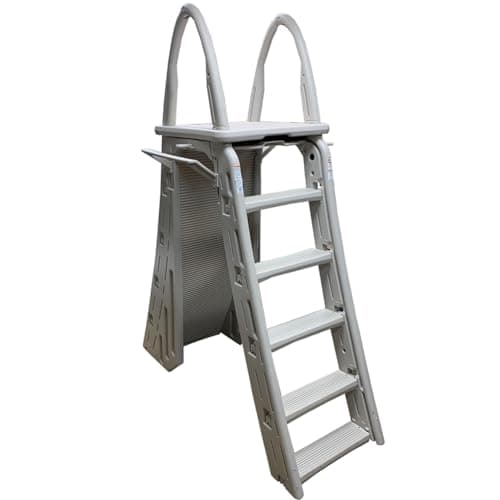
Getting in and out safely
A-Frame Above-Ground Pool Ladder
Various
Read the published weight limit before anything else. It is frequently lower than buyers assume, and it is the one spec on a ladder that genuinely matters.
#ad how this is funded · price as of October 8, 2026
Key specs
- Critical spec
- Published weight capacity — check it against every adult who will use it
- Height match
- Must match your wall height, not approximate it
- Safety feature
- Removable or lockable outer steps on better models
How it scoresour reading of published specs, not a test result
- Sizing fit
- 8.5
- Running cost
- 10.0
- Maintenance
- 8.5
- Build
- 7.5
- Value
- 8.5
Overall 8.4 / 10
What works
- Removable outer steps genuinely prevent unsupervised access, which is a real safety layer
- Resin frames do not corrode the way early steel ladders did
- Correctly matched height is far more stable than a too-tall ladder
What doesn't
- Weight limits are often lower than people expect and are easy to overlook in a listing
- A ladder sized for a 42-inch wall is wrong on a 52-inch wall and vice versa
- Cheap models flex enough to feel alarming
Skip it if: Being a barrier on its own. The CPSC's guidance treats barriers, supervision and alarms as layers; a removable step is one layer, not the answer.
What it costs to run: Buy it with the pool. Kits that include a ladder are frequently cheaper than the pool-plus-ladder bought separately, and this is one of the accessories that makes a cheap-looking kit expensive.
Several seasons: Buy-once. Built and warranted to come back out of the box for a few years, if you store it properly.
Specs from: CPSC — Pool Safely
When the liner has failed, not before
Replacement Above-Ground Pool Liner
Various
The one repair that is genuinely worth doing rather than replacing the whole pool, provided the frame is sound. Measure twice: liner fit is unforgiving.
Key specs
- Types
- Overlap, beaded and unibead — they are not interchangeable
- Measure
- Diameter and wall height, exactly
- Gauge
- Published in mil — thicker lasts longer and is harder to fit
How it scoresour reading of published specs, not a test result
- Retention
- 8.0
- Durability
- 8.0
- Handling
- 5.5
- Running cost
- 9.0
- Value
- 8.0
Overall 7.9 / 10
What works
- Far cheaper than replacing a pool whose frame is still good
- A thicker gauge liner outlasts the original on most budget kits
- Beaded liners can be replaced without dismantling the top rail
What doesn't
- Overlap, beaded and unibead are different fitting systems and buying the wrong one is a total loss
- Fitting is a warm-day job — cold vinyl will not stretch into place
- A liner failure often reveals a frame or base problem that caused it
Skip it if: A pool whose frame is corroded. Replacing the liner in a failing frame just moves the failure a few months out.
What it costs to run: The largest single unplanned expense of above-ground pool ownership, and it is mostly preventable: a ground cloth, a level base and a winter close done properly are what decide whether you ever buy one.
Several seasons: Buy-once. Built and warranted to come back out of the box for a few years, if you store it properly.
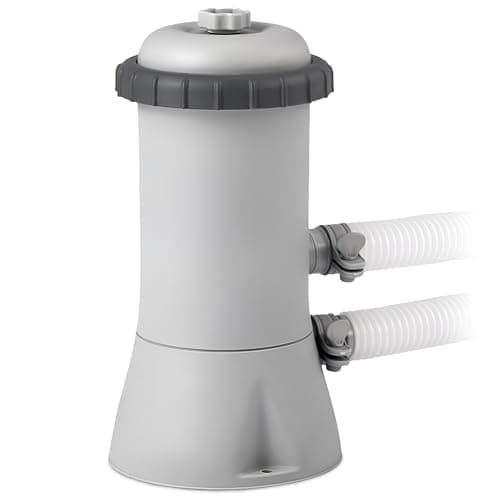
Pools up to about 6,000 gallons
Intex Krystal Clear C1000 Cartridge Filter Pump
Intex
The workhorse replacement pump for mid-size frame pools. 1,000 GPH pump flow, 750 GPH through the system once the cartridge is in the way — and that second number is the one your turnover math needs.
#ad how this is funded · price as of October 8, 2026
Key specs
- Pump flow rate
- 1,000 GPH
- System flow rate
- 750 GPH
- Rated pool size
- Up to 6,000 gallons
- Cartridge
- Type A
- Wattage
- Not published by Intex
How it scoresour reading of published specs, not a test result
- Sizing fit
- 9.0
- Running cost
- 7.0
- Maintenance
- 7.5
- Build
- 7.5
- Value
- 8.5
Overall 8.3 / 10
What works
- Intex publishes both pump flow and system flow, which is more honesty than most of this category offers
- Type A cartridges are the most widely stocked filter consumable in the US
- Sized correctly for the 12ft-15ft frame pools most families own
What doesn't
- Wattage is not published anywhere on the Intex site, so you cannot cost it before purchase
- Cartridge-only, so there is a consumable every few weeks in a busy pool
- GFCI cord length dictates where the pool can go more than people expect
Skip it if: Pools over about 6,000 gallons. Above that you are asking it to run all day to achieve one turnover, which is the expensive way to filter.
What it costs to run: Do the turnover math before you buy: 750 GPH system flow moves 4,000 gallons in 5.3 hours. Two turnovers a day is therefore about 11 hours of running. At the EIA's June 2026 US residential average of 18.34 cents per kWh, every 100 watts of pump draw running 11 hours a day for a 120-day season costs about $24. Find your wattage on the pump label and multiply.
Several seasons: Buy-once. Built and warranted to come back out of the box for a few years, if you store it properly.
Specs from: Intex — Krystal Clear cartridge filter pumps, EIA Electric Power Monthly, Table 5.6.A — US residential average price
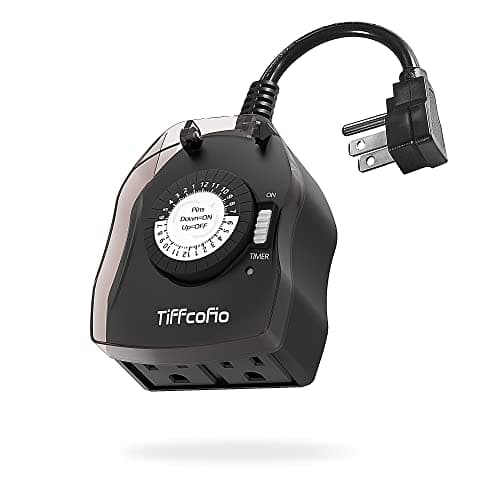
Cutting the electricity bill without cutting filtration
Outdoor Pool Pump Timer
Various
A weatherproof outdoor timer is the highest-return equipment purchase on this site. Most people run the pump too long because remembering to switch it off is a chore.
#ad how this is funded · price as of October 8, 2026
Key specs
- Type
- Outdoor-rated mechanical or digital timer
- Required rating
- Must be rated for the pump's amperage and for outdoor use
- Must not defeat
- The pump's GFCI protection
How it scoresour reading of published specs, not a test result
- Sizing fit
- 8.5
- Running cost
- 9.8
- Maintenance
- 9.0
- Build
- 7.5
- Value
- 9.5
Overall 9.0 / 10
What works
- Turns your filtration from a guess into a schedule
- Pays for itself within a single season on most pools
- Lets you shift running hours to off-peak if your utility has time-of-use rates
What doesn't
- Must be genuinely outdoor-rated and correctly amperage-matched, which cheap indoor timers are not
- Never bypass or defeat the pump's GFCI to fit one
- Mechanical timers drift and need resetting after a power cut
Skip it if: Fixing an undersized pump. Running the wrong pump on a schedule just makes the schedule longer.
What it costs to run: The arithmetic that justifies it: at the EIA's June 2026 US residential average of 18.34 cents per kWh, trimming a 400 W pump from 12 hours to 8 hours a day across a 120-day season saves 192 kWh, or about $35. That is more than the timer costs.
Several seasons: Buy-once. Built and warranted to come back out of the box for a few years, if you store it properly.
Specs from: EIA Electric Power Monthly, Table 5.6.A
Questions people actually ask
Can I install an above-ground pool myself?
What pool jobs should I not do myself?
Is it worth paying someone to maintain an above-ground pool?
Can I replace a pool liner myself?
Sources
Read next
- What a pool actually costs, with the arithmetic shownPurchase, electricity, chemicals, water and replacement parts - added up, sourced, and shown as arithmetic you can redo.
- What upkeep costs, separated from everything elseChemicals by published dosing, cartridge replacement intervals, and the honest weekly time commitment.
- Liner replacement: the big occasional cost, and how to avoid itOverlap, beaded and unibead are not interchangeable - plus the three habits that decide whether you ever need a replacement.
- How to set up an above-ground pool properlyLeveling, ground protection, filling and priming - the afternoon that decides how the rest of the season goes.
- Leveling the ground, and the weight that makes it matterThe tolerance manufacturers publish, the weight of water that enforces it, and the method for getting a circle genuinely flat with hand tools.
- Building around the pool, and what it changes about the poolDecks, platforms and steps around an above-ground pool - what they change about safety and maintenance, and the cheaper options that work.
- The electrical side, which is the one part of a pool you should not improviseGFCI protection, extension cords, timers and heater circuits - what is a homeowner job around a pool and what is not.
- What closing an above-ground pool costsPublished closing-service prices compared against the DIY list, with the part of the bill that recurs separated from the part that amortizes.