Above-Ground Pools
A cold climate does not stop you owning a pool. It picks which one.
Where winter freezes the surface, the real question is not which pool swims best. It is whether you are closing a pool every October or dismantling one.
Heads up: we earn a commission if you buy through the links on this page, at no extra cost to you. It never decides the ranking — here is how we pick and here is the full disclosure. Prices are checked automatically; last verified October 8, 2026.
The short version
- Most frame pools must come down. Intex requires draining, disassembly and indoor storage below 41°F.
- Some pools are built to stay up. Bestway’s Hydrium line publishes a cold-weather enhancement and year-round use.
- Never drain a pool that stays up. Lower it to the level the maker states — a few inches below the inlet and outlet.
- The air pillow is the structural part of the close, not padding. Inflate it to around 60%.
What to look for
1. Does the manufacturer allow it to stay up? This is the whole decision and the answer is published. Intex’s manual requires you to drain, disassemble and store the pool when the temperature drops below 41°F, warning that ice damage can cause sudden liner failure or collapse. Bestway’s year-round lines are the opposite: lower the water, never empty it.
2. Wall construction. A rigid steel wall takes ice pressure in a way a frame pool’s liner-as-wall cannot. Our permanent pools roundup covers the category, and it is the one that suits a hard winter.
3. The closing kit, budgeted from the start. A winter cover sized with proper overlap, an air pillow, plugs for the skimmer and return, and a cover pump. None of it is optional where the surface freezes, and our winterizing guide sequences it.
4. Where the equipment will live. Pumps and filters come indoors in any climate that freezes. Our equipment storage guide has the manufacturer instructions, including the line about freezing voiding a pump warranty.
The two honest paths
Path one: a seasonal pool you take down. Cheaper to buy, no winter cover to size, and no ice risk at all because there is no water and no pool. The cost is an annual take-down and rebuild, plus somewhere dry to store a large folded liner — and a fresh fill every spring, which our cost-to-fill guide prices.
Path two: a pool that stays up. More expensive to buy and more work to install, but the autumn job becomes a close rather than a demolition, and the water stays in. The Bestway Hydrium here publishes a Polar-Shield cold-weather enhancement and ships with the ground cover and winter cover in the box, which is unusual.
What does not work is choosing path two by accident: leaving a seasonal frame pool up over a freezing winter because taking it down looked like a lot of work. That is how liners split.
Closing a pool that stays up
Two details cause most of the damage we read about. The first is water level: Bestway publishes a level a few inches below the inlet and outlet valves for its year-round pools and warns that water freezing inside them damages the liner and voids the warranty. Industry guidance for other pools is four to six inches below the skimmer and no further — and our draining guide explains why a vinyl pool is never emptied.
The second is the air pillow. It is not padding for the cover; it is an ice compensator that gives expanding ice somewhere to go other than your wall. Published guidance is to inflate it to about 60% of capacity so it can compress. Our air pillow roundup covers sizing and tying it down.
What a cold climate costs you
A shorter season, and a closing routine every autumn. What it does not have to cost is a pool: the failure mode in cold climates is almost always a pool used outside what its maker allows, not the cold itself. Our bad-close guide itemizes the bill when that goes wrong, and it is larger than the entire closing kit.
If an unexpected freeze arrives while the pool is still open, that is a different and more urgent job — our overnight freeze guide covers it.
What actually freezes, and what it costs
The pool wall is rarely the first casualty. The first casualty is the pump, because a volute full of water becomes a cracked housing, and Hayward states plainly that allowing the pump to freeze with water in it will void the warranty.
Then the plumbing and fittings, then the skimmer — which is what a gizzmo exists to protect by crushing instead of the skimmer, covered in our plugs roundup. The wall and liner come last, and they are the failures caused by ice expansion that an air pillow is there to absorb.
All of it is preventable in an afternoon, and our bad-close guide itemizes the alternative.
The closing sequence, in order
Wait for genuinely cold water
Closing a warm pool leaves it biologically active under the cover all winter, which is how people find a swamp in April.Balance the chemistry first
Unbalanced water sitting still for five months is what stains liners and corrodes fittings.Lower the water to the stated level
A few inches below the inlet and outlet for a year-round pool; four to six inches below the skimmer is the usual industry guidance. Never empty it.Drain and store the equipment indoors
Pump, filter and hoses come out, get drained and go somewhere that does not freeze. Our equipment storage guide has the manufacturer instructions.Pillow, then cover, then check after storms
The pillow goes in before the cover, tied loosely and inflated to about 60%. Then pump standing water off the cover through the winter.
Spring, and why the close decides it
A pool closed clean, balanced and under a solid cover usually opens clear. A pool closed warm or unbalanced opens green, and our green opening guide exists for that morning.
In a cold climate the reopening is also later than people plan for. Our season extension guide covers the cheapest ways to add weeks at each end, and the answer is almost always a cover before a heater.
Questions to ask before buying a year-round pool
Does the maker publish year-round use?
Not 'can it stay up' from a forum, but a published statement from the manufacturer. Bestway publishes it for the Hydrium line; Intex publishes the opposite for frame pools.What water level does it want over winter?
A few inches below the inlet and outlet is the published figure for year-round Bestway pools. Get this in writing before you buy, not in October.What does the warranty say about freezing?
Bestway's year-round guidance warns that water freezing in the valves damages the liner and voids the warranty. Equipment warranties carry similar language.Is the closing kit included or extra?
The Hydrium ships with a ground cover and winter cover, which is unusual. Most pools do not, and the kit is a real line in the budget.Where will the equipment live from November to April?
Somewhere that does not freeze. If the answer is an unheated shed, that is a problem to solve before the pool arrives.
Answer those five and the cold-climate decision is largely made. The pools that fail in winter are almost never the ones bought for it — they are seasonal pools left standing because taking them down looked like too much work in October.
The rule that prevents most winter damage
Follow the manual for the pool you own, not the advice for pools in general. Almost every winter failure we read about comes from applying one category’s rules to the other: draining a pool that should have been lowered, or leaving up a pool that should have come down.
The two sentences to find before your first autumn are what water level the maker wants, and whether the pool is rated to stay up at all. Both are published, and both are specific to the line rather than the brand.
What to buy
Scores are our own reading of published specifications. They are not test results — we have not tested these products and we do not claim to.
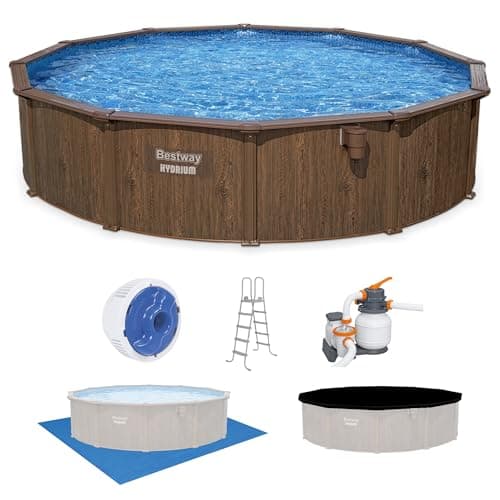
The most complete permanent set in one box
Bestway Hydrium 18' x 52" Steel Wall Pool Set
Bestway
A galvanized steel-wall pool built to stay up year-round, shipped with the sand filter, ladder, ground cover and winter cover a permanent pool needs. The warranty is the part to read closely.
Key specs
- Size
- 18 ft round x 52 in
- Capacity
- 7,192 gal at 90% fill
- Walls
- Galvanized steel walls, supports and top platform
- Year-round
- Polar-Shield cold-weather enhancement
- Liner
- UV-resistant coated liner
- In the box
- Sand filter pump, filter balls, steel ladder, skimmer, ChemConnect, ground cover, cover
- Assembly
- Under 2.5 hours with 2-3 people (FastLatch), per Bestway
- Warranty
- Liner and frame 2 years; pump 180 days
How it scoresour reading of published specs, not a test result
- Build
- 8.0
- Setup
- 7.5
- Upkeep
- 7.5
- Running cost
- 7.0
- Value
- 8.5
Overall 7.9 / 10
What works
- The only pick here that ships genuinely complete — pump, ladder, ground cover and cover all included
- Galvanized steel walls rated by the maker to stay up year-round
- Assembly measured in hours rather than a weekend, which is unusual for a steel-wall pool
- A mainstream brand with parts and support that are easy to find
What doesn't
- Two years on the frame and liner, and only 180 days on the pump — short for a pool meant to stay up
- Galvanized steel rather than resin-coated, which matters if you plan to run a salt system
- Bestway itself describes it as semi-permanent, which is a fair description
- At 7,192 gallons, everything downstream scales up: chemicals, filling and pump hours
Skip it if: Being a twenty-year purchase. It is a well-equipped pool you can leave up, with a warranty that assumes you will be replacing parts sooner than a premium steel-wall kit.
What it costs to run: Filling 7,192 gallons at the EPA WaterSense average of $6.06 per 1,000 gallons is about $44 of water. Because it stays up, you are not refilling every spring — which is the running-cost argument for a permanent pool.
Several seasons: Buy-once. Built and warranted to come back out of the box for a few years, if you store it properly.
Specs from: Bestway Hydrium 18' x 52" steel wall pool set — published specifications (retailer listing)
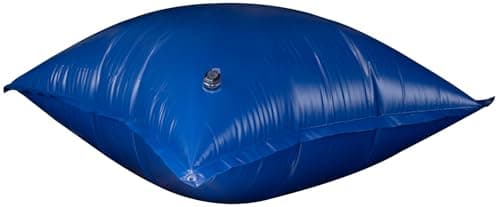
Stopping ice from pushing on the wall
Winter Air Pillow for Above-Ground Pools
Various
A few dollars of inflatable that gives expanding ice something compressible to push against instead of your pool wall. In a freezing climate this is not optional.
#ad how this is funded · price as of October 8, 2026
Key specs
- Function
- Absorbs ice expansion; centers the load away from the wall
- Inflation
- Inflate to roughly 60% — a fully inflated pillow bursts
- Placement
- Centered under the winter cover
How it scoresour reading of published specs, not a test result
- Retention
- 8.0
- Durability
- 6.5
- Handling
- 9.0
- Running cost
- 10.0
- Value
- 9.0
Overall 8.4 / 10
What works
- Extremely cheap relative to the wall or liner it protects
- Also stops rainwater and snowmelt pooling in the center of the cover
- Reusable for several winters if it survives one
What doesn't
- Cheap ones deflate mid-winter, which is when it matters
- Must be tethered or it drifts to the edge and does nothing
- Over-inflating is the most common mistake and it destroys the pillow
Skip it if: Climates that do not freeze. If your water never ices over, this is solving a problem you do not have.
What it costs to run: The cheapest insurance in this entire site against the most expensive winter failure. Inflate to about 60% and tether it.
One honest season: The cheapest setup that genuinely works for a season of real swimming. Nothing spare, nothing missing.
Five months of weather, not one night
Winter Cover for Above-Ground Pools
Various
A structural product, not a summer one. Its job is carrying snow and blocking light for a whole winter, and a solar cover pressed into that role will be in shreds by February.
Key specs
- Construction
- Woven polyethylene, weight published in mil or scrim count
- Securing
- Cable and winch, or wraparound straps
- Overlap
- Needs genuine overlap past the wall — check the stated size against your pool
- Not the same as
- A solar cover or a safety cover
How it scoresour reading of published specs, not a test result
- Retention
- 8.5
- Durability
- 8.0
- Handling
- 6.5
- Running cost
- 9.0
- Value
- 8.5
Overall 8.3 / 10
What works
- Blocks light for the whole winter, which is what stops algae in a closed pool
- Cable-and-winch securing survives wind that lifts a strapped cover
- Buying the heavier scrim genuinely doubles the number of winters you get
What doesn't
- Needs a way to shed or pump off standing water, or the weight tears it
- Bulky to store in summer
- Not a safety cover — it will not support a person and must not be treated as if it will
Skip it if: A pool you take down each autumn. If the pool comes apart, the cover is money spent on nothing.
What it costs to run: This is insurance rather than a saving. A torn cover in January means an opening in April that costs a full shock treatment and a week of filtration to fix, which is more than the better cover cost.
Several seasons: Buy-once. Built and warranted to come back out of the box for a few years, if you store it properly.
Questions people actually ask
Can you leave an above-ground pool up over winter?
Should I drain the pool completely for a freezing winter?
Do I need an air pillow?
Which pool type is best for a cold climate?
Sources
Read next
- Above-ground pools for ordinary backyardsSoft-side, metal-frame and steel-wall pools compared by what they cost across a whole season, not at the till.
- The best permanent above-ground pools, and what makes one permanentSteel- and resin-wall above-ground pools built to stay up all year, compared on wall coating, liner gauge, what ships in the box and the warranty behind it.
- How to winterize an above-ground poolThe correct closing sequence, the freeze damage that ends pools, and why a cracked pump housing is entirely preventable.
- Taking the pool down without ruining itThe take-down sequence for a seasonal pool: draining responsibly, drying completely, folding warm, and storing where rodents are not.
- The air pillow is structural, not paddingWinter air pillows compared on size, published vinyl gauge and pool ratings, with the inflation guidance that makes them work and the conflicts between listings.
- Draining an above-ground pool, and the two ways it goes wrongWhen a partial drain is the only fix, why liner makers say never to empty a vinyl pool, and the discharge rules that decide where the water may legally go.
- The bill a bad close sends you in AprilThe spring bill produced by a bad autumn close, priced line by line, and the three cheap items that prevent nearly all of it.
- A freeze is forecast and the pool is still openWhat to protect first when a cold snap arrives before closing day, why the equipment is at risk before the pool is, and when to just close early.